You are here

green unionism

Statement in Support of U.S. Railroad Workers on the Precipice of Their Historic Strike

By Jim Abernathy - Labor Network for Sustainability, September 2022

Labor Network for Sustainability (LNS) stands firmly in solidarity with railroad workers in this historic moment. Our railways are the veins of our nation, and these workers ensure our healthy circulation, getting our people and our goods wherever they are needed. Every person in this country fundamentally relies on the hard work and immense expertise of rail workers.

They worked on the frontlines of the COVID-19 pandemic to keep the country alive, without a contract, and they have been thanked by private railroad corporations with sweeping layoffs, a refusal to pay just wages and benefits, and utterly inhumane working conditions. Let us not mince words - being forced to work alone, in dangerous conditions, sometimes for up to 80 hours a week is fundamentally inhumane. These workers, too long pitted against one another by the bosses, by CEOs who seek to divide and conquer the working class of the nation, now stand united as one against this unacceptable status quo.

Rail transportation and rail labor are also vital to the health of our entire planet. They are a crucial piece of solving the climate crisis, and they must be respected as a core part of the solution to many of our systemic problems. Respect for rail transportation and rail workers means expanding the workforce so that workers can have decent schedules, ensuring robust compensation, and ensuring their safety - putting our railroads front and center in the fight for good union jobs and a livable planet.

The bosses will not act unless they are forced to by a unified working class. Our railroad workers, united, spurred on by their own righteous history of labor militancy, are prepared now to use their collective power. LNS stands ready to support our brothers and sisters on the railroad and their fight for justice on the job and for all our communities.

Read the text (PDF).

Heat Waves are Literally Killing UPS Workers

By Maximillian Alvarez - The Real News, August 31, 2022

Additional links

Featured Music (all songs sourced from the Free Music Archive at freemu​si​carchive​.org): Jules Taylor, ​“Working People Theme Song”

What It Will Take to Build a Broad-Based Movement for a Just Transition: Environmental and labor organizers reflect on hard-won lessons

Images and words by David Bacon - Sierra, August 31, 2022

In 2020, Washington State passed the Climate Commitment Act, and when it went into effect on January 1, 2022, Rosalinda Guillen was appointed to its Environmental Justice Council. The appointment recognized her role as one of Washington's leading advocates for farmworkers and rural communities.

Guillen directs Community2Community Development, a women-led group encouraging farmworker cooperatives and defending labor rights. She has a long history as a farm labor organizer and in 2013 helped form a new independent union for farmworkers, Familias Unidas por la Justicia. Guillen agreed to serve on the council but with reservations. She feared that the law's implementation would be dominated by some of the state's most powerful industries: fossil fuels and agriculture. 

"Its market-based approach focuses too much on offsets,” she says. “Allowing polluting corporations to pay to continue to pollute is a backward step in achieving equity for rural people living in poverty for generations." Just as important to her, however, is that while the law provides funding for projects in pollution-impacted communities, it doesn't look at the needs of workers displaced by the changes that will occur as the production and use of fossil fuels is reduced.

The impact of that reduction won't affect just workers in oil refineries but farmworkers as well. "The ag industry is part of the problem, not just the fossil fuel industry," Guillen says. "They're tied together. Ag's monocrop system impacts the ecological balance through the use of pesticides, the pollution of rivers and clearing forests. As farmworkers, this law has everything to do with our miserable wages, our insecure jobs, and even how long we'll live. The average farmworker only lives to 49 years old, and displacement will make peoples' lives even shorter." 

The key to building working-class support for reducing carbon emissions, she believes, is a commitment from political leaders and the environmental and labor movements that working-class communities will not be made to pay for the transition to a carbon-free economy with job losses and increased poverty. But the difficulties in building that alliance and gaining such a commitment were evident in the defeat of an earlier Washington State initiative, and the fact that the Climate Commitment Act lacked the protections that initiative sought to put in place. 

In Washington State fields, at California oil refineries, and amid local campaigns around the country, this is the big strategic question in coalition building between the labor and environmental movements: Who will pay the cost of transitioning to a green economy? 

Some workers and unions see the danger of climate change as a remote problem, compared with the immediate loss of jobs and wages. Others believe that climate change is an urgent crisis and that government policy should protect jobs and wages as a transition to a fossil-fuel-free economy takes place. Many environmental justice groups also believe that working-class communities, especially communities of color, should not have to shoulder the cost of a crisis they did not create. And in the background, always, are efforts by industry to minimize the danger of climate change and avoid paying the cost of stopping it. 

Tesla Violated Workers’ Rights By Banning Pro-Union Shirts, Labor Board Rules

By Sharon Zhang - Truthout, August 30, 2022

Tesla violated federal labor laws when it banned workers from wearing shirts with union insignia at its California warehouse as workers waged a union drive in recent years, the National Labor Relations Board (NLRB) ruled on Monday.

In 2017, Tesla banned its workers from wearing shirts with logos other than Tesla’s after workers began wearing shirts displaying a small United Auto Workers (UAW) logo, which the American Federation of Labor and Congress of Industrial Unions (AFL-CIO) said were designed specifically to meet the company’s dress code.

Though it is unlawful for employers to bar employees from wearing union insignia at work, a NLRB ruling in a 2019 case involving Walmart established that employers could do so in special circumstances. Monday’s 3-2 decision overruled that case, affirming that interfering in any way with a worker’s right to wear union insignia is “presumptively unlawful” and that Tesla had failed to establish a special circumstance justifying its ban.

Sweden: Activists and locals take action against limestone mining

By Take Concrete Action - Freedom, August 31, 2022

Right now in Sweden, activists are fighting to stop the state from throwing open the doors to corporate impunity. When the company Cementa was barred from continuing to mine limestone on the island of Gotland on the basis of environmental protections in the Swedish constitution, the government decided the constitution was the problem. They granted an exception to the company, despite the fact that thousands of people were facing water shortages due to the mine draining Gotland’s groundwater. Not only that, but Cementa is also Sweden’s second-largest emitter of carbon dioxide. Now, locals and climate activists teamed up under the name Take Concrete Action to shut Cementa down by sending hundreds of people to occupy the mine.

At the end of August, they travelled to the remote island in the middle of the Baltic sea, donned their best hazmat suits and walked into a limestone mine to stay there as long as possible. Below, they explain why.

Because Sweden is at a political crossroads that could have grave implications for its people and environment – and we see this as our best chance of stopping it.

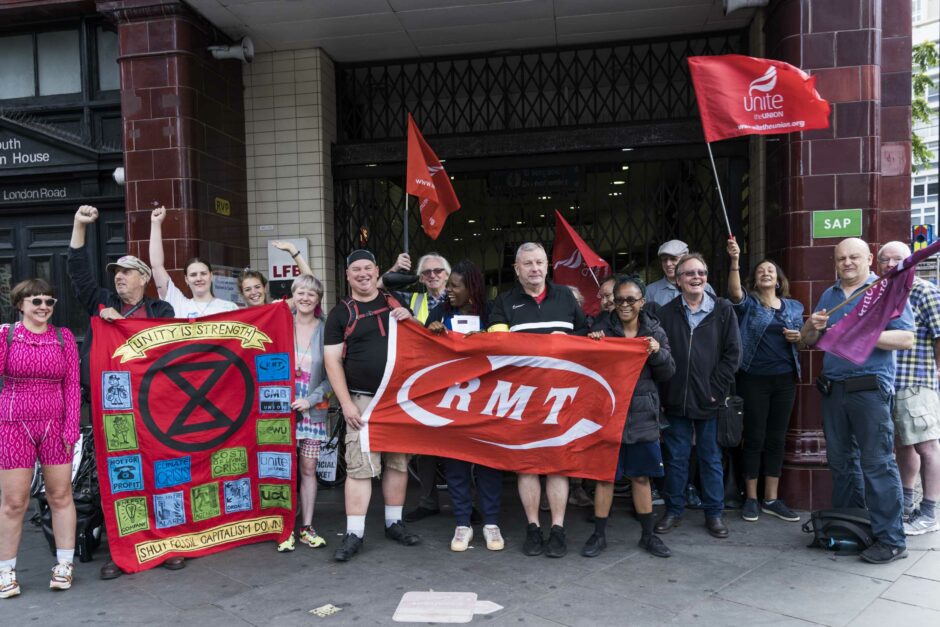
XR UK position on Strike Action

By staff - Extinction Rebellion UK, August 25, 2022

The cost of living crisis is escalating week on week, the movement to refuse to pay energy bills is gaining momentum and workers from an increasing range of industries are voting to take strike action for livable wages and secure jobs. Railway and tube staff, bus drivers, communications workers, warehouse workers and postal workers are among those striking or staging protests in recent weeks. 

At the same time the UK just recorded it’s hottest ever temperature and Extinction Rebellion is seeing a spike in interest from people who have decided now is the time to step-up and take action – over 1000 people registered for our last Open Call and the ‘Welcome to XR’ sessions have seen a significant increase in attendees. 

In this context we need to speak clearly about the common interests of striking workers and the environmental movement.

Here’s How Appalachian States Can Create “Good-Paying, Union Jobs” Cleaning Up Mines

By Ben Hunkler - Ohio River Valley Institute, August 25 2022

The Bipartisan Infrastructure Law (BIL) earmarks $16 billion for cleaning up legacy damage from the coal and gas industries, an investment that Deb Haaland, Secretary of the Department of the Interior, has promised will create “good-paying, union jobs” across Appalachia.

Ohio River Valley Institute research shows that BIL funding could create as many as 4,000 jobs reclaiming coal mine damage, primarily in Appalachian counties with disproportionately high unemployment and poverty rates. But how will these jobs compare to the precarious, low- wage jobs that proliferate in the region? They may provide above-average wages, but they likely won’t be union and won’t pay enough to support a family.

Read the text (PDF).

Climate Change Is About to Cause a Viral Explosion

By Abdullah Farooq - Jacobin, August 23, 2022

As climate change disrupts migration patterns, animals and the viruses they carry will come into unusual contact with each other — and inevitably with humans, unleashing new pandemics. The only thing that can stop this unfolding nightmare is a mass movement.

When animals migrate, be they butterfly kaleidoscopes or elk herds or bat cauldrons, they do so in response to ecological cues, which guide the manner and extent of the migration process. As climate change disrupts those cues, so too will it disrupt the migration of animals.

Climate change will thus deal a horrible blow to butterflies, bats, elk, and all manner of migratory animals. That’s tragic enough, but it gets worse: according to a recent study in Nature, this disruption will result in unusual interspecies contact, which will in turn cause new transmissions and mutations of viruses.

Through extensive modeling work, the study’s authors show that climate change will lead to altered migration patterns for thousands of animals, resulting in close to fifteen thousand new interspecies viral transmission events by the year 2070. In addition to having a massive ecological impact on the global fauna, this trend is of critical public health importance to us as humans, given that the majority of emerging infectious disease threats are zoonotic (transmitted by animal-to-human contact) in origin. The authors are cautious about predicting the probability of zoonoses into humans, but predict that geographies that are densely populated with humans will be future hot spots for interspecies viral transmission.

The study’s findings suggest that we are on the precipice of this mass-scale viral transmission event. The authors predict that the majority of these transmission events will happen between 2011 and 2040, indicating that many of them may already be taking place. While keeping temperature increases to within or below 2 degrees Celsius is a necessary goal, the authors predict that the accomplishment of this goal itself will not result in reduced viral sharing. In short, we’re probably stuck with massive changes in animal migration and vast quantities of viral transmission even if we slow climate change. However, there are other interventions we can make to stop the worst from happening.

In their model, the authors rely on a variety of land use scenarios — including alterations in deforestation, agricultural land usage, and human settlements — due to the uncertainty of how land is going to be used over the next fifty years. But none of that is inevitable. We can ensure that our land usage mitigates the impacts of climate change and prevents the emergence of the next pandemic. This can only happen if we’re able to take back control over how land is used, and democratically determine the best way to use it instead of leaving the decision up to capitalist markets.

Currently, our governments are beholden to corporate interests, which means that real estate and agribusiness have outsized influence over where and how land is developed. This has led to the unmitigated proliferation of sprawling housing developments, which often push deep into important ecological niches. This trend has already directly led to the destruction of 67 percent of coastal wetlands, which play a critical role in supporting local ecosystems, flood mitigation, carbon sequestration, and erosion control. In Brazil, Jair Bolsonaro’s far-right government has facilitated the rapid destruction of the Amazon rainforest to facilitate increased agricultural land usage. The Amazon is a massive carbon sink, and its destruction could make it impossible for the rest of the world to keep global warming from rising faster than 1.5-2 degrees Celsius.

Liberal States Like California Are Also Failing to Make Progress on Climate

By C.J. Polychroniou - Truthout, August 23, 2022

California has a well-established reputation as a national and global climate leader, but despite its remarkable successes in cutting emissions between 2006 and 2016, it has recently begun showing signs of having lost its way.

California is increasingly falling behind on its emissions reduction targets, and its existing policies have now been deemed insufficient to hit its 2030 target of reducing carbon emissions 40 percent below 1990 levels by 2030, according to new modeling from the climate policy think tank Energy Innovation.

“Compared to historical trends, California will need to more than triple the pace of emissions reductions to hit its 2030 target of reducing greenhouse gas (GHG) emissions 40 percent below 1990 levels by 2030,” the Energy Innovation report states.

The report is disappointing news, representing a weakening of the climate action that began with California’s passage of AB 32 in 2006. Otherwise known as the Global Warming Solutions Act, AB 32 was a landmark program in the struggle to reduce greenhouse gas emissions. Up until 2006, the United States was the largest emitter of carbon dioxide emissions in the world, and California was the second highest state in terms of total greenhouse gas emissions.

Support for rail strikes from Just Transition Partnership

By staff - Just Transition Partnership, August 18, 2022

The Just Transition Partnership sends solidarity to RMT, TSSA and ASLEF members taking industrial action to protect their pay, jobs and working conditions, and in the wider fight for a sustainable public transport system run for people and the planet, not private greed. Billions are being cut from our transport system at a time when increasing investment is vital to ensure a fully public, affordable, integrated and sustainable transport system.

Our railways are already being impacted by the effects of climate change, putting additional demands on a stretched workforce providing an essential public service. We need a well-paid transport workforce with secure conditions and it is indefensible to expect transport and other workers to take an effective pay cut as inflation and the costs of energy rise, especially while the profits of oil companies soar.

The UK government is failing on the climate crisis and the cost of living crisis. It has no integrated transport plans, favouring private companies which make vast profits rather than making transport affordable and our air breathable; in Scotland as well as the rest of the UK train and bus services are being cut. These actions are symptomatic of disregard for the concerns of climate, environment and workers.

The solutions to these crises have the same foundations – public investment into decarbonised and high-quality services using both taxation and legal duties on private companies; all delivered by a well-paid, skilled and secure workforce. These things won’t happen without workers in their trade unions organising to defend their wages, their jobs, their future and their rights through the power of collective bargaining. The workers movement and the climate justice movement need to build our collective power if we are to defend our future, that is why we send our solidarity to the workers on strike.

Pages

The Fine Print I:

Disclaimer: The views expressed on this site are not the official position of the IWW (or even the IWW’s EUC) unless otherwise indicated and do not necessarily represent the views of anyone but the author’s, nor should it be assumed that any of these authors automatically support the IWW or endorse any of its positions.

Further: the inclusion of a link on our site (other than the link to the main IWW site) does not imply endorsement by or an alliance with the IWW. These sites have been chosen by our members due to their perceived relevance to the IWW EUC and are included here for informational purposes only. If you have any suggestions or comments on any of the links included (or not included) above, please contact us.

The Fine Print II:

Fair Use Notice: The material on this site is provided for educational and informational purposes. It may contain copyrighted material the use of which has not always been specifically authorized by the copyright owner. It is being made available in an effort to advance the understanding of scientific, environmental, economic, social justice and human rights issues etc.

It is believed that this constitutes a 'fair use' of any such copyrighted material as provided for in section 107 of the US Copyright Law. In accordance with Title 17 U.S.C. Section 107, the material on this site is distributed without profit to those who have an interest in using the included information for research and educational purposes. If you wish to use copyrighted material from this site for purposes of your own that go beyond 'fair use', you must obtain permission from the copyright owner. The information on this site does not constitute legal or technical advice.