You are here

just transition

San Diego Labor Opposes Dakota Access Pipeline

By Jim Miller - OB Rag, December 12, 2016

The Dakota Access Pipeline (DAPL) and the heroic struggle against it have ignited a big battle inside of American labor. Earlier this fall an excellent article in Common Dreams outlined the split over DAPL at the national level with key trades unions and AFL-CIO leader Richard Trumka backing the pipeline and criticizing the protests while other large national unions were issuing statements supporting the Standing Rock resistance.

Here in California and elsewhere, Trumka’s letter in support of the pipeline received strong condemnation.

For instance, a response to it that I penned as chair of the California Federation of Teachers Climate Justice Task Force challenges the AFL-CIO leader in the strongest possible terms:

“In sum, your statement is factually inaccurate, morally suspect, politically inept, and does not stand for the values that should guide a progressive union movement worth being a part of in an era of stark threats to the future of our children.”

I have yet to receive a response.

West Virginia, “Identity Decline” and Why Democrats Must Not Look Away From the Rural Poor

How a Railway Workers Union Won New Technology That Improves Jobs and Reduces Greenhouse Gases

By Karl (Fritz) Edler, BLET Div. 482, retired, Special Rep, Railroad Workers United, Washington, DC - Labor Network for Sustainability, December 16, 2016

This is the story of one group of workers who used their union to improve their own conditions – and fight climate change – by proposing and winning their own plan for investment in improved technology. It provides an inspiring example of how workers and their unions can take their own action to reduce their employer’s greenhouse gas emissions while improving their own jobs.

Union railroad workers at Amtrak’s Washington, DC terminal use “small platform” locomotives to make up and service passenger and commuter trains. These diesel-electric locomotives use diesel engines to generate the electricity that is used to provide the motive power.  Their small size is a key advantage in the close quarters of terminal yard operations.  The units that are currently in use are almost a half-century old, and are far behind modern standards and goals for diesel emissions.

Several years ago the Brotherhood of Locomotive Engineers and Trainmen, through its DC State Legislative Board, foresaw a looming dilemma. Without action, these aging diesel-powered locomotives would be kept in service with as little maintenance as possible until they were beyond recovery. At that point they would be replaced — with the lowest price most likely being the prime consideration.

This meant that the workforce and the public would endure ever-worsening diesel particulate emissions as long as the highly-polluting engines were kept in service. When they would finally replaced, the replacement locomotives would not have the kinds of work qualities needed for best practices in train operations.  Replacement units would most likely be harder and more unwieldy to work.

The union’s State Legislative Board devised a plan to modernize the locomotives now with more energy-efficient engines using an advanced technology known as “gen-sets.” That would reduce pollution and provide higher work life quality while reducing fuel costs. It would also preserve the “small platform” that made terminal train operations safer and easier.

The Union approached the Washington, DC area Council of Governments (MWCoG) to put together a proposal to the U.S. Environmental Protection Agency (EPA). The EPA had an existing grant program to replace diesel powered equipment with less polluting equipment.

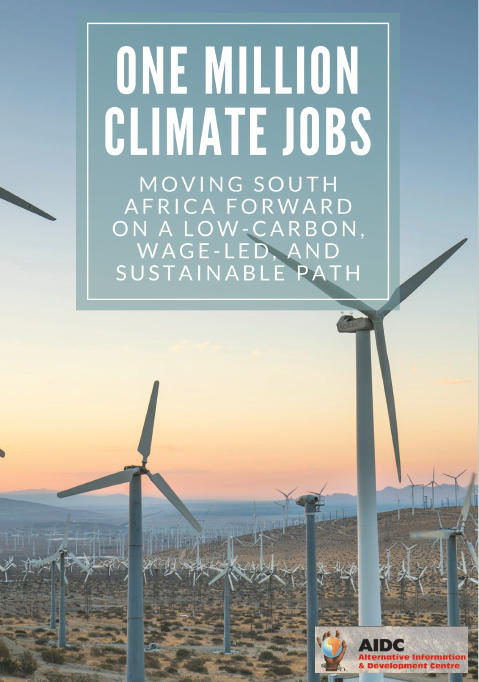
One Million Climate Jobs: Moving South Africa Forward on a Low-Carbon, Wage-Led, and Sustainable Path

By Brian Ashley, et. al. - One Million Climate Jobs - December 2016

The One Million Climate Jobs Campaign is an alliance of labour, social movements and popular organisations in South Africa that is campaigning for the creation of a million climate jobs as part of a collective approach to the crisis of unemployment and climate change. The Campaign was launched in 2011 and since then has been mobilising thousands of South Africans around real solutions to slowing down climate change, protecting the natural environment, improving the quality of life for all and moving towards a sustainable development path. Climate change will exacerbate inequality and poverty because it reduces access to food, water, energy and housing. Thus it is vital that social justice struggles around these issues incorporate struggles around climate change.

This booklet is a follow-up, six years later, to the first booklet that was produced in 2011. It is based on well- researched solutions for how South Africa can immediately begin a just transition, away from the Minerals-Energy Complex that continues to dominate the South African capitalist economy, to a low carbon economy in which the basic needs of communities are met in an equitable, sustainable and affordable way.

It recognizes that in these six years there have been many developments – for instance, renewable energy is now firmly established as part of the energy mix (although still a minor part); retrofitting buildings, and the development of environmentally friendly construction methods, is being developed, and the Rapid Bus Transit system is being slowly implemented in some municipalities.

But most of these solutions are being pursued within the logic of the market. It is not possible, we would argue, within these market parameters, to respond adequately to the enormous challenges facing us – what is needed is a publicly-driven solution for the shift to a sustainable, low-carbon future. The research that this booklet is based on begins to set out what such a transition could look like. We hope that it will be an important contribution to the ongoing work of building a political movement to struggle around these issues.

Download (PDF).

Transformative Climate Communities: Community Vision And Principles For A Successful Program

By staff - California Environmental Justice Alliance, December 2016

Transformative Climate Communities (TCC) is a groundbreaking new program that will develop comprehensive, cross-cutting, and transformative climate investments at a neighborhood scale to achieve multiple greenhouse gas, public health and economic benefits in our state’s most vulnerable communities. CEJA is deeply engaged in the implementation and working with our members to ensure the program truly meets community needs through a strong, transparent, and community-led process.

In our new report, Transformative Climate Communities: Community Vision And Principles For A Successful Program, we draw from CEJA’s members, partners, and allies to provide a snapshot of what TCC could look like in both urban and rural environmental justice neighborhoods across California. From transforming the goods movement in San Bernardino to comprehensive land use planning in Fresno, the wide range of community-led plans for place-based transformation are all grounded in an integrated, collaborative approach to reducing climate change while comprehensively addressing a legacy of environmental pollution and disinvestment in the most highly impacted communities.

The TCC program can help community-based organizations in crafting sustainability plans and leverage existing ones that address long-standing environmental health and justice challenges, while catalyzing equitable economic development at the neighborhood level. The program will achieve this by awarding large grants to develop and implement neighborhood-level climate sustainability plans drawing from deep resident engagement and in partnership with other important stakeholders.

In order to ensure the long-term successful implementation of the program, we lay out the key principles of the Transformative Climate Communities program in our report:

  1. Direct and extensive community engagement
  2. Equity for most impacted residents
  3. Multiple, integrated benefits
  4. Showcase equitable, sustainable land use planning
  5. Catalytic, leveraged investments
  6. Investment without displacement
  7. Creating a pipeline of communities

In addition, we provide some of the indicators for environmental, health, socioeconomic, community and political transformation that can be achieved though comprehensive, cross-cutting climate investments from the TCC.

CEJA’s work on the TCC program grows out of our Green Zones Initiative, where we recognized early on that in order for place-based models to be successful, communities need to have the power to guide development and investments. Green Zones require closely coordinated and leveraged public spending targeted to our most overburdened communities, with deep resident engagement to direct investment. The Transformative Climate Communities program is this vision come to life.

Through its community-level planning and investments, the TCC program can help to achieve a just transition away from inequitable and polluting development patterns that have plagued so many communities. It can help us maintain California’s global climate leadership and move us toward a new future that weaves together environmental and climate sustainability, economic opportunities, and strengthened local democracies.

Download PDF Here.

Why there’s hope for the climate movement under Trump

By Nick Engelfried - Waging Nonviolence, November 22, 2016

The climate movement woke on Nov. 9 to a new reality few of us had expected to be faced with: the specter of a Trump presidency and perhaps the most anti-environment administration and Congress in U.S. history. Suddenly our job of stopping new oil pipelines and fracking wells, preventing the construction of fossil fuel plants and shutting down existing fossil fuel infrastructure felt much harder.

Although the possibility of a Trump presidency had loomed for months, polls consistently showing Hillary Clinton in the lead made it seem remote. Many climate organizations laid their plans based on the presumption that they would most likely be dealing with a Clinton administration. “Assuming that as a nation we’ve managed to elect Hillary Clinton,” 350.org founder Bill McKibben wrote in an Election Day email to supporters, “we’ll need to start pressuring her from the earliest moments of her presidency.”

What the polls failed to account for was unexpectedly low voter turnout, caused in part by voter disaffection with both presidential candidates and a growing nationwide frustration with the existing political system. Despite Clinton winning the popular vote, low progressive turnout in key swing states granted Trump enough Electoral College votes to claim the presidency.

“We at The Climate Mobilization were not expecting a President Trump,” wrote leaders of The Climate Mobilization, a group that advocates for a Word War II-scale deployment of clean energy to fight climate change. “His election shows us that this country is desperate for change, but is still deeply in denial about the truth of the climate emergency.”

If there is any silver lining from the Trump victory, it would seem to be the evidence that vast numbers of people are hungry for a radical shift in politics. But Trump wants to take us in the opposite direction of progress on climate change. During his campaign, he pledged to scrap the Paris climate deal and the Obama administration’s Clean Power Plan. He promised to re-start approval of the Keystone XL pipeline and resurrect a dying coal industry. And his suite of potential cabinet nominees include climate science deniers and oil drilling proponents.

To many activists, the coming Trump presidency calls to mind the darkest days of the George W. Bush administration, when fossil fuel industries were basically invited to write national policy. But much has changed in the U.S. climate movement since the days of Bush. The last six years have seen the birth of climate campaigns that are bigger, bolder and more direct-action oriented than any environmental movement in decades.

Although this recent movement growth occurred during the Obama administration, its origins can be traced to a time when the climate movement was reeling from a series of shocking defeats. Obama’s campaign promises in 2008 had caused mainstream environmental groups to welcome his administration with the expectation of unprecedented progress. But this dream soon faded.

Nationalize the energy industry!

By Bruce Lesnick - Socialist Action, November 23, 2016

On Nov. 18, the Obama administration banned oil and gas drilling in the Arctic and Atlantic oceans for the next five years, while allowing drilling projects to go forward in the Cook Inlet (southwest of Anchorage, Alaska) and in the Gulf of Mexico. The media have noted the strong possibility that when Donald Trump assumes office, his administration would try to rewrite this blueprint in order to ramp up off-shore oil drilling even more.

The environmental movement points out that if the worst effects of climate change are to be avoided, the world’s remaining oil and gas deposits must remain in the ground. Yet the U.S. government, under Republican and Democratic administrations alike, has ignored these warnings and continues to feed the oil companies’ hunger for profits. In this article, Bruce Lesnick outlines why and how these companies should be taken out of the hands of the billionaire tycoons and nationalized to be run by working people.

We know that human activities are adversely affecting Earth’s climate. Scientists began to draw our attention to the link between fossil fuels, greenhouse gases, and climate in the 1980s. Since then, the evidence for anthropogenic climate change has become overwhelming. All that’s left to debate is what to do about it.

Under the current setup, energy conglomerates that owe their fortunes to fossil fuels have every incentive to dismiss global warming and to cast aspersions on climate change research. The top five oil companies (BP, Chevron, ConocoPhillips, Exxon Mobil, and Shell) reported combined profits of $93 billion for 2013. That’s more than the U.S. budget that year for Education ($71.9 billion) or Housing ($46.3 billion.) It’s more than 10 times the federal budget for environmental protection ($8.9 billion). The more coal, oil, and natural gas that get burned, the more the climate is thrown out of whack, and the more these companies are rewarded financially.

If we’re serious about addressing climate change, nationalization of the energy industry must become a central organizing demand. Nationalizing the big energy companies would make all the difference to the fight to curb greenhouse gas emissions. Right from the start, it would eliminate profit from the energy calculus and remove a large pool of money that’s used to manipulate government policy. It would make it possible to embark on a plan for a sustainable energy future, which would focus on the needs of the population and the planet as a whole, rather than on the reckless aggrandizement of a few.

But the issue of nationalization does raise many important questions: Is it moral? Is it legal? How would it work? Is it practical? Should the owners of nationalized industries be compensated?

Resolution Against the Dakota Access Pipeline

Resolution passed by Railroad Workers United - November 2, 2016

Whereas, the  unprecedented  $3.78  Billion,  1,172-mile  Dakota  Access  Pipeline would carry over half a million barrels of dirty crude oil from the Bakken oil fields in  North  Dakota,  through  South  Dakota  and  Iowa  to  Illinois  to  connect  to  other pipelines bringing oil to the East Coast and the Gulf; and

Whereas, the  pipeline  is slated to pass through the tribal lands of Standing Rock Sioux  near  Cannon  Ball,  North  Dakota,  and  underneath  the  Missouri  River,  the main source of water for the tribe; and

Whereas, the  pipeline  is  slated  to  pass  under  the  Missouri  River  a  second  time before  passing  under  the  Mississippi  River,  a  total  watershed  coving  40%  of  the continental United States; and

Whereas, the pipeline has already disturbed the lives of millions of Americans; and

Whereas, millions  of  workers--including  many  union  members  and  their  their families--live in communities that are in thepath of the proposed pipeline; and

Whereas, the transport of heavy crude is particularly volatile, leading to 18.4 million gallons of oils and chemicals spilled, leaked, or released into the air, land, and waterways  between  2006  and  2014  in  North  Dakota  alone,  causing  death,  contamination of soil and water, and numerous types of disease; and

Whereas, scientists  have  warned  that  in  order  to  avoid  wide-scale,  catastrophic climate disruption, the vast majority of known remaining fossil fuel reserves must be left in the ground; and

Whereas, people  engaged  in  protecting  their  land  and  water  have  been  brutally attacked by private security forces in both Iowa and North Dakota; and

Whereas, Native  Americans  and  other  activists  defending  their  land  and  water have  the  same  right  to  defend  their  land  and  engage  in  non-violent  protest  as workers who are protesting the actions of an unfair employer; and

Whereas, the  U.S.  Congress  has  repealed  the  ban  on  exporting  oil,  meaning  that the oil transported by the pipeline is likely to be sold overseas and not contribute to US energy independence; and

Whereas, we know that a very real threat to workers’ lives and livelihoods is the prospect of catastrophic climate change; and

Whereas pipelines  accidents,  such  as  the  recent  Helena,  Alabama  gas  pipeline explosion  which  killed  one  and  injured  five,  pose  a  threat  to  workers  and  their communities; and

Whereas, many  large  corporations,  and  especially  fossil  fuel  corporations,  have been  putting  profits  ahead  of  the  common  good  of  workers,  the  public,  and  the environment, and these corporations have been unjustly granted the constitutional  rights  and  powers of “person-hood”, diminishing  democracy and  the  voice  and power of the people; and

Whereas, numerous national and international unions have already passed resolutions against construction of the pipeline, including National Nurses United, the Amalgamated Transit Union, the Communications Workers of America, the United Electrical Workers, Service Employees International Union, and others; and

Whereas, these unions have an economic, environmental and racial justice strategy which has been employed to win membership strikes through broad base support by non-unionized workers and community members; and

Whereas, unions  in  support  of  Standing  Rock,  and  against  the  Dakota  Access  Pipeline  have  come  under  attack from reactionary unions who have engaged in the bad practice of collaborating with bosses, such as the virulently anti-union Koch Brothers; and

Whereas, Railroad  Workers  United  is  already  on  record  supporting  the  development  of  a  just  transition  plan  for

workers affected by fossil fuel elimination; and

Whereas, more long-term good paying jobs would be created by investing in sustainable energy infrastructure projects using already existing technologies while at the same time reducing greenhouse gases; and

Whereas, we support the rights of our union brothers and sisters building the pipeline to work in safe environments at jobs that are consistent with respect for the environment and the rights and safety of frontline communities;

Therefore Be  it Resolved, that we call upon the Federal Government to  make permanent the moratorium  on  construction of the Dakota Access Pipeline by revoking permits for construction issued by the Army Corps of Engineers; and

Be it Further Resolved, that Railroad Workers United calls on the labor movement to support a just transition to a renewable energy  economy  and  investment  in  the  construction  of a  nationwide sustainable energy  infrastructure that will address the growing threat of climate change and its consequent droughts, floods, fire, crop failure, species extinction and other dire consequences of global warming;

Be it Finally Resolved, Railroad Workers United urges all railroad craft unions and the rest of the labor movement to become actively involved in promoting a just transition to a sustainable alternative energy economy that protects the  environment and respects  the rights of all working people to good paying safe  jobs, human  rights and justice for all.

A new Lucas Plan for the future

By David King - Morning Star, November 26, 2016

The ideas pioneered by the Lucas workers are just as, or more, relevant now than in the 1970s, and there are strong political similarities in the situation.

As in the ’70s, we have an economic crisis caused by unjust economic policies and the failure of successive governments’ industrial strategy.

As usual, this has hit the working class hardest, and anger over this is being channelled into racism against immigrants. Now, the environmental effects of industrial capitalism are far more evident than 40 years ago, already creating wars, militarisation and widespread concern about insecurity.

Finally, introduction of new technologies threatens structural unemployment on a scale considerably greater than the ’70s.

The Tory government’s response to the economic and political crisis, despite continuing to publicly espouse neoliberal principles, looks a lot like a classic Keynesian economic stimulus package.

In the last few months it has made decisions to move ahead with a range of industrial infrastructure megaprojects — Hinkley C, fracking, HS2 and the Heathrow third runway, as well as pressing ahead with spending £200 billion on Trident renewal.

A key element in the case for all these projects is the jobs that they will generate or preserve, although the jobs estimates are bound to be inflated, while the price tag will be massively underestimated.

Compared to the ’70s, far fewer jobs will be created in this way because, due to automation and mechanisation, they are all highly capital rather than labour-intensive.

The Lucas Aerospace workers’ idea of socially useful production suggests a far better way forward.

Trump Can’t Hold Back the Tide of Climate Action

By Oscar Reyes - Foreign Policy in Focus, November 21, 2016

One of the sad ironies of Donald Trump’s victory is that climate change has risen up the political agenda only after the campaign, when both candidates and debate moderators largely ignored it. Trump’s denialism in the face of an urgent, planetary threat provides some potent imagery for how the devastation caused by his presidency might look.

Climate scientists have been quick to condemn Trump’s election as a “disaster,” and it’s not hard to see why.

The last three years have broken temperature records, with 2016 set to become the hottest yet. The UN Environment Program just warned that we need to do far more and far faster, while a new study of pledges from G20 countries found that even under Obama, the U.S. remained a long way off meeting its share of the global effort to tackle climate change. Yet we’ve just elected a man who promises to drill more oil, burn more coal, and scrap our national climate plan.

The Trump disaster could hit communities on the front line of climate justice struggles the hardest. Scenes like the militarized response to the struggle against the Dakota Access Pipeline could be the new normal under Trump if the expansion of fossil fuel infrastructure is matched with increasingly repressive policing.

It’s little wonder, then, that Trump’s election has left climate advocates reeling. But as mourning turns to anger and resistance, it’s worth recalling that there are significant limits on what Trump can do to hold back action on climate change.

The transition to cleaner energy will carry on regardless, as coal will remain uncompetitive. States and cities could ramp up their own climate efforts irrespective of the federal government. And international climate action has a momentum that’s not solely dependent on who occupies the White House.

Rogue State

Some of the loudest noises coming from the Trump camp suggest that his administration will withdraw from the Paris climate deal.

Since this process takes four years, it’s rumored that Trump is considering the shortcut of leaving the United Nations Framework Convention on Climate Change (UNFCCC), which George Bush Sr. signed in 1992 and the Senate ratified. That would set the U.S. apart from every other nation on earth (except the Vatican, which is strongly in favour of climate action all the same). There would be no clearer way to signal that Trump is making the U.S. a rogue state.

Unilateralism on this scale could throw up legal, political, and diplomatic hurdles that Trump’s team might not easily overcome. The Senate might demand a say on leaving the UNFCCC — and it’s not a given that a majority would favor the path of global isolation.

Alternatively, the Trump administration might choose to ignore Washington’s commitments without formally abandoning the international climate process. One of the first victims could be the global Green Climate Fund, which was set up to help developing countries with their climate transitions — and is now unlikely to see at least $2 billion of the $3 billion originally promised to it by the United States.

But the Trump wrecking ball won’t be able to destroy everything in its path. There are strong signs that U.S. isolation won’t wreck the Paris Agreement. Many other countries (including Saudi Arabia) have suggested that they will stick to their international climate commitments with or without the United States. There’s precedent here, too: When George W. Bush withdrew from the last global climate treaty, the Kyoto Protocol, the rest of the world continued with it anyway.

Faced with failed harvests, floods, droughts, and ever more extreme weather, most countries now realize that taking on climate change is in their own self-interest. Ultimately, the countries that lead the way in renewable energy, efficient buildings, and improved public transport (among other climate measures) will be best placed to cope with changes in the global economy.

Pages

The Fine Print I:

Disclaimer: The views expressed on this site are not the official position of the IWW (or even the IWW’s EUC) unless otherwise indicated and do not necessarily represent the views of anyone but the author’s, nor should it be assumed that any of these authors automatically support the IWW or endorse any of its positions.

Further: the inclusion of a link on our site (other than the link to the main IWW site) does not imply endorsement by or an alliance with the IWW. These sites have been chosen by our members due to their perceived relevance to the IWW EUC and are included here for informational purposes only. If you have any suggestions or comments on any of the links included (or not included) above, please contact us.

The Fine Print II:

Fair Use Notice: The material on this site is provided for educational and informational purposes. It may contain copyrighted material the use of which has not always been specifically authorized by the copyright owner. It is being made available in an effort to advance the understanding of scientific, environmental, economic, social justice and human rights issues etc.

It is believed that this constitutes a 'fair use' of any such copyrighted material as provided for in section 107 of the US Copyright Law. In accordance with Title 17 U.S.C. Section 107, the material on this site is distributed without profit to those who have an interest in using the included information for research and educational purposes. If you wish to use copyrighted material from this site for purposes of your own that go beyond 'fair use', you must obtain permission from the copyright owner. The information on this site does not constitute legal or technical advice.