You are here

just transition

The Role of Labour in the Fight Against Climate Change

By Asbjørn Wahl - International Transport Workers Federation (ITF), (hosted by Trade Unions for Energy Democracy) November 2016

The climate crisis is steadily coming closer. At the same time, we face a deepening economic crisis, as well as social and political crises. This creates an increasingly serious situation for the future of humanity.

However, given that the various crises have many of the same root causes, going to the core of our economic system, this can contribute to strengthening the mobilisation of social forces needed to break the current trend-–in favour of a democratic and planned development of society.

Action to combat dramatic climate change will require major societal transformation. In other words, we have an all-out battle on our hands over how to organise society. Solutions to the climate crisis do exist. We have most of what is required in terms of technology, knowledge, and competence to avert a climate disaster. It is the power to translate words into action that will pose the greatest challenge.

Since economic growth and ruthless exploitation of natural resources are embedded parts of a capitalist economy–indeed, any capitalism without growth is a capitalism in crisis-–a narrow focus on individual issues of environmental policy will not suffice. Nor will we be able to combat the climate crisis by making individual choices. A system critical approach is needed. We need democratic control of the economy. This means that we are not only faced with a threat, but also an opportunity-–an opportunity, not just to prevent a climate catastrophe, but also to fight the economic and social crises which are currently eroding and threatening the living conditions of millions upon millions of people. In particular, this also provides us with a foundation upon which to build extensive social alliances in search of a different kind of society.

Read the report (PDF).

Job Growth in Clean Energy: Employment in Alberta’s emerging renewables and energy efficiency sectors

By Binnu Jeyakumar - Pembina Institute, November 2016

Alberta has a meaningful plan to enable the growth of a clean energy industry, with commitment to 30% of electricity generated by renewable sources by 2030, and phasing out pollution from coal-fired generation. A portion of the anticipated revenues from the province’s economy-wide carbon levy will be used to enable these efforts. This provides a great opportunity for sustainable employment growth in the clean energy sector. This is in line with the global trends of declining investment and employment in the coal industry, while investment and employment in the renewable sector expands.

The Pembina Institute has conducted an analysis of the employment potential in the renewable energy and energy efficiency sectors in Alberta. Data was collected through literature reviews and from organizations involved in development of projects. The analysis used conservative estimates where there was uncertainty. The results are nevertheless encouraging and paint a positive picture for Albertans.

  • In Alberta, investing in renewable sources of electricity and energy efficiencyalone would generate more jobs than those lost through the retirement of coalpower ( Figure 1).
  • With a high and sustained pace of renewables growth, there are sustained levelsof employment for those engaged in related equipment installations.
  • Additional investment in community energy can increase the employmentpotential by 30-50%.
  • Long-term investments in modernizing infrastructure, the grid and ourelectricity system will result in further job creation with a wide diversity of skills,and in fields that are likely to see sustained growth.

Read the report (Link).

The Chevron Way: Polluting California and Degrading California

By various - International Transport Federation, et. al., November 2016

In the recent election, Chevron-backed campaigns lost bigtime, despite the $61 million the company has spent to influence California elections since 2009. That’s far more than any other oil company spend in state elections. The report, by the International Transport Workers Federation, was released Nov. 17 at the Chevron gates by a coalition including the Richmond Progressive Alliance (RPA), Alliance of Californians for Community Empowerment (ACCE), Communities for a Better Environment (CBE), and more.

Members of the coalition said the report, The Chevron Way: Polluting California and Degrading Democracy, will educate the public about the corrupting influence of corporate money and alert politicians that they will be judged on whether they act in the public interest or in Chevron’s interest.

In this election, in State Assembly and State Senate races, candidates heavily backed by Chevron lost. In Monterey County, Chevron spent $1.5 to oppose a ballot measure to ban fracking and expanded oil drilling. Despite being outspent 33 to 1, the measure passed.

In Richmond, Chevron sat out this election, having spent $3 million in the last election, when its candidates lost anyway. This year, two additional progressive candidates won seats on the city council and a longstanding Chevron candidate was voted out.

Chevron makes billions in profits from its huge retail and refining business in California, but has aggressively cut tax payments to federal, state and local governments. In 2015, the company paid no net income tax in the US, but instead banked nearly $1.7 billion in tax credits.

In 2015, Chevron had over $45 billion stashed in offshore accounts, including the company’s 211 active Bermuda subsidiaries, and the company’s global effective tax rate fell to below 3%.

Read the report (PDF).

Sharing the challenges and opportunities of a clean energy economy: Policy discussion paper A Just Transition for coal-fired electricity sector workers and communities

By staff - Australian Council of Trade Unions - November 2016

The ACTU is primarily concerned with workers, their rights, their welfare and their future. A just and civil society is one where everyone shares in the wealth of the nation but it is also one where economic costs are equally shared.

Transitioning an industry is a massive economic and social disruption. History shows that this has often been done poorly in Australia, with workers and communities bearing the brunt of such transitions - suffering hardship, unemployment and generations of economic and social depression.

Research in the textiles, clothing and footwear (TCF) and car manufacturing industries shows, for example, that only one third of workers find equivalent full time work following their retrenchment, while one third move into lower quality jobs (lower wage, lower job status or into part-time and casual work) and one third are locked out of the labour force altogether.

International experience however shows that a transition can be done equitably, achieve positive outcomes for workers, save communities and forge new areas of industrial growth and prosperity.

Australia is currently facing one such transition in the coal-fired electricity sector. If Australia manages this transition well, the nation would have a structured and equitable approach that could apply to any industry undergoing similar change in the future.

At last year’s Paris climate conference, Australia alongside 194 countries, committed to limit global warming to less than 2°C above pre-industrial levels. As part of this historic agreement, unions successfully achieved recognition of the need for a ‘Just Transition’ that supports the most affected workers obtain new decent and secure jobs in a clean energy economy.

While Australia’s international obligations will require a range of complementary policies that focus on emission reduction across a number of sectors of the economy, as the largest contributor to Australia’s emissions, effective reform of the electricity sector has been identified as a key step in tackling climate change.

Download (PDF).

We can have good jobs and healthy communities

By SEIU Healthcare Minnesota’s Indian Healthcare Board* - Medium, October 28, 2016
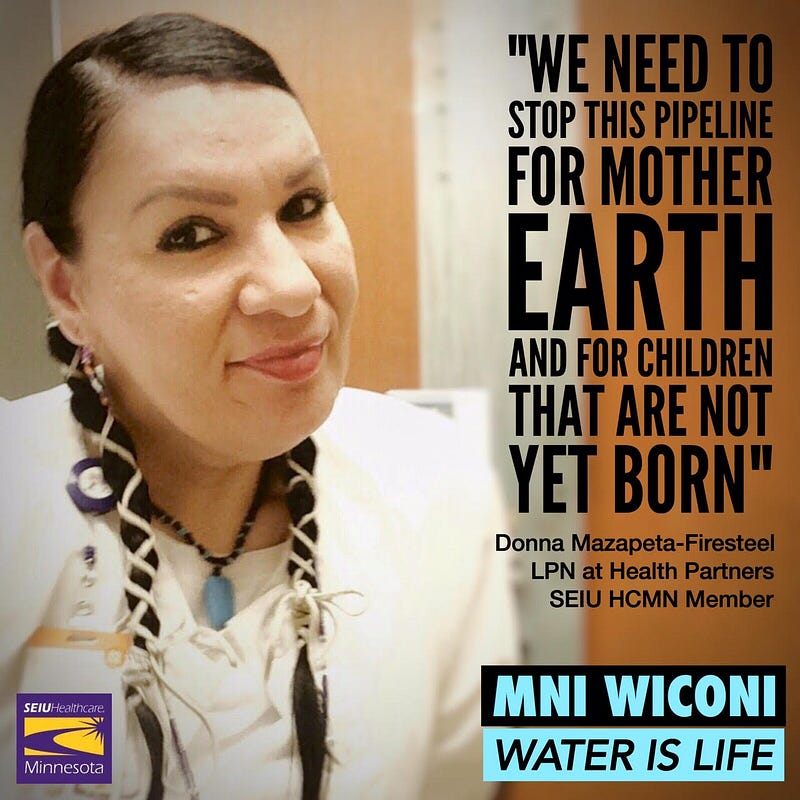
In too many communities across our country, children and families suffer from exorbitant asthma rates and other respiratory ailments from air pollution caused by corporate activities that burn fossil fuels and contaminate our air. Toxins leeched into our drinking and bathing water from this same fossil fuel industry causes serious skin, digestive, and even cancerous impacts on young and old alike. As healthcare workers, we stand on the front lines of trying to help families deal with these life-altering impacts.

Our families and children deserve clean air and water and we must do all that we can to stop allowing corporations to corrupt our livelihood unchecked. Where possible, we must choose clean alternative options so that our economy and our families can thrive. It is not a one or the other choice. We can have good jobs and healthy communities by shifting away from an economy dependent on fossil fuels to one that creates jobs for workers through a just transition to a clean energy economy.

We can and must be the change we want to see in the world and we have the chance to do it right now. In North and South Dakota, construction of a crude-oil pipeline, known as the Dakota Access Pipeline, threatens the lives and livelihoods of the people of the Standing Rock Sioux Tribe. The pipeline would pass under the Missouri River (at Lake Oahe) which is just half a mile upstream from the boundary of the Standing Rock Sioux’s reservation and provides their drinking water.

Over the last three years there have been over 200 known pipeline leaks in the United States. A spill at this site would be a health, economic and cultural catastrophe for Standing Rock Sioux families. Further, the pipeline would pass through incredibly precious culturally significant sacred lands, like burial grounds, for the tribe and infringe on their freedom to practice and protect their culture and beliefs.

We are so proud that our union, the Service Employees International Union, along with other labor unions, didn’t stand idly by and let this injustice prevail. Instead SEIU along with like-minded good jobs and justice-focused partners have stood strong with the Standing Rock Sioux tribe.

Not only do the Standing Rock Sioux deserve the respect and protection of their sacred grounds, but they deserve to know the water they are drinking is uncontaminated and safe. This is yet another instance where a low income, community of color is subjected to contamination at the hands of powerful corporations and an unresponsive government. It’s a scenario that’s all too familiar to SEIU members, having struggled through the water crisis in Flint, MI and the recent flooding in Baton Rouge.

We stand with our union and the people of the Standing Rock Sioux tribe, as well as the thousands of others who could be harmed by the construction of the pipeline. As energy technology and transportation infrastructures change to reduce harmful emissions, so should the focus of the unions that fight for a better future for all families. We can let go of environmentally and racially unjust practices and look to create the good jobs and safe communities of the future.

From asthma to cancer, America’s workers suffer at the hands of big polluters. We have a choice. We can find a solution that protects people’s health and good jobs and wages. The time is now. Our government must stop the construction of the Dakota Access Pipeline, protect the interests of the Standing Rock Sioux Tribe and transition the jobs of those whose lives and livelihoods could be impacted by ending this pipeline to good family-sustaining jobs of the future.

A Just Transition for Fossil Fuels Workers is Possible

Robert Pollin interviewed by Sharmini Peries - The Real News Network, October 24, 2016

Just transition of the workforce, and the creation of decent work and quality jobs

By secretariat - United Nations, October 26, 2016

This technical paper provides an overview of the work undertaken under the Convention on a just transition of the workforce, and the creation of decent work and quality jobs (hereinafter referred to as just transition) in the context of the impact of the implementation of response measures. The paper also presents the general concept of just transition, including the drivers and objectives of such transitions, andthen discusses the linkages between just transition and the impacts of the implementation of climate change mitigation policies. It also provides guidance on how to approach just transition at the national level. This technical paper draws upon relevant information contained in:

  • (1) reports on the work of the forum on the impact of the implementation of response measures, as well as submissions, presentations and statements made by Parties and observer organizations during previous sessions of the Conference of the Parties and the subsidiary bodies from 2008 to 2015;
  • (2) national inventory reports, national communications, biennial reports and biennial update reports submitted by Parties;
  • (3) publications by experts, international organizations and research institutes; and
  • (4) inputs from the International Labour Organization

Read the report (PDF).

The Lucas plan and the politics of technology

By David King - People and Nature, October 26, 2016

Forty years ago workers at Lucas Aerospace created a detailed plan to transition out of the arms industry and into green, sustainable products and technologies, writes David King. it never happened, yet the Lucas Plan provides a blueprint for similar initiatives today to build a deep-rooted, broad-based movement for social, economic and ecological progress.

This year is the fortieth anniversary of The Lucas Plan, the pioneering effort by workers at the Lucas Aerospace arms company to propose alternative socially useful applications of the company’s technology and workers’ skills, whilst retaining jobs. It was an inspiring model of industrial democracy and has played an important role in showing that traditional trade union concerns about jobs losses arising from closures in harmful industries such as arms, nuclear power, etc., can be met. The Plan was hugely influential in the 1980s peace movement, during the crisis at the end of the Cold War.

But although younger generations of leftists, environmentalists and peace activists may never have heard of it, the ideas of the Lucas Aerospace workers are crucially relevant for the challenges we face today, including climate change, militarism and automation/artificial intelligence. A conference in Birmingham in November will both celebrate the achievements of the Lucas workers and, we hope, reinvigorate movements for socially just solutions to those crises.

The Standing Rock Split

By Trish Kahle - Jacobin, October 19, 2016

The leadership of the AFL-CIO seems determined to meet the indigenous rebellion at Standing Rock with the most parochial view of trade unionism it can muster.

After Sean McGarvey, president of the building trades, sent a letter declaring those protesting the Dakota Access Pipeline “environmental extremists” and “professional agitators,” AFL-CIO president Richard Trumka quickly followed up with a statement defending the pipeline and lashing out at protesters for “hold[ing] union members’ livelihoods and their families’ financial security hostage to endless delay.” Trying to block each new pipeline, he concluded, was neither an “effective” way to set climate policy nor fair to the workers caught in the middle.

In doing so, Trumka and his ilk have advanced a jobs-versus-planet trope that, however common, is a manufactured falsehood. Accepting his and the building trades’ argument that pipeline construction “provides quality jobs to tens of thousands of skilled workers” prevents us from asking key questions not just about climate change, but about the wellbeing of those skilled workers: how long will these workers be employed? How safe will their workplaces be? What kinds of communities will they live in? And how will their work impact their long-term health?

Construction work is, by its very nature, temporary. On this basis, LiUNA president Terry O’Sullivan has stridently criticized people who have questioned the sustainability of pipeline construction as an employment source. “In our business we go from one temporary job to another temporary job,” O’Sullivan explained last year at an American Petroleum Institute event, “and we string enough temporary jobs together and build proud structures as we do it to create a career.”

But oil pipeline work is its own kind of temporary. Even if we wanted to dredge up every drop of oil from the earth, even if we wanted to build every pipeline possible — and we can’t do either one — an unsustainable industry can’t produce sustainable, lasting careers. And in the meantime, each new method of extraction and transportation introduces new forms of accidents and new fatal risks. Heeding O’Sullivan’s call for unabated pipeline construction would mean continuing to sacrifice workers’ lives on the altar of the fossil-fuel industry.

You wouldn’t know it from O’Sullivan’s histrionic statements, but the volatile compounds workers dig up and ship are far more dangerous than any anti-pipeline protest. Workers in the building trades are nearly three times more likely to die on the job than the average American worker — and that figure is on the rise. In 2014, 874 construction workers were killed on the job — a 5.6 percent increase over the previous year, and the highest number since 2008. Extractive industries are even more lethal: workers in that sector die nearly five times more often than other workers.

EU trade unions and the transition to low carbon industry: an opportunity to create jobs

By Elizabeth Perry - Work and Climate Change Report, October 11, 2016

In introducing a new report on October 5, the Confederal Secretary of the European Trade Union Confederation (ETUC) said, “Most trade unions see the transition to low-carbon industry as an opportunity to create industrial growth and jobs, but many workers understandably fear widespread job losses.”  The report, Industrial regions and climate policies: towards a just transition? , summarizes the results of questionnaire sent to ETUC affiliates in 17 countries. 31 responses were received, and the report provides case studies from  seven, in the following  regions: Yorkshire and the Humber in the UK, North Rhine Westphalia in Germany, Asturias in Spain, Antwerp area in Belgium, Norbotten in Sweden, Stara Zagora in Bulgaria, and Silesia in Poland. They generally provide an overview of the low-carbon policies of unions, government policies, and union involvement with policy formation in each region.  Overall in the EU, responses indicated  trade unions were involved in the development process of a national industrial strategy  in 75% of cases, usually through tripartite bodies.   There were few responses regarding training initiatives.  In conclusion, the ETUC  calls for a socially just transition to low-carbon economy which will include consultation and participation of trade unions and employers to  manage decarbonization of industry; accelerated deployment of breakthrough low-carbon technologies; investment in skills for a socially just transition to a low-carbon economy;  attention to the social impacts of decarbonization .

This report updates the information from a 2014 report, and is the result of a two-year research project.

Pages

The Fine Print I:

Disclaimer: The views expressed on this site are not the official position of the IWW (or even the IWW’s EUC) unless otherwise indicated and do not necessarily represent the views of anyone but the author’s, nor should it be assumed that any of these authors automatically support the IWW or endorse any of its positions.

Further: the inclusion of a link on our site (other than the link to the main IWW site) does not imply endorsement by or an alliance with the IWW. These sites have been chosen by our members due to their perceived relevance to the IWW EUC and are included here for informational purposes only. If you have any suggestions or comments on any of the links included (or not included) above, please contact us.

The Fine Print II:

Fair Use Notice: The material on this site is provided for educational and informational purposes. It may contain copyrighted material the use of which has not always been specifically authorized by the copyright owner. It is being made available in an effort to advance the understanding of scientific, environmental, economic, social justice and human rights issues etc.

It is believed that this constitutes a 'fair use' of any such copyrighted material as provided for in section 107 of the US Copyright Law. In accordance with Title 17 U.S.C. Section 107, the material on this site is distributed without profit to those who have an interest in using the included information for research and educational purposes. If you wish to use copyrighted material from this site for purposes of your own that go beyond 'fair use', you must obtain permission from the copyright owner. The information on this site does not constitute legal or technical advice.