You are here

just transition

Union Says Chevron Fired Several Richmond Refinery Workers Who Went on Strike

By Ted Goldberg - KQED, February 5, 2023

Chevron has fired five workers who went on strike at the oil giant’s Richmond refinery last spring, according to their union. The apparent termination of United Steelworkers Local 5 employees at one of the West Coast’s major oil refining facilities prompted the union to file complaints with federal labor regulators.

The workers Chevron fired — two during the walkout and three in the months that followed — were mostly safety operators at the refinery who played leadership roles in the strike, according to union president Tracy Scott.

The firings “were unjust,” Scott said.

One of those fired was B.K. White, a top union negotiator who became the face of the labor action and had worked at the refinery for nearly three decades.

“You could just tell it was retaliatory or punitive in nature,” said White, vice president of USW Local 5. “It appears there’s a concerted effort to break the union.”

In a complaint filed with the National Labor Relations Board, the union alleges that Chevron ordered its members to train contractors to do union-covered work and then punished them for their labor activities. The NLRB has deferred action on the Local 5's unfair labor practice charges pending arbitration of a grievance the union had already filed with the company.

News of the firings comes months after a 10-week-long strike by hundreds of USW workers. It was the first walkout at Chevron’s Richmond refinery in 40 years.

The marathon labor action ended up delivering only modest gains to workers. The contract, approved by a slim majority of union members, gave a small bump in pay and medical benefits to refinery employees who went without paychecks for more than two months.

How Much Will It Take For A Just Climate Transition In Spain?

By Carolyn Fortuna - Clean Technica, February 4, 2023

Spain will receive almost €869 million from the Just Transition Fund to kickstart its energy transformation in equitable ways.

It’s imperative that the climate transition in Spain work to phase out coal for energy production ahead of its 2030 initial energy scheme planning. If successful, the end result will be a region invested in energy efficiency, circular economy, and clean energy sources. It will foster economic resilience, renewables, and jobs.

And it looks like it just might happen. Spain will receive almost €869 million from the Just Transition Fund (JTF) following the adoption of the Just Transition Program, which includes its Territorial Just Transition Plan (TJTP).

The Just Transition Mechanism (JTM) is a key tool to ensure that the transition towards a climate-neutral economy happens in a fair way, leaving no one behind. The JTM addresses the social and economic effects of the transition, focusing on the regions, industries, and workers who will face the greatest challenges, through 3 pillars.

  • A new Just Transition Fund of €19.2 billion in current prices, is expected to mobilize around €25.4 billion in investments.
  • The InvestEU “Just Transition” scheme will provide a budgetary guarantee under the InvestEU program across the 4 policy windows and an InvestEU Advisory Hub that will act as a central entry point for advisory support requests. It is expected to deploy €10-15 billion in mostly private sector investments.
  • A new Public Sector Loan Facility will combine €1.5 billion of grants financed from the EU budget with €10 billion of loans from the European Investment Bank, to marshall €18.5 billion of public investment.

The JTF will invest in solar, offshore wind, renewable hydrogen, and the green transformation of the country’s industry in several concerning areas, according to the EU:

  • the province of A Coruña in Galicia
  • the provinces of Teruel in Aragón, León, and Palencia in Castilla y León
  • the provinces of Almería, Cádiz, and Córdoba in Andalusia
  • a group of municipalities around Alcúdia on the island of Mallorca

The region of Asturias will receive almost one third of the Spanish JTF funding, in part to support an innovation hub for artificial intelligence in a former mining site.

Preliminary Assessment of Economic Benefits of Offshore Wind: Related to Seaport Investments and Workforce Development

By Paul Deaver and Jim Bartridge - California Energy Commission, February 2023

This report responds to the directive set forth by Assembly Bill 525 (AB 525, Chiu, Chapter 231, Statutes of 2021). The law directs that on or before December 31, 2022, the California Energy Commission (CEC) shall “complete and submit to the Natural Resources Agency and relevant fiscal and policy committees of the Legislature a preliminary assessment of the economic benefits of offshore wind as they relate to seaport investments and workforce development needs and standards.” This report addresses these requirements.

This report is the second of four products that AB 525 directs the CEC to prepare, informing a strategic plan for offshore wind energy turbines installed off the California coast in federal waters in coordination with federal, state, and local agencies and a wide variety of stakeholders. The strategic plan must be submitted to the California Natural Resources Agency and the Legislature no later than June 30, 2023. The strategic plan is to be informed by interim activities and products developed by the CEC that include this report and two additional reports. The first report, Offshore Wind Energy Development off the California Coast: Maximum Feasible Capacity and Megawatt Planning Goals for 2030 and 2045, was adopted by the CEC at the August 10, 2022, public business meeting. That report established offshore wind energy planning goals of 2,000–5,000 megawatts by 2030 and 25,000 megawatts by 2045. The other interim report, also due on or before December 31, 2022, will provide a permitting roadmap that describes the time frames and milestones for a coordinated, comprehensive, and efficient permitting process for offshore wind energy facilities and associated electricity transmission infrastructure off the California coast.

For more details, see: AB 525 Reports: Offshore Renewable Energy

Download a copy of this publication here (PDF).

Episode 1: Dreaming of Abandoned Wells

Commentary: The Green New Deal in the States, Part 2

By Jeremy Brecher - Labor Network for Sustainability, February 2023

As the Green New Deal program has met headwinds in Washington, many states have plowed ahead with efforts to correct injustices and create good jobs as part of programs to fight climate change by reducing greenhouse gas emissions. “The Green New Deal in the States –Part 1” reviewed the climate, jobs, and justice programs in Hawaii and Illinois. This commentary examines the extensive Green New Deal-style programs that California has instituted this year and draws conclusions from the experience of many states.

As the Green New Deal program has met headwinds in Washington, many states have plowed ahead with efforts to correct injustices and create good jobs as part of programs to fight climate change by reducing greenhouse gas emissions. “The Green New Deal in the States –Part 1” reviewed the climate, jobs, and justice programs in Hawaii and Illinois. This commentary examines the extensive Green New Deal-style programs that California has instituted this year and draws conclusions from the experience of many states.

California: The Summer of Climate Catastrophe – and of Climate Protection

California is the world’s fifth largest economy. Climate change has led to unprecedented heat, drought, wildfires, and other extreme weather conditions that have devasted many parts of the state. Partially as a result, 80% of Californians consider climate change “a serious concern” and 60 percent want to see state-led climate action.

In 1988, just as scientists were confirming the threat of climate change, California mandated an inventory of greenhouse gas emissions. In 2002 it passed vehicle emission standards far exceeding those set by the federal government. In 2006 it passed AB 32, the Global Warming Solutions Act, which required that greenhouse gas emissions be reduced back to 1990 levels by 2020 and established a cap-and-trade program. Subsequent legislation required emissions be cut to 40% below 1990 levels and mandated 60% of all electricity from renewable sources by 2030 and 100% by 2045.[1]

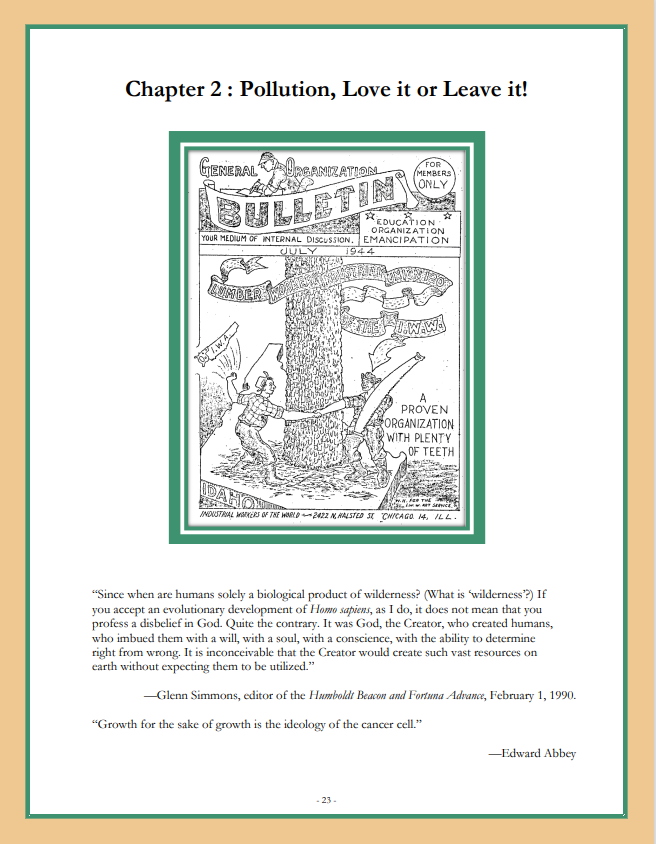
Chapter 2 : Pollution, Love it or Leave it!

By Steve Ongerth - From the book, Redwood Uprising: Book 1

Download a free PDF version of this chapter.

"Since when are humans solely a biological product of wilderness? (What is ‘wilderness’?) If you accept an evolutionary development of Homo sapiens, as I do, it does not mean that you profess a disbelief in God. Quite the contrary. It was God, the Creator, who created humans, who imbued them with a will, with a soul, with a conscience, with the ability to determine right from wrong. It is inconceivable that the Creator would create such vast resources on earth without expecting them to be utilized."

—Glenn Simmons, editor of the Humboldt Beacon and Fortuna Advance, February 1, 1990.

"Growth for the sake of growth is the ideology of the cancer cell.

—Edward Abbey

Earth shattering though it may have seemed, the IWW’s victory was both transitory and incomplete, and historical currents would never again mesh as perfectly. To begin with, the strike on the job had taken place only in the Pacific Northwest, and had excluded California at that. The Wobblies recognized one strategic weakness in this situation in noting that the employers could have eventually organized a lockout of that region and relied instead on wood production from the southern or eastern United States. They knew—in the abstract at least—that their victory would never be complete until they organized all lumber workers nationally and internationally.[1] The Wobblies inability to make inroads among the highly skilled redwood loggers of California’s North Coast was especially troublesome, and it portended their undoing. Two companies, Pacific Lumber (P-L) and Hammond Lumber Company (HLC) had each adopted separate techniques that had kept the IWW out and would soon be duplicated by the Lumber Trust elsewhere. That combined with the much larger shockwaves brought on by the Russian Revolution in 1917 conspired against the One Big Union and led to the eventual decline of the American working class as an adversarial force and the liquidation of the forests of the Pacific Northwest.

Although most corporations comprising the Lumber Trust had refused to budge, lest they embolden the Wobblies, there were those that adopted “welfare capitalism” on their own initiative, in which they would provide amenities and benefits to their workers—union or not—in an attempt to win over their loyalty. It was in the crucible of timber worker unionism, Humboldt County, where this was first attempted with any lasting success, by the Pacific Lumber Company (P-L), based in Scotia, beginning in 1909. P-L had discovered that by creating a wide variety of social programs, employee benefits, and community based events, it was able to secure the loyalty and stability of its workforce. P-L general manager A. E. Blockinger described these efforts in great detail in an article featured in the Pioneer Western Lumberman:

"A reading room with facilities for letter writing and any games, except gambling, is easily and cheaply put into any camp. Arrange subscription clubs for papers and periodicals or let the company do it for the men. If you can have a circulating library among your camps and at the mill plant, it will be much appreciated. Let the daily or weekly papers be of all nationalities as represented in your camp. Lumber trade journals are especially interesting to the men and they can and will readily follow the markets for lumber and appreciate that you have some troubles of your own.

“Organize fire departments among your men. The insurance companies will give you reductions in rates for such additional protection while it offers another opportunity for your men to relax and enjoy themselves.

“Shower baths at the camps or mill are easily and cheaply installed. They will be used and appreciated after a hot, dusty day’s work.

“Get your men loyal and keep them so. Let this replace loyalty to a union. The spirit is what you want in your men. Ten good men will accomplish as much as fifteen ordinary laborers if the spirit and good will is there. Treat them right and they will treat you right.”[2]

The employers’ introduction of paternalism achieved its intended goal. The Secretary of the Pacific Logging Congress, an employers’ association had declared in his 1912 report, “The best cure for the IWW plague—a people without a country and without a God—is the cultivation of the homing instinct in men.”[3] When the IWW campaign for the eight hour day ensued in 1917, P-L simply added more programs. Carleton H. Parker, a onetime U.C. Berkeley economics professor working for the War Department as a mediator during the lumber workers’ strike, had previously conducted sociological studies on workers, including agricultural and timber laborers. Parker was familiar with P-L, and had some fairly extensive knowledge of the Wobblies.[4] Some of the latter had been gained through first-hand studies by two of his assistants, Paul Brissenden[5] and F. C. Mills[6] who had posed as IWW members and later produced extensive studies on the organization. Using this knowledge, Parker offered many suggestions to Disque which the latter somewhat reluctantly adopted. The LLLL created social halls for its members and replaced the employment sharks with free employment agencies. The IWW quite rightly recognized these amenities as a means to buy the workers’ loyalty and likely to be liquidated when the employers drive for profits once again accelerated, but this process would take a long time, and convincing the workers of a threat that could take one or more generations to manifest proved futile.[7]

Why unions are excited about these provisions hidden deep in the Inflation Reduction Act

By Kristin Toussaint - Fast Company, January 27, 2023

The Inflation Reduction Act, which was signed into law last summer, is the U.S.’s largest-ever investment in clean and renewable energy. But it’s also a landmark policy for labor, tying $270 billion in tax incentives (of the bill’s $369 billion clean energy investment) to labor standards that will boost working conditions for those in clean energy jobs.

Those standards are set to go into effect on January 29, and labor advocates say it’s a historic opportunity to create a tremendous number of union jobs in the clean energy economy.

The IRA has tax credits that create financial incentives not only for developers to embark on more clean energy projects but also for those projects to meet high labor standards. Companies can get a 30% tax credit on their qualifying projects—from offshore wind to solar construction to energy storage—but only if they meet certain standards. That includes paying workers a prevailing wage (the federal government sets this rate for work on public projects; states can set theirs higher) and having a certain amount of work done by those in registered apprenticeship programs. (To start, 12.5% of total labor hours must be done by apprentices; that increases to 15% in 2024.)

If clean energy developers don’t meet those standards—say, paying only minimum wage and choosing not to hire any apprentices—they get a tax credit of just 6%. “The IRA provides a substantial and impactful financial benefit for developers to pay good wages, hire apprentices, and really create a pipeline to good careers in the clean energy economy,” says Dave Hancock, director of strategic campaigns at the Climate Jobs National Resource Center, which helps unions develop labor-led climate job coalitions and works toward a “worker-centered renewable economy.”

Chapter 1 : An Injury to One is an Injury to All!

By Steve Ongerth - From the book, Redwood Uprising: Book 1

Download a free PDF version of this chapter.

The mill men all insist on one thing: that the Government will grant the manufacturers protection from the lawless element of the I.W.W.’s”

—J. P. Weyerhaeuser, 1917

Is there aught we hold in common with the greedy parasite,
Who would lash us into serfdom and would crush us with his might,
Is there anything left to us but to organize and fight?
The union makes us strong…

—Lyrics excerpted from Solidarity Forever, by Ralph Chaplin, ca. 1915

The timber industry has, throughout nearly its entire history, been in the control of an elite minority of the very rich and powerful, and they have been especially avaricious, violent, and repressive towards all who would challenge their power. They have also—in spite of a barrage of slick propaganda trumpeting their careful management of the resource—depleted most of the virgin forests of the Pacific Northwest. Many environmental organizations can trace their origins to opposition to such practices, and in the struggles by environmentalists to preserve forestlands, timber workers have had a reputation for being their fiercest adversaries, and in many cases, this is true. Timber workers have a well deserved reputation for being outspoken about the pride of purpose in their job, as well as a deeply ingrained cultural machismo. Yet lumber harvesting and production is historically one of the ten most dangerous jobs in the industrialized world, and timber workers are among those most exploited by their employers. One would logically expect the timber workers to be highly resistant to such treatment, but in recent years they haven’t been. This wasn’t always so. To understand why, one must examine the industry’s origins.

Before the arrival of European-American settlers to the Pacific Northwest, the entire region stretching from northern California to Canada and Alaska from the Pacific Coast to the Rocky Mountains was dominated by coniferous old growth forests. At least 20 million acres of this land was forested, dominated by various species of trees, some of them hundreds of feet in height, over a dozen feet in diameter, and centuries or even millennia old.[1] In the southwestern part of this region, stretching from Big Sur to roughly what is now the Oregon state line, in a belt that was at least twenty miles wide for most of its expanse a very unique species of tree dominated, Sequoia sempervirens, commonly known as the California redwoods, some of them standing over 350 feet tall. Their close (and similarly large) cousins, Sequoiadendron giganteum, better known as the Giant Sequoia, only grew in a few isolated spots in the southern end of the Sierra Nevada foothills. These vast forests were far more then the trees, however. Hundreds, if not thousands of plant and animal species lived and flourished within these wooded habitats, and as far as is known, the indigenous population of the Americas had no significant lasting impact on California’s ancient redwood forests, nor did they have any lasting effect on the timberlands of the Pacific Northwest in general.[2] Like the Native Americans, the old growth forests of the Pacific Northwest had remained left more or less untouched for thousands, if not hundreds of thousands of years.

The coming of the white man changed all of that. The Russians first began exploiting the redwoods for the construction of Fort Ross in 1812, during their very brief settlement there.[3] As more Europeans arrived, the forests south of San Francisco were the first to be logged, usually through clearcutting, until these ancient stands were completely liquidated by 1860. In those days, loggers used hand saws, and felling an ancient redwood could take anywhere from two-to-five days to complete. The redwoods to the north of the Golden Gate in what is now Marin County were logged next, especially along rivers that allowed easy transportation by the available modes of the day. By this time, around 1881, the steam engine had replaced pack animals. Though this first wave of automation did not have a significant impact on the number of workers involved in the logging process, it greatly increased the impact logging had on the redwoods. Entire forests were liquidated, no matter how small the tree, because even the baby trees were used to build the skid roads used for hauling the larger ones. These forests were never replanted, and very few of them grew back, and in some cases, farmlands replaced them. By the beginning of the 20th Century, all but a few of these ancient trees were gone and logging operations migrated north to Sonoma County. One quarter century later, most of these old growth forests were likewise gone.[4]

Season 2 Ep. 4 - Stories Are Our Currency for Change

Season 2 Ep. 5 - Movements Start from Within

Pages

The Fine Print I:

Disclaimer: The views expressed on this site are not the official position of the IWW (or even the IWW’s EUC) unless otherwise indicated and do not necessarily represent the views of anyone but the author’s, nor should it be assumed that any of these authors automatically support the IWW or endorse any of its positions.

Further: the inclusion of a link on our site (other than the link to the main IWW site) does not imply endorsement by or an alliance with the IWW. These sites have been chosen by our members due to their perceived relevance to the IWW EUC and are included here for informational purposes only. If you have any suggestions or comments on any of the links included (or not included) above, please contact us.

The Fine Print II:

Fair Use Notice: The material on this site is provided for educational and informational purposes. It may contain copyrighted material the use of which has not always been specifically authorized by the copyright owner. It is being made available in an effort to advance the understanding of scientific, environmental, economic, social justice and human rights issues etc.

It is believed that this constitutes a 'fair use' of any such copyrighted material as provided for in section 107 of the US Copyright Law. In accordance with Title 17 U.S.C. Section 107, the material on this site is distributed without profit to those who have an interest in using the included information for research and educational purposes. If you wish to use copyrighted material from this site for purposes of your own that go beyond 'fair use', you must obtain permission from the copyright owner. The information on this site does not constitute legal or technical advice.