You are here

AFL-CIO

Oil Change International stands in solidarity with workers demanding better protection from record heat

By Andy Rowell - Oil Change International, July 26, 2023

As deadly fires continue to rage out of control, scientists have confirmed that the record temperatures experienced in Europe, China and the United States are due to human-induced climate change.

They are due to the fossil fuel industry and its decades-long campaign to deny the scientific evidence, spread doubt, and continue drilling. Yes, it is that simple.

And now, workers in the U.S. have had enough of working in extreme temperatures without adequate protections and breaks. And yesterday, the Teamsters Union reached a historic deal with the courier company, UPS, over worker rights and worker protections, including over heat.

As Big 3 Auto Contracts Expire: Hurried Line Speeds and Horrible Hours

By Keith Brower Brown - Labor Notes, July 25, 2023

David Sandoval remembers when he and his co-workers had a whole 72 seconds to assemble their sections of each seat for the Ford F-150, back when he started at a Michigan parts plant in 2004.

Today, 60 seconds is the deadline managers give each team racing at a dozen stations: to bolt the frame together, lay electronics, add heating and cooling gear, set cushions, and attach trim. Robotic lifting arms help on only one or two steps; handheld tools and elbow grease must do the rest. Each crew is told to clear 680 seats in a 10-hour shift.

That harsh speedup makes it small wonder that repetitive motion injuries are piling up for U.S. auto workers, while the Big 3 auto companies—Ford, General Motors, and Stellantis (formerly Chrysler)—posted $250 billion in profits in just the last four years.

On September 14, union contracts expire for 144,000 Big 3 workers. A company-wide strike at one of the three looks likely, especially after United Auto Workers members elected a reform slate to lead their union. The new president, Shawn Fain, has pledged a contract campaign and a strike–if needed–to end wage tiers, and to put workers at the wheel of the transition to electric vehicles (EVs).

To understand how that contract fight starts from conditions on the shop floor, Labor Notes interviewed workers at each of the Big 3 companies and an independent parts supplier.

From the Midwest to the South, auto workers say that their plant managers have seized on the pandemic and the EV transition to push an unsafe work pace, longer shifts and more of them, and divisions between workers. Meanwhile, some company executives are threatening layoffs and are openly preparing for a strike by stocking inventory and hiring temporary workers.

BPRA: A Win in the Fight for a Green New Deal

Battery Jobs Must Be Good-Paying Union Jobs, Says New UAW President

By Dan DiMaggio - Labor Notes, May 18, 2023

Contracts covering 150,000 auto workers at the Big 3 will expire on September 14, and the new leadership of the United Auto Workers is taking a more aggressive stance than in years past.

“We’re going to launch our biggest contract campaign ever in our history,” UAW President Shawn Fain told members in a Facebook live video.

Fain took office in March after winning the union’s first one member, one vote election. Running on the slogan, “No Corruption, No Concessions, No Tiers,” he and the Members United slate swept all the positions they ran for, giving reformers a majority on the international executive board.

While the union has vowed to take on tiered wages and benefits, job security, and plant closures, the transition to electric vehicles (EV) looms especially large.

Since President Biden signed the Inflation Reduction Act last August, companies have announced $120 billion in investments in domestic EV and battery manufacturing. The Act includes big tax credits and incentives for clean energy and EVs.

Ford alone is investing $11 billion in a new EV assembly plant and battery factories in Tennessee and Kentucky. The Biden administration wants EVs to make up half of all new vehicles sold by 2030.

How to Win a Green New Deal in Your State

By Ashley Dawson - The Nation, May 11, 2023

New York passed a publicly funded renewable energy program. This is how DSA did it—and how you can too.

New York just became the first US state to pass a major Green New Deal policy. After four years of organizing, the Build Public Renewables Act (BPRA) is now in the New York state budget. Passage of the act is a massive challenge to fossil fuel hegemony and a major victory for public power.

The BPRA authorizes and directs the state’s public power provider—the New York Power Authority (NYPA)—to plan, build, and operate renewable energy projects across the state to meet the ambitious timetable to decarbonize the grid mandated by the Climate Act of 2019. The NYPA, the largest public utility in the country, provides the most affordable energy in the state, but until now, it has been prohibited from building and owning new utility-scale renewable generation projects because of lobbying by profit-seeking private energy companies.

How did we win passage of this plan to start a publicly funded renewable energy program?

The Public Power NY movement began in late 2019 with a campaign organized by the eco-socialist working group of the NYC Democratic Socialists of America (DSA) against a rate hike request from the private utility ConEd. According to a 2018 report from the US Energy Information Administration, ConEd was already charging the second-highest residential rates of any major utility in the country (nearly double the national average), and now they wanted to raise electricity rates an additional 6 percent and gas rates by 11 percent.

To thwart this request, the Public Power campaign did intensive research into the for-profit utility’s recent history and found that though ConEd was making a billion dollars per year in profits, it had threatened to shut off power for 2 million low-income New Yorkers in 2018. Moreover, ConEd had failed to carry out grid upgrades that it had received $350 million to perform, a failure that left the power grid in an increasingly unstable state.

Lobstering Union (IAM 207), Maine Building Trades unions, Maine AFL-CIO Back Proposal to Protect Fishing Jobs & Create Union Jobs in Offshore Wind

By Andy O’Brien - Maine AFL-CIO, April 20, 2023

The Maine Lobstering Union (IAM 207) and the Maine AFL-CIO Executive Board have voted to support a proposal that would protect fishing grounds while also allowing offshore wind development in a way that creates good union jobs. The Maine Lobstering Union, IAM Local 207, the building trades, the Maine Labor Climate Council and others have worked tirelessly on the legislation, LR 741, -- with the support of bill sponsor Sen. Mark Lawrence and Senate President Troy Jackson -- to protect core fishing grounds and set high fisheries, environmental, equity, and labor standards on offshore wind development.

"We applaud the Maine Lobstering Union, Building Trades locals and others for doing the spade work to develop a solid plan for workers that protects Maine fisheries and guarantees good union jobs in the development of this new industry," said Matt Schlobohm, Maine AFL-CIO Executive Director. "When we work together to develop a worker led vision for climate action, we can create new union jobs, protect existing industries and tackle climate change head on."

Protecting Workers and Communities–From Below, Part 1: On the Ground

By Jeremy Brecher - Labor Network for Sustainability, March 23, 2023

Climate protection will create jobs for workers and economic development for communities. But as fossil fuel facilities are closed down there will also be some jobs lost and some communities will lose taxes and other economic benefits. This Commentary recounts what communities around the country are doing “on the ground” to protect workers and local economies from collateral damage from the transition to climate-safe energy. The next Commentary describes what states are doing to include such protections in their climate and energy programs.

‘Workers Know the Truth’ About the Derailment Disaster - Why Are They Being Ignored?

By Bob Hennelly - Work-Bites, February 8, 2023

Throughout the recent hazardous chemical freight train derailment in Ohio and the four-day ordeal that followed while the flaming wreck was stabilized, the one perspective that was consistently missing from the reporting was that of the union railroad workers. It didn’t matter if it was the New York Times, the Washington Post, or the Associated Press , the reporting relied on interviews with local, state and federal officials as well as statements from the Norfolk Southern, the rail carrier but not the perspective of their union workers.

It was as if robots and AI were already driving the train. The entire narrative of the cataclysm was framed by officials and the corporation whose malfunctioning train was now putting workers and the community in life-threatening jeopardy. The derailment played out in the rural borderland of Ohio and Pennsylvania requiring both states to activate an emergency evacuation response.

On Friday evening, the tranquility of East Palestine, Ohio, with a population of 4,761 people, was upended when a Norfolk Southern train with 150 cars in tow, derailed sparking a conflagration that inundated the area with toxic smoke. According to the U.S. Environmental Protection Agency [EPA], 20 of the cars in train were carrying hazardous materials. 

The U.S. EPA had to start monitoring the air for carbon monoxide, oxygen hydrogen sulfide, hydrogen cyanide, phosgene, and hydrogen chloride. Throughout the weekend, firefighters did their best to keep the disabled tanker cars cool as some of the hazardous cargo burned off. The local fire chief told reporters he was concerned about the presence of vinyl chloride, a colorless, toxic, and flammable gas.

“If you are in this red zone that is on the map and you refuse to evacuate, you are risking death,” Pennsylvania’s Gov. Josh Shapiro (D) warned. “If you are within the orange area on this map, you risk permanent lung damage within a matter of hours or days.”

In initial comments, a member of the National Transportation Safety Board [NTSB] posited that the derailment of the 150-car train was most likely caused by a problem with one of the axles on one of the freight or tanker cars. The catastrophic derailment, with significant public health and environmental implications, comes a few months after President Biden and Congress imposed a contract on the nation’s rail unions that their rank and file rejected in part because it lacked paid sick days.

Chapter 2 : Pollution, Love it or Leave it!

By Steve Ongerth - From the book, Redwood Uprising: Book 1

Download a free PDF version of this chapter.
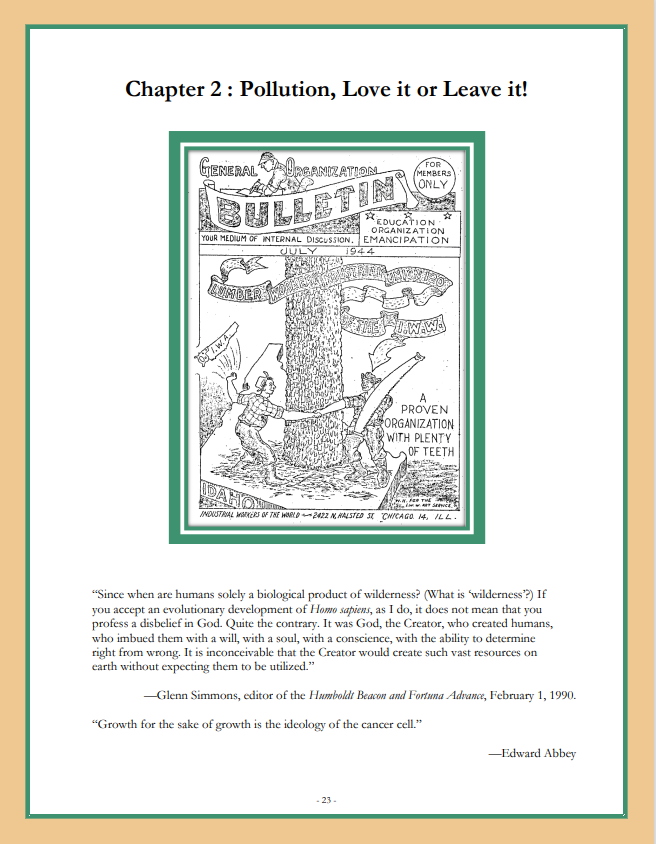
"Since when are humans solely a biological product of wilderness? (What is ‘wilderness’?) If you accept an evolutionary development of Homo sapiens, as I do, it does not mean that you profess a disbelief in God. Quite the contrary. It was God, the Creator, who created humans, who imbued them with a will, with a soul, with a conscience, with the ability to determine right from wrong. It is inconceivable that the Creator would create such vast resources on earth without expecting them to be utilized."

—Glenn Simmons, editor of the Humboldt Beacon and Fortuna Advance, February 1, 1990.

"Growth for the sake of growth is the ideology of the cancer cell.

—Edward Abbey

Earth shattering though it may have seemed, the IWW’s victory was both transitory and incomplete, and historical currents would never again mesh as perfectly. To begin with, the strike on the job had taken place only in the Pacific Northwest, and had excluded California at that. The Wobblies recognized one strategic weakness in this situation in noting that the employers could have eventually organized a lockout of that region and relied instead on wood production from the southern or eastern United States. They knew—in the abstract at least—that their victory would never be complete until they organized all lumber workers nationally and internationally.[1] The Wobblies inability to make inroads among the highly skilled redwood loggers of California’s North Coast was especially troublesome, and it portended their undoing. Two companies, Pacific Lumber (P-L) and Hammond Lumber Company (HLC) had each adopted separate techniques that had kept the IWW out and would soon be duplicated by the Lumber Trust elsewhere. That combined with the much larger shockwaves brought on by the Russian Revolution in 1917 conspired against the One Big Union and led to the eventual decline of the American working class as an adversarial force and the liquidation of the forests of the Pacific Northwest.

Although most corporations comprising the Lumber Trust had refused to budge, lest they embolden the Wobblies, there were those that adopted “welfare capitalism” on their own initiative, in which they would provide amenities and benefits to their workers—union or not—in an attempt to win over their loyalty. It was in the crucible of timber worker unionism, Humboldt County, where this was first attempted with any lasting success, by the Pacific Lumber Company (P-L), based in Scotia, beginning in 1909. P-L had discovered that by creating a wide variety of social programs, employee benefits, and community based events, it was able to secure the loyalty and stability of its workforce. P-L general manager A. E. Blockinger described these efforts in great detail in an article featured in the Pioneer Western Lumberman:

"A reading room with facilities for letter writing and any games, except gambling, is easily and cheaply put into any camp. Arrange subscription clubs for papers and periodicals or let the company do it for the men. If you can have a circulating library among your camps and at the mill plant, it will be much appreciated. Let the daily or weekly papers be of all nationalities as represented in your camp. Lumber trade journals are especially interesting to the men and they can and will readily follow the markets for lumber and appreciate that you have some troubles of your own.

“Organize fire departments among your men. The insurance companies will give you reductions in rates for such additional protection while it offers another opportunity for your men to relax and enjoy themselves.

“Shower baths at the camps or mill are easily and cheaply installed. They will be used and appreciated after a hot, dusty day’s work.

“Get your men loyal and keep them so. Let this replace loyalty to a union. The spirit is what you want in your men. Ten good men will accomplish as much as fifteen ordinary laborers if the spirit and good will is there. Treat them right and they will treat you right.”[2]

The employers’ introduction of paternalism achieved its intended goal. The Secretary of the Pacific Logging Congress, an employers’ association had declared in his 1912 report, “The best cure for the IWW plague—a people without a country and without a God—is the cultivation of the homing instinct in men.”[3] When the IWW campaign for the eight hour day ensued in 1917, P-L simply added more programs. Carleton H. Parker, a onetime U.C. Berkeley economics professor working for the War Department as a mediator during the lumber workers’ strike, had previously conducted sociological studies on workers, including agricultural and timber laborers. Parker was familiar with P-L, and had some fairly extensive knowledge of the Wobblies.[4] Some of the latter had been gained through first-hand studies by two of his assistants, Paul Brissenden[5] and F. C. Mills[6] who had posed as IWW members and later produced extensive studies on the organization. Using this knowledge, Parker offered many suggestions to Disque which the latter somewhat reluctantly adopted. The LLLL created social halls for its members and replaced the employment sharks with free employment agencies. The IWW quite rightly recognized these amenities as a means to buy the workers’ loyalty and likely to be liquidated when the employers drive for profits once again accelerated, but this process would take a long time, and convincing the workers of a threat that could take one or more generations to manifest proved futile.[7]

Union-Made Offshore Wind: AFL-CIO 2022 Convention

Pages

The Fine Print I:

Disclaimer: The views expressed on this site are not the official position of the IWW (or even the IWW’s EUC) unless otherwise indicated and do not necessarily represent the views of anyone but the author’s, nor should it be assumed that any of these authors automatically support the IWW or endorse any of its positions.

Further: the inclusion of a link on our site (other than the link to the main IWW site) does not imply endorsement by or an alliance with the IWW. These sites have been chosen by our members due to their perceived relevance to the IWW EUC and are included here for informational purposes only. If you have any suggestions or comments on any of the links included (or not included) above, please contact us.

The Fine Print II:

Fair Use Notice: The material on this site is provided for educational and informational purposes. It may contain copyrighted material the use of which has not always been specifically authorized by the copyright owner. It is being made available in an effort to advance the understanding of scientific, environmental, economic, social justice and human rights issues etc.

It is believed that this constitutes a 'fair use' of any such copyrighted material as provided for in section 107 of the US Copyright Law. In accordance with Title 17 U.S.C. Section 107, the material on this site is distributed without profit to those who have an interest in using the included information for research and educational purposes. If you wish to use copyrighted material from this site for purposes of your own that go beyond 'fair use', you must obtain permission from the copyright owner. The information on this site does not constitute legal or technical advice.


