

You are here

publications

Building a Just Transition for a Resilient Future: A Climate Jobs Program for Rhode Island

By Lara Skinner, J. Mijin Cha, Avalon Hoek Spaans, Hunter Moskowitz, and Anita Raman - The Worker Institute and The ILR School, January 2022

A new report released today by climate and labor experts at Cornell University in collaboration with the Climate Jobs Rhode Island Coalition outlines a comprehensive climate jobs action plan to put Rhode Island on the path to building an equitable and resilient clean-energy economy.

The report lays out a series of wide-ranging policy recommendations to transition the Ocean State’s building, school, energy, transportation, and adaptation sectors to renewable energy with the strongest labor and equity standards. Core provisions of the plan include decarbonizing the state’s K-12 public school buildings, installing 900 MW of solar energy statewide, 1,300 MW of offshore wind energy, and modernizing the state’s electrical grid by 2030. 

“Rhode Island is in a unique position as a state, in 2019 it had the lowest energy consumption per capita across all the United States. Rhode Island can use climate change as an opportunity to eliminate carbon emissions, increase equity, and create high-quality jobs that support working families and frontline communities,” says Avalon Hoek Spaans, Research and Policy Development Extension Associate for the Labor Leading on Climate Initiative at the Worker Institute, Cornell ILR School and one of the authors of the report.

The Worker Institute’s Labor Leading on Climate Initiative in partnership with the Climate Jobs National Resource Center, and Climate Jobs Rhode Island, began a comprehensive research, educational, and policy process in early 2021 to develop an implementation framework to drastically reduce emissions in the state while creating high-quality union family sustaining jobs.

Over the past year, the Labor Leading on Climate team has conducted outreach to numerous leaders of the labor and environmental movements as well as policymakers and experts in the climate, energy, and labor fields to better understand the challenges and opportunities that climate change and climate mitigation and adaptation presents to Rhode Island workers and unions.

“With Rhode Island on the frontlines of the climate crisis, it will take bold, ambitious action to combat climate change and reduce greenhouse gas emissions and pollution to the levels that science demands. Fortunately, tackling climate change is also an opportunity to address the other crises Rhode Island is facing: inequality and pandemic recovery,” says Lara Skinner, Director, Labor Leading on Climate Initiative, at the Worker Institute, Cornell ILR School and one of the authors of the report.

“As a small state with one of the lowest emissions in the country, Rhode Island can be innovative and efficient, employing cutting-edge approaches to reverse climate change and inequality. Rhode Island has the potential to be the first state in the country to fully decarbonize and build out a net zero economy with high-quality union jobs. This would make Rhode Island's economy stronger, fairer, and more inclusive,” says Lara Skinner, Director, Labor Leading on Climate Initiative, at the Worker Institute, Cornell ILR School and one of the authors of the report.

Read the text (PDF).

CLARA Statement on COP26 Outcomes

By staff - Climate Land Ambition and Rights Alliance, November 13, 2021

The science is clear: we are facing “Code Red for Humanity.” COP 26 started with soaring rhetoric promising to ‘keep 1.5 alive.’ Once again though, this COP has failed to listen to science and give credence to the peoples’ voices ringing outside the negotiating rooms of the COP and those taking to the streets calling for climate justice.

One bright spot, however, is the agreement on the Glasgow Committee on Non-Market Approaches and the forthcoming work program. CLARA is committed to seeing these approaches succeed in order to enable enhanced cooperation on mitigation and adaptation in order to provide communities with the support they need for climate action. But the market based mechanisms in the rest of Article 6 risk undermining real climate action with offsets that do nothing to enhance ambition to keep temperature rise below 1.5 (see more below).

Read the text (PDF).

CUT: SPECIAL COP 26

By staff - Central Única dos Trabalhadores, December 2021

The Central Única dos Trabalhadores (CUT) was present at COP 26, which took place in November, in Glasgow, Scotland. In this bulletin we expose our performance and select analyses and content considered relevant by our Central to follow the discussion from the perspective of the working class.
Due to the urgency of a global action to contain the advance of the climate crisis and face its impacts the COPs become key spaces of discussion but we follow them critically due to the limitations of presenting real solutions.
The pre-COP 26 statements of the Trade Union Confederation of Workers of the Americas (CSA) and the Belem Charter Group point out what the key discussions were this year as well as the main criticisms. We also share the trade union agenda for COP 26 of the International Trade Union Confederation - ITUC.

Read the entire statement (PDF).

The Quiet Culprit: Pension Funds Bankrolling the Climate Crisis

By staff - Climate Safe Pensions, December 2021

A first-of-its-kind report ... from Climate Safe Pensions Network and Stand.earth reveals that just 14 pension and permanent funds finance fossil fuels to the tune of $81.6 billion.The report shows a comprehensive accounting of the fossil fuel exposure of 14 pension funds in one report from Climate Safe Pensions Network and Stand.earth reveals that just 14 U.S. public pension funds are the quiet culprits of climate chaos: with $81.6 billion invested in coal, oil, and gas.

With over $46 trillion in assets worldwide, pension funds are among the largest institutional investors in fossil fuels. These investments have dangerously underperformed the rest of the market, making public pensions’ fossil fuels investments inherently risky.

Pension funds’ financial influence make them a force to reckon with in the battle to confront, slow and mitigate climate change. Pension fund decision-makers must take climate protection seriously — not only for their financial well-being, but also for the well-being of their millions members.

With 10 years of data, there’s hard evidence that divestment is a winning financial strategy. The fastest way for pensions to address climate change is to divest fossil fuel holdings and invest in just and equitable climate solutions.

Read the text (PDF).

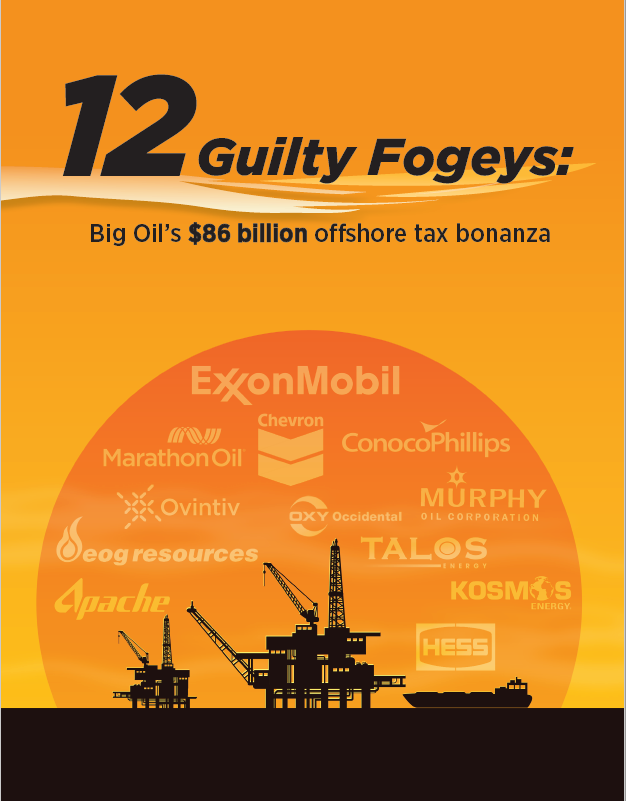
12 Guilty Fogeys: Big Oil’s $86 billion offshore tax bonanza

By staff - Friends of the Earth, Bailout Watch, and Oxfam, September 2021

Few letter-soup acronyms in Washington bureaucratese are so aptly pronounced as GILTI and FOGEI, two esoteric provisions in the tax code worth tens of billions of dollars to Big Oil’s multinational majors.

Under the Trump Administration’s radical 2017 tax law, companies that extract oil and gas overseas enjoy special exemptions within the Global Intangible Low-Tax (GILTI) regime covering Foreign Oil and Gas Extraction Income (FOGEI).

It is a fitting accident of nomenclature: FOGEI’s GILTI carveout helps prop up the fossil firms most culpable for the climate crisis — to the tune of $84 billion. An additional international tax loophole enjoyed by Big Oil is worth at least another $1.4 billion, for a grand total of over $86 billion in offshore tax giveaways.

Read the text (PDF).

COP26 Report Back: Climate Justice Activists Speak Out

Scotland's Rail Unions at COP 26

Rail Unions call for action on climate change

By staff - Transport Salaried Staffs' Association, November 10, 2021

TSSA, ASLEF, RMT, and Unite unions today united with Jeremy Corbyn and the STUC at COP26 to call on the Scottish Government to invest in Scotland’s Railways in order to fight climate change.

The unions held an event in Websters Theatre to promote their report “A Vision for Scotland’s Railways” which calls for better investment in railway infrastructure and staffing in order to encourage passengers back onto the railway. The report argues that staffed stations are safer at night and more accessible for passengers with disabilities.

Jeremy Corbyn said, “The land taken up by railways compared to roads is utterly minimal… For environmental considerations railways are the right way forward and this document indicates all of that.”

TSSA Organiser Gary Kelly said, “It’s not just the climate which is code red, it’s the railway itself. We're in the middle of a climate catastrophe when rainfall puts the railway at risk and the government's answer is to cut Network Rail staff. We're facing a real Code Red here. The question is what are we going to do about it?

ASLEF Organiser Kevin Lindsey said, “We want to see our vision become the template…. It’s crucial that passengers have an input, whether that’s people representing women, people representing young people or people representing disabled passengers, or just general passengers we want all voices to be heard. It’s so crucial to have a railway for all of Scotland.”

RMT Organiser Mick Hadley said “If we are serious about addressing the concerns about Scotland by giving the most vulnerable people access to trains, we need to give them access to staff - we need station staff to ensure it's safe to use Scotland's trains”

The unions criticised privatisation for failing both ScotRail and the people of Scotland.

Unite the Union Organiser Pat McIlvogue said, “All Abellio are concerned about is the profit, not concerned about the service, not concerned about the people, not concerned about the country. We've got a chance for a change now.”

Chairing the event, STUC General Secretary Roz Foyer said, “The current rail model fails services users and employees. We have a real opportunity when Scottish Government takes over ScotRail in April… There's an absolute need for us to mobilise people to demand that it stays a public service”

The tragic events at Stonehaven show climate change is real - it's here we're living with the effects. We need change. The rail unions are committed to working together to make that change happen.

Making COP26 Count: How investing in public transport this decade can protect our jobs, our climate, our future

By staff - International Transport Workers Federation and C40 Cities Leadership Group, November 10, 2021

Transport is currently responsible for a quarter of CO2 emissions. To combat this, a global shift to public transport, walking and cycling is needed, reducing car use alongside a transition to zero-emission vehicles. The proportion of public transport journeys in the world’s cities must double in this decade to bring global emissions down, in line with keeping the temperature rise to 1.5°C. Without this action, it will simply not be possible for countries to deliver on the global goal to at least halve emissions within this decade.

Climate protection cannot work without a modal shift. Local transport must become a good alternative to cars … above all, people must be taken along.

Robert Seifert, young vehicle maintenance worker, Berlin Doubling public transport usage as part of a green recovery would, by 2030, create tens of millions of jobs in cities around the world (4.6 million new jobs in the nearly 100 C40 cities alone), cut urban transport emissions by more than half, and reduce air pollution from transport by up to 45%2. It would protect lower-income and service-sector workers and connect city residents to work, education and community.

Read the text (PDF).

The Challenge of Building a High-road Electric Vehicle Industry with Anti-union Employers

Pages

The Fine Print I:

Disclaimer: The views expressed on this site are not the official position of the IWW (or even the IWW’s EUC) unless otherwise indicated and do not necessarily represent the views of anyone but the author’s, nor should it be assumed that any of these authors automatically support the IWW or endorse any of its positions.

Further: the inclusion of a link on our site (other than the link to the main IWW site) does not imply endorsement by or an alliance with the IWW. These sites have been chosen by our members due to their perceived relevance to the IWW EUC and are included here for informational purposes only. If you have any suggestions or comments on any of the links included (or not included) above, please contact us.

The Fine Print II:

Fair Use Notice: The material on this site is provided for educational and informational purposes. It may contain copyrighted material the use of which has not always been specifically authorized by the copyright owner. It is being made available in an effort to advance the understanding of scientific, environmental, economic, social justice and human rights issues etc.

It is believed that this constitutes a 'fair use' of any such copyrighted material as provided for in section 107 of the US Copyright Law. In accordance with Title 17 U.S.C. Section 107, the material on this site is distributed without profit to those who have an interest in using the included information for research and educational purposes. If you wish to use copyrighted material from this site for purposes of your own that go beyond 'fair use', you must obtain permission from the copyright owner. The information on this site does not constitute legal or technical advice.
