

You are here

publications

Climate Jobs: Building a Workforce for the Climate Emergency

By Suzanne Jeffery, editor, et. al - Campaign Against Climate Change, November 2021

This report was written by the Campaign Against Climate Change Trade Union Group (CACCTU). It builds on and develops the earlier work produced by CACCTU, One Million Climate Jobs (2014). The editorial group and contributors to this report are trade unionists, environmental activists and campaigners and academics who have collaborated to update and expand the previous work. Most importantly, this updated report is a response to the urgency of the climate crisis and the type and scale of the transition needed to match it.

This report shows how we can cut UK emissions of greenhouse gases to help prevent catastrophic climate change. We explain how this transformation could create millions of climate jobs in the coming years and that the public sector must take a leading role. Climate jobs are those which directly contribute to reducing emissions. This investment will give us better public transport, warmer homes, clean air in our cities and community renewal in parts of the country which have long been neglected. Most importantly, it will give us a chance for the future, avoiding the existential threat of climate breakdown.

Read the text (Link).

Songs About and by Judi Bari at the Mendocino County Museum, Remembering Judi Bari Exhibit

The Green Horizon We See Beyond the Big Blue: How Seafarers Will Lead the Just Transition Needed for a Sustainable Shipping Future

By staff - International Transport Workers Federation Seafarer's Section, October 29, 2021

Bush and forest fires, floods, heatwaves, extreme storms and rising sea levels – the life-threatening events which herald dangerous climate change are already taking place around us with increasing frequency. Scientists are clear that humans’ impact on the Earth’s climate is reaching a tipping point beyond which a safe climate is in doubt.

At the heart of the problem is our reliance on greenhouse gas-producing fossil fuels to power industries like shipping, a reliance with a long history. On a global level, international cargo shipping is responsible for about three percent of global greenhouse gas emissions. From the early 1800s, coal was used to fire steam boilers for paddle steamers, which was switched to oil variants when technology improved. Fast forward to today and billions of litres of fossil fuels are used every year to power over 50,000 vessels that keep the world’s supply chain moving.

A Panamax container ship, an averaged sized cargo vessel, consumes about 63,000 gallons (286,403 litres) of marine fuel per day travelling at between 20 and 25 knots.

The global shipping industry must break its dependency on fossil fuels. The rapid expansion of international shipping over the past 50 years has been enabled by the reliance on cheap heavy fuel oil, known as bunker fuel. Key players in the industry have lobbied against restrictions on its use, despite it being one of the most polluting of all fossil fuels.

While it is true that international shipping has low carbon intensity – that is emissions per unit of moved cargo – the total emissions of the industry is very high due to the sheer volume of global maritime shipping. Until now, the focus on carbon intensity as opposed to total carbon emissions has led to false confidence about the carbon footprint of the industry compared to other sectors.

Now that more people are understanding the impact shipping is having on our climate, our industry’s reputation is being damaged. Seafarers want to be able to tell their friends and family that they’re part of a sector taking real and equitable action to curb dangerous climate change. It’s time to act.

Read the text (PDF).

Energy transition or energy expansion?

By Sean Sweeney, John Treat, and Daniel Chavez - Trade Unions for Energy Democracy and Trans National Institute, October 22, 2021

From politicians to corporate executives, media commentators to environmental campaigners, narratives evoking the “unstoppable” progress of a global transition from fossil fuels to renewable energy have grown increasingly commonplace.
However, in reality, the global shifts in energy production, energy usage and greenhouse gas emissions we urgently need are not happening:

  • In 2019, over 80% of global primary energy demand came from fossil fuels, with global greenhouse gas emissions at record levels.
  • In 2020, wind and solar accounted for just 10% of global electricity generated.
  • Despite stories of its decline, coal-fired power generation continues to rise globally. In 2020, global efforts to decommission coal power plants were offset by the new coal plants commissioned in China alone, resulting in an overall increase in the global coal fleet of 12.5 GW.

Recently, some have argued that the Covid-19 pandemic and subsequent contraction in economic activity signal a turning point. Indeed, global energy demand fell by nearly 4% in 2020, while global energy-related CO2 emissions fell by 5.8% — the sharpest annual decline since the second world war.

Despite these short-term shifts, the pandemic has failed to result in any significant long-term changes for the energy sector or associated emissions:

  • Global energy-related CO2 emissions are projected to grow by 4.8% in 2021, the second highest annual rise on record.
  • Demand for all fossil fuels is set to rise in 2021.6 A 4.6% increase in global energy demand is forecast for 2021, leaving demand 0.5% higher than 2019 levels.
  • By the end of 2020 electricity demand had already returned to a level higher than in December 2019, with global emissions from electricity higher than in 2015.
  • By the end of 2020, global coal demand was 3.5% higher than in the same period in 2019. A 4.5% rise in coal demand is forecast for 2021, with coal demand increasing 60% more than all renewables growth combined and undoing 80% of the 2020 decline.
  • Oil demand is forecast to rebound by 6% in 2021, the steepest rise since 1976. By 2026, global oil consumption is projected to reach 104.1 million barrels per day (mb/d), an increase of 4.4 mb/d from 2019 levels.

As such, an energy transition with the depth and speed necessary for meeting the 2015 Paris Agreement shows no sign of materializing. Indeed, most of the world’s major economies are not on track to reach their Nationally Determined Contributions (NDCs) on emissions reductions.

These facts point to a clear conclusion: the dominant, neoliberal climate policy paradigm, which deploys a “sticks and carrots” approach that attempts to disincentivize fossil fuels through carbon pricing, while promoting low-carbon investment through subsidies and preferential contractual arrangements has been completely ineffective. This policy paradigm positions governments as guardians and guarantors of the profitability of private actors, thus preventing them from addressing social or environmental challenges head-on.

Read the text (PDF).

Trade Unions for Energy Democracy Global Forum on the IPCC Report

People's Utility Justice Playbook​

By Yesenia Rivera and Johanna Bozuwa - Energy Democracy Project, October 2021

Have you ever wondered who is in charge of your electricity? And why?

The People’s Utility Justice Playbook has two components:

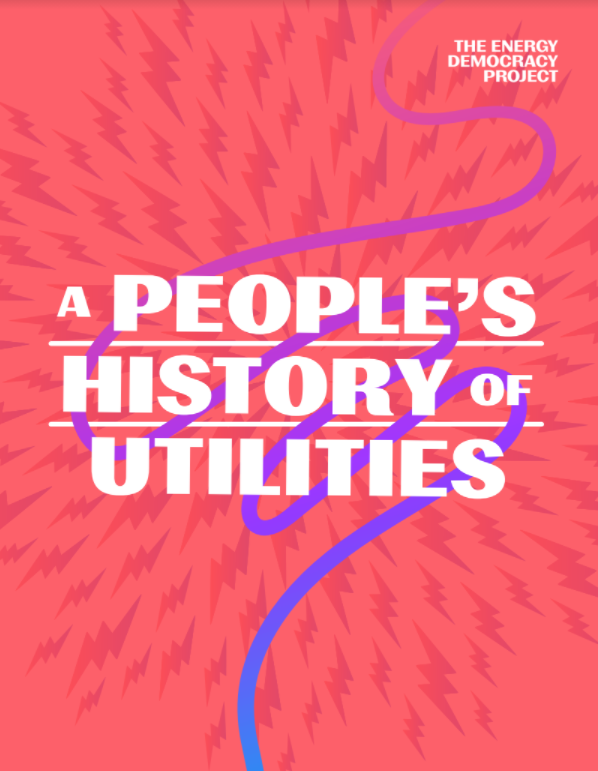
  1. a “History of Utilities” report to summarize the history of utilities for everyone to understand how our current energy system originated.
  2. a “People’s Utility Justice Playbook” to expose the tactics from electric utilities that are undermining community’s efforts, so we can build our organizing strength—to not only fight back but also to build the democratic energy system for climate justice.

This is the basic information we need to fight back against energy utilities attempting to slow or stop progress toward economic and climate justice.

History of Utilities​

Electric utilities have expanded into almost every aspect of our lives to become one of the most powerful and concentrated industries on Earth. To have a better understanding of what we’re fighting against, we first need to learn about the history of energy utilities! This PDF summarizes the entire timeline and how the rise of energy democracy came about.

People's Utility Justice Playbook

In order to fight the industry-owned utilities’ tactics, we need our own strategies for combat!

We have our very own playbook sourced from energy justice activists on the ground. They suggest strategies and tactics they employ when fighting against utilities that anyone fighting against utilities could use!

Read the History (PDF).

Read the Playbook (PDF).

A Vision for Scotland’s Railways

By staff - Unity Consulting, ASLEF, RMT, TSSA, and Unite the Union, October 29, 2021

Scotland cannot meet its environmental obligations without a world-class rail service that shifts people and goods from cars and lorries onto trains.

This requires a service that is fully staffed, with affordable fares, stations that are accessible and trains that are clean, green and attractive.

What is needed is an ambition for Scotland’s railways that is expansive, that encourages people to make rail their first travel choice and increases freight capacity.

Our long-term vision for Scotland's railways:

  • It should be a publicly operated and governed system run as public service and not for private profit
  • A system that helps Scotland meet its wider environmental and public policy ambitions
  • A railway that is supported by public subsidy
  • Is fully staffed
  • That reinvests in rail infrastructure, to help grow the economy.
  • Takes ScotRail (and the Serco operated Caledonian Sleeper) back under public ownership permanently
  • A railway that is part of a wider integrated public transport system with through ticketing
  • Is part of an industrial strategy that recognises rail services are a vital part of Scotland’s economy helping create jobs and growth
  • Has a democratic regulatory and governance structure
  • Has a cross representation of Scottish society and rail interests at the heart of decision making
  • Has representation from all four trade unions on the board of the new operator
  • Has local political representatives on the board
  • Has passenger representatives on the board

Read the text (PDF).

It’s time to act now! Just Transition must become a reality today! IndustriALL Global Union and industriAll European Trade Union on COP26

By staff - IndustriaALL, October 2021

On the occasion of the 26th Conference of the Parties to the UN Framework Convention on Climate Change (UNFCCC) taking place on 1-12 November 2021 in Glasgow, IndustriALL Global Union and industriAll European Trade Union - which collectively represent over 50 million workers in industry, energy and mining sectors globally - call on governments to finally act and make Just Transition a reality for everyone and for all generations!

For many years, the International Trade Union Movement has been vocal about the need to ensure a Just Transition that is on par with increased climate ambition. We cannot ignore the urgent need to step up our global efforts to reach climate neutrality as soon as possible. Climate change is affecting everyone, brought to our attention by recent extreme weather events around the globe, but it cannot be that the workforce and the poor will be the first to pay the price. The measures to mitigate and adapt to climate change will not affect everyone equally. Workers around the globe are at the centre of the transition and will be the actors to implement climate ambition through their daily work.

We campaigned for the inclusion of the Just Transition concept in the Paris Climate Agreement in 2015 and for the development of ILO Guidelines on how to implement it on the ground. The ILO Guidelines stress the need for tripartite dialogue, including governments, employers and trade unions, in each of the nine policy areas defined in the just transition framework1. In 2018, during COP24, 56 parties adopted the Solidarity and Just Transition Silesia Declaration, stressing “that Just Transition of the workforce and the creation of decent work and quality jobs are crucial to ensure an effective and inclusive transition to low greenhouse gas emissions and climate resilient development.” The Silesia Declaration invited all relevant stakeholders to implement it. Despite significant progress, in many places Just Transition is too often only nice words on paper.

Declarations and statements of good intentions must now be followed by concrete action. Especially during the COVID-crisis and in the aftermath, jobs were lost, social dialogue was not respected, and workers were driven into precarious conditions. Therefore, IndustriALL Global Union and industriAll European Trade Union call on governments that it is high time to move on from the narrative on paper to implementing a Just Transition through measures and resources on the ground. To achieve this, Just Transition plans must be systematically included as part of the UNFCCC reporting process, in every country.

Read the text (PDF).

The Green Jobs Advantage: How Climate Friendly Investments are Better Job Creators

By Joel Jager, et. al. - World Resources Institute, International Trade Union Confederation, and The Global Commission on the Economy and Climate, October 2021

As part of their COVID-19 recovery efforts, many governments continue to fund unsustainable infrastructure, even though this ignores the urgency of addressing climate change and will not secure longterm stability for workers.

Our analysis of studies from around the world finds that green investments generally create more jobs per US$1 million than unsustainable investments. We compare near-term job effects from clean energy versus fossil fuels, public transportation versus roads, electric vehicles versus internal combustion engine vehicles, and nature-based solutions versus fossil fuels.

Green investments can create quality jobs, but this is not guaranteed. In developing countries, green jobs can provide avenues out of poverty, but too many are informal and temporary, limiting access to work security, safety, or social protections. In developed countries, new green jobs may have wages and benefits that aren’t as high as those in traditional sectors where, in many cases, workers have been able to fight for job quality through decades of collective action.

Government investment should come with conditions that ensure fair wages and benefits, work security, safe working conditions, opportunities for training and advancement, the right to organize, and accessibility to all.

Read the text (PDF).

Are ‘Green’ Jobs Good Jobs? How lessons from the experience to-date can inform labour market transitions of the future

By Dr Anna Valero, et. al. - London School of Economics, October 2021

As governments worldwide are increasing their commitments to tackling climate change, efforts are growing to quantify and characterise the ‘green economy’, and to identify opportunities to be seized and challenges to be overcome in the transition to the net-zero economy of the future. The aim of this report and accompanying policy brief is to shed light on the quantity and quality of current green labour markets, to inform policy action and future research for the net-zero transition.

Main messages

  • Research on green jobs often uses a narrow definition of the green economy that does not cover all the jobs that will be important for driving forward the net-zero transition.
  • In contrast, the authors apply a broad approach to the UK and European economies.
  • They find that around 20% of jobs in the UK and 14 European economies can be considered directly and indirectly green, taking a broad, occupation-level definition of the ‘greenness’ of jobs.
  • They find some evidence that greener jobs tend to be ‘better’ jobs.
  • Workers in some types of green jobs, particularly those that are new occupations related to greening the economy, are likely to be educated to a higher level and be on permanent contracts, though there are differences in these relationships across countries, sectors and regions.
  • For the UK, the authors also find that greener jobs tend to pay higher wages, and are more resilient to automation.
  • Greener jobs tend to be occupied by older workers and men. Policymakers will need to ensure equitable access to green, future-fit jobs. Educational and training requirements of ‘green’ jobs will need to be met with new education and skills policies, including improved incentives for firms and individuals to train.

Read the text (link).

Pages

The Fine Print I:

Disclaimer: The views expressed on this site are not the official position of the IWW (or even the IWW’s EUC) unless otherwise indicated and do not necessarily represent the views of anyone but the author’s, nor should it be assumed that any of these authors automatically support the IWW or endorse any of its positions.

Further: the inclusion of a link on our site (other than the link to the main IWW site) does not imply endorsement by or an alliance with the IWW. These sites have been chosen by our members due to their perceived relevance to the IWW EUC and are included here for informational purposes only. If you have any suggestions or comments on any of the links included (or not included) above, please contact us.

The Fine Print II:

Fair Use Notice: The material on this site is provided for educational and informational purposes. It may contain copyrighted material the use of which has not always been specifically authorized by the copyright owner. It is being made available in an effort to advance the understanding of scientific, environmental, economic, social justice and human rights issues etc.

It is believed that this constitutes a 'fair use' of any such copyrighted material as provided for in section 107 of the US Copyright Law. In accordance with Title 17 U.S.C. Section 107, the material on this site is distributed without profit to those who have an interest in using the included information for research and educational purposes. If you wish to use copyrighted material from this site for purposes of your own that go beyond 'fair use', you must obtain permission from the copyright owner. The information on this site does not constitute legal or technical advice.
