You are here

fossil fuel capitalism

Transformation is Not a Metaphor

By Jevgeniy Bluwstein - Political Georgraphy Institute, June 17, 2021

In this intervention I highlight an element that has been overlooked in this important debate about “progressive environmental futures” (Robbins, 2019, p. 1) – the dismantling of fossil capitalism. More still, I argue that some perspectives in this forum may even distract our attention from a more direct engagement with this – in my view – most urgent question of our time. Ultimately, I suggest that by not engaging this question head on, debates about “transformation” risk rendering it a metaphor.

Here, I am inspired by the influential critique of decolonial scholarship by Tuck and Yang (2012), who insist that “decolonization is not a metaphor.” Tuck and Yang (2012) maintain that while the decolonization of academic and educational institutions through the recognition and integration of alternative knowledges is important, this is not the central objective of decolonization. Writing from a settler-colonial context, the authors suggest that “[u]ntil stolen land is relinquished, critical consciousness does not translate into action that disrupts settler colonialism” (Tuck & Yang, 2012, p. 19). In a settler-colonial context, decolonization thus must go beyond the usual critique of epistemology and beyond calls for decolonizing knowledge and methodologies. Above all, land has to be given back and colonial property relations dismantled.

Although Tuck and Yang's intervention is specific to a settler-colonial context, and thus should not be generalized, it resonates with broader critiques raised against recent trends in decolonial and ontopolitical scholarship. For instance, Chandler and Reid (2020, p. 494) are frustrated with the exuberant attention to the “coloniality of knowledge” at the expense of paying due attention to “the coloniality of real inequalities and injustices in the world.” Relatedly, the late David Graeber sees a lack of engagement with material questions of slavery, class, patriarchy, war, police, poverty, hunger and inequality in scholarship that privileges multiple ontologies of being and epistemologies of knowing (Graeber, 2015).

Drawing on these perspectives about the limits of critique, here, I draw a parallel between decolonization that requires land repatriation and not just the decolonization of knowledge production, and a vision of transformation that requires the rapid, ruptural dismantling of fossil capitalism and not just the transformation of our understanding of socio-ecological limits. In this vein, a vision of transformation that is not a metaphor needs to go beyond questions and critiques of limits, technology, labor and growth (however illuminating they may be), and to engage more directly with political strategy, organization and praxis in the here and now. After all, what matters is “which strategies can actually work to address the environmental and social crises the world faces” (Bliss, 2021, p. 1).

But isn't addressing environmental and social crises exactly what the debate in this forum is ultimately about? Yes and no. Yes, because a post-capitalist future is central to both, a degrowth and a socialist modernist vision, although in different ways. No, because this forum has not touched upon questions of political strategy, organization, and praxis for short-term dismantling of fossil capitalism, even though both camps agree that capitalism is the single biggest obstacle towards progressive environmental futures. Hoping that a future world of degrowth or socialist modernism will get us beyond fossil capitalism by, say 2050, is akin to placing our hopes in not-yet-available negative-emission technologies. Put differently, if net-zero emissions discourses risk leading to mitigation deterrence and becoming a spatiotemporal fix for fossil capitalism (Carton, 2019), can some visions of degrowth or socialist modernism similarly risk leading to transformation deterrence? If these visions do not build on political strategizing for actively dismantling fossil capitalism, I do not see why fossil capitalism cannot continue to fix its crises, to overcome its internal contradictions, and even to appropriate some degrowth or socialist demands.

Try Filling Jails Before Blowing Pipelines

By Dave Jones - System Change not Climate Change, June 16, 2021

While the year 2020 saw numerous activist mobilizations, it was the police murder of George Floyd that instantly filled streets around the world with outraged protest. People marched, torched police stations, tore down statues, and confronted police in actions noticeable both for their dedicated persistence and the diversity of participants. There is no question this uprising was effective in certain ways; a much-needed spotlight has been focused on racialized, militarized policing, on the lack of accountability within police unions, and on the basic injustice of the carceral state in general.

And yet. Given the level of outrage, it must be acknowledged that little change has occurred at the policy, much less the institutional level. Commissions are formed, local reforms proposed, and a predictable backlash invigorated, replicating a long-established pattern of protest followed by bureaucratic inertia. Time and again we witness the absorption of movement energy into the grinding processes of the regulatory labyrinth.

As with gun control following school shootings, with climate action following extreme weather events, with antiwar protests in anticipation of invasions, with international trade deals, with Occupy or pipeline blockades, the pattern is clear. I am not saying that protest is dead. My argument is that these particular forms of reactive protest are no longer effective.

What I would like the Climate Movement to consider is a tactic that moves beyond protest as it is now conceived and practiced. This nonviolent, direct action tactic is best described as “fill the jails.”

While the mass civil disobedience of both anti-KXL in Washington DC in 2011 and Extinction Rebellion more recently were steps in the right direction, the historical examples of mass arrest I am promoting have a qualitative difference.

I first learned of “fill the jails” when researching the free-speech fights conducted at the beginning of the 20th century by the Industrial Workers of the World. From San Diego, California to Missoula, Montana, Wobblies defied local ordinances that banned impromptu public speaking. They gained the right to openly organize by calling in masses of fellow workers to be arrested and fill jails until the burden on local authorities became overwhelming. Another historical example is Gandhi’s India campaign, where he vowed to “fill the prisons” in order to make governing impossible for the British.

Perhaps the best-known example of this tactic being applied successfully is the Civil Rights Movement, especially the campaign centered in Birmingham, Alabama (the “most segregated city in America”), in 1963. This is how the large-scale, non-violent direct action was described by historian Howard Zinn:

“Thursday, May 2nd, is ‘D-Day’ as students ‘ditch’ class to march for justice. In disciplined groups of 50, children singing freedom songs march out of 16th Street Baptist church two-by-two. When each group is arrested, another takes its place. There are not enough cops to contain them, and police reinforcements are hurriedly summoned. By the end of the day almost 1,000 kids have been jailed. The next day, Friday May 3rd, a thousand more students cut class to assemble at 16th Street church. With the jails already filled to capacity, and the number of marchers growing, Eugene ‘Bull’ Connor, the Commissioner of Public Safety in charge of the police and fire departments, tries to suppress the movement with violence.”

Between April 3 and May 7 roughly three thousand were arrested and booked, filling not only the jails but an “improvised fairground prison … and open-air stockade” as well. This all took place in conjunction with a well-organized boycott of downtown businesses and public transport. Televised scenes of savage reaction by the racist police were broadcast throughout the stunned world and a horrified nation — which was then forced to confront the injustice.

Keystone is Dead!

By Elizabeth Perry - Work and Climate Change Report, June 11, 2021

On June 9, TC Energy issued a press release announcing that the company, in consultation with the Alberta Government, has terminated the Keystone XL Pipeline project, although it will continue “to co-ordinate with regulators, stakeholders and Indigenous groups to meet its environmental and regulatory commitments and ensure a safe termination of and exit from the project.” The Alberta government had invested over $1 billion in the project as recently as March 2020 , and continued to defend it even after U.S. President Biden rescinded the permit in January 2021. The WCR compiled sources and reactions in January in “President Biden’s Executive Orders and Keystone XL cancellation – what impact on Canada?” A new compilation of Alberta Government statements is here . CBC Calgary describes Keystone XL is dead, and Albertans are on the hook for $1.3B.

Climate activists in Canada and the U.S. rejoiced at the latest news: “‘Keystone XL Is Dead!’: After 10-Year Battle, Climate Movement Victory Is Complete” , and activist Bill McKibben (and others) are hammering home a message of “never give up, activism works!”. The article from Common Dreams quotes Clayton Thomas Muller, longtime KXL opponent and currently a senior campaigns specialist at 350.org in Canada: “This victory is thanks to Indigenous land defenders who fought the Keystone XL pipeline for over a decade. Indigenous-led resistance is critical in the fight against the climate crisis and we need to follow the lead of Indigenous peoples, particularly Indigenous women, who are leading this fight across the continent and around the world. With Keystone XL cancelled, it’s time to turn our attention to the Indigenous-led resistance to the Line 3 and the Trans Mountain tar sands pipelines.” The National Observer expands on this with “Keystone XL is dead, but the fight over Canadian oil rages on” (June 10). The Indigenous Environmental Network news chronicles the ongoing resistance to pipeline development, as well as the reaction to the Keystone announcement.

Labor-Backed Report on Path to Equitable Green California

By Staff - Sunflower Alliance, June 10, 2021

Nineteen labor organizations—including unions representing refinery workers in Northern and Southern California and the Alameda Labor Council— have endorsed a detailed plan for an equitable transition to a clean-energy economy in California.

This major new report, A Program for Economic Recovery and Clean Energy Transition in California, details programs for meeting California’s 2030 climate goal (40 percent economy-wide reduction in greenhouse gas emissions from the state’s 1990 level) by creating roughly 418,000 jobs. It argues that state policy should ensure that the jobs created are good-paying jobs with full labor rights and access by historically excluded people.

The same strategies, the report says, could be continued to meet California’s longer-term goal of being carbon-neutral by 2045.

The report was commissioned by the American Federation of State, County and Municipal Employees Local 3299, the California Federation of Teachers, and the United Steelworkers Local 675. Its authors are faculty members of the University of Massachusetts at Amherst, including Robert Pollin, a leading expert on just transition.

The report provides detailed calculations for strategies outlined in an earlier report, Putting California on the High Road, from the UC Labor Center. Both reports emphasize the need for measures to protect fossil fuel industry workers including:

  • Pension guarantee for all workers.
  • Re-employment and income-level guarantees for all displaced workers.
  • Retraining and relocation support as needed.
  • “Glide-path income support” for workers 60 – 64.

The report comes as the Newsom administration is developing a report on Just Transition in California.

Just Transition in California: Robert Pollin in Conversation with Robert Kuttner

Labor Unions Rally Behind California’s Zero-Emissions Climate Plan

Robert Pollin interviewed by C.J. Polychroniou - Truthout, June 10, 2021

Robert Pollin, distinguished professor of economics and co-director of the Political Economy Research Institute (PERI) at the University of Massachusetts at Amherst, has been spearheading national and international efforts to tackle the climate crisis for more than a decade. Over the past few years, he and a group of his colleagues at PERI have produced green economy transition programs for numerous states. The latest such program is for California, and it is being released today.

The massive study — nearly 200 pages long — shows how California can become a zero emissions economy by 2045 while expanding good job opportunities throughout the state. Nineteen unions have already endorsed the green transition plan, making clear that they reject frameworks that falsely pit labor priorities and the environment against each other, and more are expected to do so in the days and weeks ahead.

In this interview for Truthout, Pollin, co-author with Noam Chomsky of Climate Crisis and the Global Green New Deal: The Political Economy of Saving the Planet (Verso 2020), talks about the climate stabilization project for California and the national implications of union support for a green economy transition.

C.J. Polychroniou: California has been at the forefront of the climate fight for years now, but the truth of the matter is that its efforts have fallen short. Now, you and some colleagues of yours at PERI have just completed a commissioned climate stabilization project for California. How does the project envision the clean energy transition to take place in a manner consistent with the emission targets set out by the UN Intergovernmental Panel on Climate Change (IPCC) in 2018, and how will it be financed?

Robert Pollin: This study presents a recovery program for California that will also build a durable foundation for an economically robust and ecologically sustainable longer-term growth trajectory. California has long been a national and global leader in implementing robust climate stabilization policies. This includes the 2018 Executive Order B-55-18 by then Gov. Jerry Brown. This measure committed the state to cut CO2 emissions by 50 percent as of 2030, to become carbon neutral no later than 2045, and to produce net negative emissions thereafter. These goals are somewhat more ambitious than those set out by the IPCC in 2018. Our study outlines a program through which the state can achieve its own established goals.

Our study shows how these 2030 and 2045 emissions reduction targets can be accomplished in California through phasing out the consumption of oil, coal and natural gas to generate energy in the state, since burning fossil fuels to produce energy is, by far, the primary source of CO2 emissions, and thereby, the single greatest factor causing climate change. The project we propose is to build a clean energy infrastructure to replace the existing fossil fuel-dominant infrastructure. The clean energy infrastructure will require large-scale investments to, first, dramatically raise energy efficiency standards in the state and, second, to equally dramatically expand the supply of clean renewable energy supplies, including solar and wind primarily, with supplemental supplies from low-emissions bioenergy, geothermal and small-scale hydro power. We show how this climate stabilization program for California can also serve as a major new engine of job creation and economic well-being throughout the state, both in the short- and longer run.

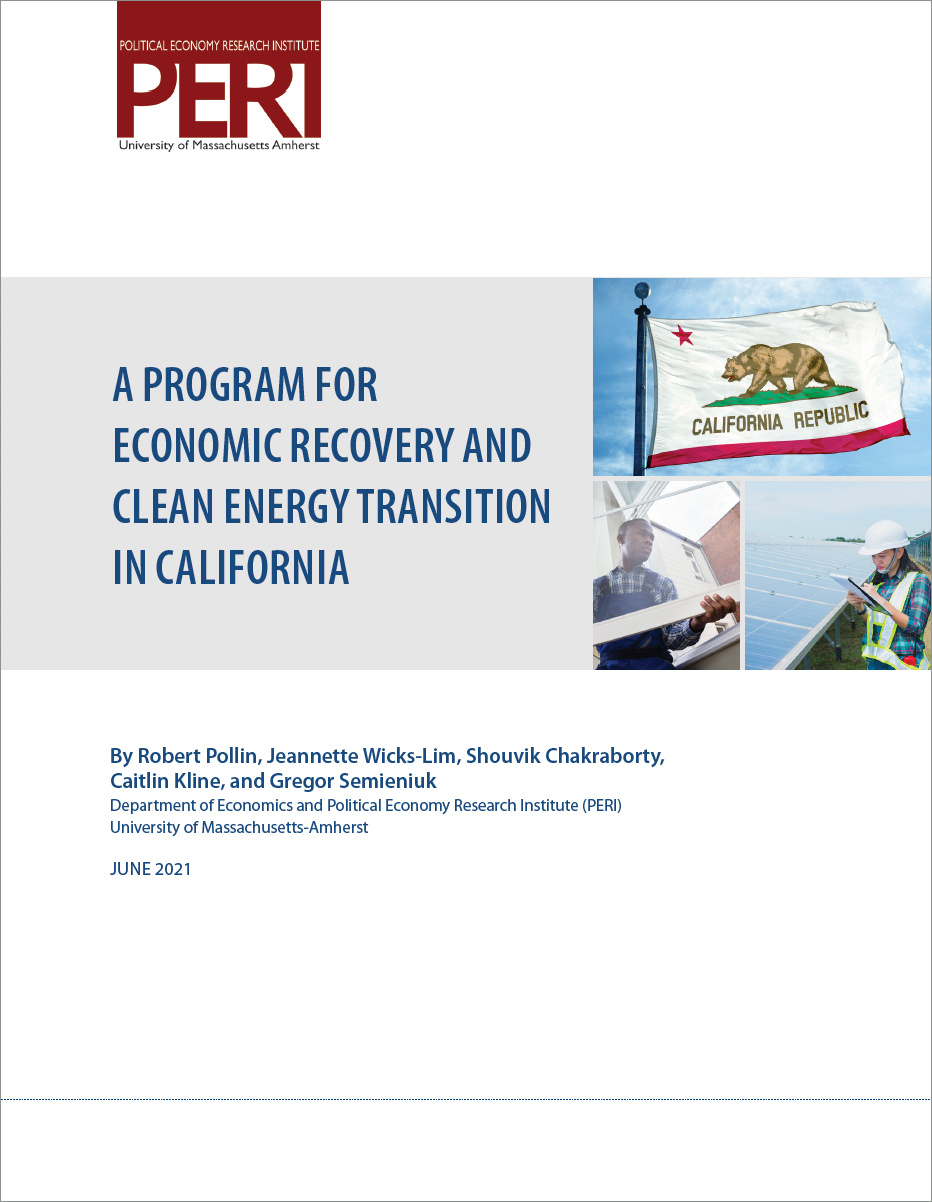
A Program for Economic Recovery and Clean Energy Transition in California

By Robert Pollin, Jeannette Wicks-Lim, Shouvik Chakraborty,Caitlin Kline, and Gregor Semieniuk - Department of Economics and Political Economy Research Institute (PERI); University of Massachusetts-Amherst, June 10, 2021

This study presents a robust climate stabilization project for California. It demonstrates that achieving the state’s official CO2 emissions reduction targets—a 50 percent emissions cut by 2030 and reaching zero emissions by 2045—is a realistic prospect. This climate stabilization project can also serve as a major engine of economic recovery and expanding economic opportunities throughout the state. This includes an increase of over 1 million jobs in the state through investment programs in energy efficiency, clean renewable energy, public infrastructure, land restoration and agriculture. The study also develops a detailed just transition program for workers and communities in California that are currently dependent on the state’s fossil fuel industries for their livelihoods. In particular, we focus here on condi­tions in Kern, Contra Costa, and Los Angeles counties.

The study is divided into nine sections:

  1. Pandemic, Economic Collapse, and Conditions for Recovery
  2. California’s Clean Energy Transition Project
  3. Clean Energy Investments and Job Creation
  4. Investment Programs for Manufacturing, Infrastructure, Land Restoration and Agri­culture
  5. Total Job Creation in California through Combined Investment Programs
  6. Contraction of California’s Fossil Fuel Industries and Just Transition for Fossil Fuel Workers
  7. County-level Job Creation, Job Displacement, and Just Transition
  8. Achieving a Zero Emissions California Economy by 2045
  9. Financing California’s Recovery and Sustainable Transition Programs

Nineteen labor unions throughout California have endorsed this study and its findings.

Read the text (PDF).

Election of Union Leader Who Called for COP26 to be Ditched ‘Not Ideal’, Say Campaigners

By Jocelyn Timperley - DeSmog, June 7, 2021

Pro-fracking union leader Gary Smith has accused politicians of “preaching about the need for a green jobs’ revolution” and said Glasgow’s hosting of the UN climate summit showed the UK had its “priorities all wrong”.

Green campaigners have expressed concern about the GMB union’s newly elected leader, who has called for Glasgow to ditch the upcoming COP26 climate summit and enthusiastically backed fracking.

Gary Smith was previously Secretary of GMB’s Scotland branch but on Thursday was elected as the union’s new UK-wide General Secretary and Treasurer. GMB is the third largest union in the UK, with some 620,000 members covering work across a range of industry sectors, including oil and gas, aviation and manufacturing, as well as the public sector.

Smith, who won just over half of the 61,000 votes cast, has a history of outspoken comments about climate change and last year slammed the international UN climate conference now due to be held in Glasgow in November, saying “our priorities are all wrong”.

“The world’s political elite will fly in and out of Glasgow later in the year but the city’s many challenges will remain the day after the circus leaves town,” he said at the time. “The best thing government could do for Glasgow is to ditch hosting the COP and instead invest the money in dealing with the state of the city.”

Smith has been a long-time backer of fracking and fiercely criticised Labour for its support for a nationwide fracking ban, saying “Britain needs gas”. He has also been outspoken on the offshoring of manufacturing and fabrication work for the UK’s renewables industry. 

In the lead up to the election, climate activist Leo Murray said Smith’s election “would not bode well for prospects of GMB finally arriving in the 21st century with respect to the climate crisis”, calling Smith a “fracking cheerleader extraordinaire”.

Responding to news of the election, Alex Brent, GMB activist and co-founder of GMB for a Green New Deal, said Smith’s scepticism towards decarbonisation and often confrontational attitude towards climate activism is “obviously not ideal”.

However, he added, “ultimately it’s not him that needs convincing – it’s workers”, noting that GMB Union was “hardly leading the way in climate action before Gary Smith became general secretary”.

“GMB members, trade unionists and climate activists will continue to organise for climate action at the only level that matters – among their branches, in their workplaces, and in their local communities,” he said. “If Gary gets in the way of that organising, then that may prove to be a problem. Until then, the work continues.”

It’s time to nationalize Shell. Private oil companies are no longer fit for purpose

By Johanna Bozuwa and Olúfẹ́mi O. Táíwò - The Guardian, June 7, 2021

It has been a bad month for big oil. A Dutch court just ruled that Shell must cut its carbon pollution by 45% by 2030. The court’s decision has rightly been celebrated: it is a much more stringent requirement than the ineffective regulations imposed to date. Meanwhile, shareholders are waging rebellions at various oil giants – ExxonMobil shareholders won two seats on the board to pressure the oil company towards a greener strategy, and shareholders at Chevron and ConocoPhillips passed nonbinding resolutions pressuring the companies to disclose their lobbying efforts and emissions amounts.

Private oil and gas companies are finally up against the wall. Shell has promised to appeal the Dutch court decision, but oil prices went negative last year and put companies on bankruptcy notice, and last week the International Energy Agency said to stop digging. Politicians have floated the idea of oil and gas magnates becoming “carbon management companies” as a way for those companies to have a “future in a low-carbon world” while retaining control over oil, gas, and profit in a planet increasingly aware of and hostile to their emissions-generating activity.

But as far as the Dutch court’s ruling or the new bout of shareholder activism goes, neither go far enough. Nor should Shell be turned into a “carbon management company”. Like all private oil companies, Shell should not exist.

Oil and gas companies are a political structure: they possess private, authoritarian dominion over the pace and volume of oil and gas production, and thus of important determinants of global emissions. These emissions and their consequences do not respect any sort of public/private distinction, nor borders, nor the rights to clean air or clean water. For decades, private oil companies have intentionally and recklessly obscured their role in the destruction of countless local environments as well as their role in the global climate crisis.

Private oil companies have propped up an ever-failing business on a complex system of national and international government subsidies, all of which function to privatize the benefits of oil and gas production while socializing its financial, environmental, and social costs – making the public pay in tax dollars, human rights abuses, and an unlivable climate. Now that these companies fear being left behind by a changing political context, their public relations strategy is to insist to a public increasingly aware of the dire need to stop carbon emissions that there is still a place for private oil companies in a “green” world.

There is a role for the workers, their skills and knowledge, and the equipment and infrastructure of oil and gas companies. But there is no longer a role for companies or profit-seeking as an organizing principle of this aspect of human society – not if we want to continue to have human society...

Read the rest here.

Get Fossil Fuels Out of Our Pension, Say Environmental Protection Workers

By Saurav Sarkar - Labor Notes, June 3, 2021

Not long ago, workers at the Environmental Protection Agency were battling the Trump Administration’s many attempts to interfere with both their agency’s mission and their rights on the job.

Under Trump, the EPA reduced union officials’ official time, restricted the ability to bring grievances, and took away office, meeting, and storage space. Now, with most of those changes undone and the Trump era behind them, EPA workers have begun to work towards a different goal: divesting their federal retirement investment program—the world’s largest defined-contribution plan—from fossil fuel stocks.

“For EPA employees, this is something that is near and dear to our hearts,” said Nicole Cantello, an EPA lawyer and president of Government Employees (AFGE) Local 704.

EPA workers issue and enforce regulations, make grants, conduct research and education, and provide technical assistance for environmental cleanup. They’re probably more aware than most workers of the urgency of the climate crisis, given that they collect greenhouse gas data, regulate vehicle emissions, and educate the public about the issue.

Even limiting global warming to 1.5 degrees Celsius above pre-industrial levels—the goal of the 2015 Paris Climate Agreement—will result, according to a landmark 2018 U.N. report, in heat waves, more droughts, more intense hurricanes and flooding, a rise in sea levels, harm to ecosystems, lower food crop yields, deforestation, and other damaging consequences.

An increase of 2 degrees or more will have far more devastating effects.

So it’s no wonder EPA workers aren’t happy, about, as Cantello put it, “being forced to invest in instruments that have fossil fuels and [greenhouse gas] emissions that are attached them.”

Pages

The Fine Print I:

Disclaimer: The views expressed on this site are not the official position of the IWW (or even the IWW’s EUC) unless otherwise indicated and do not necessarily represent the views of anyone but the author’s, nor should it be assumed that any of these authors automatically support the IWW or endorse any of its positions.

Further: the inclusion of a link on our site (other than the link to the main IWW site) does not imply endorsement by or an alliance with the IWW. These sites have been chosen by our members due to their perceived relevance to the IWW EUC and are included here for informational purposes only. If you have any suggestions or comments on any of the links included (or not included) above, please contact us.

The Fine Print II:

Fair Use Notice: The material on this site is provided for educational and informational purposes. It may contain copyrighted material the use of which has not always been specifically authorized by the copyright owner. It is being made available in an effort to advance the understanding of scientific, environmental, economic, social justice and human rights issues etc.

It is believed that this constitutes a 'fair use' of any such copyrighted material as provided for in section 107 of the US Copyright Law. In accordance with Title 17 U.S.C. Section 107, the material on this site is distributed without profit to those who have an interest in using the included information for research and educational purposes. If you wish to use copyrighted material from this site for purposes of your own that go beyond 'fair use', you must obtain permission from the copyright owner. The information on this site does not constitute legal or technical advice.