You are here

green syndicalism

Prof. Ahmed White on the Industrial Workers of the World

A park for the people: Jack Mundey and the Eastlakes green ban

By Alison Wishart - Overland, June 23, 2022

On 13 August 2021, the Geographical Names Board officially approved Bayside Council’s request to rename Eastlakes Reserve as Jack Mundey Reserve. Mundey was neither a local resident, councillor nor mayor. Yet sixty years ago, he led a movement that saved these four acres of land as a park for the local people.

The reserve, situated within the centre of a new housing development christened ‘Eastlakes’ (a much more appealing name than ‘Botany Swamps’, as it was previously known) is used for recreation, exercise and community events. To understand how Mundey—a rugby player, labourer and communist who left school at the age of fourteen—came to be honoured in this way, we need to go back to 1961.

Jack Mundey Reserve was once part of the much larger Rosebery Racecourse. In 1961, Sydney Turf Club contracted L.J. Hooker Real Estate to sell the racecourse to the highest bidder. The sales brochure proclaimed that this 56.5 acre site was just ‘four miles from the heart of the city’; ‘perfectly cleared and level’ and ready for development. In characteristic sales hyperbole, the brochure confidently declared that ‘without a doubt, it was this century’s greatest opportunity for developers and investors.’

Despite the sales pitch, the land was passed in at auction on 26 September 1961. Sydney Turf Club negotiated with the highest bidder and signed a contract for Rosebery Development Corporation, a subsidiary of Parkes Development, to purchase the site for £450,000 (£75,000 below the reserve price). Six acres on the eastern and western edges of the racecourse were reserved for the Housing Commission of NSW and not included in the sale. Harry Seidler, the famous modernist architect, would design the housing commission unit block on Maloney Avenue.

On Inflation and Working Class Struggle

By anonymous - angryworkers.org, June 17, 2022

On Saturday 18th of June, (there was) a national TUC demo in London, and as part of the build up, we were invited to sit on a panel hosted by the People’s Assembly called ‘Wages Up, Bills Down, Tories Out’. We were joined by six other panelists from the RMT, Bristol Co-operative Alliance and the Tribune, Bristol Trades Council and the NEU, the TUC and PCS, the Green and Labour Councillors for Ashley Ward, and the Secretary for Unite South West, who chaired the meeting.

Below is the transcript of the input from one AngryWorkers comrade about the current crisis, followed by a report from a comrade on the meeting in general.

I work as a housekeeper at Southmead hospital and I am a GMB rep there. I previously worked for several years in warehouses and food factories. I can see every day how people who earn around the minimum wage are struggling more.

I think we’re in a crisis in more ways than one. It’s a cost of living crisis, yes. It’s also coinciding with a long-running crisis of working class organisation and militancy (e.g. the fact that NHS workers can’t even enforce an actual pay rise, despite all the public support and the fact that we slogged our guts out in the pandemic, says a lot). And it’s also a crisis of the system where there aren’t any obvious answers.

CNT-AIT muestra su rechazo frontal a la construcción de una gasolinera en el solar adyacente al IES Cantabria

By staff - CNT-AIT Enseñanza Cantabria, May 30, 2022

Loosely translated and summarized, this CNT branch is protyesting the establishment of a gas station for both class and ecological reasons:

Desde el sindicato CNT-AIT queremos mostrar nuestro mayor rechazo a la construcción de una gasolinera en la parcela colindante al IES Cantabria. Este rechazo se basa en las siguientes razones:

  • Peligrosidad asociada al tráfico: la gasolinera lleva consigo, lógicamente, un aumento del tráfico de vehículos, de arranques y detenciones, que aumentan las posibilidades de que se de una colisión o un atropello, asunto especialmente grave en el entorno de un centro educativo.
  • Peligrosidad asociada a los accidentes: la gasolinera es, en realidad, un depósito de combustible. Las posibilidades de que se pierda el control sobre ese combustible, por pequeñas que sean, hace necesario que estas instalaciones no se realicen en zonas urbanas, muchísimo menos cerca de edificios donde se hacinan adultos y jóvenes.
  • Peligrosidad asociada a la contaminación ambiental. La emisión de gases puede resultar problemática y empeorar afecciones respiratorias.

Desde el sindicato CNT-AIT creemos que estamos, de nuevo, ante una maraña burocrática en la que ninguna institución se hace responsable. Ni Ayuntamiento, ni Autonomía, ni Estado Central: y el peligro sigue ahí, para trabajadores y estudiantes, y la falta de responsabilidad no va a hacer que ese solucione el problema.

En otras ocasiones, en otras Autonomías, se ha conseguido evitar la construcción de gasolineras. Basten los siguientes ejemplos: Getafe en la Comunidad de Madrid (diciembre de 2020), Villaverde en la Comunidad de Madrid (diciembre de 2013), La Pelusa en Andalucía (octubre de 2021), Murcia en la comunidad homónima (enero de 2020) o Aravaca en la Comunidad de Madrid (1992).

Así las cosas, señalamos que:

  • La construcción de la gasolinera debe ser detenida, dado que las personas que más van a sufrir sus consecuencias (la comunidad educativa del IES Cantabria) así lo ha demandado públicamente.
  • Existen posibilidades reales y, si desde las instituciones públicas no se dan, entendemos que es falta de interés y voluntad y no incapacidad real.

Are Refinery Workers Climate Enemies? - Part 2

By That Green Union Guy - IWW Environmental Union Caucus, May 25, 2022

For context and background, see part one, here. Unlike the first installment, this second response has ommitted the comments that preciptated it, for the sake of clarity, as well as the fact that the author tried to echo the rebutted points in the response. It should be noted that only one individual has expressed outright opposition to showing solidarity with striking refinery workers. It's a foregone conclusion that the overwhelming majority of the IWW does not share this one individual's view.

First of all, let me be clear: my position is that humanity must collectively phase out burning fossil fuels for energy, transportation, and locomotion as rapidly as possible.

That said, nobody seriously believes we can collectively cease burning fossil fuels in a single day, so the likelihood is that the burning of them will continue for some time (I aim to make that as little time as possible).

Regardless of how long it takes, no oil refinery is going to simply shut down just because large masses of people, even 3.5% of the population demand it. It’s not even technically possible, let alone economically or politically possible. Most of the Environmental Justice and Climate Justice organizations (other than a few ultra-sectarian extremists) get this, and they’ve crafted their demands accordingly.

While there’s a degree of variation among the various organizing, most of them call for the following:

  1. No new extraction of new fossil fuel sources;
  2. Rapid phase out of existing fossil fuel sources;
  3. Managed decline of the existing fossil fuel supply chain;
  4. Just transition for any and all affected workers in the entire fossil fuel supply chain;
  5. Repurposing of equipment for non fossil fuel burning purposes;
  6. Bioremediation of damaged ecosystems across the extraction supply chain;
  7. Reparations for the affected communities and tribes.

Supporting refinery workers involved in a strike is not in any way contradictory to the above demands.

Climate Justice and Class Struggle: Online Screening Event

By staff - IWW Ireland, May 18, 2022

Climate Justice and Class Struggle: Scheduled Screening to take place HERE on

Tuesday May 24, 2022 @ 1800 hours GMT

Global May Day is a project for grassroots labour unions and initiatives supporting labour struggles to make our work more visible and support each other across borders.

This year we chose to draw attention to the ecological crisis we all face and tilted a series of events around Climate Justice and Class Struggle.

A crisis brought about by the endless search for profit margins by capitalist interests. A crisis which will see wars raging worldwide, making the poorest of us suffer the earliest and most.

The global ecological crisis is an issue for the working class worldwide and already there are many of us engaged in fighting against its impacts in our local areas.

This coming Tuesday May 24, 2022 we will host and online screening of a number on important environmental struggles currently taking place around the world. It is vital that each of these campaigns be highlighted and supported.

To take part in this online screening event as part of the Global May Day events, please tune in online HERE on Tuesday May 24, 2022 at the following time @ 1800hours GMT

To find out more about Global May Day 2022 reports, you can click on the following link HERE

#1World1Struggle

#globalmayday2022

Two enemies, one fight: climate disaster and frightful energy bills

By Simon Pirani - People and Nature, May 16, 2022

Two clouds darken the sky. A close-up one: gas and electricity bills have shot up since the Russian invasion of Ukraine, and millions of families are struggling to pay. And a bigger, darker, higher one: the climate disaster, and politicians’ refusal to tackle it.

Ultimately, both these threats have a single cause: fossil fuels and the systems of wealth and power that depend on them. We need social movements to link the fight to protect families from unaffordable bills with the fight to move beyond fossil fuels, and in that way turn back global warming.

Here I suggest ways to develop such a movement in the UK, starting by demanding action on home heating.

Are Refinery Workers Climate Enemies?

By an anonymous ex-member of the IWW (with a response by That Green Union Guy) - ecology.iww.org, April 28, 2022

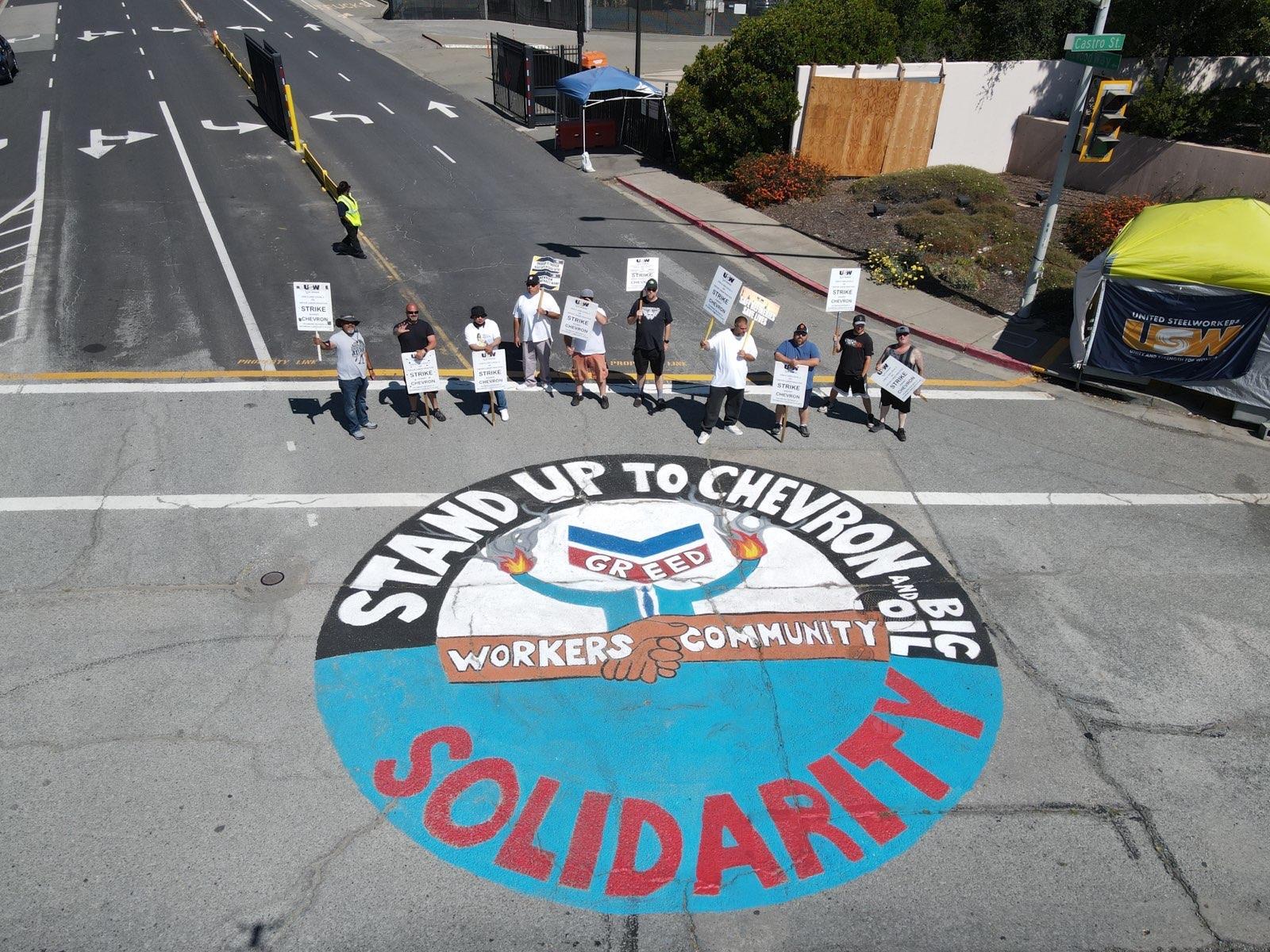
Editor's Note: Since Monday, March 21, 2022, the workers at the Chevron oil refinery in Richmond, California, members of the United Steelworkers Local 5 have been on strike and picketing the facility after voting down the company’s latest contract offer, which workers say contained insufficient wage increases and demanded cuts in union staffing that focused on health and safety in the refinery. The bosses have responded by bringing in scabs (including managers from other Chevron facilities). Meanwhile, USW Local 5 members have been picketing the refinery 24-7, and have been, at times, joined by members of the local BIPOC and/or environmental justice community. After IWW EUC cofounder and long-time Bay Area IWW General Membership Branch member, x344543, brought a call for solidarity with the striking workers to the April branch meeeting, a disgruntled member (who has since resigned from the organization), sent the following letter to the branch (name deleted for privacy reasons).

Message from a Disgruntled (former) Member:

I’m sorry to say how disappointed I am in the IWW. I’m a relatively new wobbly and although I believe in standing in solidarity with fellow workers it seems at some point lines must be drawn.

As I’ve read through these last emails about the USW Local 5 and the call to action for us to stand with them as they strike, many questions come to mind. The first one is what if fellow climate activists, many of whom are wobblies were to implement a protest blockade to stall production of this refinery in defense of the environment? I wonder if those refinery workers with whom we are picketing would come outside and join our protest line? I also wonder if they would be interested in the invitation to join the 2022 Global Climate Strike that you forwarded to us? In both cases I assume it is reasonable to conclude they would not.

As wobblies, where do we draw the line? What if oil pipeline workers go to strike for hazard pay because a tribal nation, whose land the pipeline is planned to cross blocks safe access to thier jobsite in protest of the poisoning of thier waterways? Would the IWW Environmental Caucus also put a call out to picket with those Union workers? We draw the line when it comes to police unions who’s membership is hellbent on beating and imprisoning people protesting civil injustices. Why are we supporting refinery workers? This makes no sense. Iunderstand that just about every industry is to some degree tainted with These workers primary job is to process and prepare for market the product that’s catapulted us into the current global warming apocalyptic meltdown!

Extinction Rebellion Trade Unionists: a Timely Initiative

By Rob Marsden - Red-Green Labour, April 19, 2022

The incredibly clumsy, tone deaf and downright offensive tweeting by the official Labour party twitter account of a link to The Sun attacking environmental protesters shows the absolute need to build much better grassroots links between the labour movement and activist environmental campaigns, writes Rob Marsden

Recently relaunched, Extinction Rebellion Trade Unionists exists to further such a dialogue.

Building on the success of self-organised groups such as XR Scientists and XR Doctors it aims to assist Extinction Rebellion in getting its key message across to workers whose jobs are in the direct line of the necessary rapid transition away from fossil fuels.

The founding ‘mandate’ of Extinction Rebellion Trade Unionists includes the following ideas:

  • Promote XR members to join a union.
  • Promote concerns about the climate crisis and XR within our trade unions and the trade union movement.
  • To ensure that the withdrawal from fossil fuels includes a just transition for workers.
  • Lobby for XR actions to include consultation, and link actions with trade unions,
  • To support trade union and workers strikes.
  • Promote strike action as an effective form of NVDA, in the fight for climate justice.

XR recently issued a statement in support of Fawley oil refinery workers:

“On the 8th April members of XR Trade Unionists will visit the workers on their picket line in order to show support and solidarity. The dots are being joined for us all in the current context, from the wars fuelled by fossil fuel money, the exacerbating inequalities in the cost of living crisis, and energy companies shamelessly making record profits from the plight of the ordinary person and leaving workers behind. It is now clear in the UK that we’re being ripped off, our future is being burned, sold, decimated and all the while companies and the government sit back and support corporate interest over people’s live and livelihoods. Enough of the lies, deceit and deadly political failure. Unite workers are taking disruptive nonviolent action just as we are, and we wish them luck in their endeavours.”

Green Unionism on the Chevron Richmond Refinery Workers Picket Line

By That Green Union Guy - IWW Environmental Union Caucus, April 15, 2022

Since Monday, March 21, 2022, the workers at the Chevron oil refinery in Richmond, California, members of the United Steelworkers Local 5 have been on strike and picketing the facility after voting down the company’s latest contract offer, which workers say contained insufficient wage increases. The bosses have responded by bringing in scabs (including managers from other Chevron facilities). The strike has gotten a good deal of media coverage:

However, the capitalist (and progressive) media have mostly missed some important details.

First of all, the striking refinery workers and their elected union leaders continue to emphasize that their issues extend beyond narrow bread and butter issues, such as wages and benefits. A major concern that they continue to articulate is that Chevron continues to try and cut unionized safety jobs and refuses to hire sufficient workers to safely and adequately staff the facility. Workers have complained of 12-hour days and six-day workweeks. All of these deficiencies not only risk the health and safety of the workers, but the surrounding, mostly BIPOC communities as well. Worse still, they have adverse environmental effects, a problem that hasn't been lost on the striking workers. As stated by USW Local 5 representative, B.K White:

“If we had more people and could get a better pay rate, maybe our members wouldn’t feel obligated to come in and work as many as 70 hours a week to make ends meet. We don’t believe that is safe. (that and the use of replacement workers) is at the detriment of the city of Richmond and the environment.”

Even less noticed by the media has been the presence of environmental justice activists (including, but not limited to, the Asian Pacific Environmental Network, Communities for a Better Environment, Extinction Rebellion, Fossil Free California, Richmond Progressive Alliance, Sierra Club, Sunflower Alliance, Sunrise Movement, and 350), various socialist organizations (including DSA in particular), and members from the nearby front-line BIPOC communities, who have joined the pickets in solidarity with the workers, something the workers have also not hesitated to point out. Indeed, in spite of the fact that many environmental justice activists and community members are harshly critical of Chevron's role in turning the city of Richmond into a capital blight infested sacrifice zone, they recognize that the workers are not their enemies nor are the latter responsible for the damage done by the company. On the contrary, many recognize that the unionized workforce is one of the best mitigations against far worse capital blight (it bears mentioning that there has also been a good deal of support and picket line presence from rank and file workers and union officials from many other unions, including the AFSCME, IBEW, IWW, ILWU, SEIU, UFCW, and the Contra Costa County Central Labor Council).

Such seemingly unlikely bonds of solidarity, though delicate and, at times, fragile didn't arise out of thin air, but, in fact, have resulted from years of painstaking grassroots organizing.

Pages

The Fine Print I:

Disclaimer: The views expressed on this site are not the official position of the IWW (or even the IWW’s EUC) unless otherwise indicated and do not necessarily represent the views of anyone but the author’s, nor should it be assumed that any of these authors automatically support the IWW or endorse any of its positions.

Further: the inclusion of a link on our site (other than the link to the main IWW site) does not imply endorsement by or an alliance with the IWW. These sites have been chosen by our members due to their perceived relevance to the IWW EUC and are included here for informational purposes only. If you have any suggestions or comments on any of the links included (or not included) above, please contact us.

The Fine Print II:

Fair Use Notice: The material on this site is provided for educational and informational purposes. It may contain copyrighted material the use of which has not always been specifically authorized by the copyright owner. It is being made available in an effort to advance the understanding of scientific, environmental, economic, social justice and human rights issues etc.

It is believed that this constitutes a 'fair use' of any such copyrighted material as provided for in section 107 of the US Copyright Law. In accordance with Title 17 U.S.C. Section 107, the material on this site is distributed without profit to those who have an interest in using the included information for research and educational purposes. If you wish to use copyrighted material from this site for purposes of your own that go beyond 'fair use', you must obtain permission from the copyright owner. The information on this site does not constitute legal or technical advice.