

You are here

green unionism

Taking the High Road: Strategies for a Fair EV Future

By staff - UAW Research Department, January 2020

The American automotive industry is constantly evolving and, throughout the union’s history, the United Auto Workers (UAW) has fought to ensure industry changes result in quality jobs that benefit workers and the economy.

The auto industry is facing a new shift in technology with the proliferation of electric vehicles (EVs). This shift is an opportunity to re-invest in U.S. manufacturing. But this opportunity will be lost if EVs or their components are imported or made by low-road suppliers who underpay workers. In order to preserve American jobs and work standards, what is needed is a proactive industrial policy that creates high-quality manufacturing jobs making EVs and their components.

Read the text (PDF).

Resisting RCEP from the ground up: Indian movements show the way

By staff - GRAIN & ICCFM, January 2020

In the history of people’s resistance against free trade agreements, 4 November 2019 is a day to remember. On this day, bowing to immense pressure from peasants, trade unions and rural communities, India’s central government decided to pull the plug on its participation in the Regional Comprehensive Economic Partnership (RCEP), intended to become the largest free trade area in the world. The announcement, made at the ASEAN summit in Bangkok, has implications for free trade negotiations in the entire region and puts a fork in the wheels of unifying the Asian market – a project clearly favouring the interests of agribusiness and transnational corporations.

While countries such as Japan, New Zealand and Australia are making every effort to convince India to come back to the negotiating table, whether they will succeed is not clear. For now, Delhi’s decision has provided immense relief to millions of small-scale food producers and rural workers in India.

So how did a government that is overtly neoliberal, capitalist and with visible authoritarian traits end up bowing to the pressure of farmers and workers? To understand that, we need to understand the decade that just went past us.

Read the report (PDF).

The Industrial Workers’ Climate Plan: A Great Green Charter

By various - Bristol IWW, 2019

An ecology movement that once seemed jaded is budding and blossoming beautifully. The fantastic efforts of the school strikes’ movement and groups like Extinction Rebellion, Earth Strike and the Green Anti-Capitalist Front have forced green issues back into mainstream public debate. This achievement has been marked by declarations that there is a ‘climate emergency’, first by the Welsh and Scottish governments and then, fittingly on 1st May, by the UK Parliament. A fortnight earlier, the University of Bristol had become the first UK university to declare a climate emergency. So successful have these campaigns been that there is now a broad consensus that something must be done. It is essential to build on this achievement and keep up the momentum. We urgently need to continue the conversation about what do to now.
Alongside the general strikes for climate action in September 2019, Earth Strike is therefore proposing that a Great Green Charter would be a powerful rallying document for the environmental crisis of the Twenty-First Century. The nineteenth-century movement called Chartism inspired the idea of a Great Green Charter. The Chartists drew up clear and agreed points which they pursued with a mix of political, economic and cultural approaches. Chartism became the largest reform movement of its time, taken up by thousands of ordinary people across the United Kingdom. The Chartists were successful, in as much as most of the points listed on ‘The People’s Charter’ were eventually attained, and even exceeded. While this was not within the years of Chartism, and achieved only after great struggle, the Chartists defined the terms of political reform for the decades to come.

Read the report (PDF).

Every challenge can be overcome: 6 ideas for getting started

By staff - LibCom, December 13, 2019

There is no time for hopelessness. Here are some ideas for what we can do – now – to fight back against the attacks we know are coming.

The results are in and it 's a solid majority for the most viciously right-wing Tory party in a generation. The time for a proper post-mortem will come, but right now we need to think what we – as a movement and individuals within that movement – do next.

There’s no need to go into great detail about what’s coming because we know: “points-based” migration, seizing travellers’ possessions, and a hard Brexit with their bonfire of rights and regulations are all right there in the manifesto.

And their plans for the NHS and (not) dealing with climate change are clear as day, no matter what they’ve put in the manifesto.

It’s clear, then, that as a class we will have to mobilise. Labour activists have put hundreds of thousands of activist hours – even millions, probably – into campaigning for a Corbyn government: canvassing, phone banking, travelling to marginals; not to mention the past four years of CLP meetings, arguing over deselections and reselections.

Whatever our differences over this use of time, money and energy (we were skeptical), the fact of the matter is this: we cannot spend the next five years like we’ve spent the last four.

When Corbyn became leader of the Labour Party, he and his supporters promised to build a “social movement”. That has, quite plainly, not materialised. Aside from the lack of movement infrastructure (unions, community organisations, etc), the most worrying evidence of this is that 2017 saw the lowest number of workers taking strike action since records began.

We cannot spend the next five years on internal Labour Party politicking in the hopes of possibly winning an election in 2025. The stakes over the next few years are too high. No politician is coming to save us from disaster; the task, as it always has been, is ours alone.

Bargaining Electric Power: Miners, Blackouts, and the Politics of Illumination in the United States, 1965-1979

By Trish Kahle - Journal of Energy History, December 12, 2019

This article examines how the perils conjured by blackouts in American cities after 1965 became interpreted as a key point of political and bargaining leverage for the nation’s coal miners. The anxieties provoked by these blackouts –sexual deviance, urban unrest, spoiled food, lost productivity, and Cold War incursions– pointed to a broader crisis of American political and social life driven by the massive social changes which had taken place since the end of the Second World War. As the United States entered the 1970s, a long-range energy crisis appeared not only to secure the future of the once-imperiled coal industry in the United States, but also allowed miners to recast their union as a bedrock of national security rather than as one of the main sources of the nation’s labor unrest.

Evoking the threat of coerced darkness in the modern American home which had been designed for bright illumination, they also pointed to the figurative darkness of the coal mining workscape, described by one miner as “beating the devil at a game of hell”: the constant threat of black lung, disablement, and death. A form of collective bargaining leverage thus opened up a broader debate: how, given the deadly work of coal extraction, could energy be produced in a democratic society that guaranteed the right to life, liberty, property, and, increasingly, light? Did “one man” have to “die every day” to keep the nation’s lights on? This paper argues that miners used the framework of lights and darknesses to contend that mines must be made safe and energy democratized in order to stabilize the energy regime in crisis. In so doing, they framed a new politics of illumination which allowed them to navigate a new terrain of collective action.

Read the text (PDF).

Tough Times Organizing Street Canvassers

By Gavin McAllister - Organizing Work, December 5, 2019

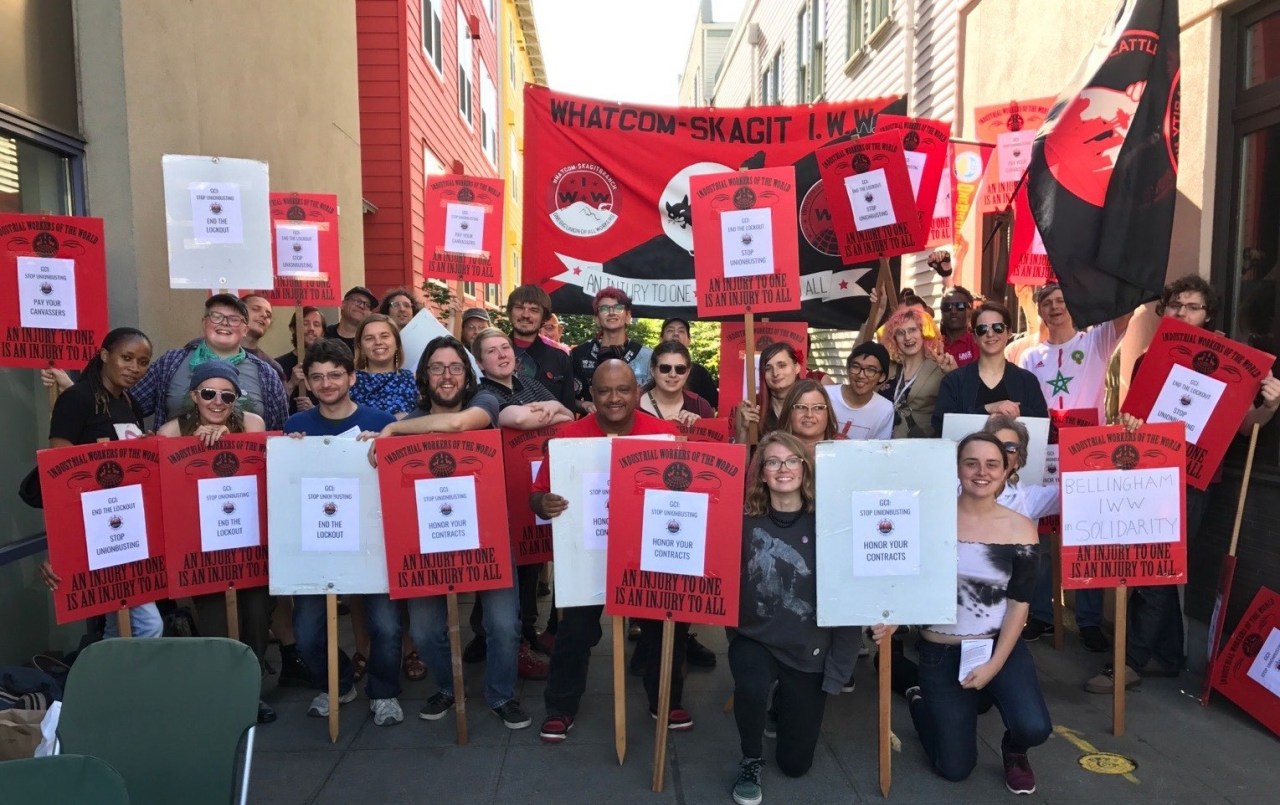
The Industrial Workers of the World (IWW) organized the Seattle office of Grassroots Campaigns, Inc. (GCI) from July 2017 to August 2018. GCI is a company neck-deep in the “nonprofit industrial complex”: it is a fundraising company that contracts with nonprofit organizations to provide high-volume small donor funds. Their business model consists of selling canvassing shifts to organizations such as the American Civil Liberties Union, the Southern Poverty Law Center, Planned Parenthood, and Doctors Without Borders. The worker’s job is to stand on a public street wearing the nonprofit’s uniform, flag down passersby, and try to convince them to donate to the nonprofit. GCI would then also collect the donor’s contact information and sell it to third party organizations, primarily the Democratic Party.

The union drive began when disgruntled workers approached the Seattle IWW General Membership Branch (GMB) in 2017. Through the course of the campaign, the union grew from a small committee to a wall-to-wall solidarity union. The drive ended on a difficult note when the employer closed the shop and fled the state in August 2018 to avoid having the union in the workplace. All 15 workers, including me, were laid off.

The campaign ultimately taught the Seattle IWW a few important lessons about the nuts and bolts of organizing in this type of workplace. We learned that it is absolutely possible to organize a fighting union at a small, high-turnover workplace. However, we underestimated how far the bosses would be willing to go to keep a union out, and we overestimated what the Labor Relations Board could do for us.

Amazon Abuses Workers and the Climate—Because It Can

By Sonali Kolhatkar - TruthDig, December 5, 2019

While online shoppers were busy taking advantage of bargain prices on Black Friday, retail workers in various European cities were walking off their jobs in anger. Hundreds of Amazon workers in six German cities protested, saying that their employer’s demands were making them ill. Similar protests were held by Amazon workers in France, aimed at the environmental cost of Black Friday, and in the U.K., members of the union GMB held signs saying pointedly, “We are not robots.” Here in the U.S., workers picked up on that theme as dozens gathered outside Amazon founder and CEO Jeff Bezos’ Manhattan apartment to insist that they are “human beings, not robots.”

A majority of American households are members of Amazon Prime. All we see with our eyes is the website that we make purchases on and the boxes that arrive on our doorstep a day or two later. Sometimes we may catch a glimpse of a delivery person rushing away to their truck to drop off the next package. But the worker protests that have plagued the company ought to deeply trouble us, as well as documented abuses in numerous recent studies and investigative reports.

As millions of Americans this holiday season have been doing, I too have been relying on the convenience of Amazon’s shopping experience to tick off the boxes on my list of gifts. In fact, I routinely count on it to meet the needs of my family. As a parent with a full-time job, I have barely 20 minutes of free time during the day to run errands, buy groceries, drive my kids to their extracurricular activities, and so on. When I see heavy rain in the forecast and realize with dismay that my child has outgrown his rain boots, it is far easier to order him the right pair of boots on Amazon in minutes than spend more than an hour driving to and from a store that may or may not have the size and price I’m looking for.

Online shopping has been a boon, especially for working mothers like me. I will admit, I have often thought of my reliance on the convenient online shopping experience as “self-care,” to use the parlance of the modern wellness movement. But each click confirming a purchase comes with a heavy bout of guilt, knowing what I know about how the workers who fulfill my order are treated.

WTO Shutdown: A Few Things From the WTO Shutdown I Carry Into the Future

By David Solnit - Common Dreams, December 4, 2019

WTO Shutdown 20-Year Anniversary Series: The Shutdown WTO Organizers History Project and Common Dreams have produced this series of ten people's history accounts and forward-looking lessons from organizers who were in the streets of Seattle in 1999—at the very end of last century. Articles in the series—including archival photos and videos—will be published over ten days to commemorate and reflect on the events that happened 20 years ago this month. Read all the articles in the series here.


“…two projects of globalization are in dispute. The one from above globalizes conformity, cynicism, stupidity, war, destruction, death and amnesia. And the one from below globalizes rebellion, hope, creativity, intelligence, imagination, life, memory and building a world where many worlds fit.”

-Subcomandante Marcos, during the 2003 WTO Ministerial in Cancun, Mexico 

I just spent a good few days with old and new friends in Seattle, reflecting back 20 years since we all shutdown the WTO, and looking forward in this moment of global uprising against economic and political injustice.  Over the fall I reconnected with a few other core organizers from the Direct Action Network—the network of local groups that organized the shutdown of the WTO 20 years ago. We put together the Shutdown WTO Organizers History Project and did some writing, talking and thinking together. 

Here are a few things about the organizing we did that seem important and I carry with  me as I organize into the coming 20 years:

  • 1) Globalization from Below  
  • 2)  Jail Solidarity
  • 3) Grassroots (vs Nonprofit) Leadership  
  • 4) Effective Mass Action Requires Organizing and Strategy. 
  • 5) Indymedia: Interrupting the Corporate Media Narrative
  • 6) Art is a Hammer

1) GLOBALIZATION FROM BELOW

We were “globalizing from below”-- connected to, working with and mutually aiding movements across the globe. When we shut down the WTO in Seattle, movements on every continent were taking action with us, and when hundreds were in jail for five days, solidarity actions took place from Mexico to India.  On Nov 30, 1999 in India thousands of farmers in Karnataka marched to Bangalore and over a thousand villagers from Anja (Narmada Valley) held a procession. Thousands took to the streets in the Philippines, Pakistan, France, UK, Portugal, across Europe, the United States and Canada. In 80 different French cities, 75,000 people took to the streets and 800 miners clashed with police.

We were part of the People’s Global Action network, which came out of a series of Zapatista-initiated “Encuentro"gatherings.  We used the phrase, “Our resistance will be as transnational as capital.” 

Blueprint for Europe's Just Transition: The Green New Deal for Europe (Edition II)

By various - The Green New Deal for Europe, December 2019

Europe today confronts three overlapping crises.

The first is an economic crisis, with rising levels of poverty, insecurity, and homelessness across the continent. The second is a climate and environmental crisis, with severe consequences for Europe’s front-line communities and even more perilous ones on the horizon. And the third is a crisis of democracy. Across the continent, people are disconnected from the locus of political decision-making not only in Brussels, but also in the communities where they reside.

These crises are products of Europe’s political decisions, and they are closely bound together. The promotion of extractive growth has driven environmental breakdown, and the devotion to budget austerity — over and above the democratic needs expressed in communities across Europe — has constrained our capacity to respond to it.

A radically new approach is necessary to reverse this destructive trend — and to deliver environmental justice in Europe and around the world. We call this approach the Green New Deal for Europe, and the following report is a comprehensive policy pack-age charting a course through Europe’s just transition.

Read the report (PDF).

No Worker Left Behind: Protecting Workers and Communities in the Green New Deal

By Jeremy Brecher - Labor Network for Sustainability, December 2019

The Green New Deal Resolution submitted by Rep. Alexandria Ocasio-Cortez and Senator Ed Markey, while it includes many protections and benefits for workers, does not include language that specifically addresses workers who might be adversely affected by the transition to a climate-safe economy. Such GND proposals were soon criticized as too vague to provide protections that workers and unions could count on. AFL-CIO president Richard Trumka, for example, told the Economic Club of Washington, DC, "We would want a whole lot of changes made so that workers and our jobs are protected in the process."

There are now several GND plans proposed by political figures, including Democratic presidential candidates, that spell out how protections for workers might be implemented. There are also a variety of GND proposals from individuals and groups that further spell out such protections.

In this briefing paper we lay out the basic elements that have been proposed to protect the well-being of workers and communities who may be adversely affected by aspects of the GND and the transition to a climate-safe economy. We summarize how each of the plans would go about protecting workers and communities whose jobs may be threatened. In the Appendix we provide partial texts from which these summaries are extracted.

The purpose of this compendium is not to evaluate which candidate or other proponent has the best plan. Rather, the purpose is to present the various strategies and programs from which future shapers of the GND can select and combine to forge the best possible program.

Read the report (PDF).

Pages

The Fine Print I:

Disclaimer: The views expressed on this site are not the official position of the IWW (or even the IWW’s EUC) unless otherwise indicated and do not necessarily represent the views of anyone but the author’s, nor should it be assumed that any of these authors automatically support the IWW or endorse any of its positions.

Further: the inclusion of a link on our site (other than the link to the main IWW site) does not imply endorsement by or an alliance with the IWW. These sites have been chosen by our members due to their perceived relevance to the IWW EUC and are included here for informational purposes only. If you have any suggestions or comments on any of the links included (or not included) above, please contact us.

The Fine Print II:

Fair Use Notice: The material on this site is provided for educational and informational purposes. It may contain copyrighted material the use of which has not always been specifically authorized by the copyright owner. It is being made available in an effort to advance the understanding of scientific, environmental, economic, social justice and human rights issues etc.

It is believed that this constitutes a 'fair use' of any such copyrighted material as provided for in section 107 of the US Copyright Law. In accordance with Title 17 U.S.C. Section 107, the material on this site is distributed without profit to those who have an interest in using the included information for research and educational purposes. If you wish to use copyrighted material from this site for purposes of your own that go beyond 'fair use', you must obtain permission from the copyright owner. The information on this site does not constitute legal or technical advice.
