You are here

green unionism

(Working Paper #13) Transition in Trouble?: The Rise and Fall of "Community Energy" in Europe

By Sean Sweeney, John Treat and Irene HongPing Shen - Trade Unions for Energy Democracy, March 2020

This TUED Working Paper explores the current crisis of local, community, and cooperative energy. Our focus is Europe where these types of initiatives have made the most progress but now find themselves facing an uncertain future. In this paper we will explain what happened, and why. The goals of this paper are twofold.

The first goal is to draw a clear line of demarcation between the bold claims being made in the name of local and community energy, “energy citizenship,” and similar concepts on the one hand, and the cur-rent reality on the other—a reality that largely confines local energy initiatives to the margins of energy systems. In the case of Europe, the distance between the claims and the reality is vast, and it is widening.

Local and community energy has attracted a lot of support and enthusiasm from activists, and it is not hard to understand why this is the case. Efforts to advance community energy are frequently carried out in the name of a commitment to social justice, advancing equality, and empowering ordinary people to take a more active role in the transition to a low carbon future. Additionally, the activists and organizations undertaking such initiatives nearly always identify with a “values-driven” mission and aim to rise above considerations of personal gain or private profit.

For a period, it seemed that such initiatives were emerging everywhere across Europe. The growth of renewable energy and the proliferation of citizen and community ownership seemed to be in-separable from each other. Spurred on by falling costs of wind and solar technologies, a radical transition in energy ownership—and a shift in control away from large energy companies to small producers and consumers—seemed not only possible, but perhaps even imminent.

But recent policy changes in Europe have placed community energy into a pattern of decline. The removal of subsidies, particularly the Feed-in Tariff, and other incentives has led to a dramatic slow-down in local energy initiatives and cooperatives. The number of households installing solar photovoltaic panels (solar PV) has slowed to a crawl as onshore wind projects have also declined. While offshore wind installations are increasing, the total level of investment and deployment of renew-able energy in Europe has fallen dramatically.

Read the report (PDF).

In Coronavirus Fight, Workers Are Forging an Emergency Green New Deal

By Jeremy Brecher - Labor Network for Sustainability, March 2020

This is the first of a series of commentaries on the Green New Deal. It argues that in the face of government and employer failure, workers and communities must take the lead to protect ourselves and each other from the coronavirus and its economic and social impacts. It proposes an emergency program to do just that. Funny – it looks a whole lot like a do-it-yourself Green New Deal.

The coronavirus pandemic threatens all of us. People are scared, and rightly so. But when we look to our government officials and employers, whose responsibility it is to provide protection in an emergency, what do we find? In the words of the National Nurses United – a union whose members are risking their lives every day on the frontlines of the coronavirus pandemic — “Federal, state, local, and employer efforts to fight the coronavirus” are “outrageous” and “ineffective.”

At least until those in authority get their act together, we need to start protecting ourselves and each other – not only as individuals, but collectively. Call it a “do-it-yourself Green New Deal.”

The core idea of the Green New Deal is to put people to work meeting our needs. So far the GND has been aimed primarily at challenging climate destruction and inequality. But our most urgent need right now is to protect against COVID-19 and the devastating impacts it will have on our communities and our jobs. The government isn’t doing it. Our employers aren’t doing it. So, if it is going to be done the people have to do it ourselves. We can take the core idea of the GND and start applying it right now. That means an “Emergency People’s Green New Deal.”

Let’s start by looking at the emergency needs that have to be met. Then we can look at the human resources we have to meet them. Finally, we’ll look at the social and political process we need to make it happen.

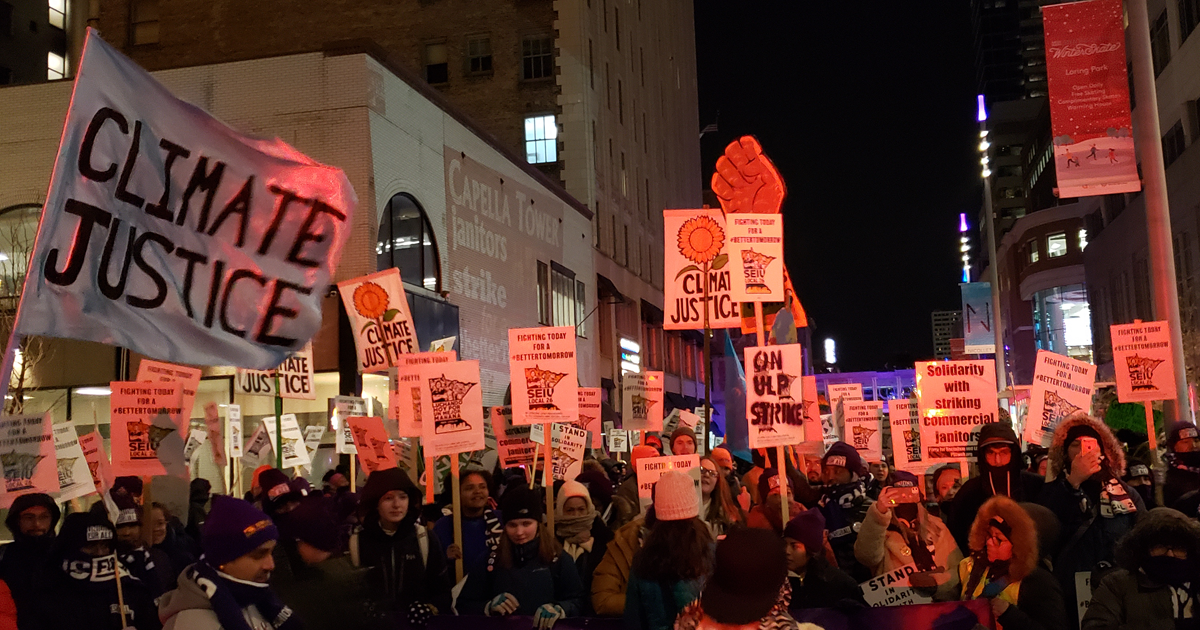
Twin Cities Janitors and Guards Feature Climate and Housing in Their Strike Demands

By Steve Payne - Labor Notes, February 20, 2020; images by SEIU Local 26

“Twin Cities janitors and security officers vote to authorize strike over pay and sick leave,” read the headline in the Minneapolis Star Tribune.

It’s true that those are among the workers’ top demands. But Service Employees (SEIU) Local 26’s fight is also for something bigger: affordable homes and a healthy planet for us all.

The union is demanding that companies negotiate over climate emissions and pay more to support affordable housing.

On February 8, 500 janitors, security officers, and their allies crowded into a warehouse space normally used for photo shoots. Banners lined the walls as people waved signs.

Local 26 has lined up every single one of its contracts, covering 8,000 workers, for this moment. Commercial office janitors, retail janitors, security officers, window cleaners, and airport workers are all fighting simultaneously.

The room was a rainbow coalition of immigrants from all over the world and people from every race and religion in the state. The union provided simultaneous interpretation into Spanish, Somali, Vietnamese, Amharic, and Nepalese. Chants in multiple languages filled the air.

Supporters from other unions and the city’s regional labor federation were there, along with a more unusual set of allies—representatives of the state’s environmental movement, including MN350 and young climate strikers.

The Future of Climate Strikes

By Jeremy Brecher - Labor Network for Sustainability, February 2020

This is the first in a series of commentaries on the Future of Climate Strikes. This introductory commentary asks whether strikes and forms of mass direct action “people power” might help halt climate destruction and bring about a Green New Deal. For the entire Future of Climate Strike series see here.

During the week of September 20, 2019 more than seven million people around the world participated in what was dubbed a global climate strike. They held more than six thousand events in 185 countries.[1] Weekly school strikes initiated by students had burgeoned within a few months into a global movement. The young people who initiated the movement vowed to continue their weekly protests and to build up to an even more disruptive week of global climate strike during the week of Earth Day 2020.

The logic underlying the climate strike movement was summed up by its founder Greta Thunburg: “Some say that we should not engage in activism, instead we should leave everything to our politicians and just vote for change instead,” she said. “But what do we do when there is no political will? What do we do when the politics needed are nowhere in sight?”[2] Her answer was a strike that would disrupt “business as usual” around the world.

Meanwhile, mass strikes and nonviolent mass uprisings around the world have been demonstrating how ordinary people can make history by intervening in business as usual. Just in the past year, Puerto Ricans held a general strike and a million of them – about one in three Puerto Ricans – occupied the capitol San Juan, forcing the government’s highest official to resign.[3] In Sudan, a two-day general strike and street protests led to the ouster of the president. In Brazil, 45 million workers took part in a general strike to protect worker rights.[4] Massive confrontations in Hong Kong, featuring a general strike, continued month after month. India saw the largest general strike in the history of the world, with 150-200 million participants.[5] In Chile demonstrations against a subway fare hike eventually brought four million people to the streets to reject the country’s 20-year experiment with extreme neoliberalism and call for a new, more democratic constitution. Millions participated in general strikes and large street protests in Algeria, Egypt, Iran, Iraq, Lebanon, Ecuador, Indonesia, Italy, France, UK, Catalonia, and the Czech Republic.[6]

Could some similar kind of mass strike and popular nonviolent uprising create the political will for climate protection and break the power of the forces that are promoting climate destruction? As the world hurtles into climate catastrophe, such a possibility has begun to take hold on the imagination of those around the world who would not sit by and see the basis for human life on earth destroyed. Groups like the student strike organizations, the Sunrise Movement, and Extinction Rebellion have called for strikes and mass direct action to implement climate protection and a Green New Deal. Sunrise Organizing Director Dyanna Jaye recently wrote,

The only way to get the political establishment to make the Green New Deal a priority in 2021 and beyond is by disrupting business as usual. Young people around the world have already been doing this with the #ClimateStrike movement. This year, we’re going to turn up the heat, starting with massive strikes on Earth Day to make sure that the Green New Deal is THE story for 2020 as we head into the elections.

Know the Union: Steve Ongerth

By Editorial Collective - Industrial Worker, Fall 2019; IWW leaflet hand drawn by Judi Bari, October 1989.

How would you like your name printed? (Options include first and last, first and last initial, first, X-number, etc. It’s completely up to you)

Steve Ongerth

What are your pronouns?

He/Him

What branch or local are you affiliated with?

Bay Area IWW GMB

Do you hold a local or national office? If so, what is it?

No

Why did you join the IWW?

I was inspired to join by reading the work of Judi Bari (“Timber Wars”) and greatly appreciating her green syndicalism (she was also an IWW member) in 1995.

Why have you stayed?

I believe in what the IWW stands for and its potential (in spite of its imperfections and limitations).

Is there a wobbly (current or historical) you most admire? 

Judi Bari (of course! And I actually was friends & comrades with her from the time I met her and joined the IWW in May 1995 until she passed away in 1997).

The revolution is over, the wage system is abolished, we installed whatever post-capitalist system you prefer. What are you doing Saturday?

Hiking in the woods or along the Bay (which hopefully isn’t drowning the SF Bay Area due to climate change and sea level rise)

What are you working on right now (union-wise)?

I am one of the cofounders of and active organizers of the IWW Environmental Unionism Caucus (I also maintain its webpage https://ecology.iww.org) I am also the Bay Area IWW Tabling Coordinator.

They killed themselves with greed: How a strike stopped privatization in DC’s Metro

By Ray Valentine - Organizing Work, December 29, 2019

Ray Valentine describes how a scheme to cut labor costs in the DC-area transit system through privatization backfired when workers at the private subcontractor went on strike.

On October 24, 120 bus operators, mechanics, and other workers represented by the Amalgamated Transit Union Local 689 walked off the job at the Cinder Bed Road MetroBus garage in Lorton, Virginia, launching the first strike to hit the Washington, DC metro area’s mass transit system in more than 40 years. The strike was unplanned and small — small enough that it won’t show up in the federal government’s tally of work stoppages — and after more than two months, workers are still out with no settlement in sight. But even though the issues that provoked the dispute have not been resolved, the fight has led to major changes that have strengthened the position of workers throughout the transit system.

The buses out of Cinder Bed drive routes that are part of the Washington Metro system and the workers wear Metro uniforms, but the garage is operated by Transdev, a French multinational. The garage was outsourced as part of a long-term plan by Metro management to cut costs by contracting out as many services as possible in order to drive down labor costs. The strike began as a fairly straightforward economic conflict over wages and benefits, and the union’s ambitions going into it were modest. But on December 13, the union and Metro reached a deal that would halt further privatization and even bring some services that have already been outsourced back in-house. 

The result is a rare win for labor, but it’s not entirely clear how it happened, even to the people who won it.

Union Members Support Coal Phase Out at Levin Terminal in Richmond

By Steve Morse, Martha Hawthorne, Jonathan Kocher, Jud Peake, and Steve Ongerth - Open Letter, January 2020

We are rank-and-file union members who support Richmond’s proposed ordinance to phase out coal and pet coke export from the city.

Others supportive of the ordinance who were present at the December 3rd meeting of the Richmond City Council, include members of unions representing nurses, educators,  and city and county workers. 

The Richmond City Council has been debating an ordinance to phase out coal and pet coke transport from the Levin Terminal over three years. It will finally come to a vote on Tuesday, January 14. We support this ordinance, and Richmond residents’ demands, because we support healthy, vibrant communities with clean air that are free from coal dust.

We also support good, well-paying jobs – union jobs – and the right to bargain collectively and organize for ourselves and our communities.  And we support full employment and a just transition for all workers displaced by the rapid transition away from fossil fuels toward clean and renewable energy that can protect us from climate disaster.

As union members, we call on other union members to oppose the fossil fuel corporations’ agenda -- which callously divides workers, community members and environmentalists -- so that we can’t effectively fight for our common interests and protect the health and safety of our families.

We ask all people to be fully part of the fight for protecting and expanding green union jobs. We all must work for a commitment to a just transition that goes beyond vague support.

We can have good jobs, healthy communities and environmental justice. With real unity, we can halt the power of the oil and coal industries to pollute our neighborhoods, and to pollute our planet.

The Green New Deal offers us a way forward. At the local, state and national level, it is our best strategy for jobs, community health and climate justice. A poll by Data for Progress shows that 62% of working union members favor a Green New Deal, while only 22% are in opposition. We want the collective voice of union workers to reflect this sentiment.

While just transition is a strategy to fully compensate and retrain workers displaced from the fossil fuel economy, the task at Levin Terminal is simpler. The workers can retain their jobs, their wages and benefits. They can retain their representation by the Operating Engineers and the other unions. By shifting terminal operations to handling materials that are compatible with community health and a sustainable world, their jobs can be sustained as well.

We commit ourselves to joining with community health and climate justice activists to create one or more viable fleshed-out plans to change the materials that are stored and shipped at the terminal.  At UC Berkeley alone, there are many resources, including the Labor Center, that could help hone this plan.

We ask Levin and the unions to commit to ongoing meetings with the Richmond community and to work in good faith to make this transition happen.  We also ask Levin to withdraw the threat that they made at the Dec. 3 City Council meeting that they would litigate if the ordinance passed. After all, this ordinance doesn't call for an immediate ban, and it includes an option to return to the council if replacement commodities genuinely cannot be found.

The Richmond City Council voted to push the vote on the ordinance to this Tuesday.  The clock is ticking, and the health and safety of the people here in our community is at stake. How much longer will workers and Richmond residents have to endure the worst air quality in the Bay Area?

Regenerative & Just 100% Policy Building Blocks Released by Experts from Impacted Communities

By Aiko Schaefer - 100% Network, January 21, 2020

The 100% Network launched a new effort to bring forward and coalesce the expertise from frontline communities into the Comprehensive Building Blocks for a Regenerative and Just 100% Policy. This groundbreaking and extensive document lays out the components of an 100% policy that centers equity and justice. Read the full report here.

Last year 100% Network members who are leading experts from and accountable to black, indigenous, people of color (BIPOC) and frontline communities embarked on a collective effort to detail the components of an ideal 100% policy. The creation of this 90-page document was an opportunity to bring the expertise of their communities together.

The Building Blocks document was designed primarily for frontline organizations looking to develop and implement their own local policies with a justice framework. Secondly, is to build alignment with environmental organizations and intermediary groups that are engaged in developing and advocating for 100% policies. The overall goals of the project are to:

  • Build the capacity of BIPOC frontline public policy advocates, so that impacted community groups who are leading, working to shape or just getting started on 100% policy discussions have information on what should be included to make a policy more equitable, inclusive and just
  • Align around frontline, community-led solutions and leadership, and create a shared analysis and understanding of what it will take to meet our vision for 100% just, equitable renewable energy.
  • Create a resource to help ensure equity-based policy components are both integrated and prioritized within renewable energy/energy efficiency policies. 
  • Build relationships across the movement between frontline, green, and intermediary organizations to create space for the discourse and trust-building necessary to move collaboration forward on 100% equitable, renewable energy policies. 

Climate Activists Can’t Afford to Ignore Labor. A Shuttered Refinery in Philly Shows Why

By Mindy Isser - In These Times, January 10, 2020

In the early morning hours of June 21, 2019, a catastrophic explosion tore through the Philadelphia Energy Solutions (PES) oil refinery in the southwest section of Philadelphia. The training and quick thinking of refinery workers, members of United Steelworkers Local 10-1, averted certain disaster and saved millions of lives. One month later, on July 21, PES declared bankruptcy—their second in as many years—and began to close down the refinery in the following months, laying off almost 2,000 people with no meaningful severance. According to workers who spoke with In These Times, the refinery stopped running crude oil in early August, although there are fewer than 100 workers who were kept on as caretakers for the waste water and steam generating units.

The fire on June 21 and the mass layoffs that followed impacted more than just the physical site of the refinery and the workers who made it run. It also ignited a debate throughout the city about what would become of the refinery site, which has been in operation for more than 150 years. On the one hand, the explosion underscored the dangers the refinery posed to the community immediately surrounding it, and the city as a whole. On the other, the subsequent closure of the refinery meant that workers were suddenly out of work, with no plan from PES or city officials of how to put them back to work.

This debate, while focused on Philadelphia, reflects much larger questions roiling supporters of a Green New Deal: how to ensure a just transition for fossil fuel workers who lose their jobs, and how to build bonds between unions looking out for their members, and climate organizers trying to stop fossil fuel extraction. Interviews with community organizers trying to curb the refinery’s toxic pollution, and workers laid off from the refinery, indicate that the answers are not easy, but require listening to workers, many of whom are already thinking about climate change—and forced, right now, to deal with the hardships of losing their jobs. In the words of Jim, a former worker who requested only his first name be used due to fear of retaliation, “Fossil fuels need to be phased out aggressively. That being said, I’m in the industry. You can’t just allow the people in that industry to become like the coal miners, just floundering.”

Pages

The Fine Print I:

Disclaimer: The views expressed on this site are not the official position of the IWW (or even the IWW’s EUC) unless otherwise indicated and do not necessarily represent the views of anyone but the author’s, nor should it be assumed that any of these authors automatically support the IWW or endorse any of its positions.

Further: the inclusion of a link on our site (other than the link to the main IWW site) does not imply endorsement by or an alliance with the IWW. These sites have been chosen by our members due to their perceived relevance to the IWW EUC and are included here for informational purposes only. If you have any suggestions or comments on any of the links included (or not included) above, please contact us.

The Fine Print II:

Fair Use Notice: The material on this site is provided for educational and informational purposes. It may contain copyrighted material the use of which has not always been specifically authorized by the copyright owner. It is being made available in an effort to advance the understanding of scientific, environmental, economic, social justice and human rights issues etc.

It is believed that this constitutes a 'fair use' of any such copyrighted material as provided for in section 107 of the US Copyright Law. In accordance with Title 17 U.S.C. Section 107, the material on this site is distributed without profit to those who have an interest in using the included information for research and educational purposes. If you wish to use copyrighted material from this site for purposes of your own that go beyond 'fair use', you must obtain permission from the copyright owner. The information on this site does not constitute legal or technical advice.