You are here

jobs

Capital Blight: It's Past Time to Get Off the Coal Train.

By That Green Union Guy - April 24, 2013

Disclaimer: The views expressed here are not the official position of the IWW (or even the IWW’s EUC) and do not necessarily represent the views of anyone but the author’s.

A recent debate took place on my personal Facebook page regarding the matter of jobs and the environment, and there is little doubt that it will not be the last.

As you may (or may not) be aware, I have been combing various environmental and labor news sources for stories about campaigns where class struggle and environmentalism have some degree of intersection (or conflict, though the latter is almost always manufactured vy the capitalist class). Most of these I have been posting on the new IWW Environmental Unionism Caucus Facebook Page, but since much of that happens while the only means of information transfer is a smart phone, so often, due to the limitations of smartphone apps, I have to engage in some klunky work-arounds, and sometimes that means that certain bits of information wind up on my personal page first, but I digress...

Last week, I happened upon a statement from a BLET engineer downplaying the dangers of coal dust drifting from coal trains passing through the southern part of the Seattle metropolitan area, and I immediately regarded this as the thoughts of a scissorbill and I said as much. That statement drew a response from another individual, a Facebook "friend" (a former Wobbly turned low-level ILWU leader, by the way), telling me that the coal dust issue was overstated, that the Sierra Club--who was leading the opposition to coal trains there--was hypocritical (due to the latter's having accepted donations from capitalist Natural Gas interests), and that I was insufficiently "solidaric" with my (business) union brothers and sisters. He informed me that the Sierra Club was only canvassing well-to-do neighborhoods in the area and completely ignoring those working class neighborhoods closest to the potential route, which--by the way--had far more immediate and far more serious environmental issues.

Since I am a transportation worker by trade (I'm a ferryboat deckhand, iu510 you know), I figured I might have fired before aiming, so I decided to dig a little further (pun not intended) and see just what was up.

I needn't have held my fire.

The Kochs and Clean Energy Jobs

By staff - International Forum on Globalization, October 2012

This IFG Special Report, “The Kochs and Clean Energy Jobs,” documents spending by the world’s two biggest billionaires intent on dealing a deathblow to green energy jobs and a low-carbon future.

IFG’s report reveals that the Kochs are today’s single largest funder of anti-environment and anti-worker activities, including:At least $643M in spending to block or rollback legal protections for the clean air, clean energy, clean water, and other environmental issues through sketchy scientific research, lobbying lawmakers, contributing to electoral candidates’ campaigns, media manipulation etc.At least $12M in spending to weaken the labor movement’s power through attacking collective bargaining rights, weakening worker protections, and stopping the financing for labor unions’ political activities.

Read the report (PDF).

The Impact of Tar Sands Pipeline Spills on Employment and the Economy

By Lara Skinner and Sean Sweeney - Cornell University Global Labor Institute, March 2012
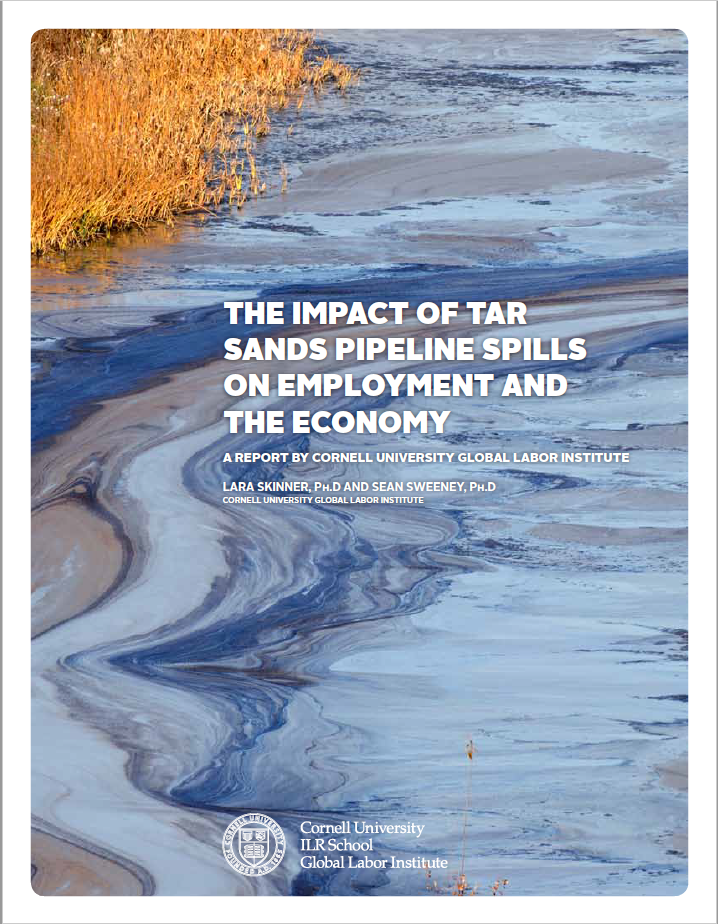
In debates over proposed tar sands pipelines such as the TransCanada corporation’s Keystone XL, little attention has been given to the potentially negative impacts of pipeline spills on employment and the economy. The proposed route for the 1,700-mile Keystone XL pipeline cuts through America’s agricultural heartland, where farming, ranching, and tourism are major employers and economic engines. Ground or surface water contamination from a tar sands oil spill in this region could inflict significant economic damage, causing workers to lose jobs, businesses to close, and residents to relocate. Such a spill could also negatively impact the health of residents and their communities.

A Closer Look at Keystone XL’s Threat to Existing Jobs and Economic Sectors:

» The negative impacts on employment and the economy of tar sands pipelines like the Keystone XL have largely been ignored. To date, a comprehensive risk assessment for the proposed Keystone XL pipeline oil spill has not been conducted. Such an assessment would provide an independent review of the risk of spills and their economic consequences. Since the first Keystone pipeline began operation in June 2010, at least 35 spills have occurred in the U.S. and Canada. In its first year, the spill frequency for Keystone’s U.S. segment was 100 times higher than TransCanada forecast.

» The Keystone XL pipeline would cut through America’s breadbasket. Agricultural land and rangeland comprise 79 percent of the land that would be affected by the proposed Keystone XL pipeline. It would cross more than 1,700 bodies of water, including the Missouri and Yellowstone rivers and the Ogallala and Carrizo-Wilcox aquifers. The Ogallala Aquifer alone supplies 30 percent of the groundwater used for irrigation in the U.S. It also supplies two million people with drinking water.

» Farming, ranching, and tourism are major sources of employment along the Keystone XL pipeline’s proposed route. Water contamination resulting from a Keystone XL spill, or the cumulative effect of spills over the lifetime of the pipeline, would have significant economic costs and could result in job loss in these sectors. Approximately 571,000 workers are directly employed in the agricultural sector in the six states along the Keystone XL corridor. Total agricultural output for these states is about $76 billion annually.

» Many of the land areas and bodies of water that Keystone XL will cross provide recreational opportunities vital to the tourism industry. Keystone XL would traverse 90.5 miles of recreation and special interest areas, including federal public lands, state
parks and forests, and national historic trails. About 780,000 workers are employed in the tourism sector in the states along the Keystone XL pipeline. Tourism spending in these states totaled more than $67 billion in 2009.

» Recent experience has demonstrated that tar sands spills pose additional dangers to the public and present special challenges in terms of clean up. There is strong evidence that tar sands pipeline spills occur more frequently than spills from pipelines carrying conventional crude oil because of the diluted bitumen’s toxic, corrosive, and heavy composition. Tar sands oil spills have the potential to be more damaging than conventional crude oil spills because they are more difficult and more costly to clean up, and because they have the potential to pose more serious health risks. Therefore both the frequency and particular nature of the spills have negative economic implications.

» The Kalamazoo River tar sands spill affected the health of hundreds of residents, displaced residents, hurt businesses, and caused a loss of jobs. The largest tar sands oil spill in the U.S. occurred on the Kalamazoo River in Michigan in 2010. This spill is the most expensive tar sands pipeline oil spill in U.S. history, with overall costs estimated at $725 million.

» The public debate around Keystone XL has focused almost exclusively on job creation from the project, yet existing jobs and economic sectors could suffer significantly from one or more spills from Keystone XL. According to the U.S. State Department, the six states along the pipeline route are expected to gain a total of 20 permanent pipeline operation jobs. Meanwhile, the agricultural and tourism sectors are already a major employer in these states. Potential job losses to these sectors resulting from one or more spills from Keystone XL could be considerable.

» Renewable energy provides a safer route to creating new jobs and a sustainable environment. The U.S. is leading the world in renewable energy investments, and employment in this sector has expanded in recent years. For every $1 million invested in renewable and clean energy, 16.7 jobs are created. By contrast, $1 million invested in fossil fuels generates 5.3 jobs.

Read the report (PDF).

Jobs Beyond Coal

By Jeremy Brecher - Labor Network for Sustainability, 2012

This manual is intended for anyone—communities, unions, environmentalists, native tribes, public officials, and others—involved with or affected by the retirement of coal-fired power plants. It is designed as a guide for those who wish to make the transition away from coal in a way that is most beneficial and least threatening to ordinary workers, consumers, and community members.

In the past decade, a broad-based campaign has formed to move America beyond coal and power the nation with clean energy. The movement includes people from all walks of life—medical professionals, faith leaders, environmentalists, business people, workers, decision makers, and local residents—who are working to address the serious pollution problems caused by coal and to seize the economic opportunity offered by clean, safe, renewable energy.

This campaign has been remarkably successful, preventing the construction of more than 165 new coal-fired power plants, and thereby keeping energy markets open for clean energy. In state after state, as newcoal proposals have stalled, advocates have launched campaigns to retire existing coal plants and replace them with clean energy, securing the retirement of more than 110 existing coal plants to date.The coal industry and their allies regularly claim that jobs, workers, and unions benefit from coal plants and that transitioning away from coal will harm them. Industry claims about creating or protecting jobs have often proved fallacious or hugely exaggerated. Still, this message resonates powerfully in tough economic times and presents a real challenge to coal retirement efforts.

Several recent campaigns have demonstrated that coal retirements can be structured in ways that take care of affected workers and the area economy, and even win the support of organized labor and local decision makers. As the case studies described in this manual show, addressing these economic challenges is most effective when the concerns of workers and the local economy are built into the campaign objectives, messaging, proposals, action, and interventions in policy arenas.

Read the report (PDF).

Are “Green” Jobs Decent?

By Lene Olsen, et. al. - International Labour Organization, 2012

This issue of the Journal focuses on the question of whether the jobs that are emerging in the efforts to reach sustainable development can be described as “decent”.

A series of case studies is presented which demonstrates that this seems to be far from the case. While these results remain very partial, this should be seen as an important reminder that “green” employment is not decent by definition and that like in any other sector, green jobs require careful stewardship from public authorities to ensure that workers are able to exercise their rights. This is all the more the case given the central role government policy plays in creating the enabling conditions for these industries to emerge and thrive.

Read the report (Link).

Towards a Greener Economy: The Social Dimensions

By International Institute for Labour Studies - International Labour Organization, November 16, 2011

The European Commission and the International Labour Organization have combined efforts in reaction to the deep crisis that hit the global economy in 2008. The aim of this joint project is to examine policies that will lead not only to a quicker recovery but also to a more sustainable, environmentally friendly and equitable global economy. This is particularly relevant given the uneven and fragile nature of the recovery process across and within countries. These efforts have culminated in the publication of two Synthesis Reports. The first report examines the origins of the crisis and provides an overview of immediate policy responses across both developed and developing economies; the second discusses green policies and labour market issues related to this necessary long-term economic transformation. Both reports are based on a series of technical discussion papers.

This second report aims to promote a clearer understanding of the nature of the green economy and its implications for labour markets, especially the reallocation of jobs from high- to low-polluting sectors. It shows that a double dividend in terms of increased decent work opportunities and a greener economy is possible, provided that complementarities between environmental, economic and social policies are adequately exploited. The report discusses the green policy measures that EU countries are currently undertaking, with a view to identifying any gaps in the policy mix. It also presents model estimates on the likely transmission mechanisms arising from these measures.

Read the report (Link).

Pipe dreams? Jobs Gained, Jobs Lost by the Construction of Keystone XL a report by Cornell University Global Labor Institute

By Ian Goodman and Brigid Rowan - Cornell University Global Labor Institute, September 2011

The purpose of this briefing paper is to examine claims made by TransCanada Corporation and the American Petroleum Institute that, if constructed, TransCanada’s proposed Keystone XL (KXL) pipeline will generate enough employment to kick-start important sections of the US economy through the creation of tens of thousands—perhaps even hundreds of thousands—of good, well-paying jobs for American workers.


This briefing paper raises a number of questions regarding the jobs claims promoted by the industry, questions that are serious enough to generate a high level of skepticism regarding the value of KXL as an important source of American jobs. With national unemployment levels presently (September 2011) around 9%, and the real unemployment figures considerably higher, jobs are desperately needed both to sustain families and to help the broader economy. However, it is our assessment—based on the publicly available data—that the construction of KXL will create far fewer jobs in the US than its proponents have claimed and may actually destroy more jobs than it generates.

The results presented below should also cast doubt on the recent claim made by American Petroleum Institute that the oil industry could create more than a million jobs over the next decade—if the US government would open public lands, beaches, oceans, to unlimited oil drilling. If the industry’s jobs estimates made in the context of KXL are any indication, then this broader claim should be scrutinized very carefully indeed.

Read the report (PDF).

Tar Sands: Rejecting False Conflict Between Trade Unions and Environment

By Joe Uehlein - Labor Network for Sustainability, August 23, 2011

Sometimes a decision forces you to think deeply about what you believe in and how you act on those beliefs. It was like that when the climate protection leader Bill McKibben asked me to sign a letter calling for civil disobedience to block the building of a pipeline designed to carry tar sands oil from Alberta to the Gulf of Mexico. Opposing the pipeline might strain ties with unions that I’ve worked with and been part of for my whole adult life. And yet the pipeline might be a tipping point that could hurtle us into ever more desperate acceleration of climate change.  Amid these conflicting pulls, what should I do? Having lived at the confluence of trade unionism and environmentalism, what’s the right course of action – what has my life’s work meant?

I was born into a union family. My dad worked in the steel mills in Lorain, Ohio and was a founder of the Steelworkers Union. My mom had been an organizer in the Clothing Workers Union in Cincinnati. I grew up near Cleveland and I walked the picket line with my dad during the 1959 steel strike.

My own trade union life began the day I walked through the factory doors at Capital Products Aluminum Corporation in Mechanicsburg, PA. I was 17 years old, and I joined the United Steelworkers of America. That summer I engaged in my first strike. The following year Hurricane Agnes pounded the mid-Atlantic states; Central Pennsylvania was devastated, and the mill was flooded out. So I joined the Laborer’s Union and went to work on construction.

That’s where I first learned something about working on pipelines. I worked building the Texas-Eastern pipeline as it wound its way through the rolling hills of Central Pennsylvania. Small teams of operating engineers, pipefitters, and laborers traveled across the state doing work we enjoyed and that we understood to be useful and important. (We didn’t know then what we know now.) It was a great job and I was a member of a great union, Laborer’s Local 158. We formed friendships and shared a solidarity that touched us all deeply.

On another job building a railroad bridge across the Susquehanna river, a buddy of mine got fired by a hubris-filled college kid. (The kid’s dad owned the construction company so the kid had been made chief foreman over all laborers.) We struck and shut the job down. The operating engineers, carpenters and ironworkers supported us. Without that support we would have lost, but we won and my brother laborer was hired back.

These jobs helped me pay my way through college. They also taught me a lot about solidarity and trade unionism, and helped launch me on a life-long pursuit of workers rights and jobs with justice, first as a local leader and eventually as an official with the AFL-CIO.

I grew up along the banks of Lake Erie and I learned at a tender age about the possibility of human threats to the environment. I was there when they posted the signs telling us to stop swimming in the lake and stop eating the fish. I’d already eaten hundreds of Lake Erie Yellow Perch and swallowed more of that lake water than I care to think about.

I also learned early about the potential conflict between protecting labor and protecting the environment. In the 1970s I worked on the concrete crew during the construction of the Three Mile Island nuclear plant, and my local union put out a bumper sticker that read “Hungry and Out of Work? Eat an Environmentalist.”

Since then I’ve devoted much of my life trying to bridge the gap between labor and environmental movements. I’ve argued that both share a common interest in combining economic and social sustainability with environmental sustainability. I’ve argued that “jobs vs. the environment” is a false choice.

Labor’s Route to a New Transportation System: How Federal Transportation Policy Can Create Good Jobs, First-Rate Mobility, and Environmentally Sustainable Communities

By staff - Cornell University Global Labor Institute, July 2011

Federal transportation policy is set every five to six years through the Surface Transportation Authorization Act. This policy largely shapes investment in our nation’s transportation system. Currently, only unions whose members are employed in the transport sector play a role in trying to influence federal transportation legislation, but the Reauthorization Act is hugely important to all union members and working people. The current legislation, Safe, Accountable, Flexible Efficient Transportation Equity Act: A Legacy for Users (SAFETEA -LU ) expires September 30, 2011. The reauthorization of federal transportation policy presents an important opportunity for union leaders and members to advocate for key policy reforms that will create good union jobs, defend and expand the role of the public sector in transportation, provide safe and affordable mobility to working families and reduce the transport sector’s contribution to air pollution and climate change.

The state of the U.S. transportation system determines working families’ access to affordable, high-quality mobility and, in turn, their ability to meet essential needs such as getting to work, school, medical services, recreation and more. The maintenance and operation of private vehicles consumes a growing portion of working families’ household budgets and puts owning and operating a vehicle completely out of reach for some. The impact of rising gas prices on working families’ mobility exacerbates the fact that only 50% of Americans have access to public transit. (need citation) Furthermore, in response to budget shortfalls, local governments have increased fares, laid off workers, reduced transit services and offered up public transit systems to privatization.

Read the text (PDF).

Coming Now to a Job Near You! Why Climate Change Matters for California Workers

By Jeremy Brecher, Brendan Smith, and Lisa Hoyos - Labor Network for Sustainability, September 2020

California is at the forefront of driving the expansion of the clean energy economy. California’s groundbreaking climate law, the Global Warming Solutions Act — AB 32 — is the most comprehensive climate legislation enacted anywhere in the US. But this law is at risk from political interests, backed by oil company resources, which are trying to overturn it.

AB 32 opponents are using a job-loss argument, creating a false divide between job creation and climate protection. They’ve done this is spite of the fact that green jobs have grown by 5% during a recessionary period where net jobs in our state fell. California already has 500,000 green jobs. We’ve got 12,000 clean energy businesses and we hold 40% of the US patents in solar, wind and advanced battery technology. Sixty percent of all clean energy venture capital is invested here (the runner-up state, Massachusetts, has 10%), with a large spike coming in the years after the passage of AB 32.

Climate change is a global problem. The AB 32 opponents who are working to stop the implementation of California’s climate law argue that our state shouldn’t try to address this problem on its own. However, California is the world’s eighth largest economy, and what we do here carries global significance, both politically and economically. We passed AB 32 in 2006. Four years later, at the national level, it is proving difficult or impossible to pass comprehensive climate policy. If California fails to build on our leadership in this arena, we will be playing into the hands of those, such as the US Chamber of Commerce, who are spending millions of dollars to thwart national action on climate change.

While the foot-dragging on climate protection continues at the national level, everyday’s news brings new evidence of the varied and devastating impacts of climate change happening around the world and within the borders of our own country.

Read the text (PDF).

Pages

The Fine Print I:

Disclaimer: The views expressed on this site are not the official position of the IWW (or even the IWW’s EUC) unless otherwise indicated and do not necessarily represent the views of anyone but the author’s, nor should it be assumed that any of these authors automatically support the IWW or endorse any of its positions.

Further: the inclusion of a link on our site (other than the link to the main IWW site) does not imply endorsement by or an alliance with the IWW. These sites have been chosen by our members due to their perceived relevance to the IWW EUC and are included here for informational purposes only. If you have any suggestions or comments on any of the links included (or not included) above, please contact us.

The Fine Print II:

Fair Use Notice: The material on this site is provided for educational and informational purposes. It may contain copyrighted material the use of which has not always been specifically authorized by the copyright owner. It is being made available in an effort to advance the understanding of scientific, environmental, economic, social justice and human rights issues etc.

It is believed that this constitutes a 'fair use' of any such copyrighted material as provided for in section 107 of the US Copyright Law. In accordance with Title 17 U.S.C. Section 107, the material on this site is distributed without profit to those who have an interest in using the included information for research and educational purposes. If you wish to use copyrighted material from this site for purposes of your own that go beyond 'fair use', you must obtain permission from the copyright owner. The information on this site does not constitute legal or technical advice.

