

You are here

green jobs

69% of Canada’s fossil fuel workers willing to move to clean energy jobs, says new poll

By Elizabeth Perry - Work and Climate Change Report, July 15, 2021

On July 14, Iron and Earth Canada released the results of online poll done on their behalf by Abacus Data , surveying 300 Canadians who currently work in the oil, gas, or coal sectors. The survey showed that 61% agreed with the statement: “Canada should pivot towards a net-zero emissions economy by 2050 to remain a competitive global economy”, and 69% answered “yes” to “Would you consider making a career switch to, or expanding your work involvement in, a job in the net-zero economy?”. The survey also measured workers’ interest in skills training and development for jobs in the net-zero economy, with 88% interested for themselves, and 80% supporting a National Upskilling Initiative . 

Although workers reported a high degree of optimism for the future (58% agreed that “ I will likely thrive in a Canadian economy that transitions to net-zero emissions by 2050”), workers also expressed their concerns – with 79% of workers under age 45 worried about reduced wages, and 77% of workers under 45 worried about losing their job. 44% of all workers would not consider taking a clean economy job if it resulted in a wage cut.

The full survey results are here , with breakdowns by age, sex, province, occupation, and Indigenous vs. Non-Indigenous. Articles summarizing the survey appeared in The National Observer, The Narwhal , and The Energy Mix.

On a related note: many younger people are not attracted to a future in the fossil fuel industry, as described in the recent CBC News article “University of Calgary hits pause on bachelor’s program in oil and gas engineering” (July 8), and “U of C sees ‘remarkable’ drop in undergrads focusing on oilpatch engineering and geology “ (Oct. 6 2020).

Climate response creates 10m jobs

By Brendan Montague - The Ecologist, July 7, 2021

Renewable energy projects already in the pipeline will create 625,000 jobs across the UK - potentially replacing 90 percent of the losses from the Covid-19 crisis, according to a new report commissioned by the European Climate Foundation.

A total of 13,000 projects identified globally are expected to create 10 million jobs across 47 different countries, with US$2 trillion of investment building one Terawatt of renewable generation capacity.

A spokesperson said: "In the UK, green energy offers enormous potential for sustained job creation and economic growth, especially in Northern England and Scotland."

The Shadow of the Mine: Coal and the End of Industrial Britain

By Laura Pidcock - Red Pepper, July 6, 2021

Imagine the mixture of pride and elation at getting a letter from the Durham Miners’ Association, asking you to speak at the annual Durham Miners’ Gala – the ‘Big Meeting’ I have been coming to year after year. Imagine getting up onto the huge stage and looking out over a sea of people, outlining the vision for working people under a socialist prime minister.

The Durham Miners’ Gala is where socialists go to politically replenish the soul for the fight ahead. It is simply the most electrifying experience in the British labour movement, steeped in working-class culture, tradition and, of course, struggle. The speech I delivered in July 2019 was partly about our confident preparations for government, and the changes a brand-new Ministry of Labour (that I would be heading) would bring. But it was also a message to activists to persevere under sustained attack. Just five months later, I found myself shaking the hand of the Tory MP, who had just taken my North West Durham seat by 1,144 votes.

In some ways, The Shadow of the Mine: Coal and the End of Industrial Britain, by Huw Beynon and Ray Hudson, is a story about that defeat, and many others Labour suffered in the 2019 election. But it is also about the long history, a serious piece of writing that assesses the political, cultural and social ramifications of deindustrialisation in South Wales and County Durham.

Both the 2016 European referendum and the 2019 Tory landslide are commonly analysed over too short a period of time to understand the real shifts in politics and community. Some constituencies elected their firstever Conservative MPs. These events seem like ‘shocks’. Beynon and Hudson’s book takes a longer view, which is both refreshing and necessary if we are to escape the stranglehold the right has on discourse and opinion.

It explains in loving, careful detail why working people’s relationship with Labour in former industrial communities – where ordinarily they would have had strong class identification with the party – had become complex and ultimately soured. South Wales and Durham are used as case studies to examine that dislocation, and what emerges is a rich, social history.

A Plan for Coal Workers as the Industry Declines

Job Creation for a Clean Jumpstart

By Amanda Novello - Data for Progress, July 2021

Government stimulus is sorely needed: more than a year into the pandemic recession, nearly 10 percent of Black workers are unemployed, and over 6 percent of all workers are unemployed. There are still more than 7 million fewer jobs than there were last June, and nearly 40% of all unemployed workers are long-term unemployed. A majority of those out of work have no college degree. In addition, there are 5 million fewer people in the labor force than pre-pandemic, including 3 million women who left the labor force since last February, and 2 million men.
Decarbonizing the economy in tandem with a full, job centered green recovery, will require many different plans to be executed at all levels of government and society. That’s why, this March, Data for Progress and Evergreen Action released the Clean Jumpstart 2021 report that offers 39 policy priorities for how to carry out our existing commitments, while increasing ambition and creating good jobs that Americans desperately need, in communities that need them most. All components of this plan are popular with likely voters. The Clean Jumpstart 2021 plan represents how a bold climate investment package, like the American Jobs Plan, could tackle the climate crisis and build a clean energy economy.

The Clean Jumpstart 2021 plan would invest a total of $2.3 trillion over four years. Some investments would create jobs more or less immediately, while others will take longer to realize full job-creation effects. Therefore, in this memo, we estimate that the plan would create an average of 2.7 million jobs annually for the first five years. But the job benefits of the plan don’t end there. The policies in Clean Jumpstart would also create up to 960,000 jobs annually for five years following (year 6-10 after investments begin). Approximately 40 percent of all jobs created would be “direct” jobs, or employment working directly toward these policy goals, and the rest would be due to additional work generated along supply chains and in communities due to the multiplied impacts of increased demand.

Read the text (PDF).

‘It’s virtually impossible’: Transition to renewables at risk as oil and gas workers struggle to access green jobs

By Daisy Dunne - The Independent., June 22, 2021

The UK’s transition away from fossil fuels to renewable power could be put at risk by barriers facing oil and gas workers looking to move into green jobs, campaigners say.

A survey of 600 offshore workers found that those looking to move from the fossil fuel industry into green jobs in renewable power currently face costly training fees, discouraging them from making the transition.

Workers responding to the poll said they are routinely forced to pay out thousands of pounds of their own cash for training courses when moving between one employer and another in the offshore sector, some of which they have already paid to take part in for their current positions.

One 42-year-old who has worked in the oil and gas sector for 20 years said the cost of training could be putting workers off trying to move into green jobs.

“People really need help to make the transition because it’s just virtually impossible to do it yourself with the way things are at the moment,” he told The Independent. None of the oil and gas workers interviewed wanted to provide their names, for fear of losing work.

He added he was hoping to see more opportunities in renewable power as the country transitions away from using fossil fuels.

“For me, it’s about moving forward in my career and about moving forward for the environment at the same time. I’ve got two young children and I can see the changes that are happening to the climate, it’s obvious to me.”

One 43-year-old who has worked in the sector for 24 years said that he would “love” to see more opportunities in renewable energy.

“I was one of the people living in a bubble thinking ‘that might not be quite right’ when it came to climate change. But it’s really my kids that brought it home to me,” he told The Independent.

Job growth in clean energy will more than offset fossil fuel losses

By Elizabeth Perry - Work and Climate Change Report, June 21, 2021

Clean Energy Canada released a new report on June 17, projecting that Canada’s clean energy sector will grow by almost 50% (over 200,000 jobs) by 2030, to reach 639,200 jobs. The report states that this will far exceed the 125,800 jobs expected to be lost in fossil fuels. Surprisingly, the province with the greatest increase in clean energy jobs will be Alberta – forecast to increase by 164% by 2030. As the introduction concludes: “Oil and gas may have dominated Canada’s energy past, but it’s Canada’s clean energy sector that will define its new reality.”

The New Reality report is the latest in the “Tracking the Energy Transition” series, updating the 2019 report. It is based on modelling by Navius Research – presented in a technical report here. Employment and GDP numbers are considered under two policy scenarios: the Pan-Canadian Framework for Clean Growth and Climate Change (the Liberal government’s previous policy) , and the Healthy Environment, Healthy Economy policy, unveiled in December 2020. The definition of “clean energy jobs” is broad, and forecasting breaks down into industry sectors – for example, stating that jobs in electric vehicle technology are on track to grow 39% per year, with 184,000 people set to be employed in the industry in 2030—a 26-fold increase over 2020. The report also highlights specific examples of the pioneering clean energy companies in Canada.

I Was Illegally Fired By Elon Musk For Trying to Unionize Tesla

By staff - More Perfect Union, June 16, 2021

Autoworker Richard Ortiz tried to organize a union at Tesla. Elon Musk's company responded by "coercively interrogating" him 3 times, then illegally firing him, federal investigators found. Ortiz is sharing his full story on camera for the first time.

More Perfect Union is a new nonprofit media org with a mission to empower working people.

Clean energy jobs as a transition destination

By Elizabeth Perry - Work and Climate Change Report, June 15, 2021

Released on June 3, Responding to Automation: Building a Cleaner Future is a new analysis by the Conference Board of Canada, in partnership with the Future Skills Centre. It investigates the potential for clean energy jobs as a career transition destination for workers at high risk of losing their jobs because of automation. The clean energy occupations were identified from three areas: clean energy production, energy efficiency , and environmental management and the “rapid growth” jobs identified range from wind turbine technicians and power-line installers to industrial engineers, sheet metal workers, and geospatial information scientists. Based on interviews with clean economy experts, as well as the interview responses from over five hundred workers across Canada, the analysis identifies the structural barriers holding employers and workers back from transition:

  • Lack of consistent financial support for workers to reskill
  • Employer hesitancy to hire inexperienced workers
  • Current demand for relevant occupations which makes change less attractive
  • Lack of awareness around potential transition opportunities
  • Personal relocation barriers, such as high living costs in new cities, and family commitments.

None of the recommended actions to overcome the barriers include a role for unions, with the burden for action falling largely on the individual employee. Only summary information is presented as a web document, but this research is part of a larger focus on automation, so it can be hoped that a fuller report will be published – if so, the partner group, Future Skills, maintains a Research website where it will likely be available.

Other news about renewable energy jobs:

“Renewable Energy Boom Unleashes a War Over Talent for Green Jobs” appeared in Bloomberg Green News (June 8), describing shortages of skilled workers in renewable energy, mainly in the U.S.. It also summarizes a U.K. report which forecasts a large need for workers in the U.K. offshore industry, which is expected to be met by people transferring from the oil and gas sector.

A report by the Global Wind Energy Council forecasts a growth of 3.3 million wind jobs worldwide by 2025, and suggests that offshore wind energy jobs could offer a natural transition for workers dislocated from offshore oil and gas and marine engineering workers. According to the analysis, in 2020, there were approximately 550,000 wind energy workers in China, 260,00 in Brazil, 115,000 in the US and 63,000 in India. A related report, The Global Wind Workforce Outlook 2021-2025 forecasts a large training gap: the global wind industry will need to train over 480,000 people in the next five years to construct, install, operate and maintain the world’s growing onshore and offshore wind fleet. That report is available for download here (registration required), and is summarized in this press release.

And forthcoming: Clean Energy Canada will release its research on the clean energy labour market in Canada on June 17. Their last jobs report, The Fast Lane: Tracking the Energy Revolution, was released in 2019.

Labor-Backed Report on Path to Equitable Green California

By Staff - Sunflower Alliance, June 10, 2021

Nineteen labor organizations—including unions representing refinery workers in Northern and Southern California and the Alameda Labor Council— have endorsed a detailed plan for an equitable transition to a clean-energy economy in California.

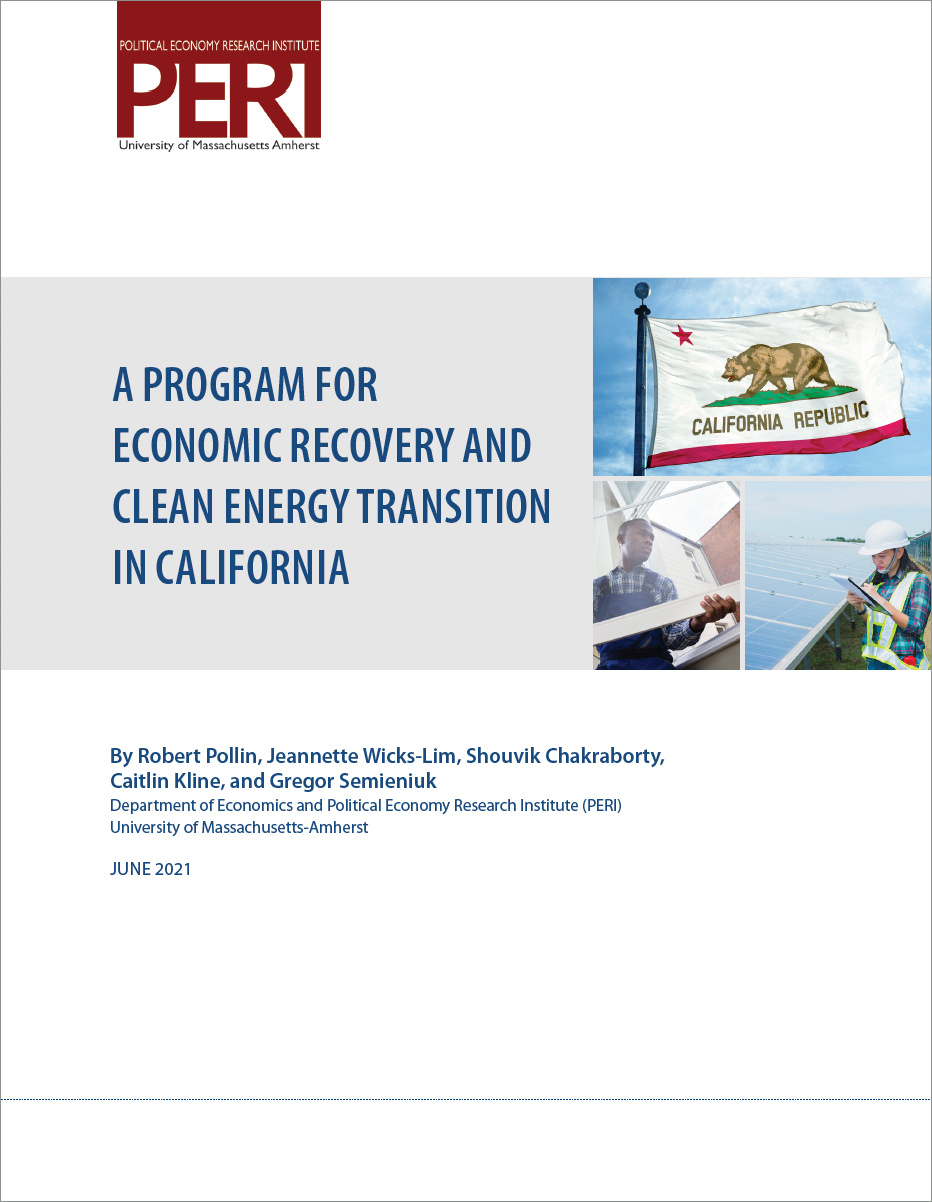
This major new report, A Program for Economic Recovery and Clean Energy Transition in California, details programs for meeting California’s 2030 climate goal (40 percent economy-wide reduction in greenhouse gas emissions from the state’s 1990 level) by creating roughly 418,000 jobs. It argues that state policy should ensure that the jobs created are good-paying jobs with full labor rights and access by historically excluded people.

The same strategies, the report says, could be continued to meet California’s longer-term goal of being carbon-neutral by 2045.

The report was commissioned by the American Federation of State, County and Municipal Employees Local 3299, the California Federation of Teachers, and the United Steelworkers Local 675. Its authors are faculty members of the University of Massachusetts at Amherst, including Robert Pollin, a leading expert on just transition.

The report provides detailed calculations for strategies outlined in an earlier report, Putting California on the High Road, from the UC Labor Center. Both reports emphasize the need for measures to protect fossil fuel industry workers including:

  • Pension guarantee for all workers.
  • Re-employment and income-level guarantees for all displaced workers.
  • Retraining and relocation support as needed.
  • “Glide-path income support” for workers 60 – 64.

The report comes as the Newsom administration is developing a report on Just Transition in California.

Pages

The Fine Print I:

Disclaimer: The views expressed on this site are not the official position of the IWW (or even the IWW’s EUC) unless otherwise indicated and do not necessarily represent the views of anyone but the author’s, nor should it be assumed that any of these authors automatically support the IWW or endorse any of its positions.

Further: the inclusion of a link on our site (other than the link to the main IWW site) does not imply endorsement by or an alliance with the IWW. These sites have been chosen by our members due to their perceived relevance to the IWW EUC and are included here for informational purposes only. If you have any suggestions or comments on any of the links included (or not included) above, please contact us.

The Fine Print II:

Fair Use Notice: The material on this site is provided for educational and informational purposes. It may contain copyrighted material the use of which has not always been specifically authorized by the copyright owner. It is being made available in an effort to advance the understanding of scientific, environmental, economic, social justice and human rights issues etc.

It is believed that this constitutes a 'fair use' of any such copyrighted material as provided for in section 107 of the US Copyright Law. In accordance with Title 17 U.S.C. Section 107, the material on this site is distributed without profit to those who have an interest in using the included information for research and educational purposes. If you wish to use copyrighted material from this site for purposes of your own that go beyond 'fair use', you must obtain permission from the copyright owner. The information on this site does not constitute legal or technical advice.
