You are here

Intergovernmental Panel on Climate Change (IPCC)

Plan, Mood, Battlefield - Reflections on the Green New Deal

By Thea Riofrancos - Viewpoint Magazine, May 16, 2019

Climate scientists are beginning to sound like radicals.

The 2018 IPCC report concluded that “unprecedented changes across all aspects of society” would be needed to limit warming to 1.5 degrees Celsius. In its devastating report on the dire state of the planet’s ecosystems, the UN’s panel on Biodiversity and Ecosystem Services likewise called for, in the words of its chairperson, “fundamental, system-wide reorganization across technological, economic and social factors, including paradigms, goals and values.”

The first, and thus far only, U.S. policy initiative that addresses the severity of the crisis before us is the Green New Deal, introduced as a congressional joint resolution this past February. The resolution proposes, among other goals, decarbonizing the economy, investing in infrastructure, and creating dignified jobs for millions. And while this resolution is, from a planetary perspective, obviously limited by its domestic scale, transforming the U.S. along these lines would surely have global reverberations, for at least two reasons: the U.S. is a major impediment to global coöperation on climate, and political parties elsewhere in the world (e.g., the UK’s Labour Party and Spain’s Socialist Party) have already begun to adopt the Green New Deal as the frame for their own domestic policies.

After a few months of swirling discourse, we can begin to identify an emergent set of positions in the debate around the Green New Deal. The right-wing has resorted to classic red-baiting, decrying the nonbinding resolution as a “socialist monster,” a road to the serfdom of state planning, rationing, and compulsory veganism. The vanishing center is clinging tightly to its cozy attachment to a politics of triangulation: the Green New Deal is a childlike dream; serious adults know that the only option is to hew to the path of bipartisanship and incrementalism. The left, of course, knows that in the context of already-unfolding climate crisis, resurgent xenophobia, and the weakening hold on legitimacy of the neoliberal consensus, the real delusions are “market-driven” solutions and nostalgic paeans to American “norms and institutions.”

But on the left, too, there are criticisms, and outright rejections, of the Green New Deal (see here, here, here, and here). There is the charge that the Green New Deal, like the old New Deal, amounts to the state, qua executive committee of the bourgeoisie, rescuing capitalism from the planetary crisis it has created. In this rendering, rather than empowering “frontline and vulnerable” communities, as the resolution claims, the policy framework will amount to a corporate welfare windfall of investment opportunities lubricated with tax breaks and subsidies; public-private partnerships; infrastructure outlays that will stimulate real estate development; and, a jobs guarantee that will stimulate consumption—a win-win for the state and capital, but, by leaving the underlying, growth-addicted, model of accumulation untouched, a loss for the planet and the communities most vulnerable to climate crisis and eco-apartheid. There’s another twist. As sometimes the same analyses point out, this win-win-lose-lose scenario is itself based on a false understanding of contemporary capitalism. In a world of secular stagnation—declining profit rates, speculative bubbles, financialization, rentier-like behavior, and accumulation-by-upward-redistribution—the vampire-like quality of capital has never been more apparent. The notion that capital might, with a little inducement, suddenly overcome these tendencies and invest in productive activities is its own nostalgic fantasy.

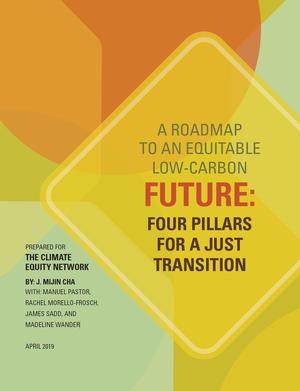
A Roadmap to an Equitable Low-Carbon Future: Four Pillars for a Just Transition

By J. Mijin Cha, JD, PhD - Climate Equity Network, April 2019

The signs that the climate crisis is already happening are clear. The most recent Intergovernmental Panel on Climate Change report detailed the evidence from more than 6,000 studies that found that over the past decade, a series of record-breaking storms, forest fires, droughts, coral bleaching, heat waves, and floods have taken place around the world in response to the 1.0 °C of global warming that has taken place since the pre-industrial era. These events, and the losses associated with them, are expected to become substantially worse with 1.5 °C of warming currently targeted by global climate agreements, and far worse if these agreements are not effective. Without major cuts in greenhouse gas (GHG) emissions, this warming threshold could be reached in as little as 11 years, and almost certainly within 20 years. Even if such cuts were to begin immediately, reaching this threshold would not be prevented, only delayed.
Any chance of staving off even worst impacts from climate change depends on significant reductions in GHG emissions and a move from a fossil fuel- based economy to a low-carbon economic future. While this transition is fundamentally necessary, the challenges it poses are great. Every aspect of our economy and our society is dependent upon fossil fuel use – from the reliance on electricity provided by fossil fuel power plants to the tax revenue local communities receive from fossil fuel extraction and facilities to the jobs held by those working in an industry that may keep their incomes high but often puts their communities at risk. The imprint of fossil fuels is so deeply embedded within our way of life that ceasing its use will require a fundamental shift in how we procure and use energy.

The good news is that this shift is possible—and California is already on a path to a low-carbon future. In addition to several ambitious climate targets, in September 2018, then-Governor Jerry Brown signed an executive order pledging the state to achieve carbon neutrality no later than 2045. As the world’s fifth largest economy, the commitment California made to reduce greenhouse gases can provide a pathway to a low-carbon future that could lay the groundwork for others to follow. But to get there, we need to aim even higher than California’s already ambitious goals.

Transitioning away from fossil fuels must be done more quickly and also in a manner that protects workers and communities economically dependent on the fossil fuel industry. Transitioning is also an opportunity to include those who have historically been excluded from the jobs and economic benefits of the extractive economy and expand the populations who have access to future jobs and economic opportunities. As we move to a low-carbon future, environmental justice communities should be prioritized for job creation and renewable energy generation. Without protecting displaced workers and expanding opportunities to other workers, transitioning to a low-carbon future will replicate the mistakes and inequalities of the extractive past and present.

Read the report (PDF).

Ecological Politics for the Working Class

By Matt T Huber - Catalyst, Spring 2019

The climate and ecological crisis is dire and there’s little time to address it. In just over a generation (since 1988), we have emitted half of all historic emissions.1 In this same period the carbon load in the atmosphere has risen from around 350 parts per million to over 410 — the highest level in 800,000 years (the historic preindustrial average was around 278).2 Human civilization only emerged in a rare 12,000 year period of climate stability — this period of stability is ending fast. The recent Intergovernmental Panel on Climate Change (IPCC) report suggests we have a mere twelve years to drastically lower emissions to avoid 1.5 C warming — a level that will only dramatically increase the spikes in extreme superstorms, droughts, wildfires, and deadly heat waves (to say nothing of sea-level rise).3 New studies show changing rainfall patterns will threaten grain production like wheat, corn, and rice within twenty years.4 A series of three studies suggest as early as 2070, half a billion people will, “experience humid heat waves that will kill even healthy people in the shade within 6 hours.”5

You don’t have to be a socialist to believe the time frame of the required changes will necessitate a revolution of sorts. The IPCC flatly said we must immediately institute “rapid, far-reaching and unprecedented changes in all aspects of society.”6 The noted climate scientist Kevin Anderson said, “… when you really look at the numbers behind the report, look at the numbers the science comes out with, then we’re talking about a complete revolution in our energy system. And that is going to beg very fundamental questions about how we run our economies.”7

The radical climate movement has long coalesced around the slogan “system change, not climate change.” The movement has a good understanding that capitalism is the main barrier to solving the climate crisis. Yet sometimes the notion of “system change” is vague on how systems change. The dilemma of the climate crisis is not as simple as just replacing one system with another — it requires a confrontation with some of the wealthiest and most powerful sectors of capital in world history. This includes a mere 100 companies responsible for 71 percent of the emissions since 1988.8 The fossil fuel industry and other carbon-intensive sectors of capital (steel, chemicals, cement, etc.) will not sit by and allow the revolutionary changes that make their business models obsolete.

Like all other such battles, this confrontation will take a highly organized social movement with a mass base behind it to force capital and the state to bend to the changes needed. Yet, as Naomi Klein argues, this is really “bad timing” because over the last several decades it is capital who has built formidable power to neutralize their main challenges like a regulatory state, progressive tax structures, and viable trade unions.9 The history of the nineteenth and twentieth century shows that the largest challenge to the rule of capital has come from organized working-class movements grounded in what Adaner Usmani calls “disruptive capacity” — particularly strikes and union organizing. 10 It is the working class that not only constitutes the vast majority of society, but also has the strategic leverage to shut down capital’s profits from the inside.11

Why Unions Must Bargain Over Climate Change

By Nato Green - In These Times, March 12, 2019

Union contract negotiations include mandatory and permissive subjects of bargaining. Employers are required by law to negotiate over mandatory subjects—wages, benefits and working conditions. Permissive subjects, such as decisions about which public services will be provided and how, have historically been the purview of management. We only negotiate over how managerial decisions affect members’ jobs. Employers may voluntarily agree to negotiate permissive subjects, but unions can’t legally strike over them.

In recent years, some unions have embraced “bargaining for the common good,” which use the union campaign to win broad, righteous public benefits. The best current example of this is the Los Angeles teachers’ strike, which opposed the underfunding, privatization and overcrowding of schools—all of which hurt students. Common good goals often bump against the constraints of what is legally bargainable. For instance, does a demand from teachers' unions that school districts use district-owned property to fund and build affordable housing for teachers affect working conditions? While shortages of affordable housing affect teachers very directly, how school districts use their land and invest their money is normally considered a managerial prerogative.

But last fall’s report from the Intergovernmental Panel on Climate Change is a game-changer. It concludes that humanity has 12 years to cut greenhouse gas emissions enough to hold global warming to 1.5 degrees Celsius—and avoid civilization-threatening consequences of climate change. There is a lot of space between projected best- and worst-case future scenarios. It’s the difference between bad and apocalyptic. That space represents hundreds of millions of people dying. Avoiding worst-case scenarios, in strictly scientific terms, requires everyone to do everything, immediately.

The looming timeline of the IPCC report means unions must have a right to bargain over climate change, especially in the public sector. What good is it to negotiate the assignment of overtime when the sky is on fire? Does a public employer really want to claim that its direct complicity in the potential collapse of civilization has no bearing on working conditions? Can government claim that abandoning its workforce to die or flee their homes doesn’t affect working conditions? If employers don’t accept that every choice made today affects the near future, they’re denying science. Local and state governments in Democratic strongholds may find it politically challenging to posture about resisting Republicanism nationally while denying the local implications of that stance.

Thanks to the Sunrise Movement and Rep. Alexandria Ocasio-Cortez (D-N.Y.), the Green New Deal provides a framework for us to declare our part in everyone doing everything immediately. The Green New Deal calls for a government-funded jobs program to carry out a just transition to a carbon-free economy at the rates called for by the IPCC report. This is a perfect common good framework for unions to respond to the most urgent challenge of our time, while simultaneously promoting a high-functioning public sector as antidote to neoliberalism’s degradation of public services.

An Ecosocialist Green New Deal: Guiding Principles

By the DSA Ecosocialist Working Group - Democratic Socialists of America - February 28, 2019

The IWW has not endorsed this document; however, individual members of the IWW EUC have helped shape it.

Humankind has reached a moment of existential crisis. Human activity is causing disastrous climate disruption and Earth’s sixth mass extinction event, triggering critical losses of biodiversity. We are already locked in for global warming that will have catastrophic effects, and we are on a slippery path to our own extinction. The 2018 Special Report from the Intergovernmental Panel on Climate Change (IPCC) warns unequivocally that “without societal transformation and rapid implementation of ambitious greenhouse gas reduction measures, pathways to limiting warming to 1.5°C and achieving sustainable development will be exceedingly difficult, if not impossible, to achieve.”

Yet, the crisis we face exceeds ecological breakdown. Deepening inequality, suppressed democracy, precarious jobs, racial and gendered violence, border hostility, and endless wars make up the terrain on which climate destabilization will be unleashed. The most vulnerable members of society will be hit hardest, first, and suffer most.

We must solve the climate crisis and the inequality crisis together. Climate remedies in the context of austerity will produce a popular backlash, as we see in the yellow vest protests against a fuel tax. Corporations profiting from fossil extraction have long worked to turn workers against environmentalists, claiming that clean energy would be a job killer. But working class and poor people’s quality of life, gravely threatened by climate disruption, would greatly improve in a just transition. Because corporate capitalism rewards extraction to concentrate wealth, it must be replaced by a sustainable economy. A Green New Deal can begin the transition from exploitative capitalism to democratic ecological socialism.

The urgency and scale of the crisis we face demand solutions that meet the magnitude of this moment. The ineffectual gradualism and corporate obedience demonstrated by the U.S. government’s climate response has proven to be a dead-end for humanity. We need rapid, systemic transformation that heals the stratification of wealth and power while putting decarbonization and justice at the forefront.

We need a Green New Deal. We demand a Green New Deal, and we demand that it serve people and planet—not profit.

Read the report (PDF).

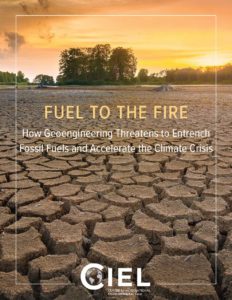
Fuel to the Fire: How Geoengineering Threatens to Enrich Fossil Fuels and Accelerate the Climate Crisis

By Carroll Muffett and Steven Felt - Center for International Environmental Law, February 2019

The present report investigates the early, ongoing, and often surprising role of the fossil fuel industry in developing, patenting, and promoting key geoengineering technologies. It examines how the most heavily promoted strategies for carbon dioxide removal and solar radiation modification depend on the continued production and combustion of carbon-intensive fuels for their viability.

It analyzes how the hypothetical promise of future geoengineering is already being used by major fossil fuel producers to justify the continued production and use of oil, gas, and coal for decades to come. It exposes the stark contrast between the emerging narrative that geoengineering is a morally necessary adjunct to dramatic climate action, and the commercial arguments of key proponents that geoengineering is simply a way of avoiding or reducing the need for true systemic change, even as converging science and technologies demonstrate that shift is both urgently needed and increasingly feasible. Finally, it highlights the growing incoherence of advocating for reliance on speculative and risky geoengineering technologies in the face of mounting evidence that addressing the climate crisis is less about technology than about political will.

Read the report (Link).

Towards a just transition: coal, cars and the world of work

By Béla Galgóczi - European Trade Union Institute, 2019

The role of trade unions and social dialogue is key in demonstrating the major differences between coal-based energy generation and the automobile industry. This book presents two faces of a just transition towards a net-zero carbon economy by drawing lessons from these two carbon-intensive sectors. The authors regard just transition not as an abstract concept, but as a real practice in real workplaces. While decarbonisation itself is a common objective, particular transitions take place in work environments that are themselves determined by the state of the capital-labour relationship, with inherent conflicts of interest, during the transition process.

The case studies presented in this book highlight the major differences between these two sectors in the nature and magnitude of the challenge, how transition practices are applied and what role the actors play.

Read the report (Link).

The Sky's Limit: Why Denmark Must Phase Out North Sea Oil and Gas Extraction

By Bronwen Tucker, et. al. - Oil Change International, September 2019

Over the past thirty years, Denmark has positioned itself as a global climate leader through its policies to support wind power, district heating, and energy efficiency, amongst other actions.5Building on this, in June 2019, the newly elected Danish government committed to a new climate target of reducing emissions 70 percent below 1990 levels by 2030, surpassing its previous goal of 40 percent by 2020.

However, Denmark’s plans to expand North Sea oil and fossil gas extraction undermine this record of climate action. This is because the potential carbon emissions from the oil, gas, and coal in the world’s currently operatingfields and mines would already fully exhaust and exceed carbon budgets consistent with the Paris goals. Simply put, we cannot afford to bring new extraction online — in Denmark or anywhere else.

This report applies these stark global carbon budget limits to the outlook for oil and gas production in Denmark. We find that Denmark’s plans to allow new North Sea oil and gas projects in the 2020s and 2030s would undermine its aspirations of climate leadership. The carbon dioxide (CO2) emissions from burning Danish-produced oil and gas would be substantial, overtaking Denmark’s total expected domestic CO2 emissions from energy by mid-2025 (see Figure 1, with details on the domestic reduction curves in Section 1). In other words, if current plans to expand North Sea extraction are left unaddressed, Denmark will either (a) meet its domestic emissions targetsbut export oil and gas with associated emissions that overshadow this domestic progress, or (b) fail to meet its emissions targets and continue to consume more oil and gas domestically than is Paris-aligned.

Source: Oil Change International analysis based on data from Rystad UCube, Danish Energy Agency, and 92 Group.8There is a cumulative 665 million tonnes (Mt) of CO2 associated with Danish oil and gas between 2019 and 2050. Of these potential CO2 emissions, 401 Mt of CO2 would come from new projects yet to be developed that would peak between the mid-2020s and mid-2030s. This means over 60 percent of anticipated emissions related to Denmark’s oil and gas extraction in the coming decades are not yet committed — the projects they are associated with will either require new licenses from the Danish government or final investment decisions (and final government approval) to be developed.

Read the report (PDF).

Drilling Towards Disaster: Why US Oil and Gas Expansion is Incompatible With Climate Limits

By Kelly Trout and Lorne Stockman - Oil Change International, et. al., January 2019

World governments, including the United States, committed in 2015 in the Paris Agreement to pursue efforts to limit global average temperature rise to 1.5 degrees Celsius above pre-industrial levels and, at a maximum, to keep warming well below 2 degrees Celsius (°C). This report is part of The Sky’s Limit series by Oil Change International examining why governments must stop the expansion of fossil fuel production and manage its decline – in tandem with addressing fossil fuel consumption – to fulfill this commitment.
The global Sky’s Limit report, released in 2016, found that the world’s existing oil and gas fields and coal mines contain more than enough carbon to push the world beyond the Paris Agreement’s temperature limits. This finding indicates that exploring for and developing new fossil fuel reserves is incompatible with the Paris goals. In fact, some already-operating fields and mines will need to be phased out ahead of schedule.

Since the global Sky’s Limit report in 2016, new scientific evidence has added urgency to this call for a managed decline of fossil fuel production. The latest report from the Intergovernmental Panel on Climate Change warns that reaching 2°C of warming would significantly increase the odds of severe, potentially irreversible impacts to human and natural systems, compared to limiting warming to 1.5°C. The difference could be the wipeout or resilience of whole communities and ecosystems. The report underscores that a 1.5°C path is possible but will require “rapid and far- reaching” transitions and “deep emissions reductions in all sectors” so that carbon pollution nears zero by 2050.

Unfortunately, existing climate measures aren’t cutting it – literally. Current national policy pledges under the Paris Agreement would put the world on course for 2.4 to 3.8°C of warming, a catastrophic outcome.

This glaring gap in ambition has been driven in part by a systemic policy omission. Over the past three decades, climate policies have primarily focused on addressing emissions where they exit the smokestack or tailpipe. Meanwhile, they have largely left the source of those emissions – the oil, gas, and coal extracted by fossil fuel companies – to the vagaries of the market.

Basic economics tells us that the consumption of any product is shaped by both supply and demand. It follows that reducing supply and demand together, or ‘cutting with both arms of the scissors,’ais the most efficient and effective way to reduce a harmful output. Putting limits on fossil fuel extraction – or ‘keeping it in the ground’ – is a core yet underutilized lever for accelerating climate action.

Curbing the supply of fossil fuels does not mean turning off the taps overnight. Rather, it means stopping new projects that would lock in new pollution for the coming decades. It means managing an orderly and equitable wind-down of existing fossil fuel infrastructure and extraction projects within climate limits. It makes it possible to plan for a just transition for workers and communities.

If the world is to succeed in meeting the Paris goals, this type of comprehensive and clear-eyed approach is urgently needed everywhere, and particularly in the United States – one of the world’s top producers and users of fossil fuels.

Read the report (PDF).

Working Together for a Just Transition

By David Powell, Alfie Stirling and Sara Mahmoud - New Economics Foundation, November 2018

This short pamphlet has been produced to launch the New Economics Foundation’s new programme of work on the 'just transition'. Our interest is in the practicality of change: the policies, processes, narrative and investment needed to accelerate the UK’s progress on 'just transition', here and now. Over the coming months and years we will be working at local and national levels to explore what is needed to build common cause and provide the right mixture of incentives and critical challenge to all parties to help unlock a new momentum for a 'just transition' for the UK.

It has been produced in association with the Friedrich-Ebert-Stiftung’s London Office, part of the international network of FES. The London office was established in 1988 to promote better understanding of British- German relations. FES's work in the United Kingdom focuses in particular on the exchange of ideas and discussion on the following topics: common challenges facing Germany, the United Kingdom and the European Union; economic and social policy; experiences gained from differing regional and local policies and practices; and a continuing dialogue between politicians as well as between the trade unions in both countries.

Read the report (PDF).

Pages

The Fine Print I:

Disclaimer: The views expressed on this site are not the official position of the IWW (or even the IWW’s EUC) unless otherwise indicated and do not necessarily represent the views of anyone but the author’s, nor should it be assumed that any of these authors automatically support the IWW or endorse any of its positions.

Further: the inclusion of a link on our site (other than the link to the main IWW site) does not imply endorsement by or an alliance with the IWW. These sites have been chosen by our members due to their perceived relevance to the IWW EUC and are included here for informational purposes only. If you have any suggestions or comments on any of the links included (or not included) above, please contact us.

The Fine Print II:

Fair Use Notice: The material on this site is provided for educational and informational purposes. It may contain copyrighted material the use of which has not always been specifically authorized by the copyright owner. It is being made available in an effort to advance the understanding of scientific, environmental, economic, social justice and human rights issues etc.

It is believed that this constitutes a 'fair use' of any such copyrighted material as provided for in section 107 of the US Copyright Law. In accordance with Title 17 U.S.C. Section 107, the material on this site is distributed without profit to those who have an interest in using the included information for research and educational purposes. If you wish to use copyrighted material from this site for purposes of your own that go beyond 'fair use', you must obtain permission from the copyright owner. The information on this site does not constitute legal or technical advice.