You are here

Intergovernmental Panel on Climate Change (IPCC)

Covid, Climate Change: Is the World Ready for “Global Public Goods”?

By Sean Sweeney - New Labor Forum, January 2022

Covid-19 has provided a stark reminder that today’s world is both scarred by grotesque levels of inequality and populated by billions of vulnerable people. However, it has also stimulated renewed interest in “global public goods” (GPGs) and how this foundational idea might be utilized to address a range of social crises, including climate change.

Global public goods is a nice phrase, but what does it mean? The basic idea is simple: no person can be excluded from using the “good” in question. At the mundane or everyday level, streets and parks fall into the public goods category. At the global level, a stable climate would qualify, as would the means to achieve and sustain it.

A guiding principle for a GPG approach to climate protection can perhaps be expressed in one sentence: increasing emissions anywhere endangers people everywhere; reducing emissions anywhere benefits people everywhere. If this principle holds true, then the means of implementation will also either be themselves public goods or they will, almost by definition, be designed to serve the public good.

Building a Just Transition for a Resilient Future: A Climate Jobs Program for Rhode Island

By Lara Skinner, J. Mijin Cha, Avalon Hoek Spaans, Hunter Moskowitz, and Anita Raman - The Worker Institute and The ILR School, January 2022

A new report released today by climate and labor experts at Cornell University in collaboration with the Climate Jobs Rhode Island Coalition outlines a comprehensive climate jobs action plan to put Rhode Island on the path to building an equitable and resilient clean-energy economy.

The report lays out a series of wide-ranging policy recommendations to transition the Ocean State’s building, school, energy, transportation, and adaptation sectors to renewable energy with the strongest labor and equity standards. Core provisions of the plan include decarbonizing the state’s K-12 public school buildings, installing 900 MW of solar energy statewide, 1,300 MW of offshore wind energy, and modernizing the state’s electrical grid by 2030. 

“Rhode Island is in a unique position as a state, in 2019 it had the lowest energy consumption per capita across all the United States. Rhode Island can use climate change as an opportunity to eliminate carbon emissions, increase equity, and create high-quality jobs that support working families and frontline communities,” says Avalon Hoek Spaans, Research and Policy Development Extension Associate for the Labor Leading on Climate Initiative at the Worker Institute, Cornell ILR School and one of the authors of the report.

The Worker Institute’s Labor Leading on Climate Initiative in partnership with the Climate Jobs National Resource Center, and Climate Jobs Rhode Island, began a comprehensive research, educational, and policy process in early 2021 to develop an implementation framework to drastically reduce emissions in the state while creating high-quality union family sustaining jobs.

Over the past year, the Labor Leading on Climate team has conducted outreach to numerous leaders of the labor and environmental movements as well as policymakers and experts in the climate, energy, and labor fields to better understand the challenges and opportunities that climate change and climate mitigation and adaptation presents to Rhode Island workers and unions.

“With Rhode Island on the frontlines of the climate crisis, it will take bold, ambitious action to combat climate change and reduce greenhouse gas emissions and pollution to the levels that science demands. Fortunately, tackling climate change is also an opportunity to address the other crises Rhode Island is facing: inequality and pandemic recovery,” says Lara Skinner, Director, Labor Leading on Climate Initiative, at the Worker Institute, Cornell ILR School and one of the authors of the report.

“As a small state with one of the lowest emissions in the country, Rhode Island can be innovative and efficient, employing cutting-edge approaches to reverse climate change and inequality. Rhode Island has the potential to be the first state in the country to fully decarbonize and build out a net zero economy with high-quality union jobs. This would make Rhode Island's economy stronger, fairer, and more inclusive,” says Lara Skinner, Director, Labor Leading on Climate Initiative, at the Worker Institute, Cornell ILR School and one of the authors of the report.

Read the text (PDF).

Beyond a Just Transition

Beyond "Just Transition"

By Dr Eurig Scandrett - The Jimmy Reid Foundation, December 3, 2021

Introduction

It is no use simply saying to South Wales miners that all around them is an ecological disaster. They already know. They live in it. They have lived in it for generations. They carry it in their lungs… you cannot just say to people who have committed their lives and their communities to certain kinds of production that this has all got to be changed… Everything will have to be done by negotiation, by equitable negotiation, and it will have to be taken steadily along the way. Otherwise, you will find … that there is a middle-class environmental group protesting against the damage and there’s a trade-union group supporting the coming of the work. Now for socialists this is a terrible conflict to get into. Because if each group does not really listen to what the other is saying, there will be a sterile conflict which will postpone any real solutions at a time when it is already a matter for argument whether there is still time for the solutions. Raymond Williams (1982/1989)

The idea of ‘Just Transition’ (JT) has gained traction in recent years. With its roots in the union movement at the end of the twentieth century, it has developed into a concept with diverse and contested meanings. This engagement with JT has created spaces within the urgent policy areas of climate change mitigation to address potential job losses and the disproportionate impact up on the poorest communities, and more positively, to work for the generation of good quality, unionised jobs and greater social equality in a green economy. This is a fast-moving and often technical area of policy development. In Scotland, the Just Transition Commission (2021) reported in May 2021 after meeting over a period of two years, and relevant technical and policy reports are published with increasing frequency.

This paper is not a detailed contribution to these debates, on which others are more competent to comment, although it will inevitably touch on these. The paper aims to take a somewhat longer-term and more abstracted view of JT. It asks what do we mean by ‘Just’ and to what are we expecting to ‘Transition’ to? It argues that, in the discussions over the meanings of JT, the collective interests of workers, low-income communities and the environment are central, and require mechanisms to facilitate challenging dialogues between these interests.

There is an inevitable tendency, in developing positions on JT, to seek common ground between the two principal social movements that have driven JT debates: unions and environmental NGOs; or else between different unions or different industrial sectors. This process of seeking common ground can lead to a dilution of principle on all sides, a common denominator that all can live with, but with which none is entirely satisfied. While the process of negotiating common ground is a necessary and useful process for practical purposes, and a process at which the union movement is particularly adept, this paper argues that JT also provides the opportunity for a deeper dialogue in which all key stakeholders – the environment and working-class people who are either dependent on or excluded from the current unsustainable economy – can seek to incorporate the principles of the others. There are areas where the union movement and the environmental movement disagree. These areas of disagreement could be seen as potentially fertile grounds for deep dialogue in order to seek meaningful and lasting resolution.

This paper is, therefore, not intended to reflect the policy of any union or environmental group, but rather constitute a contribution to a debate within these movements and outwith them as well. It is, in places, designed to challenge. Indeed, it makes the case that the union and environmental movements can best learn from one another by being willing to be challenged by each other. All social movements reflect the interests of their participants, members, opinion formers and supporters and are contingent upon the social and political conditions in which they are acting. This is a strength, but also leads to ‘blind spots’ which are best addressed through collective self-reflection and challenges in solidarity from comrades in the struggle.

It is argued here that JT provides an opportunity to explore, for example, the tension well known in unions between representing the immediate interests of members and the long-term interests of the working-class; and in the environmental movement between the disproportionately educated, white, professional middle-class membership of the NGOs and the communities most directly affected by environmental devastation.

As has been recognised in some of the debates about JT, the idea can be located in a radical working-class tradition which, in Britain includes defence diversification, the East Kilbride Rolls Royce boycott of Chilean engines, the Lucas Aerospace Alternative Plan, the Upper Clyde Shipbuilders work-in, amongst others. JT can be more than a mechanism to address climate change, for it can also be a process which can be applied to transitions of many kinds that the labour movement and the left more generally have long advocated: the transition to a more democratic economy, more equal society and socially beneficial system of production, distribution and exchange. The paper, therefore, argues that the union movement, along with environmental and anti-poverty movements would benefit from going ‘beyond’ just transition.

Blah, Blah, Blah, Yay: Another Epic Fail for the COP, but Seeds of Growth for our Movements

By John Foran - Sierra Club, December 1, 2021

As COP 26 began, Greta Thunberg summed up the whole thing quite succinctly using just one word, three times:  Blah blah blah.

And as it ended two weeks later, she tweeted:

The #COP26 is over. Here’s a brief summary: Blah, blah, blah. But the real work continues outside these halls. And we will never give up, ever [emphasis added].

And indeed, COP 26 was an epic fail, even by the dismal standards of the 25 COPs that preceded it, but at the same time, the global climate justice movement made some much needed forward progress.

Chomsky and Pollin: Protests Outside of COP26 Offered More Hope Than the Summit

By C.J. Polychroniou, Noam Chomsky, and Robert Pollin - Truthout, November 22, 2021

The legacy of the 2021 United Nations Climate Change Conference (COP26) this fall was perhaps best encapsulated by its president, who bowed his head and — close to tears — actually apologized for the process, which ended with a last-minute watering-down of participants’ pledges on coal.

“May I just say to all delegates I apologize for the way this process has unfolded and I am deeply sorry,” said Alok Sharma, the British politician who served as president for COP26. The conference ended on November 13 with a disheartening “compromise” deal on the climate after two weeks of negotiations with diplomats from more than 190 nations.

In the interview that follows, leading public intellectuals Noam Chomsky and Robert Pollin offer their assessments of what transpired at COP26 and share their views about ways to go forward with the fight against the climate crisis. Chomsky — one of the most cited scholars in history and long considered one of the U.S.’s voices of conscience — is Institute Professor Emeritus at the Massachusetts Institute of Technology and currently Laureate Professor of Linguistics and Agnese Nelms Haury Chair in the Agnese Nelms Haury Program in Environment and Social Justice at the University of Arizona. He is joined by one of the world’s leading economists of the left, Robert Pollin, who is Distinguished Professor and co-director of the Political Economy Research Institute at the University of Massachusetts at Amherst. Chomsky and Pollin are co-authors of the recently published book, Climate Crisis and the Global Green New Deal: The Political Economy to Save the Planet.

C.J. Polychroniou: COP26, touted as our “last best hope” to avert a climatic catastrophe, has produced an outcome that was a “compromise,” according to United Nations Secretary General António Guterres, while activists conducted a funeral ceremony at the Glasgow Necropolis to symbolize the failure of the summit. Noam, can you give us your analysis of the COP26 climate agreement?

Noam Chomsky: There were two events at Glasgow: within the stately halls, and in the streets. They may have not been quite at war, but the conflict was sharp. Within, the dominant voice mostly echoed the concerns of the largest contingent, corporate lobbyists; rather like the U.S. Congress, where the impact of lobbyists, always significant, has exploded since the 1970s as the corporate-run neoliberal assault against the general population gained force. The voice within had some nice words but little substance. In the streets, tens of thousands of protesters, mostly young, were desperately calling for real steps to save the world from looming catastrophe.

COP26 Report Back: Climate Justice Activists Speak Out

Noam Chomsky: Ending Climate Change “Has to Come From Mass Popular Action,” Not Politicians

By Poyâ Pâkzâd, Benjamin Magnussen, and Noam Chomsky - Jacobin, November 19, 2021

Benjamin Magnussen: To change subjects: What do you see as the greatest obstacle in solving the climate crisis?

Noam Chomsky: There are two major obstacles. One is, of course, the fossil fuel companies. Second is the governments of the world, including Europe and the United States. We have just seen that very dramatically over the summer. On August 9, 2021, the IPCC [Intergovernmental Panel on Climate Change] issued its last analysis of the climate situation. It was a very dire warning — much more than before.

The message basically was, “We have two choices.” We can either start right now cutting back on fossil fuel use, [and] do it systematically every year, until we phase them out by mid-century. That’s one choice. The other choice is cataclysm. The end of organized human life on earth. Not immediately — we’ll just reach irreversible tipping points, and it goes on to disaster. Those are the options.

How did the great powers react? The day after the IPCC report, Joe Biden issued an appeal to the OPEC cartel [Organization of the Petroleum Exporting Countries] to increase production. Europe chimed in by calling on all producers, including Russia, to increase production. Increase production. This is a response to the IPPC warning that we have to start reducing right now.

That’s for political reasons, for profit for the oil companies. [The] political reason is that they want the price reduced. It’s better for them. [For] Joe Biden, if the gas prices are high, it harms his electoral prospects. [If] you read the major business press right now, [there’s] a big discussion going on: What’s the best way to increase production? Is it through the American shale oil — the fracking industry — or is it through OPEC? But how do we increase production best? That’s the business press. Turn to the petroleum journals. [They are] euphoric: “We just found new fields to exploit. Demand is going up. It’s great.”

Let’s go to the US Congress. The Biden program — under pressure from young activists, the Bernie Sanders movements, and so on — is actually a big improvement on any previous ones, on paper. It’s not wonderful, but it’s much better than anything else. Well, the [previous] negotiations in Congress over the “reconciliation bill,” initiated by Bernie Sanders, cut back very sharply from Sanders’s proposals. It’s a very valuable bill. It somewhat reverses the huge assault on the population during the neoliberal era.

The Republicans are 100 percent opposed. Nothing. [They] won’t accept anything. The Democrats do have a swing vote. The so-called moderate Democrats, who should be called “ultra-reactionaries,” are the swing vote. One of them is the chair of the Senate Energy Committee, [who] also happens to be the champion in Congress of receiving funding from the fossil fuel industry — which is quite an achievement, because they pay off everyone — but he’s the champion. His name is Joe Manchin. He has a policy — he’s made it explicit — that’s taken from the playbook of the oil companies. He made it very clear; he said: “No elimination, only innovation.” So, no cutbacks on the use of fossil fuel. If you can make up something new, it’s okay. So, he’s blocking it. There are climate change provisions in it. They’re already out. Blocked.

In Europe, it varies. There are some countries, like Denmark, for example, that are moving toward renewable energy pretty significantly. Others vary. But when it comes to the crunch, telling the oil companies and the producers right now what to do, Europe is, as far as I know, unified in saying, “Increase production” — right after the warning that we have to decrease production. That’s the world we live in.

Lesson from COP26: Protecting the climate requires anti-capitalist struggle

By W. T. Whitney Jr. - People's World, November 17, 2021

Dealing with climate change, the United Nations held its “Conference of the Parties”—COP26—in Glasgow Nov. 1-13. Unfortunately, nothing happened likely to slow down progression toward a catastrophic outcome. The nations failed to reach even a non-binding agreement on reducing fossil fuel emissions that disturb the climate. In the wake of the conference, the theme “system change not climate change” gains new relevance.

With smooth words obscuring a grim reality, a New York Times reporter described “a major agreement…calling on governments to return next year with stronger plans to curb their planet-warming emissions.” But then comes the admission: COP26 left “unresolved the crucial question of how much and how quickly each nation should cut its carbon dioxide and other greenhouse gases over the next decade.”

The conference’s hesitant approach originates from past difficulties in reaching collective and binding agreements. In recognition of such, the 2015 COP meeting ruled that henceforth nations need only submit goals for voluntarily reducing emissions.

The delegates at COP26 decided to renew a previous agreement, still unfulfilled, to provide poor nations with an inadequate $100 billion annually to assist them in “transition…recovery…and adaptation.” Rich nations were urged to double their funding by 2025. COP26 did not address phasing out coal production.

Prior to the gathering, publicity centered on “Keep 1.5 (degrees C) alive.” The slogan expressed determination not to allow dangerous levels of atmospheric warming to exceed 1.5°C above pre-industrial levels, as promised by the 2015 COP meeting. A conservative estimate foresees a 50% probability that, at the current rates of emissions, greenhouse house gases will spike to that level in just 15 years.

Climate scientists associated with the UN’s Intergovernmental Panel on Climate Change (IPCC) periodically issue Assessment Reports. Part I of the current version, reporting on the “physical science basis of climate change,” predicts that “Global warming of 1.5°C and 2°C will be exceeded during the 21st century.” Consensus exists that temperature elevations of the order of 3°C will lead to exponentially accelerating planetary changes that will be irreversible.

The dim prospect of nations and the international community mobilizing effectively has unsettled all quarters of society. References to short-sightedness, disregard for the truth, opportunism, and immorality are standard. What’s in order for the protection of humanity is a gigantic rising-up of the concerned and afflicted, but it’s not on the horizon.

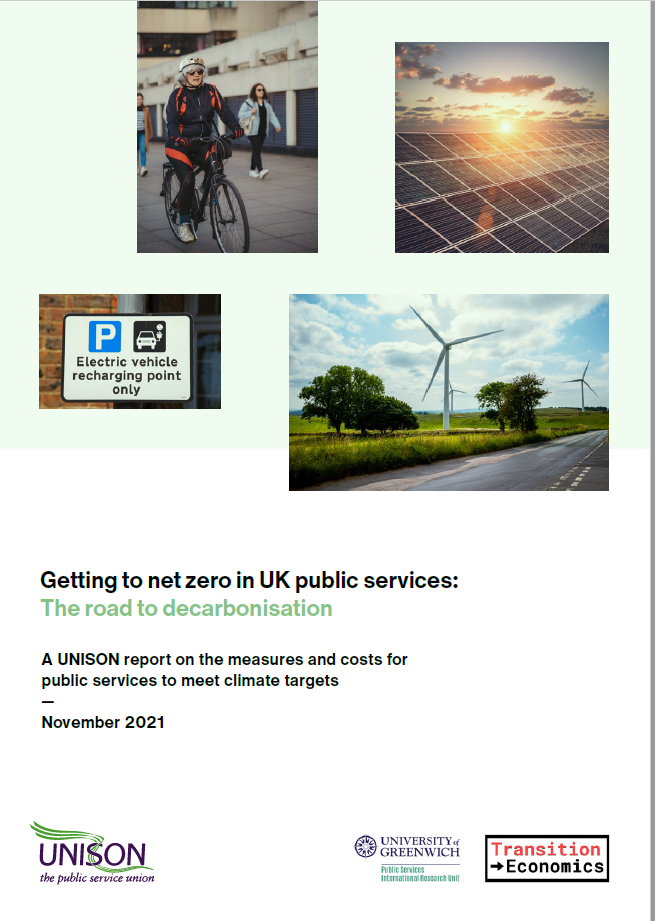
Getting to Net Zero in UK Public Services: The Road to Decarbonisation

By Dr. Vera Weghmann, et. al. - Unison, November 2021

Public services as a whole (excluding transport) represent about 8% of the UK’s direct greenhouse gas emissions. The NHS alone represents about 4% of the UK’s emissions. When procurement, construction, and social housing are taken into account, public services’ impacts are much greater.

Different sectors within the overall framework of public services have declared their decarbonisation plans. Some are ahead of the national targets. The NHS has declared that it will reach net zero by 2040, with an ambition to reach an 80% reduction by 2028 to 2032. More than one-third of local authorities (single- and upper-tier) committed themselves to decarbonise their local area by or before 2030.

The government aims to reduce direct emissions from public sector buildings by 75% against a 2017 baseline by the end of the Sixth Carbon Budget.

This report identified 21 different measures that should be taken across buildings, transport, electricity generation, waste, procurement and land use along with costed measures for each of nine different public services.

In our analysis, the UK’s public services need a capital investment injection of over £140 billion to 2035 to meet their Net Zero obligations. This will set the public sector on track to meet their climate targets and contribute to the UK’s overall carbon reduction aims. The analysis also identified measures that required annual operational expenditures of £1 billion to hit net zero targets. UNISON fully advocates that quality public services are best delivered by public ownership of public services and utilities rather than privatisation, outsourcing or PFI contracting of public services.

As well as improving the quality of life for service users, workers and the wider community, a number of the measures will also result in significant savings to public services’ budgets, through lower energy bills, cheaper to run fleets, and procurement savings. UNISON fully advocates that quality public services are best delivered by public ownership of public services and utilities rather than privatisation, outsourcing or PFI contracting of public services.

Read the text (PDF).

Pages

The Fine Print I:

Disclaimer: The views expressed on this site are not the official position of the IWW (or even the IWW’s EUC) unless otherwise indicated and do not necessarily represent the views of anyone but the author’s, nor should it be assumed that any of these authors automatically support the IWW or endorse any of its positions.

Further: the inclusion of a link on our site (other than the link to the main IWW site) does not imply endorsement by or an alliance with the IWW. These sites have been chosen by our members due to their perceived relevance to the IWW EUC and are included here for informational purposes only. If you have any suggestions or comments on any of the links included (or not included) above, please contact us.

The Fine Print II:

Fair Use Notice: The material on this site is provided for educational and informational purposes. It may contain copyrighted material the use of which has not always been specifically authorized by the copyright owner. It is being made available in an effort to advance the understanding of scientific, environmental, economic, social justice and human rights issues etc.

It is believed that this constitutes a 'fair use' of any such copyrighted material as provided for in section 107 of the US Copyright Law. In accordance with Title 17 U.S.C. Section 107, the material on this site is distributed without profit to those who have an interest in using the included information for research and educational purposes. If you wish to use copyrighted material from this site for purposes of your own that go beyond 'fair use', you must obtain permission from the copyright owner. The information on this site does not constitute legal or technical advice.