

You are here

UNITE-HERE

TESTIMONY: Alabama's Warrior Met Coal and Wall Street Greed

By Braxton Wright - Facing South, April 20, 2022

This month marks one year since 1,100 members of the United Mine Workers of America went on strike at Warrior Met Coal in Alabama following the failure of the union and company to agree on a labor contract. The strike continues today.

Warrior Met was created to buy the assets of Walter Energy after that company declared bankruptcy in 2015. A number of hedge funds own shares in Warrior Met, with New York-based BlackRock — the world's largest asset manager — controlling the most, at about 13% at the end of 2021.

Earlier this year, Senate Budget Committee Chair Bernie Sanders (I-Vermont) held a hearing on Wall Street greed and growing oligarchy in the United States that used Warrior Met as a case study. Sanders invited the CEO of BlackRock to appear at the hearing, along with those from two other hedge funds and Warrior Met, but they all declined to testify.

When Warrior Met was facing bankruptcy, workers agreed to an across-the-board wage cut of 20% along with cuts to their health care and retirement benefits as part of a restructuring deal made by the private equity firms, saving the company an estimated $1.1 billion over the past five years. Since 2017, Warrior Met has paid over $1.5 billion in dividends to its shareholders while paying its CEO over $4 million per year.

"Yet, now that the company has returned to profitability and has seen its stock price skyrocket by 250% during the pandemic, Warrior Met has offered its workers an insulting $1.50 raise over five years and has refused to restore the health care and pension benefits that were taken away from them five years ago," Sanders said in a statement announcing the hearing. "Outrageously and unacceptably, the company has also demanded the power to fire workers who engage in their constitutional right to strike and give seniority to new hires, rather than miners who have given their adult lives to Warrior Met."

Among those who spoke at the hearing was Braxton Wright, a Warrior Met miner and striking UMWA member. He called on lawmakers to support the "Stop Wall Street Looting Act," a measure sponsored by Sen. Elizabeth Warren of Massachusetts and Rep. Mark Pocan of Wisconsin, both Democrats, to help to reform the private equity industry and to give employee compensation higher priority in bankruptcies. This is Wright's written testimony from the hearing.

Green Unionism on the Chevron Richmond Refinery Workers Picket Line

By That Green Union Guy - IWW Environmental Union Caucus, April 15, 2022

Since Monday, March 21, 2022, the workers at the Chevron oil refinery in Richmond, California, members of the United Steelworkers Local 5 have been on strike and picketing the facility after voting down the company’s latest contract offer, which workers say contained insufficient wage increases. The bosses have responded by bringing in scabs (including managers from other Chevron facilities). The strike has gotten a good deal of media coverage:
However, the capitalist (and progressive) media have mostly missed some important details.

First of all, the striking refinery workers and their elected union leaders continue to emphasize that their issues extend beyond narrow bread and butter issues, such as wages and benefits. A major concern that they continue to articulate is that Chevron continues to try and cut unionized safety jobs and refuses to hire sufficient workers to safely and adequately staff the facility. Workers have complained of 12-hour days and six-day workweeks. All of these deficiencies not only risk the health and safety of the workers, but the surrounding, mostly BIPOC communities as well. Worse still, they have adverse environmental effects, a problem that hasn't been lost on the striking workers. As stated by USW Local 5 representative, B.K White:

“If we had more people and could get a better pay rate, maybe our members wouldn’t feel obligated to come in and work as many as 70 hours a week to make ends meet. We don’t believe that is safe. (that and the use of replacement workers) is at the detriment of the city of Richmond and the environment.”

Even less noticed by the media has been the presence of environmental justice activists (including, but not limited to, the Asian Pacific Environmental Network, Communities for a Better Environment, Extinction Rebellion, Fossil Free California, Richmond Progressive Alliance, Sierra Club, Sunflower Alliance, Sunrise Movement, and 350), various socialist organizations (including DSA in particular), and members from the nearby front-line BIPOC communities, who have joined the pickets in solidarity with the workers, something the workers have also not hesitated to point out. Indeed, in spite of the fact that many environmental justice activists and community members are harshly critical of Chevron's role in turning the city of Richmond into a capital blight infested sacrifice zone, they recognize that the workers are not their enemies nor are the latter responsible for the damage done by the company. On the contrary, many recognize that the unionized workforce is one of the best mitigations against far worse capital blight (it bears mentioning that there has also been a good deal of support and picket line presence from rank and file workers and union officials from many other unions, including the AFSCME, IBEW, IWW, ILWU, SEIU, UFCW, and the Contra Costa County Central Labor Council).

Such seemingly unlikely bonds of solidarity, though delicate and, at times, fragile didn't arise out of thin air, but, in fact, have resulted from years of painstaking grassroots organizing.

One day longer. One day stronger. One year later

By Kim Kelly - The Real News, April 13, 2022

It was supposed to be a terrible day. Thousands of United Mine Workers of America (UMWA) members and supporters were scheduled to convene in Tuscaloosa County, Alabama, on the morning of April 6, 2022, to commemorate the one-year anniversary of the beginning of the Warrior Met Coal strike. But, much like the coal bosses themselves, the forecast was not cooperating. The weather report, in typical fickle Alabama fashion, had been fluctuating between rain, more rain, and certain waterlogged doom; the union had bought ponchos in bulk to prepare. As UMWA International President Cecil E. Roberts said before the rally, “A little bad weather isn’t going to slow us down.”

By the time I arrived at Tannehill State Park that morning, I was fully prepared to spend my day stuck in the mud impersonating a drowned rat. I was not surprised to see that the day’s schedule had been moved up in a bid to outrun the rain. The original start time was slated for 11AM, but the rally was already in full swing by 10:30AM. Like all UMWA rallies, this one opened with a prayer, and I’m sure I wasn’t the only person in the crowd hoping (or praying) that the universe would see fit to send us some good luck after all.

Buses were still arriving as speakers took the stage; according to an emailed UMWA press release, at least 1,200 UMWA members and retirees had bused in from Illinois, Pennsylvania, Ohio, Kentucky, and West Virginia, and they were joined by union members from across the South. It was a family reunion, with a greater purpose—when the call for solidarity went out, folks listened. They came to pay their respects by the hundreds, traveling across rivers and valleys and up from hills and hollers to be there alongside their afflicted siblings.

California Climate Jobs Plan Continues to Gain Union Endorsements

By That Green Union Guy - IWW Environmental Union Caucus - March 11, 2022

The California Climate Jobs Plan, popularly known as "the Pollin Report"--which has been described as a "sholvel ready just transition/Green New Deal" plan--and was immediately endorsed by nineteen California based labor unions, including three United Staeelworkers Union locals which primarily represent refinery workers upon its unveiling has since gained the support of many additional unions. The following unions (so far) have since endorsed the plan (knowing that while the plan isn't perfect, it's at least a step in a positive direction):

November 2021:

  • Inland Boatmen's Union (IBU), SF Bay Region (an affiliate of the ILWU)
  • Railroad Workers United
  • IWW San Francisco Bay Area General Membership Branch

February 2022:

  • International Lonshore and Warehouse Union (ILWU) Northern California District Council (NCDC)

The council is composed of delegates from the following ILWU Locals:

  • ILWU Local 6 (Bay Area Warehouse)
  • ILWU Local 10 (Bay Area Longshore)
  • ILWU Local 34 (Bay Area Shipping Clerks)
  • ILWU Local 75 (Bay Area Dock Security Guards)
  • ILWU Local 91 (Bay Area “Walking Bosses”)
  • ILWU Local 14 (Eureka; combined)
  • ILWU Local 18 (Sacramento; ditto)
  • ILWU Local 54 (Stockton)
  • Bay Area IBU (already endorsed individually)
  • and the pensioners from all of the above.

However, the NCDC's endorsement does not automatically mean that each of its constituent locals have individually endorsed the plan.

The more unions that endorse and take an active role in motivating the proposal either by lobbying at the California state level, engaging in public actions to promote the goals of the plan, or even engaging in workplace actions (whereaver relevant and practiceble), the greater chances the plan has of being realized.

(That said, it should be noted that this is not an IWW organizing project, although IWW members have been active in securing additional union endorsements).

A sample resolution (a copy of the text adopted by the SF Bay Area IBU) is available here.

Download the plan - here.

COP26: A Report Back from Floridian Workers

Just Transition Alliance: COP26 Media Report

Hurricane Capitalism

By Eric Fretz - Marx 21, September 3, 2021

Again and Again under capitalism, we have seen poorer people disproportionately hit by the deadly effects of events like cyclones and earthquakes, as natural disasters highlight existing unnatural inequalities. It is now obvious that not just the effects, but the causes of extreme weather are stemming from capitalism.

The recent IPCC report proved that higher air and sea temperatures caused by global warming have already led to more hurricanes, and will continue to do so. “In the past seventy years,” Bill McKibben noted, “the United States has averaged three land-falling storms a year; Ida is the seventeenth in the past two years.” 

But warming also leads to a “rapid intensification” of storms. Ida turned into a hurricane in just six hours.

When Ida hit the Louisiana coast Sunday as a Category 4 hurricane with winds up to 150 mph, it was the second most powerful storm to hit the state in its recorded history.

Devastation 

Over 1 million homes and businesses in Louisiana and Mississippi are without power, including the entire city of New Orleans, parts of which may remain without electricity for weeks. 

Sewage pumping stations in New Orleans, which have no backup power, stopped working, leaving 441,000 people in 17 parishes with no clean drinking water, and no water to flush toilets. Another 329,000 people were under boil water advisories. However, it may be hard for many to boil water without electricity.

Added to this misery was a heat advisory which combined with humidity to reach real feel temperatures of over a hundred degrees

Tens of thousands of residents were left to themselves in figuring out how to evacuate, and even those with cars were at a standstill on choked highways. 

In a chilling reminder of the horrors of Katrina, the New Orleans Police Department announced that “anti-looting patrols” would be set up. The mayor then used the resulting arrests to justify a curfew and calling in the National Guard—not to rescue people or rebuild, but to patrol the streets. 

As in Katrina, it is poor and black people who are most at risk of losing their homes—and their lives.

Ida came one year after Hurricane Laura, which brought widespread destruction to the mostly Black industrial area around Mossville, causing chemical fires and turning Lake Charles into a toxic soup. The displacement and continued housing shortage caused by Laura worsened the spread of Covid in the area. 

The displacement caused by Ida in New Orleans could be even worse. Hospitals in Louisiana are already filled with over 2,400 patients with coronavirus. There were not enough empty beds in the state to evacuate patients from New Orleans hospitals. Staff in one hospital reported having to manually pump air into the lungs of intubated Covid patients as they moved them to a floor with a working generator.

California unions endorse a plan for Green Recovery and fossil fuel phase-out

By Elizabeth Perry - Work and Climate Change Report, July 21, 2021

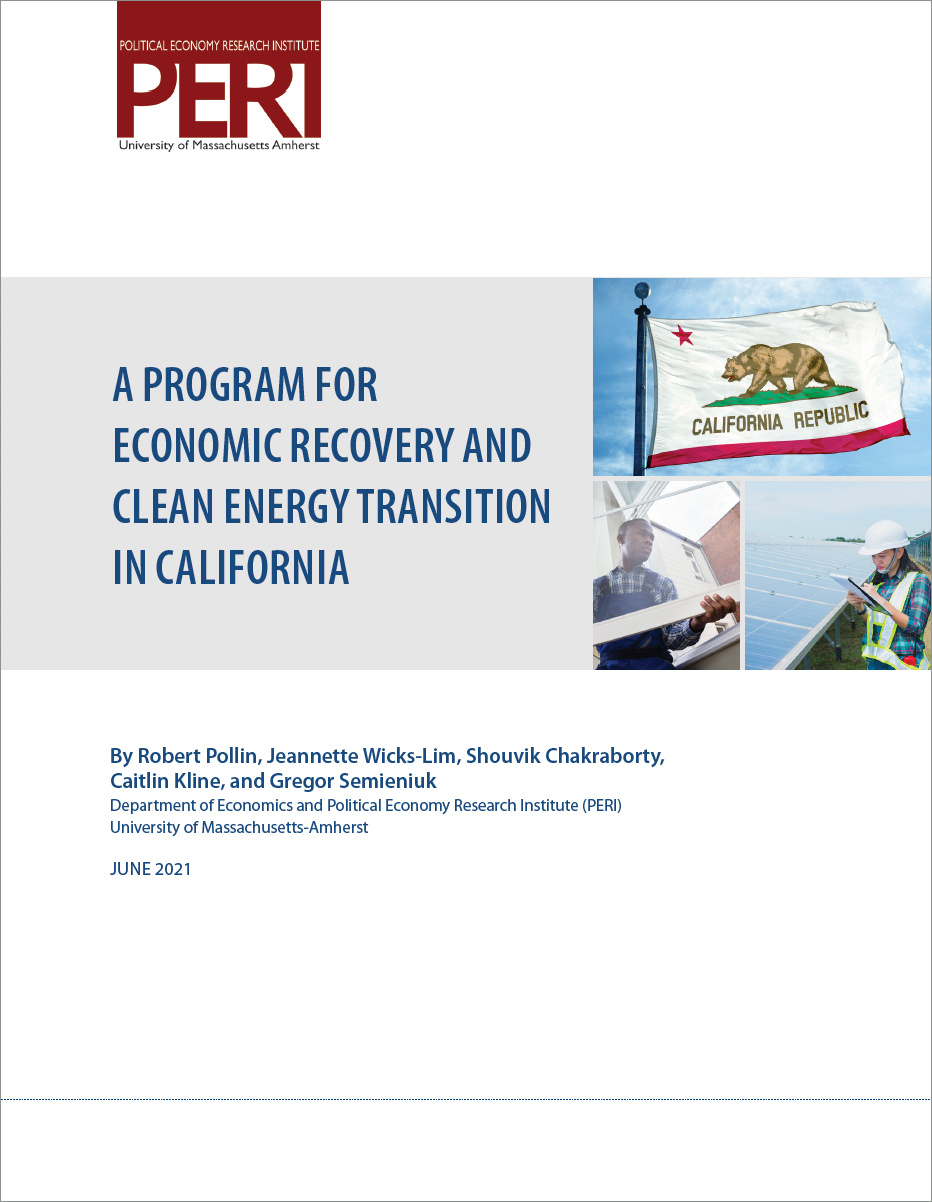
A Program for Economic Recovery and Clean Energy Transition in California, released in June, is the ninth in a series of reports titled Green Economy Transition Programs for U.S. States, published by the Political Economy Research Institute (PERI), and written by researchers led by Robert Pollin. In this latest report, the authors address the challenge of economic recovery from the Covid-19 pandemic, and contend that it is possible to achieve California’s official CO2 emissions reduction targets—a 50 percent emissions cut by 2030 and zero emissions by 2045— and at the same time create over 1 million jobs. The investment programs they propose are based on the proposed national THRIVE Agenda, (introduced into the U.S. Congress in February 2021), and rely on private and public investment to energy efficiency, clean renewable energy, public infrastructure, land restoration and agriculture. The report discusses these sectors, as well as the manufacturing sector, and also includes a detailed just transition program for workers and communities in the fossil fuel industry.

In Chapter 6, “Contraction of California’s Fossil Fuel Industries and Just Transition for Fossil Fuel Workers”, the authors note that only 0.6% of California’s workforce was employed in fossil fuel-based industries in 2019 – approx.112,000 workers. They model two patterns for the industry contraction between 2021-2030: steady contraction, in which employment losses proceed evenly, by about 5,800 jobs per year; and episodic contraction, in which 12,500 job losses occur in just three separate years, 2021, 2026, and 2030. After developing transition programs for both scenarios, they estimate that the average annual costs of episodic contraction would be 80% higher ($830 million per year) than the costs of steady contraction ($470 million per year). As with previous PERI reports, the authors emphasize the importance of the quality of jobs to which workers relocate: “It is critical that all of these workers receive pension guarantees, health care coverage, re-employment guarantees along with wage subsidies to insure they will not experience income losses, along with retraining and relocation support, as needed. Enacting a generous just transition program for the displaced fossil fuel-based industry workers is especially important. At present, average compensation for these workers is around $130,000. This pay level is well above the roughly $85,000 received by workers in California’s current clean energy sectors.” Relief Programs for Displaced Oil & Gas Workers Elements of an Equitable Transition for California’s Fossil Fuel Workers is a 2-page Fact Sheet summarizing the chapter.

Labor-Backed Report on Path to Equitable Green California

By Staff - Sunflower Alliance, June 10, 2021

Nineteen labor organizations—including unions representing refinery workers in Northern and Southern California and the Alameda Labor Council— have endorsed a detailed plan for an equitable transition to a clean-energy economy in California.

This major new report, A Program for Economic Recovery and Clean Energy Transition in California, details programs for meeting California’s 2030 climate goal (40 percent economy-wide reduction in greenhouse gas emissions from the state’s 1990 level) by creating roughly 418,000 jobs. It argues that state policy should ensure that the jobs created are good-paying jobs with full labor rights and access by historically excluded people.

The same strategies, the report says, could be continued to meet California’s longer-term goal of being carbon-neutral by 2045.

The report was commissioned by the American Federation of State, County and Municipal Employees Local 3299, the California Federation of Teachers, and the United Steelworkers Local 675. Its authors are faculty members of the University of Massachusetts at Amherst, including Robert Pollin, a leading expert on just transition.

The report provides detailed calculations for strategies outlined in an earlier report, Putting California on the High Road, from the UC Labor Center. Both reports emphasize the need for measures to protect fossil fuel industry workers including:

  • Pension guarantee for all workers.
  • Re-employment and income-level guarantees for all displaced workers.
  • Retraining and relocation support as needed.
  • “Glide-path income support” for workers 60 – 64.

The report comes as the Newsom administration is developing a report on Just Transition in California.

Just Transition in California: Robert Pollin in Conversation with Robert Kuttner

Pages

The Fine Print I:

Disclaimer: The views expressed on this site are not the official position of the IWW (or even the IWW’s EUC) unless otherwise indicated and do not necessarily represent the views of anyone but the author’s, nor should it be assumed that any of these authors automatically support the IWW or endorse any of its positions.

Further: the inclusion of a link on our site (other than the link to the main IWW site) does not imply endorsement by or an alliance with the IWW. These sites have been chosen by our members due to their perceived relevance to the IWW EUC and are included here for informational purposes only. If you have any suggestions or comments on any of the links included (or not included) above, please contact us.

The Fine Print II:

Fair Use Notice: The material on this site is provided for educational and informational purposes. It may contain copyrighted material the use of which has not always been specifically authorized by the copyright owner. It is being made available in an effort to advance the understanding of scientific, environmental, economic, social justice and human rights issues etc.

It is believed that this constitutes a 'fair use' of any such copyrighted material as provided for in section 107 of the US Copyright Law. In accordance with Title 17 U.S.C. Section 107, the material on this site is distributed without profit to those who have an interest in using the included information for research and educational purposes. If you wish to use copyrighted material from this site for purposes of your own that go beyond 'fair use', you must obtain permission from the copyright owner. The information on this site does not constitute legal or technical advice.
