You are here

reports

Just Transition at the Intersection of Labour and Climate Justice Movements: Lessons from the Portuguese Climate Jobs Campaign

By Chrislain Eric Kenfack - University of Alberta, 2019

In the current context of climate change and its accompanying adverse effects on natural, human and social systems, the imperative of transitioning to low- and preferably post-carbon societies has become a non-negotiable reality if we want to avoid reaching the point of no return in terms of environmental and climate catastrophe. Such a transition requires that the interests and needs of workers and their communities be taken into consideration to make sure they do not bear the heaviest part of the burden in terms of loss of jobs and means of survival, and that they are prepared to face the new, post-carbon labour environment.

The concept of Just Transition was coined to describe both the socio-political project put forward by trade unions in response to climate change, and the recognition by climate activists that the livelihoods and security of workers and their communities must be ensured during the transition to a post-carbon society. However, just transition movements are divided between two quite different orientations, which are labelled “affirmative” and “transformative.” On the one hand, affirmative just transition advocates envisage a transition within the current political-economic system. Transformative just transition activists, on the other hand, envisage a post-capitalist transition.

This article, drawing upon an extensive case study of the Portuguese climate jobs campaign, goes beyond showing how these orientations shape the positions taken by union and climate activists. The article also analyses how the conflicts and cooperation between these key actors can shed light on the possibilities and/or limitations of just transition as a framework for the collective action needed to achieve rapid, deep decarbonisation of economies in the Global North context.

Read the report (PDF).

Internationalising the Green New Deal: Strategies for Pan-European Coordination

By Daniel Aldana Cohen, Kate Aronoff, Alyssa Battistoni, and Thea Riofrancos - Common Wealth, 2019

Climate politics are today bursting to life like never before. For four decades, market fundamentalists in the United States and United Kingdom have blocked ambitious efforts to deal with the climate crisis. But now, the neoliberal hegemony is crumbling, while popular climate mobilisations grow stronger every month. There has never been a better moment to transform politics and attack the climate emergency.

When the climate crisis first emerged into public consciousness in the 1980s, Margaret Thatcher and Ronald Reagan were consolidating a neoliberal doctrine that banished the most powerful tools to confront global heating— public investment and collective action.

Instead, neoliberals sought to free markets from democratically imposed constraints and the power of mass mobilisation. Thatcher insisted that there was no alternative to letting corporations run roughshod over people and planet alike in the name of profit. Soon, New Democrats and New Labour agreed. While the leaders of the third way spoke often of climate change, their actual policies let fossil capital keep drilling and burning. Afraid to intervene aggressively in markets, they did far too little to build a clean energy alternative.

Then the financial crisis of 2008 and the left revival that exploded in its wake laid bare the failures of the neoliberal project. An alternative political economic project is now emerging—and not a moment too soon. As the Intergovernmental Panel on Climate Change put it, keeping global warming below catastrophic levels will require “rapid, far-reaching and unprecedented changes in all aspects of society.” In other words: public investment and collective action.

Fortunately, movements on both sides of the Atlantic have been building strength to mount this kind of alternative to market fundamentalism. On the heels of Occupy Wall Street and Black Lives Matter, Bernie Sanders’s 2016 Democratic primary campaign breathed new life into the American left and its electoral prospects. Jeremy Corbyn’s election as leader of the Labour Party, spurred by a vibrant grassroots mobilisation, gives those of us in the U.S. hope: if New Labour could give way to Corbynism, surely Clintonism can give way to the left wing of the Democratic party. In the U.K., drawing on tactics from the Sanders campaign, Momentum has developed a new model of mass mobilisation to transform a fossilised political party. It’s restoring the dream that formal politics can be a means for genuinely democratic political organising. In turn, U.S. leftists are learning from Momentum’s innovations.

The vision of the Green New Deal that has taken shape in the United States in the past few months is in many ways a culmination of the U.S. left’s revival. The Green New Deal’s modest ambition is to do all that this moment requires: decarbonise the economy as quickly as humanly possible by investing massively to electrify everything, while bringing prodigious amounts of renewable power online; all this would be done in a way that dismantles inequalities of race, class and gender. The Green New Deal would transform the energy and food systems and the broader political economy of which they are a part.

Read the report (PDF).

18 Strategies for a Green New Deal: How to Make the Climate Mobilization Work

By Jeremy Brecher - Labor Network for Sustainability, 2019

The Green New Deal projects a broad vision of creating a climate-safe America through an economic and social mobilization on a scale not seen since the New Deal and World War II.

That mobilization can provide a historic opportunity to create millions of good, high-wage jobs, virtually eliminate poverty, provide unprecedented levels of prosperity and economic security, and counteract systemic injustices. So far discussion about the Green New Deal has rightly focused on values and goals. But there are many practical problems that will have to be solved as well.

The LNS discussion paper 18 Strategies for a Green New Deal: How to Make the Climate Mobilization Work lays out how the Green New Deal can realize its goals.

Read the report (PDF).

Manifesto for a new popular internationalism in Europe

By various - ReCommonsEurope, May 26, 2019

In the last ten years, popular anger has expressed itself without interruption against discriminatory and anti-democratic policies in favour of the rich and big companies - policies implemented by national governments and often coordinated by the European Union (EU). It has taken the form of initiatives by trade unions, but also by new movements such as ‘15M’ in Spain (also called in other countries the movement of the ‘Indignados’), the occupation of the squares in Greece and the huge demonstrations in Portugal in 2011, the movements against the “Loi Travail” (Labour law) in France and against the Water Tax in Ireland in 2016, the great demonstrations for autonomy and against political repression in Catalonia in 2017. Feminist struggles gave rise to the historic demonstrations in Poland (« Czarny Protest » against the anti-abortion law in 2017), Italy (« Non Una di Meno » movement since 2016), Spain (feminist general strike of 5 million people on the 8th March 2018), as well as a victory over the political influence of the Catholic Church in Ireland with the legalisation of abortion by referendum in May 2018, and are at last succeeding in imposing their centrality in all social struggles.

The year 2018 also saw the emergence of new social movements against the dominant economic and political order, with the movement against the « slavery law » (neoliberal reform of labour laws) in Hungary, the demonstration and development of the « Indivisible » antiracist movement in Germany, the Yellow Vests movement in France and French-speaking Belgium against unjust fiscal policies and the lack of democracy in political institutions. Nor should we forget the climate demonstrations, driven mainly by young people who have gone on strike in many countries, including Sweden, Denmark, Switzerland, Belgium, France and Great Britain. All these social movements, and others, have challenged the austerity measures and authoritarianism of the policies being implemented in Europe, by posing directly or indirectly the question of a radical alternative social project to capitalism, productivism, ecological devastation, racism and patriarchy. This Manifesto sees itself as an integral part these movements and shares their objectives: the struggle against all forms of domination, for universal rights, for equality and for a democracy to be invented – a democracy which would not stop at the gates of companies and the threshold of working-class areas, and which would necessarily be radically opposed to the logic of a capitalist system (whether the latter claims to be ‘protectionist’, and so against ‘foreigners’, or ‘liberal’) which is destroying social rights and the environment.

Read the report (PDF).

(Working Paper #12) The Road Lest Travelled: Reclaiming Public Transport for Climate-Ready Mobility

By Sean Sweeney and John Treat - Trade Unions for Energy Democracy, May 2019

This working paper examines some of the key questions at the heart of climate-related debates on transport, and around passenger road transport in particular. It also looks at some of the more important issues surrounding public transport specifically, and the failure of neoliberal transport policy to improve and expand public transport in ways that fulfill its full social and environmental potential.

Part One: Mobility Rising: Transport, Energy and Emissions Trends

In Part One of this paper, we survey the current trends in energy, transportation and emissions. Although emissions continue to rise across the global economy, transport-related emissions are growing faster than those of other major sectors. Transport is now responsible for almost one-third of final energy demand and nearly two-thirds of oil demand. It is also responsible for nearly one-quarter of global carbon dioxide (CO2) emissions from the use of fuel. This means that controlling and reducing CO2 emissions from cars, trucks, and motorcycles must become a policy priority.

Part Two: Neoliberal Transport and Climate Policy at the Crossroads

In this part, we review the policy landscape, including how transport-related emissions from the transport sector are addressed in the Paris Climate Agreement—which is hardly at all. We show that neoliberal climate policy has failed to make any real progress in addressing transport-related emissions, while at the same time preventing public transport from realizing its potential, mainly due to the insistence on a “public-private partnership” model in a futile effort to “unlock” private investment.

Part Three: The Electric Car—Myths and Realities

We summarize the myths and realities surrounding electric cars, and highlight some of the major issues associated with their possible mass deployment. We show that common assumptions about the role of private EVs in the future of sustainable mobility are not at all consistent with what is actually happening, what is likely to happen in the future, or with what is even possible or desirable from a trade union perspective.

Part Four: Taming the Transport Network Companies (TNCs): From Uberization to Enhanced Public Mobility for All

In Part Four, we look at the rise of TNCs and other recent developments and trends in urban transport. This has triggered a global debate on “new mobility services.” In this part of the paper we argue that TNCs currently undercut public transport systems and contribute to traffic congestion and often increase emissions. But the same “platform technologies” that gave us Uber and similar companies can become integrated into public transport systems in ways that complement traditional public transport modes and reduce dependence on private vehicles.

Part Five: Shifting Gears: A Trade Union Agenda for Low-Carbon Public Mobility

Finally, we summarize some of the climate-related arguments that unions can use in their fight to defend, expand and improve public transport. We believe these arguments are consistent with the values and priorities of many transport unions and progressive trade unionism in general.

The authors hope this paper will encourage unions representing workers in all sectors to deepen their discussions around the future of transport—to join the conversation about what public transport can and should look like in future, and what needs to happen in order to bring that vision to reality.

Read the report (PDF).

Sea Change: Climate Emergency, Jobs and Managing the Phase-Out of UK Oil and Gas Extraction

By Greg Muttitt, Anna Markova, and Matthew Crighton - Oil Change International, Platform, and Friends of the Earth Scotland, May 2019

This new report released by Oil Change International, Platform and Friends of the Earth Scotland shows that a well-managed energy transformation based on Just Transition principles can meet UK climate commitments while protecting livelihoods and economic well-being, provided that the right policies are adopted, and that the affected workers, trade unions and communities are able to effectively guide these policies.

This report examines the future of UK offshore oil and gas extraction in relation to climate change and employment. It finds that:

  • The UK’s 5.7 billion barrels of oil and gas in already-operating oil and gas fields will exceed the UK’s share in relation to Paris climate goals – whereas industry and government aim to extract 20 billion barrels;
  • Recent subsidies for oil and gas extraction will add twice as much carbon to the atmosphere as the phase-out of coal power saves;
  • Given the right policies, job creation in clean energy industries will exceed affected oil and gas jobs more than threefold.

In light of these findings, the UK and Scottish Governments face a choice between two pathways that stay within the Paris climate limits:

  1. Deferred collapse: continue to pursue maximum extraction by subsidising companies and encouraging them to shed workers, until worsening climate impacts force rapid action to cut emissions globally; the UK oil industry collapses, pushing many workers out of work in a short space of time. Or:
  2. Managed transition: stop approving and licensing new oil and gas projects, begin a phase-out of extraction and a Just Transition for workers and communities, negotiated with trade unions and local leaders, and in line with climate change goals, while building quality jobs in a clean energy economy.

The report recommends that the UK and Scottish Governments:

  • Stop issuing licenses and permits for new oil and gas exploration and development, and revoke undeveloped licenses;
  • Rapidly phase out all subsidies for oil and gas extraction, including tax breaks, and redirect them to fund a Just Transition;
  • Enable rapid building of the clean energy industry through fiscal and policy support to at least the extent they have provided to the oil industry, including inward investment in affected regions and communities;
  • Open formal consultations with trade unions to develop and implement a Just Transition strategy for oil-dependent regions and communities.

Read the text (PDF).

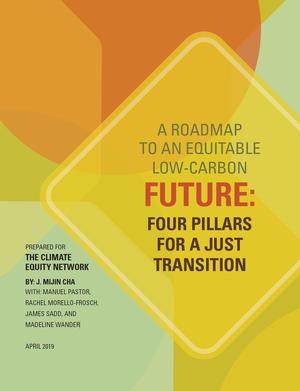
A Roadmap to an Equitable Low-Carbon Future: Four Pillars for a Just Transition

By J. Mijin Cha, JD, PhD - Climate Equity Network, April 2019

The signs that the climate crisis is already happening are clear. The most recent Intergovernmental Panel on Climate Change report detailed the evidence from more than 6,000 studies that found that over the past decade, a series of record-breaking storms, forest fires, droughts, coral bleaching, heat waves, and floods have taken place around the world in response to the 1.0 °C of global warming that has taken place since the pre-industrial era. These events, and the losses associated with them, are expected to become substantially worse with 1.5 °C of warming currently targeted by global climate agreements, and far worse if these agreements are not effective. Without major cuts in greenhouse gas (GHG) emissions, this warming threshold could be reached in as little as 11 years, and almost certainly within 20 years. Even if such cuts were to begin immediately, reaching this threshold would not be prevented, only delayed.

Any chance of staving off even worst impacts from climate change depends on significant reductions in GHG emissions and a move from a fossil fuel- based economy to a low-carbon economic future. While this transition is fundamentally necessary, the challenges it poses are great. Every aspect of our economy and our society is dependent upon fossil fuel use – from the reliance on electricity provided by fossil fuel power plants to the tax revenue local communities receive from fossil fuel extraction and facilities to the jobs held by those working in an industry that may keep their incomes high but often puts their communities at risk. The imprint of fossil fuels is so deeply embedded within our way of life that ceasing its use will require a fundamental shift in how we procure and use energy.

The good news is that this shift is possible—and California is already on a path to a low-carbon future. In addition to several ambitious climate targets, in September 2018, then-Governor Jerry Brown signed an executive order pledging the state to achieve carbon neutrality no later than 2045. As the world’s fifth largest economy, the commitment California made to reduce greenhouse gases can provide a pathway to a low-carbon future that could lay the groundwork for others to follow. But to get there, we need to aim even higher than California’s already ambitious goals.

Transitioning away from fossil fuels must be done more quickly and also in a manner that protects workers and communities economically dependent on the fossil fuel industry. Transitioning is also an opportunity to include those who have historically been excluded from the jobs and economic benefits of the extractive economy and expand the populations who have access to future jobs and economic opportunities. As we move to a low-carbon future, environmental justice communities should be prioritized for job creation and renewable energy generation. Without protecting displaced workers and expanding opportunities to other workers, transitioning to a low-carbon future will replicate the mistakes and inequalities of the extractive past and present.

Read the report (PDF).

Steel Arising

By Julian M Allwood, Cyrille F Dunant, Richard C Lupton, and André C H Serrenho - University of Cambridge, April 2019

The global steel industry is transforming from using iron ore to recycling scrap. Global arisings of steel scrap are likely to treble in the next thirty years and we will never need more blast furnaces than we have today. The extent and speed of this global transformation depends on two competing forces: on the one hand, today’s recycling technology cannot currently produce the highest qualities of high-volume steel econonically; on the other, recycling has the critical advantage that it reduces the greenhouse gas emissions released in producing steel to around a third of those from primary production. As the steel industry turns from ore to scrap and action on climate change accelerates, what opportunities does this create for steel in the UK?

UK consumers currently demand around 15 million tonnes per year of steel in final goods. Although the UK’s steel production has fallen to well below this figure, it manufactures goods containing around the same annual total. However, the UK largely exports its steel products and manufactured steel goods at low value, while importing most high-value final goods containing steel. Only one sixth of UK final consumption of steel goods is currently made with steel produced in the UK, and that is mainly lower value components for construction.

Despite this weak current position, the UK has four comparative advantages by which it could profit in the ongoing global transformation of steel production.

Read the report (Link).

Decent work in the management of electrical and electronic waste (e-waste)

By staff - International Labour Organization, April 2019

At its 329th Session (March 2017), the Governing Body of the International Labour Office decided that a Global Dialogue Forum on decent work in the management of electrical and electronic waste (e-waste) would be held in Geneva. During its 334th Session (October– November 2018), it decided that the date of the meeting would be 9–11 April 2019 and that all interested governments should be invited. Eight Employer and eight Worker participants would be appointed on the basis of nominations made by their respective groups in the Governing Body, and selected intergovernmental organizations and non-governmental organizations would be invited as observers.

The purpose of the Global Dialogue Forum is to discuss current and emerging issues and opportunities related to the promotion of decent work in the management of e-waste, with the aim of adopting points of consensus, including recommendations for future action by the International Labour Organization (ILO) and its Members. Taking place in the centennial year of the ILO, the Forum is also an opportunity to discuss more broadly the future of work in the circular economy.

Read the report (Link).

Does the transition to the Circular Economy on a global scale enhance mechanisms of intragenerational inequality?

By Sara Huier - International Development Studies and Global Studies, Roskilde University, April 2019

The study argues that the Circular Economy (CE) model often privileges the Global North economies’ standpoint, revealing a significant inadequacy. Therefore, the present research investigates the extent of the disparities in closed-loop strategies between developed and developing countries. The objective of the analysis is to understand whether these contingencies are relevant and whether they are the display of global economy dynamics that reinforce mechanisms of inequality, conflicting with the Sustainable Development rationale.

It is found that the analysis corroborates the existence of imbalanced drivers, opportunities, barriers and drawbacks between the Global North and the Global South, although potential benefits for the South are entailed. However, it also emerges the existence of critical transnational dynamics which may prevent the achievement of CE objectives globally. The existence of these overlooked and unaddressed global forces is identified as the actual problem of the CE model. Indeed, the narrow focus of the CE on production processes and local, national and regional dynamics diverts the attention from the Global Value Chains. Thus, it is recommended to analyse the global CE structure by applying the Global Value Chain framework, in order to investigate if it is possible to overcome the exposed CE’s limits.

Read the Report (PDF).

Pages

The Fine Print I:

Disclaimer: The views expressed on this site are not the official position of the IWW (or even the IWW’s EUC) unless otherwise indicated and do not necessarily represent the views of anyone but the author’s, nor should it be assumed that any of these authors automatically support the IWW or endorse any of its positions.

Further: the inclusion of a link on our site (other than the link to the main IWW site) does not imply endorsement by or an alliance with the IWW. These sites have been chosen by our members due to their perceived relevance to the IWW EUC and are included here for informational purposes only. If you have any suggestions or comments on any of the links included (or not included) above, please contact us.

The Fine Print II:

Fair Use Notice: The material on this site is provided for educational and informational purposes. It may contain copyrighted material the use of which has not always been specifically authorized by the copyright owner. It is being made available in an effort to advance the understanding of scientific, environmental, economic, social justice and human rights issues etc.

It is believed that this constitutes a 'fair use' of any such copyrighted material as provided for in section 107 of the US Copyright Law. In accordance with Title 17 U.S.C. Section 107, the material on this site is distributed without profit to those who have an interest in using the included information for research and educational purposes. If you wish to use copyrighted material from this site for purposes of your own that go beyond 'fair use', you must obtain permission from the copyright owner. The information on this site does not constitute legal or technical advice.