






You are here
reports
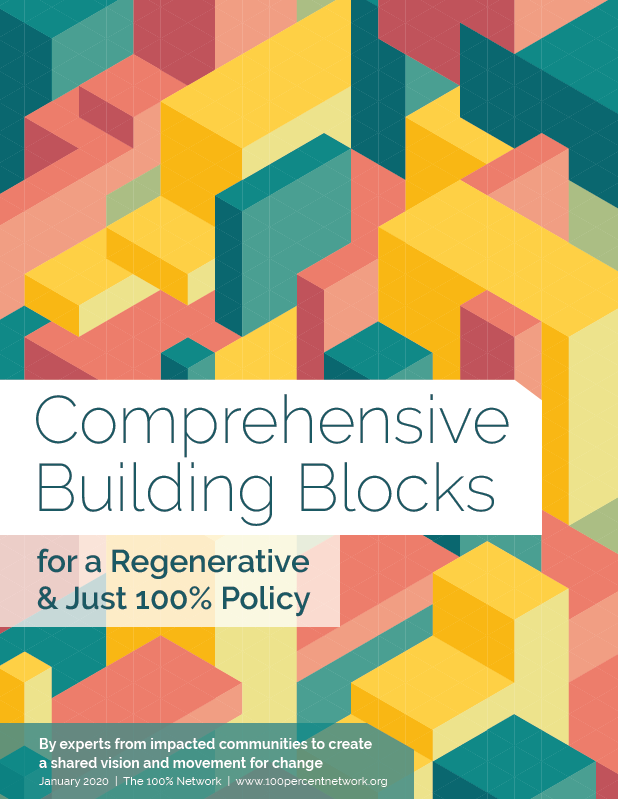 The 100% Network launched a new effort to bring forward and coalesce the expertise from frontline communities into the Comprehensive Building Blocks for a Regenerative and Just 100% Policy. This groundbreaking and extensive document lays out the components of an 100% policy that centers equity and justice.
  The American automotive industry is constantly evolving and, throughout the union’s history, the United Auto Workers (UAW) has fought to ensure industry changes result in quality jobs that benefit workers and the economy.
 An ecology movement that once seemed jaded is budding and blossoming beautifully. The fantastic efforts of the school strikes’ movement and groups like Extinction Rebellion, Earth Strike and the Green Anti-Capitalist Front have forced green issues back into mainstream public debate. This achievement has been marked by declarations that there is a ‘climate emergency’, first by the Welsh and Scottish governments and then, fittingly on 1st May, by the UK Parliament. A fortnight earlier, the University of Bristol had become the first UK university to declare a climate emergency. So successful have these campaigns been that there is now a broad consensus that something must be done. It is essential to build on this achievement and keep up the momentum. We urgently need to continue the conversation about what do to now.
 Climate change and human rights are not separate concepts, but rather go hand-in-hand. In line with the increased recognition in human rights bodies, countries around the world, and public discourse, Rights in a Changing Climate demonstrates the fundamental links between human rights and climate change and documents the growing momentum within the UN climate regime to articulate the legally binding duties of States to protect, respect, and promote human rights in the context of the climate crisis.
 Europe today confronts three overlapping crises.
 The Green New Deal Resolution submitted by Rep. Alexandria Ocasio-Cortez and Senator Ed Markey, while it includes many protections and benefits for workers, does not include language that specifically addresses workers who might be adversely affected by the transition to a climate-safe economy. Such GND proposals were soon criticized as too vague to provide protections that workers and unions could count on. AFL-CIO president Richard Trumka, for example, told the Economic Club of Washington, DC, "We would want a whole lot of changes made so that workers and our jobs are protected in the process."
 On September 28, 2019, more than 150 trade union representatives, activists and policy allies from more than a dozen countries came together in New York City for a one-day international conference on “The Green New Deal, Net-Zero Carbon, and the Crucial Role of Public Ownership.”
 THE WORLD’S LARGEST PENSION FUNDS comprise over half of global investment capital. The Canada Pension Plan Investment Board (CPPIB) manages one of the country’s largest pools of investments, at $400 billion. How pension funds choose to invest has significant bearing on how we collectively address the climate emergency and the needed energy transition away from fossil fuels. In this report we ask: Is the CPPIB investing with the 1.5-degree Celsius limit on global average temperature rise in mind?
The Fine Print I:
Disclaimer: The views expressed on this site are not the official position of the IWW (or even the IWW’s EUC) unless otherwise indicated and do not necessarily represent the views of anyone but the author’s, nor should it be assumed that any of these authors automatically support the IWW or endorse any of its positions.
Further: the inclusion of a link on our site (other than the link to the main IWW site) does not imply endorsement by or an alliance with the IWW. These sites have been chosen by our members due to their perceived relevance to the IWW EUC and are included here for informational purposes only. If you have any suggestions or comments on any of the links included (or not included) above, please contact us.
The Fine Print II:
Fair Use Notice: The material on this site is provided for educational and informational purposes. It may contain copyrighted material the use of which has not always been specifically authorized by the copyright owner. It is being made available in an effort to advance the understanding of scientific, environmental, economic, social justice and human rights issues etc.
It is believed that this constitutes a 'fair use' of any such copyrighted material as provided for in section 107 of the US Copyright Law. In accordance with Title 17 U.S.C. Section 107, the material on this site is distributed without profit to those who have an interest in using the included information for research and educational purposes. If you wish to use copyrighted material from this site for purposes of your own that go beyond 'fair use', you must obtain permission from the copyright owner. The information on this site does not constitute legal or technical advice.
 This site is not the official webpage of the Industrial Workers of the World.