

You are here

reports

Take the Plant Save the Planet (pamphlet)

By Green Jobs Oshawa - Socialist Project, March 22, 2020

On November 26, 2018, General Motors announced a number of plant closures in North America, the largest of which was in Oshawa, Ontario. The Oshawa facility, once the largest auto complex on the continent, was to end all its assembly operations by the end of 2019.

The issue is not simply a matter of bringing the environmental movement and the labour movement together; each must be transformed if the sum is to be more than the currently limited parts. The environmental movement must raise itself to a new level by concretely engaging the working class and the labour movement must escape what for it has become an existential crisis. The threats and opportunities of the environmental crisis offer a chance for labour revival, but only if this incorporates a renewed approach to organizing, struggle, radical politics, and the maximization of informed membership participation.

Read the report (PDF).

The energy crises revealed by COVID: Intersections of Indigeneity, inequity, and health

By Kathleen Brosemer, et. al. - various, Spring 2020

The global COVID-19 pandemic is a health crisis, an economic crisis, and a justice crisis. It also brings to light multiple ongoing, underlying social crises. The COVID-19 crisis is actively revealing crises of energy sovereignty in at least four ways:

  • First, there are many whose access to basic health services is compromised because of the lack of energy services necessary to provide these services.
  • Second, some people are more vulnerable to COVID-19 because of exposure to environmental pollution associated with energy production.
  • Third, energy services are vital to human well-being, yet access to energy services is largely organized as a consumer good. The loss of stable income precipitated by COVID-19 may therefore mean that many lose reliable access to essential energy services.
  • Fourth, the COVID-19 crisis has created a window of opportunity for corporate interests to engage in aggressive pursuit of energy agendas that perpetuate carbon intensive and corporate controlled energy systems, which illuminates the ongoing procedural injustices of energy decision making.

These four related crises demonstrate why energy sovereignty is essential for a just energy future. Energy sovereignty is defined as the right for communities, rather than corporate interests, to control access to and decision making regarding the sources, scales, and forms of ownership characterizing access to energy services. Energy sovereignty is a critical component in the design of a post-COVID-19 energy system that is capable of being resilient to future shocks without exacerbating injustices that are killing the most vulnerable among us.

Download (PDF).

Against Green Reactionaries: Writings on eco-fascists and exterminationists

By various - Green Antifascist - Spring 2020

A compilation of writings against ecofascist infiltration of revolutionary ecology and green anarchist milieus, includes:

  • Confronting the Rise of Eco-Fascism Means Grappling with Complex Systems - by Emmi Bevensee and Alexander Reid Ross
  • There’s nothing anarchist about Eco-Fascism - by Scott Campbell
  • On No Platform and ITS - by William Gillis
  • ITS, or the rhetoric of decay - a Joint statement of insurrectional groups in Mexican territory

Web editor's note: we highly recommend the first three sections of this document. As for the last chapter, we vehemently disagree with their anti-organizational and anti-structural dogma as well as their sectarian denunciations of "the left", but welcome their distancing from ITS and similarly minded eco-fascists. In any case, the document is a package deal. Plus, note our standard disclaimer:

Disclaimer: The views expressed here are not the official position of the IWW (or even the IWW’s EUC) and do not necessarily represent the views of anyone but the author.

Download (PDF).

Winding Down BC's Fossil Fuel Industries: Planning for Climate Justice in a Zero-Carbon Economy

By Marc Lee and Seth Klein - Corporate Mapping Project, March 2020

IMAGINE IT’S 2025 AND BECAUSE OF THE ESCALATING CLIMATE CRISIS, governments in Asia have declared ambitious new climate action plans, including the elimination of metallurgical coal for steel manufacturing within five years, to be replaced by state-of-the-art hydrogen-powered furnaces; and an aggressive transition off of natural gas and toward renewables within a dec-ade. After a short period of time, BC’s fossil fuel exports dry up, workers are laid off and local communities get hit with declines in both public- and private-sector jobs due to falling incomes.

It is this type of scenario that needs to inform planning for BC’s fossil fuel industries (coal, oil and gas). This report’s framework for a managed wind-down aspires to thoughtfully and strategic-ally phase out the extraction and production of fossil fuels in BC, most of which are exported and burned elsewhere.

The BC government’s continued interest in expanding production and export of its fossil fuels suggests little willingness to contemplate a managed wind-down so long as there are external buyers for BC resources. However, there is a risk that market conditions could change abruptly as other jurisdictions implement more aggressive climate policies and importers cut their con-sumption of fossil fuels. Fully phasing out BC’s fossil fuel industries over the next 20 to 30 years may be — for now at least — politically unthinkable. Nonetheless, this report aims to start a necessary conversation in BC. The managed wind-down framework is built on four pillars:

  1. Establish carbon budgets and fossil fuel production limits;
  2. Invest in the domestic transition from fossil fuels and develop a green industrial strategy;
  3. Ensure a just transition for workers and communities;
  4. Reform the royalty regime for fossil fuel extraction.

More than half of BC’s gas production is exported to Alberta for oil sands processing, with additional exports to the United States. Only 9 per cent of production is consumed within BC. Virtually all of the province’s coal is exported, with little domestic consumption. The bulk of production is higher-quality metallurgical coal used in steelmaking as opposed to thermal coal used to generate electricity.

Read the report (PDF).

(Working Paper #13) Transition in Trouble?: The Rise and Fall of "Community Energy" in Europe

By Sean Sweeney, John Treat and Irene HongPing Shen - Trade Unions for Energy Democracy, March 2020

This TUED Working Paper explores the current crisis of local, community, and cooperative energy. Our focus is Europe where these types of initiatives have made the most progress but now find themselves facing an uncertain future. In this paper we will explain what happened, and why. The goals of this paper are twofold.

The first goal is to draw a clear line of demarcation between the bold claims being made in the name of local and community energy, “energy citizenship,” and similar concepts on the one hand, and the cur-rent reality on the other—a reality that largely confines local energy initiatives to the margins of energy systems. In the case of Europe, the distance between the claims and the reality is vast, and it is widening.

Local and community energy has attracted a lot of support and enthusiasm from activists, and it is not hard to understand why this is the case. Efforts to advance community energy are frequently carried out in the name of a commitment to social justice, advancing equality, and empowering ordinary people to take a more active role in the transition to a low carbon future. Additionally, the activists and organizations undertaking such initiatives nearly always identify with a “values-driven” mission and aim to rise above considerations of personal gain or private profit.

For a period, it seemed that such initiatives were emerging everywhere across Europe. The growth of renewable energy and the proliferation of citizen and community ownership seemed to be in-separable from each other. Spurred on by falling costs of wind and solar technologies, a radical transition in energy ownership—and a shift in control away from large energy companies to small producers and consumers—seemed not only possible, but perhaps even imminent.

But recent policy changes in Europe have placed community energy into a pattern of decline. The removal of subsidies, particularly the Feed-in Tariff, and other incentives has led to a dramatic slow-down in local energy initiatives and cooperatives. The number of households installing solar photovoltaic panels (solar PV) has slowed to a crawl as onshore wind projects have also declined. While offshore wind installations are increasing, the total level of investment and deployment of renew-able energy in Europe has fallen dramatically.

Read the report (PDF).

The Future of Alberta's Oil Sands Industry: More Production, Less Capital, Fewer Jobs

By Ian Hussey - Parkland Institute, March 2020

Major restructuring and consolidation of the Alberta-dominated Canadian oil and gas industry has been taking place since 2014 (Hussey et al. 2018), when the lower-for-longer oil price scenario in which the province still finds itself began.

This report explores the employment, capital spending, and operational spending implications of the ongoing restructuring and consolidation of the industry. More specifically, the report explains that oil sands industry maturation—which was significantly advanced over the latest commodity cycle—means there has been a recent shift in the industry from its growth phase (2000–2018) to its mature phase (2019 onward).

Read the report (Link).

Fighting the wrong battles: how obsession with military power diverts resources from the climate crisis

By Sam Perlo-Freeman - Campaign Against Arms Trade, February 15, 2020

The first duty of government, it is often said, is to provide for the security of its people. But what is security? For whom, and from what? UK governments typically view security through a military lens; but the real threats affecting the security of people in the UK and worldwide, most urgently the climate crisis, are not susceptible to military force, and indeed military interventions by the UK and its allies this century have had an overwhelmingly disastrous impact on peace and security.
The central role of the military in the government’s understanding of security is reflected in budgetary allocations. There is thus a widespread consensus on maintaining military spending at a minimum of 2% of GDP, the NATO target, with many politicians calling for far higher levels. Meanwhile, the climate crisis, the most urgent threat to human security worldwide, receives far less funding.

Military security or sustainable security

This report argues for a shift of focus both in understanding of security and in resources away from military security and towards a concept of sustainable security that prioritises the security of people over that of states and addresses the underlying causes of conflict and insecurity. In particular, the climate crisis needs to be treated as the urgent, devastating and present threat to human security that it is, with resources allocated accordingly.

Arguments for higher military spending typically start from the premise that the world is an ever more dangerous place. While this contains an element of truth, such arguments are based on a narrow and fundamentally flawed understanding of security centred on military power. The conclusion that what is needed is greater military force from the west is fallacious. Indeed, it has often been the actions of the UK and its allies that have made the world more dangerous, as in Iraq.

Non-military security challenges are minimised or ignored. Climate change, for example, is barely mentioned in the Government’s most recent Strategic Defence and Security Review. When mentioned, they are often framed in terms of the impact on national security, and approached with ‘hard’ security responses, such as militarised borders to deal with mass migration. Meanwhile, ambitions for the UK to retain or regain status as a ‘great military power’, able to project military force around the world, are presented as essential requirements for security, on a par with ensuring the survival and sovereignty of the nation.

Read the text (PDF).

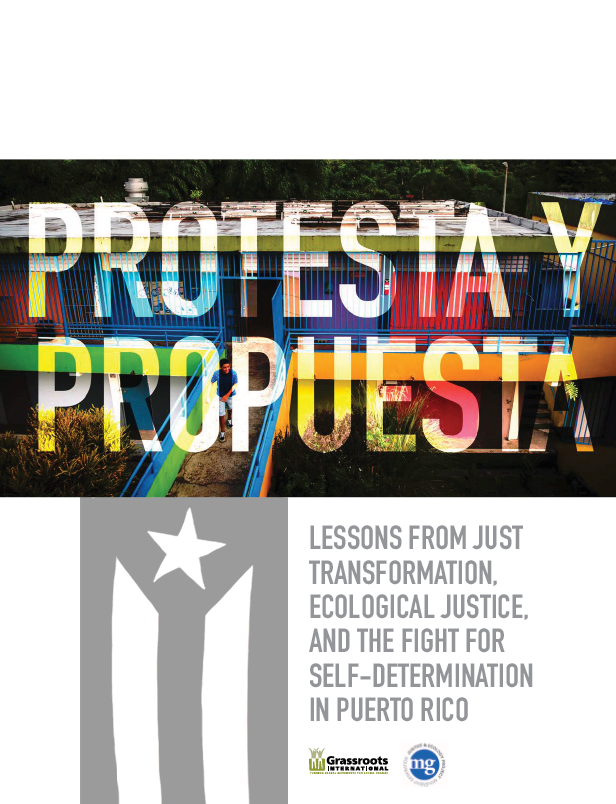
Protesta Y Propuesta: Lessons from Just Transformation, Ecological Justice, and the Fight for Self-Determination in Puerto Rico

By Brooke Anderson and Jovanna García Soto - Grassroots International and Movement Generation, February 2020

“De la Protesta a la Propuesta” (“From protest to proposal”). That’s the slogan that watershed protectors used when they successfully stopped open pit mining in the heart of Puerto Rico’s mountains then brought those same lands under community control. For those of us looking to build just transformation in place, we have much to learn from Puerto Rico’s social movements which are at once both visionary and oppositional, centering sovereignty and self-governance.

Just transformation, or just transition, is the work “to transition whole communities toward thriving economies that provide dignified, productive, and ecologically sustainable livelihoods that are governed directly by workers and communities.”

In the U.S., the term just transition was originally used by the labor movement to demand that with the phaseout of polluting industries, workers would be retrained and adequately compensated rather than bear yet another cost from working in that industry. Environmental justice communities on the fenceline of these polluting industries then built common cause with workers for a just transition that would not put the environmental or economic burden on workers or communities. In the U.S., the term has since further evolved to capture systemic transformation of the whole economy. While U.S. frontline groups often use the term just transition, some Puerto Rican social movements use the term just transformation—especially as a way to capture the necessity of achieving decolonization and sovereignty as part of any transition. As such, we’ll be using just transformation in this report, as well as other concepts such as self-determination and ecological justice.

Read the report (Link).

Scotland's Just Transition Commission Interim Report

By Jim Skea, et. al. - Scottish Just Transition Commission, February 2020

1.1 The Just Transition Commission was established by Scottish Ministers to advise on how just transition principles can be applied to climate change action in Scotland. Our remit is to prepare practical recommendations within two years of our first meeting, meaning our final report is due to be shared with Ministers by January 2021. We have been asked for recommendations that will help support action to:

  • maximise the economic and social opportunities that the move to a net-zero economy by 2045 offers
  • build on Scotland’s existing strengths and assets
  • understand and mitigate risks that could arise in relation to regional cohesion, equalities, poverty (including fuel poverty), and a sustainable and inclusive labour market

1.2 This report has been prepared as a result of a request from the Cabinet Secretary for Environment, Climate Change, and Land Reform asking for interim advice to inform the updated Climate Change Plan. We hope this document can be helpful in this regard.

1.3 We held our inception meeting at the start of last year, when we agreed a work plan and an approach to collecting evidence. Since that initial meeting, we have travelled the country speaking to a range of stakeholders regarding the challenges and opportunities of transitioning to a net-zero economy. This has included a variety of activities, such as consideration of written evidence, discussions with experts, engagement events and site visits.

1.4 While we have been carrying out this programme of work, we are very aware that public concern over the impact and response to climate change has never been higher. There have also been important changes on the policy front. With this in mind, there are a number of developments that we can point to as being broadly positive in terms of delivering a just transition to a net-zero economy in Scotland.

Read the report (Link).

What could be wrong about planting trees?: The new push for more industrial tree plantations in the Global South

By Winfridus Overbeek - World Rainforest Movement, February 2020

What could be wrong about planting trees? Haven’t communities around the world been planting a diversity of trees since the dawn of human civilization?

Yes they have. But in more recent times, companies have also been planting trees, especially in Africa, Asia and Latin America, and the way they do so is very different from that of communities. They cover huge areas with trees from one single species, creating vast industrial or monoculture plantations devoid of biodiversity.

Today, these same companies plan to start a new round of massive expansion. Exploiting growing public awareness and concern about climate change, they argue that monoculture plantations are an excellent option to help solve some of the world’s most urgent problems: loss of forests, global heating and dependence on fossil fuels (oil, coal and gas).

The corporate argument is that plantations will encourage “forest restoration”, can serve as a natural “solution” to the climate emergency, or help foster a “bio-economy”.

The simple truth, however, is that the industries involved want more plantations simply to increase their profit margins. And other industries and polluters are also using such deceptive arguments, in order to hide their contributions to an ever-worsening social and environmental planetary crisis.

In this booklet, WRM aims to alert community groups and activists about the corporate push for a new round of industrial tree plantation expansion. It also reveals why planting trees on such a large scale can be extremely detrimental, in spite of seductive marketing campaigns claiming that these plantations will or could be a “solution” to the climate crisis.

Read the report (PDF).

Pages

The Fine Print I:

Disclaimer: The views expressed on this site are not the official position of the IWW (or even the IWW’s EUC) unless otherwise indicated and do not necessarily represent the views of anyone but the author’s, nor should it be assumed that any of these authors automatically support the IWW or endorse any of its positions.

Further: the inclusion of a link on our site (other than the link to the main IWW site) does not imply endorsement by or an alliance with the IWW. These sites have been chosen by our members due to their perceived relevance to the IWW EUC and are included here for informational purposes only. If you have any suggestions or comments on any of the links included (or not included) above, please contact us.

The Fine Print II:

Fair Use Notice: The material on this site is provided for educational and informational purposes. It may contain copyrighted material the use of which has not always been specifically authorized by the copyright owner. It is being made available in an effort to advance the understanding of scientific, environmental, economic, social justice and human rights issues etc.

It is believed that this constitutes a 'fair use' of any such copyrighted material as provided for in section 107 of the US Copyright Law. In accordance with Title 17 U.S.C. Section 107, the material on this site is distributed without profit to those who have an interest in using the included information for research and educational purposes. If you wish to use copyrighted material from this site for purposes of your own that go beyond 'fair use', you must obtain permission from the copyright owner. The information on this site does not constitute legal or technical advice.
