

You are here

climate change

They Wanted to Keep Working; Exxon-Mobil Locked Them Out: Facing deunionization efforts and the existential threat of climate change, oil refiners in Beaumont, Texas, seek a fair contract

By Mindy Isser - In These Times, May 24, 2021

The lockout began May 1, known in most parts of the world as International Workers’ Day. In a matter of hours, the ExxonMobil Corporation escorted 650 oil refiners in Beaumont, Texas, off the job, replacing experienced members of United Steelworkers (USW) Local 13 – 243 with temporary workers in an effort to force a vote on Exxon’s latest contract proposal. USW maintains the proposal violates basic principles of seniority, and more than three weeks after the union members were marched out of their facility, they remain locked out.

“We would have rather kept everyone working until we reached an agreement,” Bryan Gross, a staff representative for USW, tells In These Times. ​“That was our goal.”

Because strikes and lockouts are often measures taken under more dire circumstances, either when bargaining has completely stalled or is being conducted in bad faith, USW proposed a one-year contract extension. But Exxon rejected the offer, holding out for huge changes to contractual language regarding seniority, safety and layoffs. ​“It’s a control issue,” Gross adds. ​“Exxon wants control.”

As the oil industry attempts to deskill (and ultimately deunionize) its labor force, refinery workers like those in Beaumont find themselves under siege. Not only is their industry buckling beneath the weight of a global health crisis, but climate change has come to threaten their very livelihoods. Many workers remain skeptical of existing plans for a just transition.

Once again on sabotage and climate change

By Lars Henriksson - Climate and Capitalism, May 22, 2021

What should we do when airy political promises amount to little more than excuses for business as usual, and when the friendly climate protests have not prevented the world from heading towards a burning inferno? Submissively accept doom or take the climate struggle to a new level?
That Andreas Malm does not preach resignation will come as no surprise to those who know the author — activist and socialist since childhood and today well-known in the radical section of international academia. For those unfamiliar with him, the book’s title should dispel all doubt.

To stoically wait for doom is not an option for most of us, even if some claim to have drawn that conclusion. The book’s final section is a reckoning with intellectuals such as Roy Scranton and Jonathan Franzen who flirt with that standpoint.

For the rest of us, who either try to do something, or wish we knew how to do something, the question is: what do we do now? It is this question to which Malm devotes most of his book.

The attention given to the book ahead of publication has mostly concerned the question of sabotage as a method in the climate struggle. Despite the book’s provocative title, this is far from an anarchist cookbook but a thought-through — albeit impatient — contribution to the debate about strategy and tactics in the climate movement.

Malm raises a question posed by the British author John Lanchester: Why has the climate movement not resorted to violence? Given what is at stake is humanity’s survival, it is strange that nobody has started blowing up petrol stations or at least started scratching the paint on city jeeps, Lanchester states, in what Malm refers to as Lanchester’s paradox.

In the latter case, the effort is very small and would make these gas guzzling monster cars almost impossible to own in a city like London. Malm himself has a past as an SUV-saboteur of the milder kind, when the group The Indians of the Concrete Jungle in the early 2000s let the air out of gas guzzling luxury cars’ tyres in upper class neighborhoods. He takes this paradox — that the climate movement, despite knowing what is at stake, continues to be peaceful and well behaved — as the starting point for his argument.

“What’s the alternative?”: Answering the hardest question asked by workers and communities that feel threatened by energy transition

By Sean O'Leary - Ohio River Valley Institute, May 18, 2021

At ORVI, we’ve documented the inability of the fossil fuel and petrochemical industries to serve as engines for job growth and prosperity in Appalachia. Although these findings may be greeted with doubt, disbelief, and sometimes anger, we find that, once the numbers sink in and people in the mining and fracking regions of Pennsylvania and the Ohio Valley look around at their communities — the struggling downtowns, declining populations, and the departures of their sons and daughters to places far away in search of opportunity — reality usually takes hold.

It can be a profoundly sad moment. But, for local leaders who may have invested years promoting these industries as economic saviors, the realization can be bitter and give rise to a question that is equal parts a challenge and a plea — What’s the alternative?

When you’re on the receiving end of that question, you feel its weight. And, if you don’t have an answer, you can feel that you’re stealing someone’s — maybe an entire community’s — hope and you’re leaving them with nothing.

IEA calls for a future without fossil fuel investment

By Elizbeth Perry - Work and Climate Change Report, May 18, 2021

Net Zero in 2050: A roadmap for the global energy system was released by the International Energy Agency on May 18, and has been described as a “bombshell”, and a “landmark”. Why? The normally conservative IEA describes the global energy future bluntly and urgently, calling for “…. from today, no investment in new fossil fuel supply projects, and no further final investment decisions for new unabated coal plants. By 2035, there are no sales of new internal combustion engine passenger cars, and by 2040, the global electricity sector has already reached net-zero emissions.”

This special report claims to be “ the world’s first comprehensive study of how to transition to a net zero energy system by 2050 while ensuring stable and affordable energy supplies, providing universal energy access, and enabling robust economic growth.” It sets out 400 indicators for “an economically productive pathway to 2050”, where energy production will be dominated by renewables instead of fossil fuels. The report also flags and discusses bioenergy, carbon capture, and behavioural changes as “key uncertainties” for the future.

Highlights from the discussion of employment in Chapter 4:

  • In 2021, approx. roughly 40 million people work directly in the oil, gas, coal, renewables, bioenergy and energy network industries . 
  • By 2030 in the Net Zero scenario, 30 million more people will be working in clean energy, efficiency and low‐emissions technologies. 
  • By 2030, employment in oil, gas and coal fuel supply and power plants will decline by around 5 million jobs.
  • Nearly two‐thirds of workers in the emerging clean energy sectors will be highly skilled by 2030, and the majority will require substantial training. 
  • The new jobs created in the net zero economy will have more geographic flexibility. Around 40% are jobs located close to where the work is being done, e.g. building efficiency improvements or wind turbine installation, and the remaining are jobs tied to manufacturing sites. 

Canada’s Climate Emergency Unit seeks to light a spark across Canada

By Elizabeth Perry - Work and Climate Change Report, May 17, 2021

A report released at the end of April examines the performance and the links between Canada’s oil companies

The Climate Emergency Unit is a newly-launched initiative of the David Suzuki Institute, with the Sierra Club B.C. and the Rapid Decarbonization Group of Quebec as Strategic Partners. The Unit is led by Seth Klein and inspired by his 2020 book, A Good War: Mobilizing Canada for the Climate Emergency, which argues that climate mobilization requires an effort similar to what previous generations expended against the existential threat of fascism during the Second World War. (This is an approach shared with the U.S. group The Climate Mobilization, and others). The stated goal of the CEU is “to work with all levels of government and civil society organizations – federal, provincial, local and Indigenous governments, businesses, trade unions, public institutions and agencies, and industrial/sectoral associations” – to network, educate and advocate for the mobilization ideas in A Good War, to decarbonize and electrify Canadian society and the economy, while enhancing social justice and equity. 

In an article in Policy Options in November 2020, Klein summarizes the four hallmarks of a government committed to an urgent, emergency response:

  • It spends what it takes to win;
  • It creates new economic institutions to get the job done;
  • It shifts from voluntary and incentive-based policies to mandatory measures;
  • It tells the truth about the severity of the crisis and communicates a sense of urgency about the measures necessary to combat it.

Seth Klein was the founding Director of the Canadian Centre for Policy Alternatives in British Columbia, and continues to publish in the CCPA Policy Note , as well as in the Climate Emergency Unit blog, and as a columnist for The National Observer – for example, with “Feds need to treat climate crisis like a national emergency” on April 30.

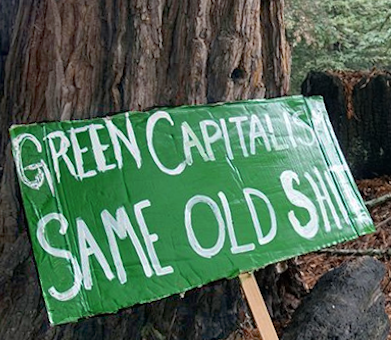
Green Economy, Green Capitalism? The Case Against The Case for Climate Capitalism

By Nick Grover - The Bullet, May 14, 2021

Even now, with a ten-year timeframe left for action, it’s rare for the climate crisis to be treated as the emergency it is. So, credit where due to Tom Rand. In his The Case for Climate Capitalism: Economic Solutions for a Planet in Crisis (Toronto: ECW Press, 2020), Rand calls for a rapid transition away from fossil fuels and toward renewables; he blames the political and business elite for the mess and says they will have to pay the price as markets turn against oil and assets are stranded; he even advocates for expansion of public transit. Where the book gets less refreshing is Rand’s tone toward the people who have been saying these things all along: his secondary enemy, leftists fusing demands for climate action with calls for economic justice.

Rand’s Case for Climate Capitalism aims to preserve and “co-opt” the forces of capitalism to usher in a transition toward green tech. His case is presented as simple pragmatism: the emergency we face affords us no time to discuss economic reforms; we must unite and do what works instead of holding out for a perfect system. His concern is that left ideas like the Green New Deal and Leap Manifesto – which wed strong climate action with job guarantees, labour protections, taxing the rich, and expanding social programs – alienate conservatives and the business class when we need them in our coalition to save the planet.

Congress Should Enact a Federal Renewable Electricity Standard and Reject Gas and False Solutions

By various - (690 Organizations), May 13, 2021

Dear Majority Leader Schumer, Speaker Pelosi, Chairman Manchin, and Chairman Pallone,

On behalf of our millions of members and activists nationwide, we, the undersigned 697 organizations—including climate, environmental and energy justice, democracy, faith, Indigenous, and racial justice groups—urge you to pass a Renewable Electricity Standard (RES) in the infrastructure package and reject gas and other false climate solutions to address the climate emergency.

As Congress prepares to pass a historic infrastructure package and President Biden has globally pledged to slash carbon emissions by 50% below 2005 levels by 2030, we should look to the 28 states, Washington, D.C., and Puerto Rico that have passed Renewable Electricity Standards (also known as renewable portfolio standards), as opposed to only seven states with Clean Electricity Standards (CES). The bold leadership demonstrated in RES-leading states like Hawaii, Vermont, and Washington, D.C. provide a roadmap to building a new renewable energy future. Funding this transition must start with shifting all fossil fuel subsidies to mass renewable energy deployment.

Renewable energy sources are sources that naturally replenish and are most often defined as solar, wind, and geothermal power. In contrast, so-called “clean” energy standards generally encompass these renewable sources but also include other technologies, like gas with or without carbon capture and sequestration, biomass, and nuclear, which are significant sources of pollution and carry a host of health and safety risks. In order to avoid perpetuating the deep racial, social, and ecological injustices of our current fossil-fueled energy system, Congress should ensure that any federal energy standard does not include these dirty energy sources.

Specifically, we write to express our concern that recent Clean Electricity Standard (CES) legislation, including the CLEAN Future Act (H.R. 1512), embed these injustices because they include gas and false solutions. The inclusion of gas and carbon capture and storage as qualifying energies in any CES undermines efforts to end the fossil fuel era and halt the devastating pollution disproportionately experienced by Black, Brown, Indigenous, and other communities of color in this country. Even a partial credit for fossil fuel resources that attempts to factor in lifecycle emissions runs the risk of subsidizing environmental harm for years to come. Allowing dirty energy to be bundled with clean energy under a federal energy standard would prolong the existence of sacrifice zones around dirty energy investments and delay the transition to a system of 100 percent truly clean, renewable energy.

Utility Workers Union and UCS estimate costs to transition U.S. coal miners and power plant workers in joint report

By Elizabeth Perry - Work and Climate Change Report, May 12, 2021

Hard on the heels of the April statement by the United Mine Workers Union, Preserving Coal Country: Keeping America’s coal miners, families and communities whole in an era of global energy transition, the Utility Workers Union of America (UWUA) jointly released a report with the Union of Concerned Scientists on May 4: Supporting the Nation’s Coal Workers and Communities in a Changing Energy Landscape. This report is described as “a call to action for thoughtful and intentional planning and comprehensive support for coal-dependent workers and communities across the nation.” The report estimates that in 2019, there were 52,804 workers in coal mining and 37,071 people employed at coal-fired power plants – and that eventually all will lose their jobs as coal gives way to cleaner energy sources. Like the United Mine Workers, the report acknowledges that the energy shift is already underway, and “rather than offer false hope for reinvigorated coal markets, we must acknowledge that thoughtful and intentional planning and comprehensive support are critical to honoring the workers and communities that have sacrificed so much to build this country.”

Specifically, the report calls for a minimum level of support for workers of five years of wage replacement, health coverage, continued employer contributions to retirement funds or pension plans, and tuition and job placement assistance. The cost estimates of such supports are pegged at $33 billion over 25 years and $83 billion over 15 years —and do not factor in additional costs such as health benefits for workers suffering black lung disease, or mine clean-up costs. The report states: “we must ensure that coal companies and utilities are held liable for the costs to the greatest extent possible before saddling taxpayers with the bill.” Neither do the cost estimates include the recognized needs for community supports such as programs to diversify the economies, or support to ensure that essential services such as fire, police and education are supported, despite the diminished tax base. 

The report points to the precedents set by Canada’s Task Force on Just Transition for Canadian Coal Power Workers and Communities ( 2018), the German Commission on Growth, Structural Change and Employment (2019), as well as the New Mexico Energy Transition Act 2019 and the Colorado Just Transition Action Plan in 2020. The 12-page report, Supporting the Nation’s Coal Workers and Communities in a Changing Energy Landscape was accompanied by a Technical Report, and summarized in a UCS Blog which highlights the situation in Illinois, Michigan, and Minnesota. A 2018 report from UCS Soot to Solar also examined Illinois.

The National Black Climate Summit

Luddism for the age of robotics

By Simon Pirani - The Ecologist, May 7, 2021

Climate breakdown is driven by industrial production, production by machines controlled by people. But can those very people demand a new, low carbon production?

Are the technologies developed by giant capitalist corporations – Walmart’s logistics or Elon Musk’s driverless cars – the foundation on which a post-capitalist society can be built? No way, argues Gavin Mueller in his latest book, Breaking Things At Work: the Luddites were right about why you hate your job (Verso, 2021).

He challenges “Marxist theoreticians” who see “the capitalist development of technology as the means for creating both abundance and leisure”, to be “realised once the masses finally [take] the reins of government and industry”.

Against these technocratic illusions, Mueller proposes “a decelerationist politics: of slowing down change, undermining technological progress, and limiting capital’s rapacity, while developing organisation and cultivating militancy”.

Pages

The Fine Print I:

Disclaimer: The views expressed on this site are not the official position of the IWW (or even the IWW’s EUC) unless otherwise indicated and do not necessarily represent the views of anyone but the author’s, nor should it be assumed that any of these authors automatically support the IWW or endorse any of its positions.

Further: the inclusion of a link on our site (other than the link to the main IWW site) does not imply endorsement by or an alliance with the IWW. These sites have been chosen by our members due to their perceived relevance to the IWW EUC and are included here for informational purposes only. If you have any suggestions or comments on any of the links included (or not included) above, please contact us.

The Fine Print II:

Fair Use Notice: The material on this site is provided for educational and informational purposes. It may contain copyrighted material the use of which has not always been specifically authorized by the copyright owner. It is being made available in an effort to advance the understanding of scientific, environmental, economic, social justice and human rights issues etc.

It is believed that this constitutes a 'fair use' of any such copyrighted material as provided for in section 107 of the US Copyright Law. In accordance with Title 17 U.S.C. Section 107, the material on this site is distributed without profit to those who have an interest in using the included information for research and educational purposes. If you wish to use copyrighted material from this site for purposes of your own that go beyond 'fair use', you must obtain permission from the copyright owner. The information on this site does not constitute legal or technical advice.
