You are here

climate justice

Climate politics at a dead end – How to build a new road

By Patrick Mazza - Cascadia Planet, November 13, 2014

Disclaimer: The views expressed here are not the official position of the IWW (or even the IWW’s EUC) and do not necessarily represent the views of anyone but the author’s.

Climate politics is dead-ended. 

It may seem strange to make such a statement in the wake of the much-heralded U.S.-China climate deal announced November 12.  So let me clarify.

President Obama did announce the intent to reduce U.S. carbon emissions 26-28% by 2025, while China said it would peak carbon emissions and generate at least 20% of its energy from non-fossil sources by 2030. 

All well and good, but far from the 6% annual emissions cuts required to hold overall global warming under 2° Celsius, the minimal borderline between climate disruption that is merely severe and that which is utterly catastrophic (though many scientists believe the cutoff is more like 1.5°C). In other words, the U.S.-China agreement represents only a slower road to climate hell.

Okay, but it’s a start, right?

“The agreement with China is a good first step. But we hope it is but a first step because it is not enough to prevent significant climate change,” noted Kevin Trenberth, senior scientist at the National Center for Atmospheric Research.

Unfortunately, it may be the last step possible in the current political environment.  Republican election victories in the U.S. Senate and states around the country have put legislative progress on global warming into a deep freeze.

Book Review Symposium: This Changes Everything; Capitalism vs. the Climate

By Noel Castree, Juan Declet-Barreto, Leigh Johnson, Wendy Larner, Diana Liverman, and Michael Watts - Academia.Edu, November 2014

In Naomi Klein’s latest book, This Changes Everything: Capitalism vs. the Climate (Simon & Schuster, 2014), the activist, journalist, and author lays out an argument that will probably be familiar to many readers of Human Geography . Carbon is not the problem, but rather a symptom of the real problem: global capitalism. The purpose of this Human Geography book review symposium is to give serious academic consideration to Klein’s ideas, arguments, and visions of a carbon-free future. Thus in the pages that follow, six geographers—Noel Castree, Juan Declet-Barreto, Leigh Johnson, Wendy Larner, Diana Liverman, and Michael Watts—weigh in with their readings and critiques of Klein’s book. Following these six reviews and concluding the symposium is the full text of the hour-long interview conducted by John Finn with Klein in late 2014.

Read the text (Link).

As Casualties Mount, Scientists Say Global Warming Has Been "Hugely Underestimated"

By Dahr Jamail - TruthOut, October 20, 2014

Disclaimer: The views expressed here are not the official position of the IWW (or even the IWW’s EUC) and do not necessarily represent the views of anyone but the author’s.

As we look across the globe this month, the signs of a continued escalation of the impacts of runaway anthropogenic climate disruption (ACD) continue to increase, alongside a drumbeat of fresh scientific studies confirming their connection to the ongoing human geo-engineering project of emitting carbon dioxide at ever-increasing rates into the atmosphere.

A major study recently published in New Scientist found that "scientists may have hugely underestimated the extent of global warming because temperature readings from southern hemisphere seas were inaccurate," and said that ACD is "worse than we thought" because it is happening "faster than we realized."

As has become predictable now, as evidence of increasing ACD continues to mount, denial and corporate exploitation are accelerating right along with it.

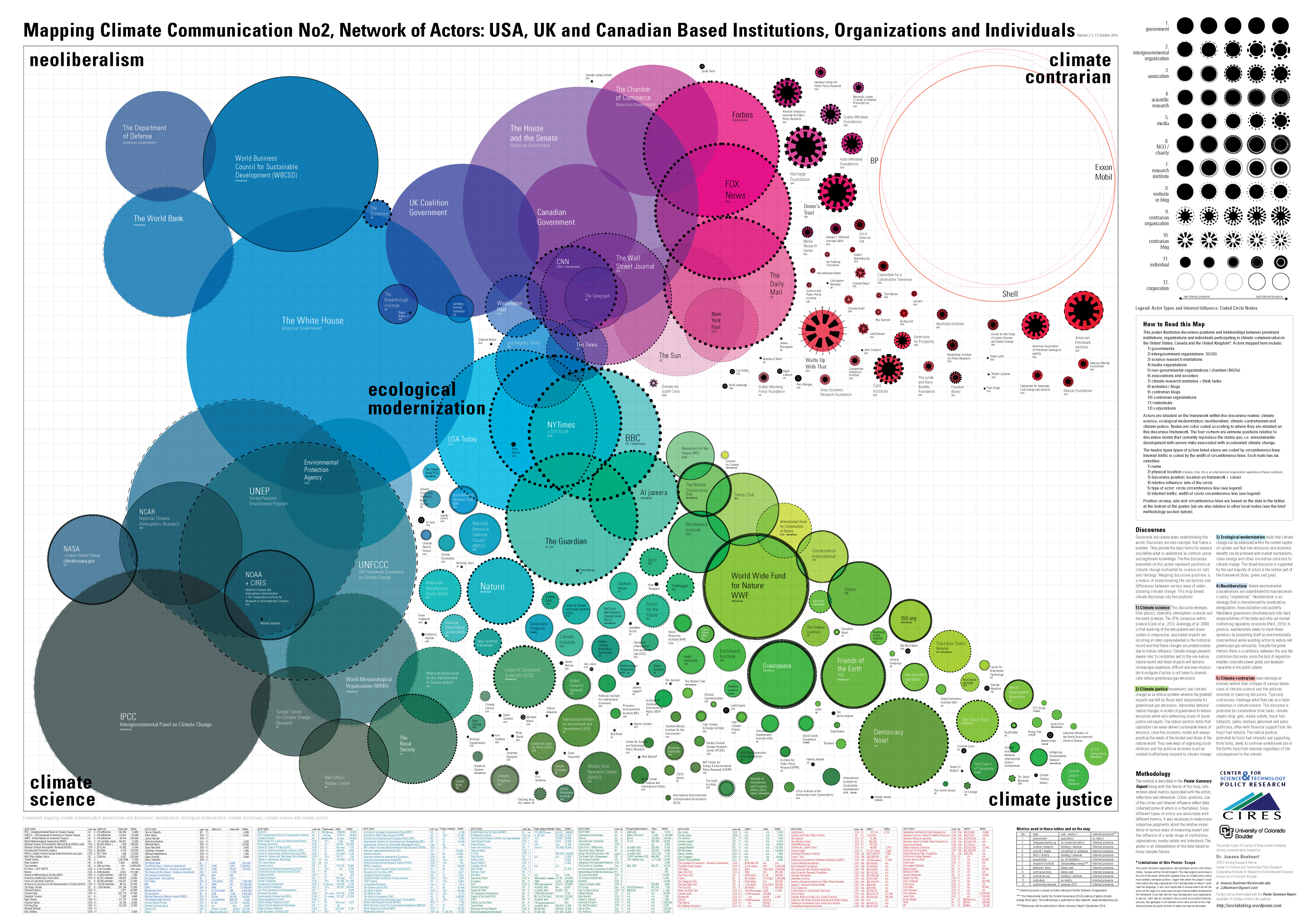
Mapping Climate Justice

By Dr Joanna "Jody" Boehnert - EcoLabs, October 16, 2014

Disclaimer: The views expressed here are not the official position of the IWW (or even the IWW’s EUC) and do not necessarily represent the views of anyone but the author’s.

Web Editor's Note: The IWW Environmental Unionism Caucus is featured on the climate map as one of the "climate justice" organizations.

The Mapping Climate Communication Project illustrates key events, participants and strategies in climate communication.

1) Climate Timeline visualizes the historical processes and events that have lead to various ways of communicating climate change. Key scientific, political and cultural events are plotted on a timeline that contextualizes this information within five climate discourses. These reveal very different ideological, political and scientific assumptions on climate change.

2) Network of Actors displays relationships between 237 individuals, organizations and institutions participating in climate communication in Canada, United States and the United Kingdom.

Details about this project can be found in the Mapping Climate Communication: PosterSummary Report. This report can be downloaded here:


The maps reveal how specific details in climate communication are contextualized within complex debates. For example:

  • How does a climate march impact the volume of media coverage of climate change?
  • How does the work of the climate denial industry potentially impact climate policy?
  • Do popular movies and books on climate result in activity in the climate movement?
  • What are the relationships between organizations active in climate communication?

By illustrating key events and actors over time and within five discourses this work makes links between disparate factors and reveals dynamics that contribute to public understanding of climate change.

The project also explores politicised issues in climate communication by using a discourse approach to analyse the various strategies and ideologies held by those organizations, institutions and individuals participating in climate communication in the public realm. This report describes the impact of neoliberal dogma and modes of governance on climate communication as one of the central problems preventing a global response to climate change. Theorizing the impact of neoliberalism on climate change communication and policy is key to an understanding of why emissions continue to rise despite the significant work by the climate science community and the environmental movement over the past four decades.

The U.S. Export-Import Bank’s Dirty Dollars: U.S. tax dollars are supporting human rights, environment, and labor violations at the Sasan Coal-Fired Power Plant and Mine in India

By various - Sierra Club, 350.org, Carbon Market Watch, Pacific Environment, and FOE, October 2014

In January and May 2014, a coalition of non-governmental organizations (NGOs), the Sierra Club, 350.org, Carbon Market Watch, Pacific Environment, and Friends of the Earth U.S. (hereafter referred to as the Fact Finding Team), undertook two field visits to Singrauli, India, to meet with communities affected by Reliance Power’s Sasan Ultra Mega Power Project (UMPP) and its associated mine to assess the project’s effect on local communities and the environment.

Since the U.S. Export-Import Bank (Ex-Im Bank) approved over $900 million in financing for the coal project in October 2010, little information has been provided by the agency about Sasan’s compliance with Ex-Im environmental, social, human rights, and corruption policies. This includes the Bank’s commitments under the Equator Principles1 and the International Finance Corporation (IFC) Performance Standards,2 the agency’s environmental, social, human rights and corruption policies, as well whether or not the project has lived up to the expectations laid out in the Environmental and Social Impact Assessment (ESIA) documents for the mine and the power plant. An apparent lack of oversight prompted the NGOs involved in this report to conduct this independent investigation. The Fact Finding Team has uncovered numerous reports of corruption and human rights and labor violations associated with the Sasan coal project, all of which have largely been ignored by the Ex- Im Bank.

Read the report (PDF).

Railroad Worker Jen Wallis: "The Fence is Capitalism...It's Time to Take it Down!"

By Jen Wallis - exclusive, September 21, 2014

Disclaimer: The views expressed here are not the official position of the IWW (or even the IWW’s EUC) and do not necessarily represent the views of anyone but the author’s.

Editor's note: Jen Wallis meant to give the following speech at the People's Climate March in Seattle on Sunday, September 21, 2014, but had to abbreviate it due to time constraints. Here is the entire speech she would have given:

Hi my name is Jen Wallis, and I’m a founding member of Railroad Workers United. We are a rank-and-file caucus of the various national and international railroad unions. A few of us started this organization to respond to the decades of infighting created by the carriers to keep us divided.

I've been a conductor with BNSF Railway for over ten years. In 2008, I was injured on the job through no fault of my own. I was one of the first workers to file a whistleblower suit against a major railroad for retaliation for reporting a work-related injury. After 6 years of litigation, I won my case in Federal Court this past March, so I know a little bit about what it takes to fight corporations and what they will do to you and your family. I lost much of my support system, and I lost my house to foreclosure. And just as a side note, I first met Kshama Sawant when she showed up and got arrested for those of us fighting foreclosure. She is amazing!!! Over 1,000 railroaders who filed similar complaints have lost. I’m one of a handful to have won. The railroads have a lot of money to fight you, and they usually win.

I’ve taken it upon myself to use my victory to speak out for safety on the railroad because I’m one of the few people who can and not get fired for it, and I was actually in San Francisco speaking at a labor conference this past July when I got word that a group of unelected union officials from the conductor’s union had been meeting in secret with BNSF for 18 months, and unleashed a proposal that would have ended the job of the conductor on freight trains right here in my territory. My job. One person running trains at least a mile long through our communities where there have always been at least two, and engineer and a conductor. 140 years of railroading tradition gone with one contract. All the railroads would follow that precedent.

So we at Railroad Workers United went into what I can only call DEFCON 1 organizing. We had less than a month to mount a campaign to vote no before ballots were to be sent out. There were plenty of carrots in the agreement being dangled for the huge numbers of new hires we have, with things like “worker retention board” which claimed if you can’t hold a job, we’ll pay you to sit at home and not work, ending pay scale for new hires, and huge buy-outs for those getting close to retirement anyway. It was the standard concessionary agreement. Now those of us who have been in the game long enough knew these were only empty promises. We’ve seen enough of these broken in our careers, but the massive numbers of new hires did not, and we saw what scare tactics do at places like Boeing. Unions usually don’t defeat concessionary contracts, even when those companies are swimming in profits.

We knew we had to be bold, as bold as they were. I immediately started a FB group to protest the meeting in Sea-Tac where the officers would be to give us the hard-sell pitch. Now railroaders aren’t allowed to strike, and we haven’t done much in terms of organizing anything since 1894. You won’t find many of us who have ever so much as held a sign on a picket line. So I invited people who are more comfortable with holding signs - I invited my environmentalist friends I’d been trying to build alliances with these last couple of years - people from Backbone, from 350.org, Rising Tide, and members of the more radical unions like the Teamsters and Teachers and ILWU, and they showed up for us. Jess Spear showed up for us. The media we got in Seattle from that little picket inspired towns all across the country to follow suit. In places like Greybull, Wyoming and Creston Iowa, we got the spouses and families out there holding signs, (probably for the first times in their life), because they know our jobs and how terrifying it would be to have their loved ones out on these dangerous trains by themselves working under extreme fatigue in every kind of weather. We added over 2,000 new members to our facebook group in a month, distributed thousands of stickers and flyers and talking points. Many of us put our lives on hold and spent every waking moment organizing around this.

Finally, on September 10th, less than two months after we first got wind of it, the results were in. From the Gulf Coast to the Great Lakes to right here in the Pacific Northwest, our members voted that proposal down. It was one of the proudest moments of my life. But as sweet as that victory was, none of that means anything compared to this fight against climate change. I have a 9 year-old son. I read recently that by the time he is my age, at the rate we’re going, this planet will experience a mass extinction. Extinction! And I can’t help but wonder If I’ve really done enough to protect him from that future.

Now our recent victory was a huge inspiration to all of us. We now know what we have to do, and we know what it takes to do it. We understand completely now that we are fighting an industry that cares as much about us as they do the environment, which is not at all...It might seem a little scary for environmentalists to approach labor, and sometimes the feeling is mutual, but when my co-workers saw that tripod up in Everett with the sign that said “Cut Oil Trains, Not Conductors”, they were blown away. Nobody has stood up for us in a very long time. America has what I call an epidemic of fence-straddling. Most people like to be perched up there, listening to information from both sides and occasionally hopping down from one to the other based on the news we get or the friends we know or which side has the most money or slickest campaign. But my friends, the fence is an illusion. If we could all just step back for a minute and notice that big field we’ve been in together this entire time. The fence is capitalism and corporate plutocracy, and it’s time to take it down!!!

It's Time to Take Over the Big Energy Firms

By staff - Fire Brigades Union, August 2014

How can we solve the problems of climate change, eliminate fuel poverty and improve energy security? Most politicians look to the market for solutions – but these plainly do not work.

The climate crisis has been caused largely by around 100 companies, which between them produced nearly two-thirds of the greenhouse gas emissions generated since the dawn of the industrial age.

Fifty of those fi rms are privately-owned – mostly oil companies such as Chevron, Exxon, BP and Royal Dutch Shell and coal producers such as British Coal Corp, Peabody Energy and BHP Billiton. Some 31 of the companies are state-owned companies such as Saudi Aramco, Gazprom and Statoil. Nine were government-run industries, producing mainly coal in countries such as China, the former Soviet Union, North Korea and Poland.

Everyone knows that heating and lighting our homes are basic necessities – yet the price of doing so continues to spiral upwards across the globe. It’s a disgrace that 25,000 people die of the cold every winter in the UK. Yet the government’s own projections say that gas prices are likely to go up over the next decade. Poorer families spend more than high earning households as a proportion of their spending on energy bills. This fuel poverty is a blight on the lives of millions – and a damning indictment of the welfare system in this day and age.

The UK has some of the least energy efficient households in Europe. Refurbishing, modernising and rebuilding the housing stock would make sense for improving living standards, reducing carbon emissions and creating hundreds of thousands of jobs. However the rule of the market does not and will not provide the investment needed.

Read the report (PDF).

Interview - The Politics of Going Green

Chris Williams and Robert Pollin interviewed by Jessica Desvarieux - The Real News Network, July 30, 2014

Disclaimer: The views expressed here are not the official position of the IWW (or even the IWW’s EUC) and do not necessarily represent the views of anyone but the author’s.

Biography

Chris Williams is a long-time environmental activist and author of Ecology and Socialism: Solutions to Capitalist Ecological Crisis. He is chair of the science department at Packer Collegiate Institute and adjunct professor at Pace University, in the Department of Chemistry and Physical Science. His writings have appeared in numerous publications, including TruthOut, Z Magazine, Green Left Weekly, Alternet, CommonDreams, ClimateAndCapitalism, ClimateStoryTellers, The Indypendent, Dissident Voice, International Socialist Review, Socialist Worker, and ZNet. He reported from Fukushima in 2011 and was a Lannan writer-in-residence in Marfa, Texas over the summer of 2012, where he began work on his second book. He was awarded the Lannan 2013-4 Cultural Freedom Fellowship to continue this work. He has just returned from four months in Vietnam, Morocco and Bolivia, examining the impact of economic development and climate change in relation to energy, food and water issues.

Robert Pollin is professor of economics at the University of Massachusetts Amherst. He is the founding co-director of the Political Economy Research Institute (PERI). His research centers on macroeconomics, conditions for low-wage workers in the US and globally, the analysis of financial markets, and the economics of building a clean-energy economy in the US. His latest book is Back to Full Employment. Other books include A Measure of Fairness: The Economics of Living Wages and Minimum Wages in the United States and Contours of Descent: US Economic Fractures and the Landscape of Global Austerity.

Coal Miners and the Green Agenda

By Robert Pollin - New Labor Forum, Winter 2014

From 2014...

In June 2012, President Obama announced his “Climate Action Plan.” This is his administration’s major second-term initiative to re-energize its agenda around fighting climate change and supporting major new investments in clean energy.

The primary focus of the Action Plan is the administration’s program to dramatically reduce carbon emissions from the country’s electricity utility plants. These emissions result primarily from burning coal, but also natural gas, to produce electricity. Carbon emissions from electricity generation represent about one-third of all greenhouse gas emissions produced by all sources within the U.S. economy today. It is evident that these emissions need to be cut dramatically if we are going to stop playing Russian roulette with the environment.

New Regulations and Technologies Are Not Enough

The administration’s strategy for achieving these emissions cuts is to begin strictly enforc-ing the existing air pollution regulations estab-lished as part of the 1990 Clean Air Act.

The administration is taking this approach because it allows them to avoid asking Congress to either spend more money or pass new regulations.The administration expects that the utility companies can achieve the needed emissions reductions through a technological fix: the introduction of carbon capture and sequestra-tion (CCS) processes, through which, they believe, coal and natural gas could burn cleanly. This is how the phrase “clean coal” has begun to emerge on billboards and TV commercials. CCS encompasses several specific technolo-gies that aim to capture carbon emissions from power plants and other industrial facilities. The captured carbon is then transported, usually through pipelines, to locations where it is then stored permanently—that is, for all time—in subsurface geological formations.

Opponents of the administration’s Action Plan claim that CCS remains unproven and, even if it becomes technically feasible, would impose heavy new costs on utilities.

In this instance, the administration’s critics have the weight of evidence on their side. As such, the Action Plan faces two fundamental problems. First, as there is no proven technol-ogy for delivering clean coal—or, for that mat- ter, clean oil or natural gas—the only viable path for dramatically reducing carbon emis-sions is to sharply reduce fossil fuel consump-tion. This, in turn, means that workers and communities dependent on the fossil fuel indus-tries will face job losses and retrenchment. It is therefore no surprise that even Democratic pol-iticians representing the affected communities are actively opposing Obama’s initiative.

Read the report (PDF).

One Million Climate Jobs: Tackling the Environmental and Economic Crises

By Jonathan Neale, et. al. - Campaign against Climate Change, 2014

This booklet is about hope in the face of crisis. The economy is not working. Mass unemployment has lasted for years, and will last for many more. And at some point gradual climate change is going to turn into swift catastrophe. Dangerous climate change is a consequence of the work of the hands and brains of many men and women. It will take the hands and brains of many men and women to undo the damage. So many climate activists, and several trade unions, have decided to fight to make the government create one million climate jobs. This report sets out our case. To halt climate change we need drastic cuts in the amount of carbon dioxide and other greenhouse gases we put into the air. That means leaving most of the existing reserves of high carbon fuels – coal, oil and gas – in the ground. There are thousands of things we need to do to make that a reality. But three of them will make most of the difference.

We need workers to build enough wind power, solar power, wave power and tidal power to meet all our energy needs. We need workers to insulate and retrofit all our existing homes and buildings in order to conserve energy. And we need workers to run a massive public transport system powered by renewable electricity. We have people who need jobs, and jobs that must be done. So we want the government to hire a million people to do new climate jobs now in an integrated National Climate Service.Our estimate is that those workers could cut our CO2 emissions by 86% in twenty years. We can also create another half a million jobs in the supply line. And we can guarantee a new job to anyone who loses their job because of these changes.

This booklet explains how we can do all of this, and why we must. ‘Climate jobs’ are not the same as ‘green jobs’. Some green jobs help the climate, but ‘green jobs’ can mean anything – park rangers, bird wardens, pollution control, or refuse workers. All these jobs are necessary, but they do not stop climate change. Climate jobs are jobs that lead directly to cuts in emissions of greenhouse gases, and so slow down climate change. For instance, workers who build wind farms replace power stations that burn coal or oil. Workers who insulate buildings reduce the oil and gas we burn. Bus drivers reduce the amount of oil we burn in cars. We want a million new jobs. We don’t want to add up existing jobs and new jobs and say that now we have a million climate jobs. We don’t mean jobs that will be ‘created’ by some mysterious market process by 2030. We want the government to hire 90,000 new workers each month to do new climate jobs. In a year we will have a million new jobs.

Read the report (PDF).

Pages

The Fine Print I:

Disclaimer: The views expressed on this site are not the official position of the IWW (or even the IWW’s EUC) unless otherwise indicated and do not necessarily represent the views of anyone but the author’s, nor should it be assumed that any of these authors automatically support the IWW or endorse any of its positions.

Further: the inclusion of a link on our site (other than the link to the main IWW site) does not imply endorsement by or an alliance with the IWW. These sites have been chosen by our members due to their perceived relevance to the IWW EUC and are included here for informational purposes only. If you have any suggestions or comments on any of the links included (or not included) above, please contact us.

The Fine Print II:

Fair Use Notice: The material on this site is provided for educational and informational purposes. It may contain copyrighted material the use of which has not always been specifically authorized by the copyright owner. It is being made available in an effort to advance the understanding of scientific, environmental, economic, social justice and human rights issues etc.

It is believed that this constitutes a 'fair use' of any such copyrighted material as provided for in section 107 of the US Copyright Law. In accordance with Title 17 U.S.C. Section 107, the material on this site is distributed without profit to those who have an interest in using the included information for research and educational purposes. If you wish to use copyrighted material from this site for purposes of your own that go beyond 'fair use', you must obtain permission from the copyright owner. The information on this site does not constitute legal or technical advice.