You are here

labor and environment

Guidelines for a just transition towards environmentally sustainable economies and societies for all

By staff - International Labor Organization, 2015

At its 102nd Session (2013), the International Labour Conference adopted a resolution and a set of conclusions, hereafter referred to as the conclusions, concerning sustainable development, decent work a nd green jobs putting forward a policy framework for a just transition.

At its 321st Session (June 2014), the Governing Body of the ILO endorsed the proposal to hold a tripartite meeting of experts in 2015 as a follow-up to the Conference conclusions.

Following the decision of the Governing Body, the Office convened the Tripartite Meeting of Experts from 5–9 October 2015 to:

  • review, amend and adopt draft guidel ines based on a compilation and thorough review by the Office of experiences from country policies and sectoral strategies towards environmental sustainability, the greening of enterprises, social inclusion and the promotion of green jobs;
  • distil lessons and good practices in respect of policy formulation in each of the nine policy areas identified in the just transition framework, through tripartite dialogue;
  • recommend ways to give practical effect to the guidelines in terms of their dissemination and practical application at the country level by constituents and adopt policy guidelines on a just transition towards environmentally sustainable economies and societies for all.

The following guidelines as agreed by the Experts are meant to provide non-binding practical orientation to Governments and social partners with some specific options on how to formulate, implement and monitor the policy framework, in accordance with national circumstances and priorities.

The guidelines are anchored in the vision, opportunities and challenges, guiding principles and the type of policies to implement, as contained in the conclusions. The guidelines also incorporate the International Labour Standards listed in the appendix to the conclusions across policy areas.

The following text reproduces verbatim parts of the text of the conclusions which provide the basis for the present policy guidelines. These parts include the vision, the opportunities and challenges identified, as well as guiding principles.

It also reproduces the introduction to the key policy areas a nd institutional arrangements framework and the paragraph concerning rights.

The latter includes a reference to the appendix of the conclusions with some international labour standards and resolutions that may be relevant to the just transition framework. This appendix is reproduced as Annex 1 of the present text.

Download PDF Here.

Beauty and its Beast

By Alexandra Scranton - Women's Voices for the Earth, November 2014

3salon workers, a population dominated by women, are exposed to a myriad of chemicals of concern everyday in their workplaces. Hair sprays, permanent waves, acrylic nail application, and numerous other salon products contain ingredients associated with asthma, dermatitis, neurological symptoms and even cancer. Salon workers absorb these chemicals through their skin and breathe them in as fumes build up in the air of the salon over the course of the workday. Research shows that salon workers are at greater risk for certain health problems compared to other occupations. This report will highlight the results of decades of research on the beauty care workforce, demonstrating the disproportionate incidence of cancers, neurological diseases, immune diseases, birth defects, reproductive disorders, skin diseases, asthma, and breathing problems in this population. Clearly, action is needed to improve conditions for salon workers and to help create and ensure healthier workplaces in the future. Recommendations for salon workers, salon owners, salon product manufacturers, and researchers, as well as long-term policy solutions, are presented in this report as options for improving the health and safety of salon workers.

Read the report (PDF).

Low carbon jobs: The evidence for net job creation from policy support for energy efficiency and renewable energy

By Will Blyth, Rob Gross, Jamie Speirs, Steve Sorrell, Jack Nicholls, Alex Dorgan, and Nick Hughes - UK Energy Research Center, November 2014

‘Green’ sectors account for as many as 3.4 million jobs in the EU, or 1.7% of all paid employment, more than car manufacturing or pharmaceuticals. Given the size of the green jobs market, and the expectation of rapid change and growth, there is a pressing need to independently analyse labour market dynamics and skills requirements in these sectors. What is more controversial is the question of whether policy driven expansion of specific green sectors actually creates jobs, particularly when the policies in question require subsidies that are paid for through bills or taxes. There are strong views on both sides of this debate. Politicians often cite employment benefits as part of the justification for investing in clean energy projects such as renewables and energy efficiency. Such claims are often backed up by project or sector-specific analyses. However, other literature is more sceptical, claiming that any intervention that raises costs in the energy sector will have an adverse impact on the economy as a whole.

The UKERC Technology and Policy Assessment (TPA) theme was set up to address such controversies through comprehensive assessment of the current evidence. This report aims to answer the following question:

“What is the evidence that policy support for investment in renewable energy and energy efficiency leads to net job creation in the implementing regions?”

The focus on net jobs here is important: whilst it is clear that jobs can be created at a local scale by spending money on new infrastructure projects, other jobs may be displaced if the new project provides activities or services that would otherwise have been provided elsewhere in the economy. Analysis of net jobs therefore needs to take account of both jobs created and jobs displaced.

Read the report (PDF).

What Did the 2010 Deepwater Horizon Oil Spill and Offshore Drilling Moratorium Mean for the Workforce?

By Joseph E. Aldy - Common Resources, August 22, 2014

On April 20, 2010, the Transocean Deepwater Horizon suffered a catastrophic blowout while drilling in a BP lease in the Gulf of Mexico’s Macondo Prospect. This accident resulted in the largest oil spill in US history and an unprecedented spill response effort. Due to the ongoing spill and concerns about the safety of offshore oil drilling, the US Department of the Interior suspended offshore deep water oil and gas drilling operations on May 27, 2010, in what became known as the offshore drilling moratorium. The media portrayed the impacts of these events on local employment, with images of closed fisheries, idle rigs, as well as boats skimming oil and workers cleaning oiled beaches.

In a new RFF discussion paper, “The Labor Market Impacts of the 2010 Deepwater Horizon Oil Spill and Offshore Drilling Moratorium,” I estimate and examine the net impact of the oil spill, the drilling moratorium, and spill response on employment and wages in the Gulf Coast. The spill and moratorium represented unexpected events in the region, and the resulting economic impacts varied within and among the Gulf states. Coastal counties and parishes were expected to bear the vast majority of the burden of these two events, while inland areas were expected to be largely unaffected. The moratorium was expected to affect Louisiana—with significant support of the offshore drilling industry—but not, for example, Florida, which had no active drilling off of its coastline. Beyond the economic impacts, the timing and magnitude of the spill response varied across the states over the course of the spill as well.

Despite predictions of major job losses in Louisiana resulting from these events, I find that the most oil-intensive parishes in Louisiana experienced a net increase in employment and wages. In contrast, Gulf Coast Florida counties south of the Panhandle experienced a decline in employment. Analysis of the number of business establishments, worker migration, accommodations industry employment and wages, sales tax data, and commercial air arrivals likewise show positive economic activity impacts in the oil-intensive coastal parishes of Louisiana and reduced economic activity along the non-Panhandle Florida Gulf Coast. The billions of dollars of spill response and clean-up mobilized over the course of the spring and summer of 2010 positively impacted economic activity, similar to the effect of fiscal stimulus. The geographic variation in labor market impacts reflects the focus of spill response efforts in Louisiana and the absence of oil and thus spill response along the Gulf coast of Florida south of the Panhandle.

Read the report (PDF).

Video: Trade Unionists At Oakland Climate Rally Call For Public Power

By Steve Zeltser - Labor Video Project, September 21, 2014

Disclaimer: The views expressed here are not the official position of the IWW (or even the IWW’s EUC) and do not necessarily represent the views of anyone but the author’s.

Trade unionists at the Oakland climate rally on September 21, 2014 called for public control of the utility industry and challenging the profit drive by the energy industry and utilities that are destroying the planet. They also discussed the climate and environmental crisis cause by the US military. Workers also discussed the attacks on education and privatization as well as healthcare.

The U.S. Export-Import Bank’s Dirty Dollars: U.S. tax dollars are supporting human rights, environment, and labor violations at the Sasan Coal-Fired Power Plant and Mine in India

By various - Sierra Club, 350.org, Carbon Market Watch, Pacific Environment, and FOE, October 2014

In January and May 2014, a coalition of non-governmental organizations (NGOs), the Sierra Club, 350.org, Carbon Market Watch, Pacific Environment, and Friends of the Earth U.S. (hereafter referred to as the Fact Finding Team), undertook two field visits to Singrauli, India, to meet with communities affected by Reliance Power’s Sasan Ultra Mega Power Project (UMPP) and its associated mine to assess the project’s effect on local communities and the environment.

Since the U.S. Export-Import Bank (Ex-Im Bank) approved over $900 million in financing for the coal project in October 2010, little information has been provided by the agency about Sasan’s compliance with Ex-Im environmental, social, human rights, and corruption policies. This includes the Bank’s commitments under the Equator Principles1 and the International Finance Corporation (IFC) Performance Standards,2 the agency’s environmental, social, human rights and corruption policies, as well whether or not the project has lived up to the expectations laid out in the Environmental and Social Impact Assessment (ESIA) documents for the mine and the power plant. An apparent lack of oversight prompted the NGOs involved in this report to conduct this independent investigation. The Fact Finding Team has uncovered numerous reports of corruption and human rights and labor violations associated with the Sasan coal project, all of which have largely been ignored by the Ex- Im Bank.

Read the report (PDF).

Railroad Worker Jen Wallis: "The Fence is Capitalism...It's Time to Take it Down!"

By Jen Wallis - exclusive, September 21, 2014

Disclaimer: The views expressed here are not the official position of the IWW (or even the IWW’s EUC) and do not necessarily represent the views of anyone but the author’s.

Editor's note: Jen Wallis meant to give the following speech at the People's Climate March in Seattle on Sunday, September 21, 2014, but had to abbreviate it due to time constraints. Here is the entire speech she would have given:

Hi my name is Jen Wallis, and I’m a founding member of Railroad Workers United. We are a rank-and-file caucus of the various national and international railroad unions. A few of us started this organization to respond to the decades of infighting created by the carriers to keep us divided.

I've been a conductor with BNSF Railway for over ten years. In 2008, I was injured on the job through no fault of my own. I was one of the first workers to file a whistleblower suit against a major railroad for retaliation for reporting a work-related injury. After 6 years of litigation, I won my case in Federal Court this past March, so I know a little bit about what it takes to fight corporations and what they will do to you and your family. I lost much of my support system, and I lost my house to foreclosure. And just as a side note, I first met Kshama Sawant when she showed up and got arrested for those of us fighting foreclosure. She is amazing!!! Over 1,000 railroaders who filed similar complaints have lost. I’m one of a handful to have won. The railroads have a lot of money to fight you, and they usually win.

I’ve taken it upon myself to use my victory to speak out for safety on the railroad because I’m one of the few people who can and not get fired for it, and I was actually in San Francisco speaking at a labor conference this past July when I got word that a group of unelected union officials from the conductor’s union had been meeting in secret with BNSF for 18 months, and unleashed a proposal that would have ended the job of the conductor on freight trains right here in my territory. My job. One person running trains at least a mile long through our communities where there have always been at least two, and engineer and a conductor. 140 years of railroading tradition gone with one contract. All the railroads would follow that precedent.

So we at Railroad Workers United went into what I can only call DEFCON 1 organizing. We had less than a month to mount a campaign to vote no before ballots were to be sent out. There were plenty of carrots in the agreement being dangled for the huge numbers of new hires we have, with things like “worker retention board” which claimed if you can’t hold a job, we’ll pay you to sit at home and not work, ending pay scale for new hires, and huge buy-outs for those getting close to retirement anyway. It was the standard concessionary agreement. Now those of us who have been in the game long enough knew these were only empty promises. We’ve seen enough of these broken in our careers, but the massive numbers of new hires did not, and we saw what scare tactics do at places like Boeing. Unions usually don’t defeat concessionary contracts, even when those companies are swimming in profits.

We knew we had to be bold, as bold as they were. I immediately started a FB group to protest the meeting in Sea-Tac where the officers would be to give us the hard-sell pitch. Now railroaders aren’t allowed to strike, and we haven’t done much in terms of organizing anything since 1894. You won’t find many of us who have ever so much as held a sign on a picket line. So I invited people who are more comfortable with holding signs - I invited my environmentalist friends I’d been trying to build alliances with these last couple of years - people from Backbone, from 350.org, Rising Tide, and members of the more radical unions like the Teamsters and Teachers and ILWU, and they showed up for us. Jess Spear showed up for us. The media we got in Seattle from that little picket inspired towns all across the country to follow suit. In places like Greybull, Wyoming and Creston Iowa, we got the spouses and families out there holding signs, (probably for the first times in their life), because they know our jobs and how terrifying it would be to have their loved ones out on these dangerous trains by themselves working under extreme fatigue in every kind of weather. We added over 2,000 new members to our facebook group in a month, distributed thousands of stickers and flyers and talking points. Many of us put our lives on hold and spent every waking moment organizing around this.

Finally, on September 10th, less than two months after we first got wind of it, the results were in. From the Gulf Coast to the Great Lakes to right here in the Pacific Northwest, our members voted that proposal down. It was one of the proudest moments of my life. But as sweet as that victory was, none of that means anything compared to this fight against climate change. I have a 9 year-old son. I read recently that by the time he is my age, at the rate we’re going, this planet will experience a mass extinction. Extinction! And I can’t help but wonder If I’ve really done enough to protect him from that future.

Now our recent victory was a huge inspiration to all of us. We now know what we have to do, and we know what it takes to do it. We understand completely now that we are fighting an industry that cares as much about us as they do the environment, which is not at all...It might seem a little scary for environmentalists to approach labor, and sometimes the feeling is mutual, but when my co-workers saw that tripod up in Everett with the sign that said “Cut Oil Trains, Not Conductors”, they were blown away. Nobody has stood up for us in a very long time. America has what I call an epidemic of fence-straddling. Most people like to be perched up there, listening to information from both sides and occasionally hopping down from one to the other based on the news we get or the friends we know or which side has the most money or slickest campaign. But my friends, the fence is an illusion. If we could all just step back for a minute and notice that big field we’ve been in together this entire time. The fence is capitalism and corporate plutocracy, and it’s time to take it down!!!

Environmentalism as if Winning Mattered: A Self-Organization Strategy

By Stephen D’Arcy - The Public Autonomy Project, September 17, 2014

Disclaimer: The views expressed here are not the official position of the IWW (or even the IWW’s EUC) and do not necessarily represent the views of anyone but the author’s.

[Note: This article was first published on the internet as a contribution to the Reimagining Society Project hosted by ZCommunications in 2009, where it seems no longer to be available. This version is substantially revised.]

Many people doubt that the environmental movement can actually defeat its adversaries and achieve its key aims. After all, it seems clear that winning would mean introducing sweeping social change and a new kind of sustainable and socially just economy. But the forces arrayed against this kind of change – including corporations, governments, and many affluent consumers hoping to raise their consumption levels – seem to represent too powerful a force to be overcome by a relatively small and seemingly powerless group of environmental activists.

These doubts about the capacity of environmentalists to win are confined neither to the movement’s self-serving and greed-motivated adversaries in business and government, nor to the many indifferent bystanders who cast an equally skeptical eye on all attempts to transform society by means of popular mobilization from below. As it happens, many environmental activists themselves are no less convinced that failure is all but inevitable.

When this sort of pessimism overtakes environmentalists, they tend to adopt one of several familiar responses. First, there is the response of those who retreat from the movement altogether in favor of “lifestyle” environmentalism, replacing their former activism with “conscious” shopping. Second, there are those who reject activism as naïve compared to their own approach of apocalyptic “survivalism” which leads them to prepare for the day when “civilization” collapses, such as by stockpiling food or learning how to hunt and gather. A third group responds to the apparently bleak outlook for environmental activism not by leaving the movement, but by remaining active while seeking to cultivate “friends in high places,” linking arms with Big Business or the capitalist state in a mode of “mainstream” environmentalism that tries to promote “environmentally friendly” capitalism and “socially responsible” corporations. A fourth group also remains active, but replaces the aim of winning with the more readily attainable aim of making a moral statement, by serving as a “moral witness” or by “speaking truth to power.” Finally, a fifth group also accepts the inevitability of failure but tries to seize every opportunity to put on public display the purity of their own uncompromising and self-righteous (albeit relentlessly impotent) radicalism, as a form of self-congratulatory “posturing.”

There is nothing to be gained by adopting a judgmental or holier-than-thou attitude toward people who adopt such responses. Why condemn such choices, which are all more or less understandable adaptations to the admittedly distressing predicament of contemporary environmentalism?

Nevertheless, we do need to see these stances for what they undoubtedly are: failures (in some cases) or refusals (in others) to develop a strategy for winning. Yet a strategy for winning is precisely what we need. The scale of the general environmental crisis is well known, and needs no special emphasis here: we are only too well-informed about the potentially catastrophic impact of plutogenic (caused-by-the-rich) climate change, the degradation of air quality, the erosion and poisoning of soil, the disappearance of forests and spreading of deserts, the despoliation of both fresh water sources and oceans, the historically unprecedented rates of species extinction, and so on. If nothing is done about any of this, it is not because there is any uncertainty about the gravity of these threats (notwithstanding cynical attempts by Big Business to fund “denial” research from “free market think tanks,” as a transparent ploy to muddy the waters of public discussion).

Something must be done, clearly. And most people certainly want more to be done. Globally, according to a survey of world opinion in 2010, “84 percent of those polled globally said the problem was serious, with 52 percent saying it was very serious. The number of people saying that it was not a problem averaged just 4 percent.” Even in the United States, where public awareness about environmental issues is lower than anywhere else on earth, “in 2010, 70 percent of US respondents described the problem as serious and 37 percent described it as very serious.” According to Steven Kull, director of WorldPublicOpinion.org (which conducted the poll), “most people around the world appear to be impatient that their government is not doing enough to address the problem of climate change.” Indeed, “on average across all nations polled, 60 percent want climate change to get a higher priority, 12 percent want a lower priority.”

Evidently, inaction on the part of governments does not reflect any pressing need to “change attitudes” or “educate the public.” If governments and corporations were even modestly responsive to public opinion, the prospects for implementing real change would be much more favorable for our side than they actually are at present.

The widespread pessimism about the movement’s prospects for success is impossible to explain without relating it to a widely understood insight registered in another recent opinion poll. According to a 2012 Harris Poll, 86% of Americans believe that “Big companies” have “too much power and influence in Washington.” An even higher percentage, 88% of Americans, believe that “political action committees that give money to political candidates” also have too much power and influence. Conversely, a full 78% of Americans believe that “public opinion” has “too little power and influence in Washington.” Americans, it seems, understand the workings of their political process rather better than many people give them credit for.

It should be clear, therefore, that we need a strategy for winning, and we need to develop it sooner rather than later. The approach that I pursue in this article will be to identify strategic objectives for weakening and ultimately defeating the adversaries that stand in the way of doing what science, morality, and good sense dictate must be done: transforming our destructive, unjust and unsustainable social order into a democratic, egalitarian and sustainable one.

An Arresting Experience: Doing direct action at BNSF Delta Yard

By Patrick Mazza - Cascadia Planet, September 8, 2014

Disclaimer: The views expressed here are not the official position of the IWW (or even the IWW’s EUC) and do not necessarily represent the views of anyone but the author’s.

Following is the story of why I and four others engaged in an act of civil resistance at BNSF Delta Yard in Everett, Washington September 2.  The act was intended to draw attention to a Petition for Redress of Grievances Inflicted by Fossil Fuels.  Please sign our petition here
I am a veteran climate activist.  I have written about the climate crisis for over 25 years and for most of the last 15 worked full-time to advance climate solutions.  I have spent a lot of time trying to stop global warming sitting in front of a computer.  On September 2, 2014 it was time to sit in front of a train. 

Five of us attached ourselves to a tripod made of three 18-foot steel poles erected across a train track at Delta Junction, the north end of BNSF’s Everett Delta staging yard.  I locked myself at the foot of one of the poles.  School teachers Liz Spoerri and Jackie Minshew and coffee shop owner Mike Lapointe fastened themselves to the others. Abby Brockway, a house painter and artist, ascended to perch at the top.

Our banner, “Cut Oil Trains, Not Conductors,” expressed solidarity with railroad workers fighting against dangerous, single-person train crews.  During the day the action drew numerous supporting honks from truckers driving across the bridge above.

Around 150 yards to the south an orange BNSF engine was linked at the head of a black mile-long snake of tanker cars filled with North Dakota Bakken shale oil.  This is the same extraordinarily unstable crude that on July 6, 2013 leveled several city blocks and incinerated 47 people at Lac-Megantic on the Quebec-Maine border.  That exploded in fireballs after derailments October 19, 2013 in Edmonton, Alberta and November 8, 2013 in Aliceville, Alabama. A derailment and fire December 30, 2013 in Casselton, North Dakota erupted in a toxic plume that forced evacuations in a five-mile radius.  Another Bakken train derailed and was engulfed in flames January 7, 2014 in Plaster Rock, New Brunswick.

Every week oil trains each carrying up to three million gallons of volatile Bakken crude trundle through Seattle 8 to 13 times and Washington up to 19 times, according to BNSF’s own figures. Sightline's Eric de Place reports that oil unit train traffic through Washington has risen from essentially zero in August 2012 to an average of 2.6 trains a day. They run past stadiums and heavily populated neighborhoods, and through tunnels underneath Seattle and Everett.  Just this July 24 a nearly 100-tanker train derailed beneath the Magnolia Bridge in Seattle.  Fortunately no toxic fireball . . . this time.

How the Fracking Industry Undermines Labor

By Sydney Baldwin, Ryanne Waters and Katherine Cirullo - Food and Water Watch, August 28, 2014

Disclaimer: The views expressed here are not the official position of the IWW (or even the IWW’s EUC) and do not necessarily represent the views of anyone but the author’s.

Is there a salary worth risking your health or even your life? Big Oil and Gas might think so, but the ex-industry workers with whom we spoke aren’t so convinced.

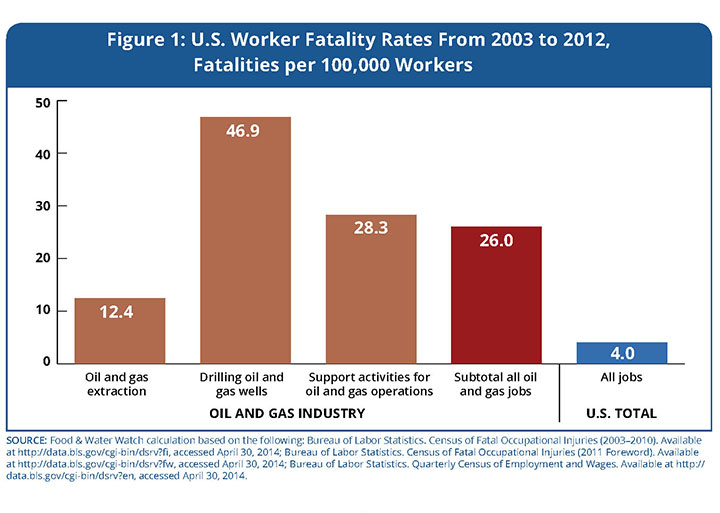
Today, Food & Water Watch released Toxic Workplace: Fracking Hazards on the Job, a research brief that exposes the dangers of working in the fracking industry. Subject to long hours on the job, sloppy safety regulations and reporting, lack of injury compensation and close contact with hazardous chemicals, former industry laborers agree that the fracking workplace is a toxic one. As we reflect on the social and economic successes of the labor movement over this holiday weekend, it becomes more evident that the fracking industry may have missed the memo.

The practice of hydraulic fracturing involves drilling down to a targeted rock formation and injecting large volumes of water, sand and toxic chemicals at extreme pressure to create fractures in the rock and release tightly held oil and gas. The chemicals used in the fracking process can cause cancer and damage the nervous system, immune and cardiovascular systems and upset the endocrine system.

At the site, workers can be exposed to volatile organic compounds, including benzene and toluene, as well as fugitive methane, which are often released during fracking and can mix with nitrogen oxide emissions from diesel-fueled vehicles and stationary equipment to form ground-level ozone. Workers can also be exposed to silica sand, which is often used in the fracking process, and is a known human carcinogen. Long term exposure to silica, a component that makes up as much as 99 percent of frac sand, increases the likelihood of developing silicosis, which damages lung tissue and inhibits lungs function. Breathing it can make a person more susceptible to tuberculosis and is also associated with autoimmune disorders and kidney disease.

Pages

The Fine Print I:

Disclaimer: The views expressed on this site are not the official position of the IWW (or even the IWW’s EUC) unless otherwise indicated and do not necessarily represent the views of anyone but the author’s, nor should it be assumed that any of these authors automatically support the IWW or endorse any of its positions.

Further: the inclusion of a link on our site (other than the link to the main IWW site) does not imply endorsement by or an alliance with the IWW. These sites have been chosen by our members due to their perceived relevance to the IWW EUC and are included here for informational purposes only. If you have any suggestions or comments on any of the links included (or not included) above, please contact us.

The Fine Print II:

Fair Use Notice: The material on this site is provided for educational and informational purposes. It may contain copyrighted material the use of which has not always been specifically authorized by the copyright owner. It is being made available in an effort to advance the understanding of scientific, environmental, economic, social justice and human rights issues etc.

It is believed that this constitutes a 'fair use' of any such copyrighted material as provided for in section 107 of the US Copyright Law. In accordance with Title 17 U.S.C. Section 107, the material on this site is distributed without profit to those who have an interest in using the included information for research and educational purposes. If you wish to use copyrighted material from this site for purposes of your own that go beyond 'fair use', you must obtain permission from the copyright owner. The information on this site does not constitute legal or technical advice.

