You are here

green jobs

Just Transition in California: Robert Pollin in Conversation with Robert Kuttner

Labor Unions Rally Behind California’s Zero-Emissions Climate Plan

Robert Pollin interviewed by C.J. Polychroniou - Truthout, June 10, 2021

Robert Pollin, distinguished professor of economics and co-director of the Political Economy Research Institute (PERI) at the University of Massachusetts at Amherst, has been spearheading national and international efforts to tackle the climate crisis for more than a decade. Over the past few years, he and a group of his colleagues at PERI have produced green economy transition programs for numerous states. The latest such program is for California, and it is being released today.

The massive study — nearly 200 pages long — shows how California can become a zero emissions economy by 2045 while expanding good job opportunities throughout the state. Nineteen unions have already endorsed the green transition plan, making clear that they reject frameworks that falsely pit labor priorities and the environment against each other, and more are expected to do so in the days and weeks ahead.

In this interview for Truthout, Pollin, co-author with Noam Chomsky of Climate Crisis and the Global Green New Deal: The Political Economy of Saving the Planet (Verso 2020), talks about the climate stabilization project for California and the national implications of union support for a green economy transition.

C.J. Polychroniou: California has been at the forefront of the climate fight for years now, but the truth of the matter is that its efforts have fallen short. Now, you and some colleagues of yours at PERI have just completed a commissioned climate stabilization project for California. How does the project envision the clean energy transition to take place in a manner consistent with the emission targets set out by the UN Intergovernmental Panel on Climate Change (IPCC) in 2018, and how will it be financed?

Robert Pollin: This study presents a recovery program for California that will also build a durable foundation for an economically robust and ecologically sustainable longer-term growth trajectory. California has long been a national and global leader in implementing robust climate stabilization policies. This includes the 2018 Executive Order B-55-18 by then Gov. Jerry Brown. This measure committed the state to cut CO2 emissions by 50 percent as of 2030, to become carbon neutral no later than 2045, and to produce net negative emissions thereafter. These goals are somewhat more ambitious than those set out by the IPCC in 2018. Our study outlines a program through which the state can achieve its own established goals.

Our study shows how these 2030 and 2045 emissions reduction targets can be accomplished in California through phasing out the consumption of oil, coal and natural gas to generate energy in the state, since burning fossil fuels to produce energy is, by far, the primary source of CO2 emissions, and thereby, the single greatest factor causing climate change. The project we propose is to build a clean energy infrastructure to replace the existing fossil fuel-dominant infrastructure. The clean energy infrastructure will require large-scale investments to, first, dramatically raise energy efficiency standards in the state and, second, to equally dramatically expand the supply of clean renewable energy supplies, including solar and wind primarily, with supplemental supplies from low-emissions bioenergy, geothermal and small-scale hydro power. We show how this climate stabilization program for California can also serve as a major new engine of job creation and economic well-being throughout the state, both in the short- and longer run.

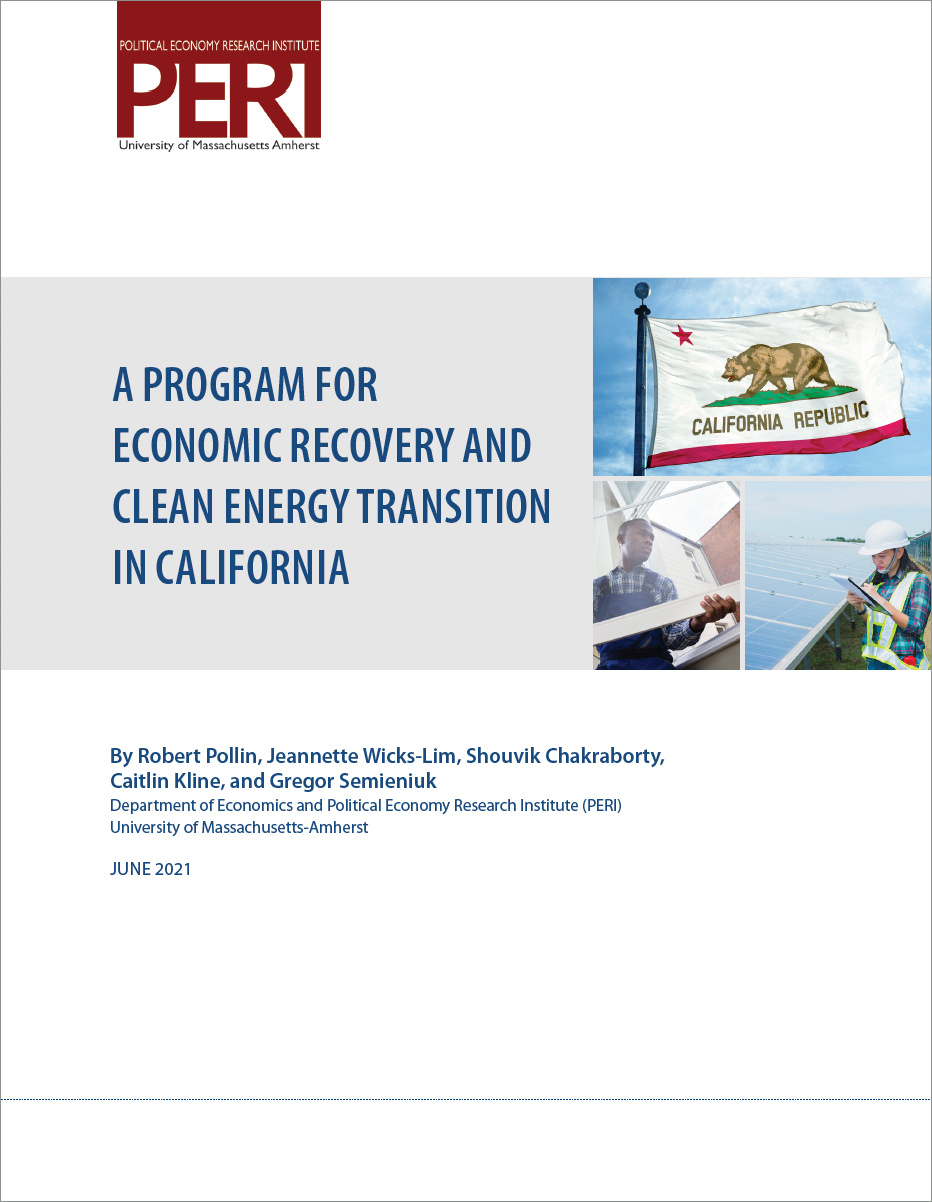
A Program for Economic Recovery and Clean Energy Transition in California

By Robert Pollin, Jeannette Wicks-Lim, Shouvik Chakraborty,Caitlin Kline, and Gregor Semieniuk - Department of Economics and Political Economy Research Institute (PERI); University of Massachusetts-Amherst, June 10, 2021

This study presents a robust climate stabilization project for California. It demonstrates that achieving the state’s official CO2 emissions reduction targets—a 50 percent emissions cut by 2030 and reaching zero emissions by 2045—is a realistic prospect. This climate stabilization project can also serve as a major engine of economic recovery and expanding economic opportunities throughout the state. This includes an increase of over 1 million jobs in the state through investment programs in energy efficiency, clean renewable energy, public infrastructure, land restoration and agriculture. The study also develops a detailed just transition program for workers and communities in California that are currently dependent on the state’s fossil fuel industries for their livelihoods. In particular, we focus here on condi­tions in Kern, Contra Costa, and Los Angeles counties.

The study is divided into nine sections:

  1. Pandemic, Economic Collapse, and Conditions for Recovery
  2. California’s Clean Energy Transition Project
  3. Clean Energy Investments and Job Creation
  4. Investment Programs for Manufacturing, Infrastructure, Land Restoration and Agri­culture
  5. Total Job Creation in California through Combined Investment Programs
  6. Contraction of California’s Fossil Fuel Industries and Just Transition for Fossil Fuel Workers
  7. County-level Job Creation, Job Displacement, and Just Transition
  8. Achieving a Zero Emissions California Economy by 2045
  9. Financing California’s Recovery and Sustainable Transition Programs

Nineteen labor unions throughout California have endorsed this study and its findings.

Read the text (PDF).

Over Fifty Organizations Release Green New Deal Plan for Pacific Northwest Forests

By Dylan Plummer - Cascadia Wildlands, June 9, 2021

Today, dozens of forest and climate justice organizations across northern California, Oregon, and Washington released a sweeping Green New Deal for Pacific Northwest Forests platform calling for the transformation of current forest practices on private, state, and federal land in the face of the climate crisis and ecological collapse. The platform emphasizes the critical role that the forests of the Pacific Northwest must play in efforts to mitigate climate change and to safeguard communities from climate impacts such as wildfire and drought. The six pillars of the Green New Deal for Pacific Northwest Forests address the intersecting issues of industrial logging, climate change, species collapse, economic injustice and the disempowerment of frontline communities.

Matt Stevenson, a high-schooler, and the leader of the Forest Team of Sunrise Movement PDX, a youth organization focused on climate justice, said:

As a high schooler, I have grown up without much hope for my future, and with the knowledge that my generation may inherit a broken and desolate earth. Industrial forestry practices and the timber industry is one of the largest causes of this hopelessness, one of the leading destructive forces of the Pacific Northwest, and the single largest carbon emitter in Oregon. If I, or my generation, wants any hope of a liveable future we must fundamentally transform the way we treat our forests.

Biden Says He Backs a Just Transition for the Climate Crisis. Advocates Say, “Prove It.”

By Rachel M. Cohen - In These Times, June 2, 2021

While the administration has taken some early steps to provide support for energy workers and frontline communities in the transition away from fossil fuels, experts and activists say the crisis demands a more transformative approach.

One of the most difficult problems that political leaders have faced in addressing climate change has not involved the science or technology, but the politics, including bringing key constituencies like energy workers and their labor unions on board. This skepticism and resistance to change is why a so-called ​“just transition” — referring to an ethical and economically secure shift away from a fossil-fuel powered economy — has become so integral to crafting a successful climate plan. 

Figuring out how to provide economic security for both energy workers that have depended on the nation’s fossil fuels and frontline communities has become a leading priority for activists and elected officials alike. The Biden administration, for its part, has thrown its weight behind developing a just transition, though some advocates tell In These Times that federal leaders haven’t gone far enough, or worry the executive branch’s rhetoric won’t deliver real results. Other researchers have called for more careful study of past economic transitions, as well as more firm commitments around social programs such as universal healthcare. 

On January 27, one week after taking office, Biden signed an executive order establishing an interagency working group focused on addressing the economic needs of ​“coal, oil, gas, and power plant communities.” The group, co-chaired by National Economic Council director Brian Deese and National Climate Adviser Gina McCarthy, is a collaboration between 12 federal agencies including the labor, interior, treasury and energy departments. 

In late April the working group published an initial report identifying 25 of the most impacted regions for coal-related declines, and highlighted existing federal programs that could provide nearly $38 billion in funding for relief. The report noted that ​“creating good-paying union jobs in Energy Communities is necessary but not sufficient” and stressed that ​“foundational infrastructure investments” including broadband, water systems, roads, hospitals and other institutions would be necessary to economically revitalize these areas. The group also noted that a just transition would require prioritizing pollution mitigation and environmental remediation, like plugging leaking oil and gas wells and reclaiming abandoned mine land. These objectives hold the potential not only for job creation but also achieving environmental justice priorities.

Offshore Oil and Gas Goal for Inclusion in the Regulations of The Sustainable Development Goals Act

By Noreen Mabiza - Ecology Action Center, June 2021

RECOMMENDED GOAL:

Offshore oil and gas development is phased out by 2030 in away that ensures a just transition for workers. Drilling in allprotected areas is banned.

RATIONALE:

There is currently no oil and gas production in NovaScotia’s offshore however actions by the provincialgovernment indicate a desire to keep growing theindustry. In March 2021 the provincial budget indicated anincreased investment in Nova Scotia’s offshore ($10 millioncompared to $1.8 million for renewables). In May 2021, theC-NSOPB announced a call for bids on parcels of landoffshore and if successful would grant a license to explore.

If the province expands offshore oil and gas, allassociated emissions with extraction and production willbe counted towards our emissions inventory while use ofthe fossil fuels will be attributed to the end user. In otherwords, Nova Scotia will not only continue to add to itsemissions through production but is also contributing tocontinued fossil fuel use elsewhere. What the provinceneeds to focus on as we work towards achieving net-zeroby 2050 is a shift away from fossil fuels and the justtransition of fossil fuel workers to green jobs.

Just transition is a social justice framework for facilitatingthe shift to a zero-carbon economy. A just transition of theoil and gas sector would mean that the costs of phasingout the fossil fuels are not unfairly borne by the workersand that the benefits of a clean economy are fairlydistributed. Key components of this transition includecentering the voices of workers, reskilling and upskillingthe workforce and shifting investments from fossil fuelstoward green jobs.

Read the text (PDF).

Can Carbon Capture Save Our Climate— and Our Jobs?

By Jeremy Brecher - Labor Network for Sustainability, June 2021

As storms, heat waves, fires, floods, and other devastating effects of global warming have grown, more and more people have become convinced of the need to reduce greenhouse gases (GHG) emitted into the atmosphere. The Paris Agreement defined the goal of limiting global average temperature increase to 1.5 degrees Celsius above pre-industrial levels. At the April Climate Summit President Joe Biden announced the U.S. will target reducing emissions by 50-52 percent by 2030 compared to 2005 levels and reaffirmed the U.S. commitment to reach net zero emissions by 2050. These goals indicate what the consensus of climate scientists says is necessary to ward off the most destructive possible effects of climate change. The question remains how to realize them.

There are two well established and proven means to reduce GHG emissions. The first is to replace the burning of fossil fuels with renewable energy from solar, wind, hydropower, and geothermal sources. The other is to reduce the amount of energy we need through a myriad proven means ranging from switching from gasoline to electric vehicles to insulating houses. Numerous studies and thousands of implementations lay out the scientific and economic effectiveness of protecting the climate by reducing fossil fuel emissions.

There is a third means that is being promoted: continue burning fossil fuels but capture carbon–the principal greenhouse gas–either in the smokestack or by sucking it out of the air after it has been released. Various techniques for doing this have been developed with various names–carbon capture and storage (CCS), carbon capture and utilization (CCU), bioenergy with CCS (BECCS), and direct air capture with CCS (DACCS). We will refer to them together as “carbon capture.”

There is a debate in the climate and labor movements about the use of carbon capture as a climate solution. Some maintain that carbon capture is necessary to reduce greenhouse gas emissions. They argue as well that it can be a way to save the jobs of coal miners and fossil-fuel power plant workers and provide power needed for industry while still protecting the climate and that it will create large numbers of jobs. Others say that carbon capture is unproven, costly, problematic for health and the environment, more productive of jobs, and ineffective for climate protection. They argue that renewable energy and energy efficiency are superior both for climate and for workers and communities. They maintain that a transition to fossil-free energy is already underway and that organized labor and the climate movement should take the lead in ensuring that transition benefits rather than harms workers.

Read the text (PDF).

Making "Build Back Better" Better: Aligning Climate, Jobs, and Justice

By Jeremy Brecher - Common Dreams, June 1, 2021

At the end of March 2021, President Joe Biden laid out his $2 trillion American Jobs Plan–part of his "Build Back Better" infrastructure program–to "reimagine and rebuild a new economy." Congress is expected to spend months debating and revising the plan. The public and many special interests will play a significant role in that process. President Biden has promised to follow up with additional proposals to further address climate policy and social needs.

Many particular interests will seek to benefit from the overall Build Back Better program–and that's good. But as Congress and the public work to shape the ultimate form of that program, we also need to keep our eyes on the ultimate prize: combining climate, jobs, and justice. What policies can integrate the needs of working people, the most oppressed, and our threatened climate and environment?

The Green New Deal reconfigured American politics with its core proposition: fix joblessness and inequality by putting people to work at good jobs fixing the climate. The Biden administration's Build Back Better (BBB) plan has put that idea front and center in American politics. Now we need to specify strategies that will actually achieve all three objectives at once.

There are many valuable plans that have been proposed in addition to Biden's Build Back Better plan. They include the original Green New Deal resolution sponsored by Sen. Ed Markey and Rep. Alexandria Ocasio-Cortez; the THRIVE (Transform, Heal, and Renew by Investing in a Vibrant Economy) Agenda; the Evergreen Action Plan; the Sierra Club's "How to Build Back Better" economic renewal plan; the AFL-CIO's "Energy Transitions" proposals; the BlueGreen Alliance's "Solidarity for Climate Action," and a variety of others. All offer contributions for overall vision and for policy details.

There are six essential elements that must be integrated in order to realize the Build Back Better we need for climate, jobs, and justice:

  • Managed decline of fossil fuel burning
  • Full-spectrum job creation
  • Fair access to good jobs
  • Labor rights and standards
  • Urgent and effective climate protection
  • No worker or community left behind

These strategies can serve as criteria for developing, evaluating, and selecting policies to make Build Back Better all that it could be.

Grieving Transit Local Has Been Leading Fights for Safety and Service Restoration

By Staff - Labor Notes, May 28, 2021

We join the whole labor movement in mourning the nine brothers and sisters from Transit (ATU) Local 265 and SEIU Local 521 who were killed on May 26 in a mass shooting at a workplace union meeting.

At an emotional candlelight vigil last night at San Jose city hall, Local 265 President John Courtney—who was meeting with members when the shooting broke out—told the crowd: “Hold each other, love each other, hug each other. Kiss each other when you get home from the end of the day. We’re all we’ve got.

“These aren’t names to us. These are people we know, and we love, and we’ve seen every single day of our working lives, and it really, really hurts down to the very core of our souls. So please, ATU, let’s do what we do and stand with each other, for each other, by each other.”

Nationally it’s the third workplace shooting in two months, which is unusually high.

This particular local has been important in waging fights on behalf of transit workers and riders across the entire San Francisco Bay Area. The union fought with the Santa Clara Valley Transportation Authority (VTA) to restore fare-free rear-door boarding in January, when Covid cases were spiking in San Jose. Rank-and-file bus drivers forced management’s hand when they started planning to stop boarding at the front door whether the agency agreed or not.

After that victory, Courtney said his union’s 1,500 members had “seen with their own eyes how important it is to be unified within our union, and to have the support of other unions and the community to win what we need.”

That victory inspired a bigger current campaign that has united six Bay Area transit locals with their riders to fight for the immediate release of $1.7 billion in transit rescue funds. Courtney told Labor Notes after a May 6 rally, “It means a lot that the community has our back.”

Bay Area Transit Workers and Riders Demand to Unlock $1.7 Billion Already Earmarked for Jobs and Bus Service

Pages

The Fine Print I:

Disclaimer: The views expressed on this site are not the official position of the IWW (or even the IWW’s EUC) unless otherwise indicated and do not necessarily represent the views of anyone but the author’s, nor should it be assumed that any of these authors automatically support the IWW or endorse any of its positions.

Further: the inclusion of a link on our site (other than the link to the main IWW site) does not imply endorsement by or an alliance with the IWW. These sites have been chosen by our members due to their perceived relevance to the IWW EUC and are included here for informational purposes only. If you have any suggestions or comments on any of the links included (or not included) above, please contact us.

The Fine Print II:

Fair Use Notice: The material on this site is provided for educational and informational purposes. It may contain copyrighted material the use of which has not always been specifically authorized by the copyright owner. It is being made available in an effort to advance the understanding of scientific, environmental, economic, social justice and human rights issues etc.

It is believed that this constitutes a 'fair use' of any such copyrighted material as provided for in section 107 of the US Copyright Law. In accordance with Title 17 U.S.C. Section 107, the material on this site is distributed without profit to those who have an interest in using the included information for research and educational purposes. If you wish to use copyrighted material from this site for purposes of your own that go beyond 'fair use', you must obtain permission from the copyright owner. The information on this site does not constitute legal or technical advice.