

You are here

green jobs

Labor Network for Sustainability Calls for “Climate Solidarity” on Anniversary of Superstorm Sandy

By staff - Labor Network for Sustainability, Octber 24, 2017

On this fifth anniversary of Superstorm Sandy, it is time to recognize that climate change is a dagger pointing at the jobs and well-being of American workers.

Since Sandy we have seen storm after storm, wildfire after wildfire, flood after flood, all demonstrating the greater intensity that climate scientists have warned us will result from climate change. In the aftermath of Hurricanes Harvey and Irma, the Labor Department said 1.5 million workers were not at their jobs because of weather. And the experience of Sandy, Katrina, and other climate-intensified storms shows that the devastation to workers and unions continues for years after the immediate impact.

There is no escape from climate devastation except a planned transition from a fossil fueled economy to a fossil free economy. That will require change in every industry from manufacturing to construction to agriculture. And that will require millions of jobs. Climate protection is our best jobs program.

The transition to a climate-safe economy must be a just transition. We need to use that transition to reverse the growing inequality and injustice of our society. And we need to make sure that poor and working people are protected against any unintended side effects of climate protection.

The labor movement’s most essential value is solidarity. Summed up in the hallowed adage “An injury to one is an injury to all,” it is the recognition that “looking out for number one” doesn’t work, that we will survive and prosper only if we look out for one another. Climate protection is the new solidarity: protecting our brothers and sisters as well as ourselves from destruction.

It’s Time for the Climate Movement to Embrace a Federal Jobs Guarantee

By Varshini Prakash and Sarah Meyerhoff - In These Times, May 24, 2018

With global temperatures rising and midterm elections approaching, 2018 is the year the climate movement must take bold action towards a fossil-free future.

Across the country, young people face daily reminders that our society doesn’t serve our futures. We suffer from unemployment and underemployment that is well beyond the national average, with young people of color struggling disproportionately to find work and economic opportunity. We are straddled with historic student loan debts. And in a moment when we should be working quickly to avert climate catastrophe and transition to an inclusive, fossil-free economy, many of our elected officials remain passive as the Trump administration attacks our air, water and land. 

As youth leaders in the climate justice movement, we believe now is the time to embrace a bold political vision that addresses climate change while working to end racialized economic inequality.

A centerpiece of that vision is a federal jobs guarantee, a policy through which the government directly employs anyone who wants a job but doesn’t have one. The jobs guarantee has deep roots in the U.S. progressive tradition and is seeing growing support from scholars and movement leaders who tout its potential to put Americans to work while helping to rebuild our infrastructure, schools and healthcare system. With Sen. Bernie Sanders developing a jobs guarantee proposal, as well as a score of down-ballot candidates and Democratic presidential hopefuls also voicing support, the policy is sure to feature prominently in the 2018 and 2020 election cycles.

Climate scientists say that the next few years may be the only ones we have left to avert catastrophic global warming. A jobs guarantee program with a strong focus on stopping and preparing for climate change—a climate jobs guarantee—might be the last, best hope to quickly marshal public support and resources behind climate action. Simply put, this is a can’t-miss opportunity for the climate movement—and for our generation.

The Plan (Documenatary)

By Steve Sprung - The Plan, May 2018

Full Length Version:

THE PLAN is a two-part film essay - Part 1 (120mins) Part 2 (90mins). It tells the story of the Lucas workers alternative plan in the context of its time and in relation to the challenges we face today.

The two parts are suitable for screening together, with an intermission, or on consecutive occasions.

Less is More

By staff - Clean Energy Canada - May 2, 2018

From the introduction:A win for our economy, consumers, and the climate? It may sound like an elusive unicorn, but energy efficiency checks all of the above. While underreported, measures to help homes, small businesses, and industry save on energy are a win-win for Canada—good for the climate and Canadian competitiveness. The federal government’s Pan-Canadian Framework on Clean Growth and Climate Change has introduced a number of such measures as a way to cut carbon pollution and help Canada meet its Paris Agreement targets. These include improved building codes and energy labelling for buildings, so people can better understand the energy performance of their homes and businesses. But what does a more efficient future mean for Canadians? Clean Energy Canada and Efficiency Canada hired Dunsky Energy Consulting to model the net economic impacts of energy efficiency measures in the pan-Canadian framework. They also modelled what the impacts would be if we went a step further, implementing the most ambitious efficiency goals found in jurisdictions across North America.

Read the report (PDF).

Potential Jobs and Wages from Investments in Defensible-Space Approaches to Wildfire Safety

By Ernie Niemi - Environment Now, April 2018

This report provides information rural communities in the forested regions of California might find useful if they want to assess the potential impact on jobs and wages when weighing how to allocate resources between two general strategies for improving their wildfire safety.
One general strategy takes the forest-altering approach, which entails logging/thinning across large areas of the forest to alter the behavior of fires before they come near a community. This approach often is promoted as a source of jobs for local workers, especially when it produces logs and chips for sawmills and biomass-fired power facilities that are highly visible employers.

The other general strategy for improving wildfire safety takes the defensible-space approach. It directly prevents buildings from igniting from wildfires by trimming vegetation within 200 feet of the buildings and modifying the buildings (e.g., replacing shingle roofs with fire-safe materials). The defensible space-approach has been shown to be highly effective in protecting homes from wildfire, but it sometimes receives less attention because its impacts on jobs and wages are spread among diverse employers.

This report begins to fill the current gap in information about potential jobs and wages from defensible-space work. It describes the potential jobs and wages that can result from investments in defensible-space work and compares them with the jobs and wages that can result from forest-altering investments. It draws on research specific to defensible-space activities but, because this research is limited, it also uses data from research on similar activities. Ecosystem-restoration activities provide estimates of potential jobs and wages from vegetation-management activities undertaken to improve defensible-space safety. Home remodeling activities provide estimates for home modifications that reduce the ignitability of homes and other buildings. The data indicate that spending $1 million to enhance the defensible space around buildings by trimming vegetation can create 23 jobs. Of these, 17 jobs are directly tied to the contractors doing the work, and 6 are indirect jobs supported by spending by the contractors and direct employees.

Read the text (Link).

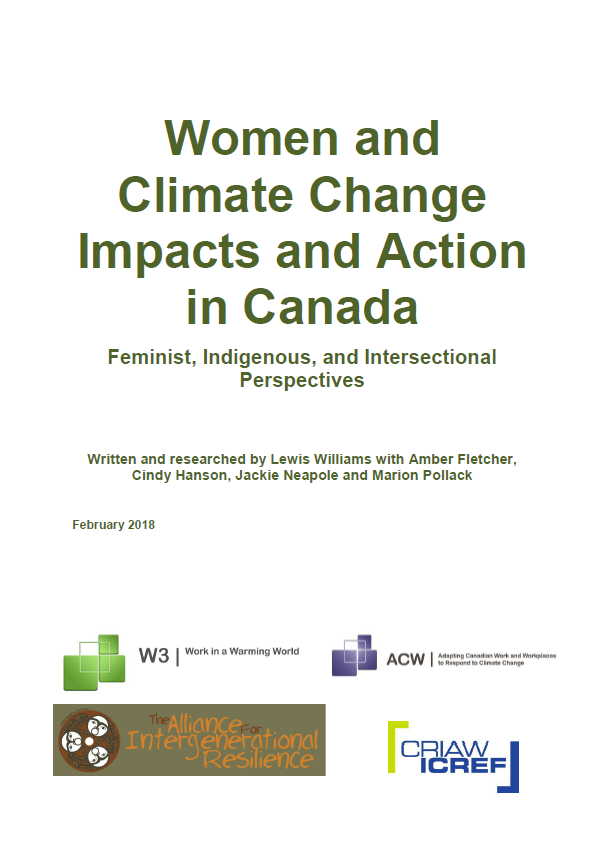
Women and Climate Change Impacts and Action in Canada: Feminist, Indigenous, and Intersectional Perspectives

Written and researched by Lewis Williams with Amber Fletcher, Cindy Hanson, Jackie Neapole and Marion Pollack - Work and Climate Change Report - February 2018

Climate change is unequivocally occurring across the globe, impacting the conditions, experiences, and livelihoods of communities in multiple ways.2 Between 1948 and 2007 temperatures in Canada increased at a rate approximately twice the global average.3 Accelerated rates of global warming and dramatically increased temperatures are expected to occur in parts of Canada well into the future.4 Yet, Canada remains one of the world’s biggest per capita carbon polluters5 and is falling far short of meeting climate mitigation goals under the Paris Agreement, an international agreement for meeting climate change mitigation and adaptation targets.

Emerging research on the gendered impacts of climate change in Canada demonstrates how climate change is exacerbating inequalities between women and men. Women’s lower incomes relative to men, their gendered roles and social statuses, and the ways in which these interact with changing environments and related policies and programs affect women’s experiences of climate change. Despite these inequities, gender considerations are remarkably absent in climate plans and policies across the country.

Climate change is largely the result of the tightly interwoven forces of colonialism, patriarchy, and neoliberal forms of development.9 These conditions are constraining women’s knowledge, expertise, and unique agencies in addressing what is probably the most defining issue of our age. Yet women, including Indigenous women, have significant roles to play in the articulation of feminist and Indigenous worldviews, and aligned climate action strategies.

Read the Report (PDF).

Appalachian solar jobs on the line in Trump’s Suniva decision

By Kyle Pennell - Appalachian Voices, January 19, 2018

Solar panel manufacturer Suniva was once one of the biggest players in the U.S. market. But back in April, the company declared bankruptcy. Foreign panel makers, Suniva argued, enjoyed government subsidies at a level that made it impossible for solar panel makers in the U.S. to compete. The company filed a petition with the U.S. International Trade Commission (ITC) calling for strong tariffs against foreign manufacturers. Another panel manufacturer, SolarWorld, joined the petition shortly thereafter.
In August, the companies presented their case to the ITC. They charged that foreign competition has cost the U.S. solar panel manufacturing industry 1,200 jobs and led to a 27 percent decline in wages since 2012.

But cheap, imported solar panels-along with reductions in installation costs and technological advances-have made possible the solar energy boom that has unfolded in recent decades. Back in 2006, only about 30,000 homes in the U.S. had solar panels; today, over 1.3 million American households have gone solar. Utility-scale solar electricity generation has increased by a factor of about 50 over the same period. Without access to cheap solar panels, efforts aimed at moving America toward energy sustainability would be undermined.

Moreover, many of the major players in the American solar industry have spoken out against tariffs. They argue that SolarWorld and Suniva’s petition figures are inflated, and that tariffs would significantly raise costs for solar installers, which employ far more people than panel manufacturers do. In a letter filed with the ITC, solar installer Sunnova suggested that “the imposition of tariffs on solar cells and panels will significantly harm the U.S. economy by destroying jobs.” The Solar Energy Industries Association agrees: in a recent analysis, it found that the industry would shed 88,000 jobs if tariffs are approved.

In early September, the ITC ruled in favor of Suniva and SolarWorld, agreeing that foreign solar panel imports have indeed hurt U.S. manufacturers. The ITC offered the Trump administration three recommendations: a 35 percent tariff on all imported solar panels, an 8.9-gigawatt import cap for 2018, and a tariff of about 30 percent on solar cells and panels. Under all three plans, the tariffs would mostly be phased out after four years.

But the plaintiffs criticized the ruling as insufficient, and have pushed for even harsher tariffs, including a minimum solar panel price of $0.74 per watt on all imported panels and an import cap of 5.7 gigawatts per year.

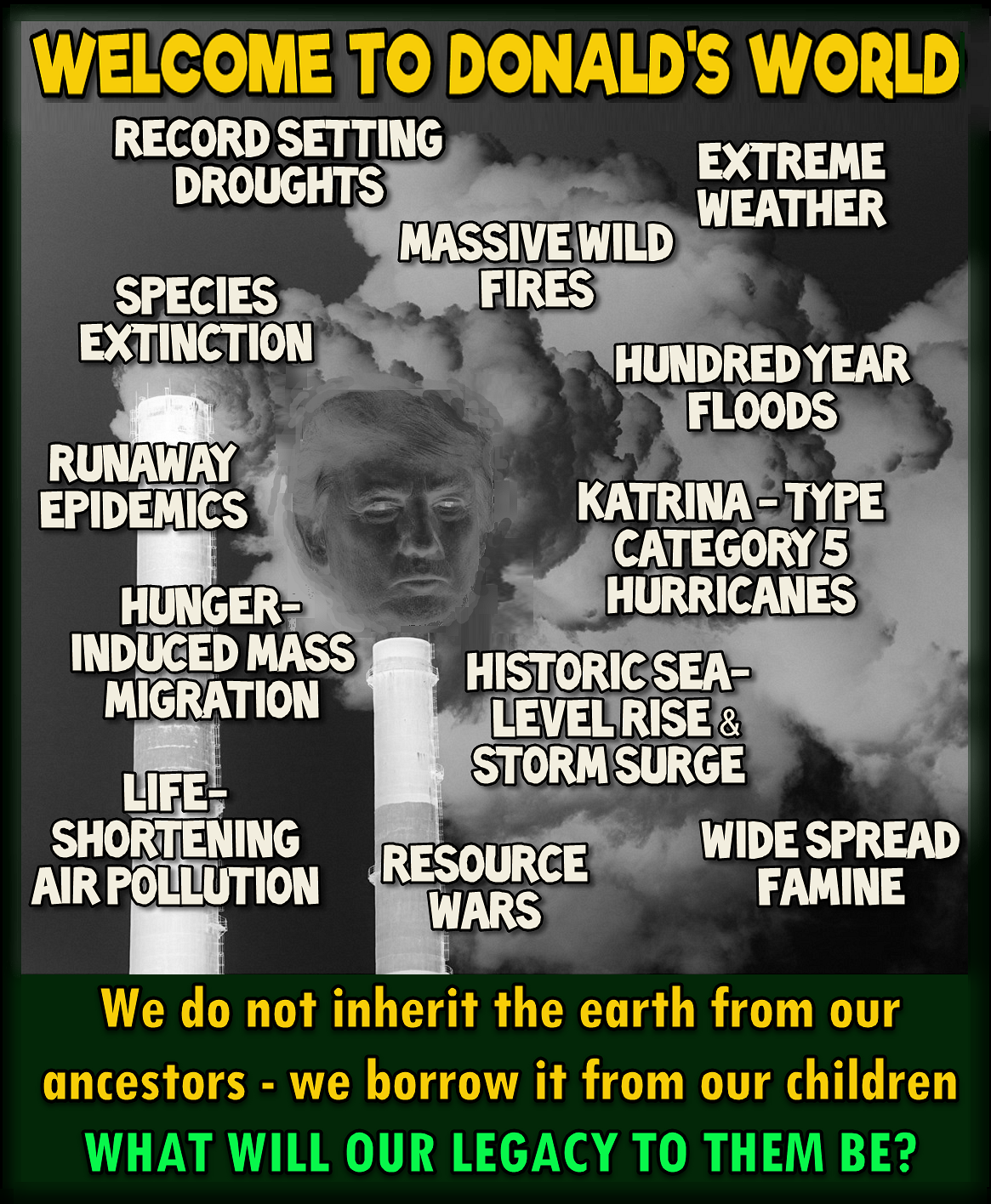
The decision as to which tariff scheme to adopt is now up to President Donald Trump. Adopting a high-tariff scheme could allow him to claim that he has encouraged domestic manufacturing and land a blow against China, both of which were major tenets of his campaign platform during last year’s presidential election.

The GOP Tax Bill Assaults the Planet as Well as the Poor

By Basav Sen - Common Dreams, December 5, 2017

If you are an average American, your government has just declared war against you. Unless you happen to be an oligarch. I’m talking, of course, about the monstrosity of a tax bill that Congress looks set to pass.

With good reason, only about one-third of Americans support the bill, since its primary purpose is to cut taxes for corporations and fabulously wealthy people at all costs.

The costs are high indeed, since the bill systematically raises taxes on struggling lower to middle income people. It gets rid of taxpayers’ ability to deduct state and local taxes paid from their taxable income, which is a form of double taxation. While this increases everyone’s taxes, struggling working people will feel the pain of this double taxation more than oligarchs. Make the Poor (and the Middle Class) Pay Again. And Again.

It also ends the deductibility of large medical expenses, effectively a large tax increase for the seriously ill, especially the uninsured or underinsured among them. Make the Sick Bankrupt Again.

In an all-out assault on higher education, it turns tuition reductions or waivers for graduate student teaching and research assistants into taxable income, a move that would make graduate school unaffordable for most people. Make America Uneducated Again.

The bill also gets rid of tax-exempt bonds for affordable housing construction, which are used to finance more than half of affordable rental units built each year. Make Housing Unaffordable Again.

In fact, it raises taxes on most people in so many ways that it is disingenuous to even call it a tax cut. This bill is a massive tax increase on most of us.

Lost in the debate around the tax bill, however, are provisions that will make more wind-reliant Iowans and Texans jobless, leave more hurricane-struck Puerto Ricans without access to basic necessities, poison more African-Americans with toxic fumes, and submerge more Native Alaskan villages, just to enrich a particular subset of oligarchs.

The tax bill kills the modest tax credits for solar and wind power, effectively raising taxes retroactively on renewable energy developers. It also kills the tax credit for electric cars, but does not touch the much larger subsidies for fossil fuels. Make Fossil Fuel Barons Rich Again, by subsidizing them while raising their competitor’s taxes.

These changes in energy tax credits will hurt many more people than just the owners of solar and wind companies. Solar and wind energy create many, many more jobs — hundreds of thousands more — than coal, even though they account for much smaller share of our overall energy mix than fossil fuels. If the intent of the tax bill truly were to create jobs, it would reinstate the solar and wind tax credits and eliminate fossil fuel subsidies, not the other way round. Make Americans Jobless Again.

A Green New Deal for Washington State: Climate Stabilization, Good Jobs, and Just Transition

By Robert Pollin, Heidi Garrett-Peltier, and Jeannette Wicks-Lim - Political Economy Research Institute, December 4, 2017

This study examines the prospects for a transformative Green New Deal project for Washington State.  The centerpiece of the Green New Deal will be clean energy investments—i.e. both investments in the areas of renewable energy and energy efficiency.  The first aim of this Green New Deal project is to achieve a 40 percent reduction in all human-caused carbon dioxide (CO2) emissions in Washington State relative to the state's 2014 emissions level.  The second aim is to achieve this 2035 CO2 emission reduction standard while also supporting existing employment levels, expanding job opportunities and raising average living standards throughout Washington State.   

We estimate that clean energy investments in Washington State that would be sufficient to put the state on a true climate stabilization trajectory will generate about 40,000 jobs per year within the state.   We consider a series of policies to support this state-level Green New Deal program.  These include a carbon tax, which we estimate can raise an average of about $900 million per year even with a low-end tax rate of $15 per ton of carbon.   We also consider a series of regulatory policies, direct public spending measures, and private investment incentives.

Read the text (PDF).

IBEW 569 Position on Reaching 100% Renewable Energy

By staff - IBEW 569, November 3, 2017

Whether a utility, municipal program, CCA or another provider or program, providers and subcontractors shall:

  1. Energy Identification: Inform customers of the percentage of renewable, greenhouse-gas-free electricity offered. Power may be labeled as “clean” or “green” if it comes from renewable energy generated from solar, wind, geothermal and other eligible renewable energy resources in California and defined by California law in the Public Utilities Code as Category 1.
  1. Exclude RECs: Provide renewable energy from actual renewable sources customers can trust while creating union jobs in the community for local workers. Renewable Energy Certificates (RECs) undermine these goals. There is no guarantee power content that includes voluntary RECs is clean or green therefore it must not be marketed as “clean” or “green” so as not to mislead the public.
  1. Communication to Consumers: Send at least three written notices to potential customers, and each notice will include a description of the percentage of the power mix that comes from California solar, wind, geothermal, small hydro-electric or other state certified green power sources.
  1. Creating Union Jobs: Procure power from union-generated sources; employ unionized customer service representatives; sign Project Labor Agreements on each Power Generation Project; sign Project Labor Agreements on Energy Efficiency Projects/Programs; agree in writing to neutrality in the event employees or subcontractor employees wish to unionize.
  1. Community Benefits: Sign Community Benefits Agreements to include local projects and local hiring and prioritizing projects, programs and actions to reduce emissions in disadvantaged communities that rank in the top 25 percent of CalEnviroScreen’s ranking for San Diego region communities.
  1. Local Project Build-Out: Emphasize development of new renewable resources from proven developers in San Diego and adjacent counties and strictly limit the use of non-renewable energy sources that are recognized under the California RPS to the amount permitted as “Qualified Renewable Resource.”
  1. Energy Efficiency: Develop a resource plan that integrates supply-side resources with programs that will help customers reduce their energy costs through improved energy efficiency and other demand-side measures. As part of this integrated resource plan, actively pursue, promote and ultimately administer a variety of customer energy efficiency programs that can cost-effectively displace supply-side resources.
  1. Workforce Impacts: Determine if the program will 1) result in negative impacts for employees of the incumbent utility (including layoffs, work hour reductions, etc.) and 2) if the wages, fringe benefits and job protections are similar to those offered by the utility to employees in comparable job classifications.

Pages

The Fine Print I:

Disclaimer: The views expressed on this site are not the official position of the IWW (or even the IWW’s EUC) unless otherwise indicated and do not necessarily represent the views of anyone but the author’s, nor should it be assumed that any of these authors automatically support the IWW or endorse any of its positions.

Further: the inclusion of a link on our site (other than the link to the main IWW site) does not imply endorsement by or an alliance with the IWW. These sites have been chosen by our members due to their perceived relevance to the IWW EUC and are included here for informational purposes only. If you have any suggestions or comments on any of the links included (or not included) above, please contact us.

The Fine Print II:

Fair Use Notice: The material on this site is provided for educational and informational purposes. It may contain copyrighted material the use of which has not always been specifically authorized by the copyright owner. It is being made available in an effort to advance the understanding of scientific, environmental, economic, social justice and human rights issues etc.

It is believed that this constitutes a 'fair use' of any such copyrighted material as provided for in section 107 of the US Copyright Law. In accordance with Title 17 U.S.C. Section 107, the material on this site is distributed without profit to those who have an interest in using the included information for research and educational purposes. If you wish to use copyrighted material from this site for purposes of your own that go beyond 'fair use', you must obtain permission from the copyright owner. The information on this site does not constitute legal or technical advice.
