

You are here

Canada

First year progress report on the Pan-Canadian Framework lacks any mention of Just Transition

By Elizabeth Perry - Work and Climate Change Report, December 12, 2017

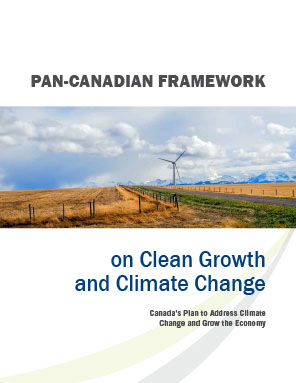
On December 9th, the Governments of Canada and British Columbia jointly announced the first annual progress report on the implementation of the Pan-Canadian Framework on Clean Growth and Climate Change – officially titled,  the First Annual Synthesis Report on the Status of Implementation – December 2017 (English version)  and Premier rapport annuel du cadre pancanadien sur la croissance propre et les changements climatiques (French version).     The report summarizes the year’s policy developments at the federal and provincial/territorial  level – under the headings pricing carbon pollution ; complementary actions to reduce emissions;  adaptation and climate change resilience ; clean technology, innovation and jobs; reporting and oversight; and looking ahead.  It is striking that the report is up to date enough to include mention of the Saskatchewan climate change strategy, released on December 4, as well as the Powering Past Coal global alliance launched by Canada and Great Britain in November at the Bonn climate talks – yet in the section on “Looking Ahead”, there is no mention of another important outcome of the Bonn talks: a Just Transition Task Force in Canada.  As reported by the Canadian Labour Congress in “Unions applaud Canada’s commitment to a just transition for coal workers”,  “Minister McKenna also announced her government’s intention to work directly with the Canadian Labour Congress to launch a task force that will develop a national framework on Just Transition for workers affected by the coal phase-out. The work of this task force is slated to begin early in the new year.”  No  mention of that, nor in fact, any use of the term “Just Transition” anywhere in the government’s progress report.

Environment Canada touts ‘good progress’ on climate after scathing audit” appeared in the National Oberserver (Dec. 11), summarizing some of the progress report highlights and pointing out that not everyone agrees with the government’s self-assessment that “While good progress has been made to date, much work remains”. Recent criticism has come from the Commissioner of the Environment and Sustainable Development in her October report ; from Marc Lee at the Canadian Centre for Policy Analysis in “Canada is still a rogue state on climate change”  (Dec.11) ; and from the Pembina Institute in  State of the Framework: Tracking implementation of the Pan-Canadian Framework on Clean Growth and Climate Change .  The Pembina Institute report calls on the federal government to speed up on all policy fronts, with specific recommendations including: “extend the pan-Canadian carbon price up to $130 per tonne of pollution by 2030, implement Canada-wide zero emission vehicle legislation, ban the sale of internal combustion engines, and establish long-term energy efficiency targets.”

Just Transition for the coal industry is expensive – but cheaper than failure to address the needs

By Elizabeth Perry - Work and Climate Change Report, September 5, 2017

July 2017 saw the release of  Lessons from Previous Coal Transitions:  High-level Summary for Decision-makers , a synthesis report of case studies of past coal mining transitions in Spain, U.K., the Netherlands, Poland, U.S., and the Czech Republic – some as far back as the 1970’s.  Some key take-aways from the report:  “Because of the large scale and complexity of the challenges to be addressed, the earlier that actors (i.e. workers, companies and regions) anticipated, accepted and began to implement steps to prepare and cushion the shock of the transition, the better the results”; “the aggregate social costs to the state of a failure to invest in the transition of workers and regions are often much higher that the costs of not investing from an overall societal perspective.” While the level of cost details varies in the case studies, it is clear that costs are significant.  For example, the case study of Limburg, Netherlands states that the national government spent approximately 11.6 billion Euros (in today’s prices) on national subsidies to support coal prices and regional reconversion, in addition to  several 100 million per year in EU funds. “One estimate also suggested that in the Dutch case, all told, regional reinvestment in new economic activities also cost about 300 to 400 000€/per long-term job created.”  Limburg is also cited as “remarkable for the relatively consensual nature of the transition between unions, company and government.”  (see page 10).

The Synthesis report and individual case study reports of the six countries are available here . These are the work of the Research and Dialogue on Coal Transitions project, a large-scale research project led by Climate Strategies and the Institute for Sustainable Development and International Relations (IDDRI) , which also sponsors the Deep Decarbonization Pathways Project.  Future reports scheduled for 2018: a Global report, and a Round Table on the Future of Coal.

Realizing a Just and Equitable Transition Away From Fossil Fuels

By Georgia Piggot, Michael Boyland, Adrian Down, and Andreea Raluca Torre - Stockholm Environment Institute, January 2019

Meeting agreed climate goals requires a rapid decarbonization of the global energy system, which in turn necessitates a reduction in fossil fuel production. While limiting fossil fuel use will likely bring a multitude of societal benefits — related to reduced climate risks, sustainable economic growth, air quality and human health — it is important to recognize that not everyone will benefit equally from a transition to a low-carbon economy. In particular, those who rely on fossil fuel production for their livelihood, or who were anticipating using fossil-fuelled energy to meet development needs, may carry a disproportionate share of the burdens of an energy transition.

The need for a “just transition” to a low-carbon economy — namely, a transition that minimizes disruption for workers and communities reliant on unsustainable industries and energy sources — is gaining traction in climate policy and political discourse. A call for “a just transition of the workforce” was included in the preamble to the Paris Agreement, and the United Nations Framework Convention on Climate Change (UNFCCC) secretariat has prepared a technical paper on transition planning.10 In addition, several national and regional governments have recently announced new transition planning processes, including Canada, Germany, Spain, Scotland, New Zealand, and the European Union.

A central concern of just transition efforts is to ensure that low-carbon transitions address social and economic inequality. The UNFCCC calls for a transition that “contribute(s) to the goals of decent work for all, social inclusion and the eradication of poverty.” Likewise, the European Commission aims to “boost the clean energy transition by bringing more focus on social fairness.” And the Scottish Government is seeking a transition that “promotes inclusive growth, cohesion and equality.”

Key messages:

  • Governments are introducing new “just transitions” policies to help workers and communities move away from fossil fuels.
  • Most policies assume that justice goals will be achieved by helping those dependent on coal, oil and gas move into new roles; however, there is little critical reflection on what justice means in the context of an energy transition away from fossil fuels.
  • There are a number of gaps in current just transition policies when viewed through a justice lens. For example, no policies contain measures to improve the lives of people currently marginalized in the energy system.
  • Creating just and equitable transition policies requires collecting data on the current distribution of the harms and benefits of the energy system, and mapping out how this will change as fossil fuels become a less-prominent part of the energy mix.
  • By taking justice considerations into account, transition policies are more likely to limit social and political resistance, win a broad consensus, and achieve effective implementation.

Read the text (PDF).

GM Oshawa: Making Hope Possible

By Sam Gindin - The Bullet, December 13, 2018

The once unimaginable – the end of GM Oshawa – seems on the verge of becoming the new reality. If there is any lesson to be learned here it is that overturning this imposed reality can’t be achieved by traditional protest and traditional alternatives. Continuing our dependence on unaccountable corporations, offering subsidies and concessions without means to enforce job guarantees, making competitiveness the only test of worthwhile activity, looking to ‘better’ free trade agreements and so on, are dead ends. All they offer is more of the same: death by a thousand cuts.

Imagining a radically different and more democratic approach based on community and national planning – opening the door to the formerly unthinkable – may, as overwhelmingly ambitious as that may seem, be the only option with any chance of success.

On November 26, 2018, General Motors (GM) announced that the Oshawa Assembly plant, once the largest auto complex in North America, will no longer exist. In the 1970s, the site included three massive assembly plants that turned out 3,000 vehicles daily. Other GM plants in the city made batteries, radios, radiators and axles. A host of independent component plants with their own special capacities, spread across the city and nearby localities. At the end of the 1970s, GM had some 23,000 plant and office workers in Oshawa. At the time of GM’s latest death notice, over 85% of those jobs had already vanished, leaving 3,000 workers desperate to hang on to the one remaining GM operation in the city.

Climate Stability, Worker Stability: are they compatible?

By Dr. Louise Comeau, JD, PhD and Devin Luke - Adapting Canadian Work and Workplaces to Respond to Climate Change, December 3, 2018

It appears we face a low- carbon transition dilemma. On the one hand, climate change solutions, like greenhouse gas regulation and carbon pricing, raise concerns about potential job displacement for workers in traditional energy sectors like oil and gas production and fossil-fuel generated electricity. Hence the calls for just transition. Our research, however, suggests that this blame may be at least partially misplaced. Energy workforce changes are currently affected by broader societal changes relating to fuel-cost differentials (i.e., natural gas cheaper than coal), automation, and the societal transition to non-unionized, unstable and lower-paying work. Greenhouse gas regulations and carbon pricing are certainly not the only driver of workforce change, and likely not, at least currently, not the primary driver.

Should proponents of renewable energy, energy efficiency and the low-carbon transition address these broader societal trends? If so, how? Is the solution to focus on collective responses such as energy cooperatives, public sector ownership of renewable energy supply, utility-scale and managed energy efficiency programs, rather than market- based, privatized solutions? These questions are worth answering. Our goal with this study was to better understand the training needs associated with renewable energy and energy efficiency job projections. There appears, however, to be a greater need to better integrate climate change and low-carbon economy discussions into a broader discourse on the nature of work.

Read the report (PDF).

Renewable energy: planning a just transition

By Sandeep Pai and Savannah Carr-Wilson - The Ecologist, November 28, 2018

As the transition to renewables speeds up, governments will have to seriously think about what will happen to people working in the fossil fuel industry.

When governments start planning for national renewable energy transitions, it is important that they are clear about new job creation (in renewables or any other sector) and how to rehabilitate fossil fuel workers and connected communities.

Forward planning 

Ken Smith of Unifor explained the need for governments to have a just transition plan. “Suppose there is a man living by the river in a fire zone. He has children and belongings. He doesn’t want to lose things when fire comes. What should he do?

"He should build the bridge before fire comes. That’s what is required. Similarly, countries have to plan a transition. Give training, and deploy fossil fuel workers in other industries. Create jobs before the transition.” 

Sandeep asked Ken whether he thinks oil sands workers need a transition plan. He replied, “Yes, absolutely. There are all kinds of things that can be done. There is lots for all of us in Canada. The future doesn’t have to be so gloomy. But we have to plan a transition for workers.

"I was unemployed so I had to move here. But I moved away from my family. Now Fort McMurray is my home and people here are my family members.

"It’s like a temporary community. However, it can’t just work on oil. We need to diversify, get training and develop industries like wind, solar and hydro. This will prevent a collapse.”

Just cuts for fossil fuels? Supply-side carbon constraints and energy transition

By Philippe Le Billon and Berit Kristoffersen - Economy and Space, November 2018

Reducing greenhouse gas emissions has generally been approached through demand-side initiatives, yet there are increasing calls for supply-side interventions to curtail fossil fuel production. Pursuing energy transition through supply-side constraints would have major geopolitical and economic consequences. Depending on the criteria and instruments applied, supply cuts for fossil fuels could drastically reduce and reorient major financial flows and reshape the spatiality of energy production and consumption. Building on debates about just transitions and supply constraints, we provide a survey of emerging interventions targeting the supply of, rather than the demand for, fossil fuels. We articulate four theories of justice and selection criteria to prioritize cuts among fossil fuel producers, including with regard to carbon-intensity, production costs, affordability, developmental efficiency, and support for climate change action. We then examine seven major supply-constraint instruments, their effectiveness, and possible pathways to supply cuts in the coal, oil and gas sectors. We suggest that supply cuts both reflects and offers purposeful political spaces of interventions towards a 'just' transition away from fossil fuel production.

Read the text (PDF).

A Just and Fair Transition: For Canadian Coal Power Workers and Communities

By staff - Task Force on Just Transition for Canadian Coal Power Workers and Communities, October 2018

The devastating impacts of climate change are becoming clearer each year. More frequent and intense floods, storms, fires, heat waves, and droughts are destroying communities and homes, and putting the lives and futures of Canadians at risk. The Intergovernmental Panel on Climate Change’s 2018 report on global warming of 1.5°C shows that our window to prevent the worst-case scenario is quickly closing.

We do know what is causing climate change and we can do something about it. We need to reduce the amount of greenhouse gas (GHG) emissions released into our environment. There are several ways in which we can accomplish this, including wasting less energy and investing in cleaner energy sources. Businesses, scientists, governments, communities, and individuals in Canada and around the world are beginning to prove that you can reduce GHG emissions, invest in reliable and affordable clean energy, create decent jobs, and have stable economies.

Although coal-fired electricity has contributed significantly to Canada’s economic past and present—and provided Canadians with affordable and reliable electricity and heat for many generations—it produces significant amounts of air pollutants and GHG emissions. It has well documented costs to human health and is a major contributor to climate change: approximately 20% of all GHG emissions in the world came from coal-fired electricity in 2013.

Recognizing these facts, and supported by commitments in the 2015 Paris Agreement, Canada and other countries are intent on replacing coal-fired electricity with cleaner sources of fuel over the coming years and decades. In 2016, Canada committed to the phase-out of traditional coal-fired electricity across the country by 2030.

Phasing out coal-fired electricity, however, will have direct and indirect impacts on thousands of workers, dozens of communities, and four provinces, including:

  • Alberta, Saskatchewan, New Brunswick, and Nova Scotia;
  • Nearly 50 communities with nearby coal mines or generating stations;
  • 3,000 to 3,900 workers at coal-fired generating stations and domestic thermal coal mines;
  • Over a dozen generating stations, owned by six employers;
  • Nine mines, owned by three employers.

In reality, the phase-out of coal fired electricity generation is already underway, especially in Alberta.

The extensive personal and societal impacts of the phase-out of coal-fired electricity are reasons why the labour movement has been advocating for a just transition alongside Canada’s efforts to reduce GHG emissions. We cannot leave affected workers and communities behind during the transition to a low-carbon economy. They too must have hope for the future.

Read the report (Link).

Jobs vs the Environment?: Mainstream and Alternative Media Coverage of Pipeline Controversies

By Robert A Hackett and Philippa R Adams - Corporate Mapping Project, September 2018

Much of the argument advanced in support of expanding Canada’s fossil fuel production centres on job creation and economic benefits. Politicians, pundits and corporate spokespeople who support fossil fuel infrastructure projects—such as new oil and gas pipelines—often evoke this rhetoric when they appear in the media.

This study examines how the press—including corporate and alternative outlets—treats the relationship between jobs and the environment. Focusing on pipeline projects that connect Alberta’s oil sands to export markets, it also asks which voices are treated as authoritative and used as sources, whose views are sidelined, which arguments for and against pipelines are highlighted, and what similarities and differences exist between mainstream and alternative media coverage of pipeline controversies.

Read the report (PDF).

Just Transition and Beyond Just Transition: Canada in Action

By C.M. Flynn - Adapting Canadian Work and Workplaces to Respond to Climate Change, August 27, 2018

Just Transition is an elusive concept. First developed by the Canadian Labour Congress (CLC) at the turn of the 21st century, it has suffered from neglect for much of the last 20 years. Workshops, symposia and half-day conferences proliferated in the EU and other countries, but the meetings have duplicated each other’s work, and to date there had been no common definition or sharing of information about what works and what has not worked in just transition experiences.

With this in mind, and mindful of Canada’s historic leadership, the Adapting Canadian Work and Workplaces to Respond to Climate Change project (ACW) brought together 6 groups active in the field to form an organizing committee. The committee invited the broadest range of Canadian groups involved in Just Transition to a daylong roundtable with three main goals:

  1. Share experiences among Canadian groups about the work each is doing to transition to a low carbon economy: what has worked, what has failed, and why?
  2. Think forward about how we can broaden Just Transition beyond its current focus.
  3. Share next steps that each group will be taking.

Read the report (PDF).

Pages

The Fine Print I:

Disclaimer: The views expressed on this site are not the official position of the IWW (or even the IWW’s EUC) unless otherwise indicated and do not necessarily represent the views of anyone but the author’s, nor should it be assumed that any of these authors automatically support the IWW or endorse any of its positions.

Further: the inclusion of a link on our site (other than the link to the main IWW site) does not imply endorsement by or an alliance with the IWW. These sites have been chosen by our members due to their perceived relevance to the IWW EUC and are included here for informational purposes only. If you have any suggestions or comments on any of the links included (or not included) above, please contact us.

The Fine Print II:

Fair Use Notice: The material on this site is provided for educational and informational purposes. It may contain copyrighted material the use of which has not always been specifically authorized by the copyright owner. It is being made available in an effort to advance the understanding of scientific, environmental, economic, social justice and human rights issues etc.

It is believed that this constitutes a 'fair use' of any such copyrighted material as provided for in section 107 of the US Copyright Law. In accordance with Title 17 U.S.C. Section 107, the material on this site is distributed without profit to those who have an interest in using the included information for research and educational purposes. If you wish to use copyrighted material from this site for purposes of your own that go beyond 'fair use', you must obtain permission from the copyright owner. The information on this site does not constitute legal or technical advice.
