

You are here

Canada

‘Troubling Incrementalism’: Is the Canadian Pension Plan Fund Doing Enough to Advance the Transition to a Low-carbon Economy?

The justice and equity implications of the clean energy transition

By Sanya Carley and David Konisky - Nature Energy, August 2020

The transition to lower-carbon sources of energy will inevitably produce and, in many cases, perpetuate pre-existing sets of winners and losers. The winners are those that will benefit from cleaner sources of energy, reduced emissions from the removal of fossil fuels, and the employment and innovation opportunities that accompany this transition. The losers are those that will bear the burdens, or lack access to the opportunities. Here we review the current state of understanding—based on a rapidly growing body of academic and policy literature—about the potential adverse consequences of the energy transition for specific communities and socio-economic groups on the frontlines of the transition. We review evidence about just transition policies and programmes, primarily from cases in the Global North, and draw conclusions about what insights are still needed to understand the justice and equity dimensions of the transition, and to ensure that no one is left behind.

Read the text (PDF).

Forward Together: A Good Jobs and Climate Action Budget

By staff - Canadian Labour Congress, August 2020

The Canadian Labour Congress (CLC) believes that saving lives, protecting public health, and containing the coronavirus outbreak must remain the federal government’s overriding priority. In the near term, this includes continued income support for individuals unable to work due to COVID-19, as well as proper personal protective equipment, workplace health and safety precautions, and training for workers.

As public health measures permit, fiscal policy measures responding to the recession and unemployment crisis will need to prioritize helping Canadians return to decent jobs. The economic crisis has disproportionately affected low-paid, vulnerable workers in precarious employment, especially women, young workers, newcomers, workers of colour, and workers with disabilities. Accordingly, the plan for economic recovery must be gendered, inclusive, inequality-reducing, and sustainable.

Read the report (PDF).

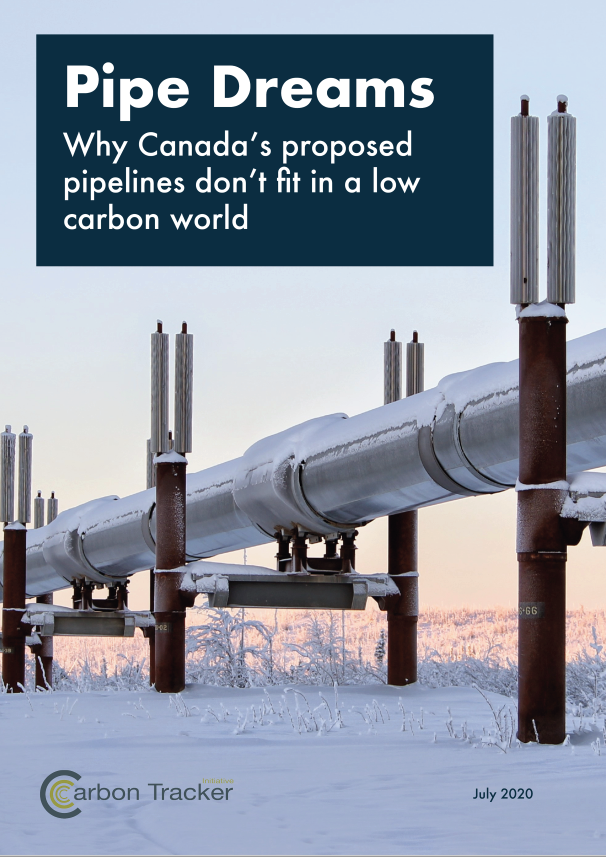
Pipe Dreams: Why Canada’s proposed pipelines don’t fit in a low carbon world

By Axel Dalman and Andrew Grant - Carbon Tracker - July 2020

Carbon Tracker’s modelling shows no new oil sands are needed in a low carbon world.

Prospective pipeline projects represent a significant expansion of capacity, with taxpayer support. However, new pipelines are surplus to requirements under Paris Agreement demand levels.

Canadian authorities face the challenge of trying to reconcile their natural resources development plans with their positioning on climate. Canada has previously having shown leadership on climate change issues, but its government support for pipelines – which are reliant on the failure of the Paris Agreement – risks damaging its credibility.

Key Findings:

Our research has previously shown that no new oil sands projects are needed in a low carbon world. All unsanctioned oil sands projects are uncompetitive under both the International Energy Agency’s 1.7-1.8°C Sustainable Development Scenario (SDS) and c.1.6°C Beyond 2 Degrees Scenario (B2DS).

All proposed new pipelines from Western Canada, in particular Keystone XL and Trans Mountain expansion, are surplus to requirements in a Paris-compliant world. Pipeline capacity may have proved a constraint in recent years, but under SDS, all future oil supplies from Western Canada can be accommodated by upgrades and replacements to existing pipelines, local refining and limited rail freight.

Even if discounts for Canadian crude narrow, new oil sands projects remain uneconomic. Western Canadian heavy oil trades at a steep discount to international benchmarks due to quality and transport challenges, averaging $25 below Brent over the last decade. Even if greater pipeline capacity reduces this to $10 in the future, in line with levels seen during previous periods of unconstrained supply, new projects still remain uneconomic under the SDS. Indeed, even if Canadian heavy oil were to trade at parity with Brent, which is extremely unlikely due to its lower quality, there would still be no new oil sands production under the B2DS and just 120,000 bbl/d would enter the market in the SDS – a level which would be covered by existing rail capacity.

Investors in oil sands face depressed cash flows in a low carbon world of falling oil demand and weak pricing, but will be forced to produce or pay the price due to inflexible “take-or-pay” transport fees for excess new pipeline capacity.

While take-or-pay contracts spread the impacts, pipeline investors still face financial risks as upstream production weakens. Uncontracted capacity will probably remain unused by producers, and contracts may cannibalise tariffs from other pipelines. Even take-or-pay commitments are subject to counterparty risk in a falling oil market.

The Canadian government’s stakes in Keystone XL and Trans Mountain could well prove to be a drain on the public purse. Under the SDS, government tax revenues and the value of the assets are unlikely to reach the levels anticipated at the time of sanction.

Canada’s leadership position on climate change may be undermined by its support for projects reliant on the failure of the Paris Agreement.

Read the report (Link).

A Fair Climate Policy for Workers: Implementing a just transition in various European countries and Canada

By Pia Björkbacka - The Central Organisation of Finnish Trade Unions SAK, June 26, 2020

Both the Paris Agreement on Climate Change and the target of carbon neutrality by the year 2035 set out in the government programme of Finnish Prime Minister Sanna Marin refer to a just transition for workers towards a low-carbon society. Such a just transition has long been sought by the trade union movement and is an important condition for achieving ambitious climate policy objectives.

The programme of the Marin government states that the government will work with labour market organisations to harmonise economic and labour market policies. Achieving climate objectives will also require co-operation with the social partners, and sectoral assessments in particular.

A just transition has been selected as one approach to reaching the target of a carbon neutral Finland by 2035. The government will pledge to implement emission reduction measures in a socially and regionally equitable way that involves all sectors of society. The government programme envisages establishing a round table on climate policy in Finland under the committee on sustainable development. Bringing together the various actors in society will ensure that climate measures serve the general interests of society and enjoy broad public support.

(Government Programme of Prime Minister Marin 2019)

The implementation of climate policy is causing restructuring in various sectors, meaning that climate policy decisions and actions also have social implications.

The European Commission has estimated that mitigating climate change will create more jobs in the European Union than it will cost (European Commission, 2019), but the changes will be sectoral. Even though labour market restructuring – which is also guided by climate policy - is creating new employment opportunities, it also brings fears of unemployment.

Realising employment opportunities requires substantial investment in employee skills and innovation. It is very important for the benefits and costs of low-carbon restructuring to be evenly shared across various sectors, occupations, population groups and regions. Successfully transitioning to a carbon-neutral society will not only require emission reduction measures and business and energy policies, but also employment, social welfare, education and regional policies.

The principle of a just transition will seek to meet these challenges. This means implementing emission reductions in a way that is fair to workers. It is about creating new, decent and sustainable jobs, in-service training for new employment, and security of earnings. The goal of a just transition is to increase the participation and commitment of workers in deciding policies for mitigating climate change nationally, regionally and within businesses, thereby promoting a smooth transition to a carbon-neutral society.

Read the text (PDF).

Retooling Our World for the Future

By staff - Adapting Canadian Work and Workplaces to Respond to Climate Change - June 24, 2020

The Coalition of Black Trade Unionists joined Green Jobs Oshawa’s first “Retooling Our World for the Future” Summit; a summit for community leaders, environmentalists, labour and social justice advocates all working towards the common goal of public ownership and repurposing our world and jobs for socially beneficial manufacturing. Here is the link to the video of the summit and a description of the speakers on Youtube.

Green Strings: Principles and conditions for a green recovery from COVID-19 in Canada

By Vanessa Corkal, Philip Gass, and Aaron Cosbey International Institute for Sustainable Development, June 2020

Key Messages

  • The COVID-19 crisis, while difficult and tragic, also provides a critical opportunity to align efforts to meet Canada’s climate goals with the challenge of economic reconstruction post-pandemic.
  • IISD has developed seven "green strings" recommendations: key principles, criteria, and conditionalities that should be applied to government measures for economic recovery from COVID-19 to ensure a green recovery.
  • Canada’s leading environmental groups, representing close to two million people, have signed on to the recommendations, including the Pembina Institute, Climate Action Network Canada, David Suzuki Foundation, Environmental Defence, Greenpeace Canada, Équiterre, Ecojustice, Ecology Action Centre, Conservation Council of New Brunswick, Stand.earth, Leadnow, Sierra Club Canada Foundation, and Wilderness Committee.

The reasons to set and apply "green strings" are clear:

  • Conditions in the public interest are the government’s right and duty.
  • The benefits of green stimulus and recovery measures are backed by evidence. 
  • We need a new economic model for the workers of today and tomorrow.
  • Urgent action is needed to address the climate crisis. 
  • Health and climate change imperatives go hand in hand. 
  • There is strong public support for ensuring a green recovery. 

The following seven “green strings” should be attached to COVID-19 recovery measures announced by Canada’s government:

  1. Support only companies that agree to plan for net-zero emissions by 2050.
  2. Make sure funds go towards jobs and stability, not executives and shareholders.
  3. Support a just transition that prepares workers for green jobs.
  4. Build up the sectors and infrastructure of tomorrow.
  5. Strengthen and protect environmental policies during recovery.
  6. Be transparent and accountable to Canadians.
  7. Put people first and leave no one behind.

We can no longer continue with the status quo, worsening the climate and biodiversity crises and locking our country and the global community in to stark health, environmental, and economic outcomes. We must seize this difficult moment to transform our economy and our institutions to serve vital public policy goals from environment to equity. The stakes are high.

Read the text (Linked PDF).

Unifor's Road Map for a Fair, Inclusive and Resilient Economic Recovery

By staff - Unifor, June 2020

Unifor is Canada’s largest union in the private sector, representing 315,000 workers in every major area of the economy.

The union advocates for all working people and their rights, fights for equality and social justice in Canada and abroad, and strives to create progressive change for a better future.

Unifor brings a modern approach to unionism: adopting new tools, involving and engaging our members, and always looking for new ways to develop the role and approach of our union to meet the demands of the 21st century.

Every person of working age in Canada has a right to a good job and the benefits of economic progress.

Unifor is presenting this plan in June 2020, four months after the novel coronavirus arrived in Canada, at a time when restric-tions on movement, activities and business operations are begin-ning to lift, but infection rates and illness continue to grow.

Read the report (PDF).

A Call for Federal Leadership: Stand with oil sands workers calling for renewable energy

By Lliam Hildebrand - Iron and Earth, March 4, 2020

The workers of Iron & Earth are urging the federal government to show bold leadership to put Canada on the fast track to a net-zero economy now. This week we wrote to Prime Minister Trudeau and Deputy Prime Minister Freeland and asked them to enact a plan that will put us to work building the new economy.

The Teck mine cancellation could represent a historic milestone, marking the moment that Canada shifted collectively towards a prosperous net-zero economy. But in order to move in this new direction, we need visionary federal climate policy that includes urgent investments across the country, with special attention to Alberta and Saskatchewan. Here is the text of our letter:

March 4, 2020

The Right Honourable Justin Trudeau
Office of the Prime Minister of Canada
80 Wellington Street
Ottawa, ON K1A 0A2

The Right Honourable Chrystia Freeland
Deputy Prime Minister of Canada
House of Commons
Ottawa, ON, K1A 0A6

Re: the cancellation of the Teck Frontier project and building the new net-zero economy

Dear Prime Minister Trudeau and Deputy Prime Minister Chrystia Freeland,

Iron & Earth is a not-for-profit organization led by fossil fuel industry and Indigenous workers, whose aim is to help build the policies and infrastructure required to meet climate targets. We are concerned about the increasingly polarized conversation and contexts around energy development in Canada and the significant economic shifts that the recent Teck project cancellation represents. We are writing to urge you to show bold leadership to put us decisively on track to a net-zero economy.

Labour’s Vision for Economic Recovery

By staff - Canadian Labour Congress - May 13, 2020

Canada is in the midst of the worst unemployment crisis since the Great Depression. Millions of workers have lost their jobs and now face an uncertain future.

Canada’s unions are proposing a set of ambitious initiatives in order to achieve a strong, sustainable and inclusive economic recovery. It is a recovery that places workers directly at the centre of every policy and strategy going forward.

COVID-19 has laid bare the underlying inequalities of our society. The labour movement has been witness to the growing divide between the have and have-nots and is ready to advise on ways to narrow the gulf to ensure fairness for everyone.

By fixing what has long been broken, we can ensure that no one is left behind in the coming phases of recovery.

The guiding principles we propose build on current government efforts to respond to economic disruptions wrought by the pandemic. These priorities aim to ensure that the economic recovery:

  • Focuses on getting Canadians back to work and fully employed in decently paid, productive jobs. As we learned from the Great Recession in 2008, joblessness and labour underutilization will persist without labour market planning, coordination and concerted action by governments.
  • Focuses on public investment in infrastructure, and on renewal and expansion of public services. Amidst general uncertainty, weak consumer demand and high levels of indebtedness, business investment will not, by itself, be the engine of recovery. Strong public investment can lift incomes and economic activity that will, in turn, stimulate business investment.
  • Focuses on being gendered, inclusive and committed to reducing inequality. The pandemic and economic shutdown have worsened insecurity and inequality, which will further slow the recovery if left unchecked. It is time to address the precarity, poor working conditions and wage discrimination in sectors dominated by women, including care work, retail and health services. This work is essential to the health and well-being of our communities and economy.

Canada’s unions reject the failed thinking and economics of austerity. Canadians remember how the Conservative Party of Canada cut spending to balance budgets in 2010, just months after the worst depths of the Great Recession. The government prioritized financial support for banks and corporations, instead of investing in people and communities. Those decisions led to years of sluggish economic growth, persistently high unemployment, growing precarity and insecurity, and rising inequality.

Read the report (PDF).

Pages

The Fine Print I:

Disclaimer: The views expressed on this site are not the official position of the IWW (or even the IWW’s EUC) unless otherwise indicated and do not necessarily represent the views of anyone but the author’s, nor should it be assumed that any of these authors automatically support the IWW or endorse any of its positions.

Further: the inclusion of a link on our site (other than the link to the main IWW site) does not imply endorsement by or an alliance with the IWW. These sites have been chosen by our members due to their perceived relevance to the IWW EUC and are included here for informational purposes only. If you have any suggestions or comments on any of the links included (or not included) above, please contact us.

The Fine Print II:

Fair Use Notice: The material on this site is provided for educational and informational purposes. It may contain copyrighted material the use of which has not always been specifically authorized by the copyright owner. It is being made available in an effort to advance the understanding of scientific, environmental, economic, social justice and human rights issues etc.

It is believed that this constitutes a 'fair use' of any such copyrighted material as provided for in section 107 of the US Copyright Law. In accordance with Title 17 U.S.C. Section 107, the material on this site is distributed without profit to those who have an interest in using the included information for research and educational purposes. If you wish to use copyrighted material from this site for purposes of your own that go beyond 'fair use', you must obtain permission from the copyright owner. The information on this site does not constitute legal or technical advice.
