

You are here

Green New Deal (GND)

COP26 Report Back: Climate Justice Activists Speak Out

Want to Know How We Can Win a Just Transition? States Hold a Key

By Mindy Isser - In These Times, November 16, 2021

The climate justice movement has undoubtedly picked up steam in the last three years as talk of a Green New Deal has made its way into the mainstream. But even after uphill and innovative organizing, our federal government has not adequately responded to the serious and existential threat of climate change: The Build Back Better bill, touted by the Biden administration as our generation’s great hope for action on climate change, has been almost completely gutted in Congress, where it still awaits passage. And after the ultra-wealthy took private jets to and from the United Nations Climate Change Conference (COP26) in Glasgow, it does not appear that the urgent action we need will come any time soon. As temperatures increase and storms become worse, the environmental situation is even more dire: Humans can expect ​“untold suffering,” scientists warn, including mass extinction and death, if we don’t act fast.

Amid our elected leaders’ monumental failures, the climate justice movement has smartly moved its focus away from pet projects, like small-scale lawsuits, and towards organizing to build a movement with enough popular support to change our political system. To get the numbers we need — of workers in the many millions — it is necessary to ensure that climate solutions, whether it’s stopping coal extraction or halting fossil fuel digging, don’t abandon workers in those industries. This is the idea behind a ​“just transition,” which aims to move to an environmentally sustainable economy while making sure all workers have safe and dignified work. 

State by state, organizers are working hard to make a just transition a reality and, fortunately, there are a few wins to point to. Unions and environmental groups won a joint victory this June, when the Climate and Community Investment Act, SB 999, passed in Connecticut. The legislation will do three important things: require prevailing wages for construction workers on renewable energy projects, ensure renewable energy projects create good, union jobs for Connecticut residents from disadvantaged communities, and negotiate community benefits agreements, which are agreements that describe a developer’s obligations to the broader community.

This state-level legislation is a step toward an urgent — and existential — need. Kimberly Glassman is the director of the Foundation for Fair Contracting of Connecticut, a non-profit organization that represents both building trades unions and union contractors to monitor public works’ projects for compliance with wage and other labor laws. She told In These Times, ​“As we transition away from fossil fuel dependent energy into green energy, [we have to make sure] that the workforce that has built their livelihoods in the fossil fuel industry has a way to transition and has access to good paying jobs in the green energy sector.” 

New website launched to promote greener international trade agreements

By Elizabeth Perry - Work and Climate Change Report, November 10, 2021

GreenNewTrade.org is a new website aimed at climate justice activists and the general public, describing past and current trade challenges to “Green New Deal–type policies”, and calling for changes to trade rules. For Canadians, the most famous such international trade dispute occurred when Japan and the EU challenged the domestic content provisions in Ontario’s Green Energy Act – and in 2013, the World Trade Organization ruled against Ontario. There have also been numerous challenges under the investor–state dispute settlement (ISDS) rules of NAFTA and the successor United States Canada Mexico Trade Agreement (USMCA) – the website gives the example of US coal mining company Westmoreland, which in 2018 challenged Alberta’s planned phaseout of coal-fired power plants.

For an introduction to the issues, see Beyond NAFTA 2.0: A Trade Agenda for People and Planet, a report released in 2019 by some of the same groups behind this new website: the Canadian Centre for Policy Alternatives, the Institute for Agriculture and Trade Policy, Institute for Policy Studies, and the Rosa Luxemburg Stiftung–New York. A blog post at the Business and Human Rights Resources website describes GreenNewTrade.org .

Transforming Eskom: Working Class Climate Justice

Transforming Eskom: Africa’s Biggest Polluter

Transforming Eskom: Youth Securing a Just Climate Future

Introducing...The Socialist Green New Deal

By Mark Douglas - London Green Left Blog, November 2, 2021

Web Editor's Note: There are several "socialist" versions of the Green New Deal that predate the following version (and sometimes when someone refers to their own version as "socialist" they're really implying that the others don't conform to their own party line, but no such sectarian undertone is evident here, except in the sense of inter-party debates within the UK, so we have included it as part of the discussion.

The Green New Deal remains the most potent political concept in recent years: it has undergone several phases and adoption by many political parties and movements. It has strong support across progressive trends in western Europe but has not been properly implemented anywhere.

Social Democratic parties think it is some solution to their lack of real policy to deal with poverty and the climate challenge. Left parties know that it presents a challenge to capitalism, if properly implemented, because greedy corporations cannot adapt and de-carbonise to reduce climate destabilisation.

In Green Left we say that a Socialist version of the Green New Deal needs to be fought for as part of the transition to a new political economy.

A Green New Eskom: Transforming Power, Transforming South Africa

By staff - Climate Justice Coalition, November 2021

The campaign for a Green New Eskom is being led by the Climate Justice Coalition, a coalition of South African civil society, grassroots, trade union, and community-based organisations. We are calling for a rapid and just transition to a more socially owned, renewable energy powered economy, providing clean, safe, and affordable energy for all, with no worker and community left behind in the transition.

The Problem: Eskom’s old, unreliable and polluting coal power stations plunge us into rolling blackouts i.e. load-shedding or load reductions. Eskom has been mired in corruption, which has driven it deep into debt, sent electricity prices soaring, and robbed the public purse of trillions of rands.

Looking at Eskom now, it can be hard to think that it can be part of the solution to our problems rather than the cause of them. It can be hard to think of Eskom as anything but a headache, a drain on the taxpayer, and one of the gravest threats to our economy and environment.

The Solution: A better Eskom is possible. One that provides affordable, reliable and clean energy. An Eskom that drives a just transition to a more socially-owned renewable energy future that empowers and benefits communities, workers, businesses and all South Africans.

Not only is a transformed Eskom possible, it is absolutely vital. We simply cannot ensure a prosperous and sustainable future for South Africa without fixing Eskom. This may be one of the biggest and most important tasks in creating a better South Africa for all.

Read the entire statement (PDF).

Perspectives on a Global Green New Deal

By Harpreet Kaur Paul, et. al - Global Green New Deal, November 2021

Promises of a ‘Green New Deal’ have captured the imagination of climate activists, scholars and policymakers across Europe and North America. Unless grounded in principles of global justice, the promise of green jobs and infrastructure in the Global North could simply mean a continuation of colonial patterns of inequality and exploitation around the world. What would it mean for the Green New Deal to be globally fair? Published by the London Office of the Rosa Luxemburg Stiftung and The Leap, Perspectives on a Global Green New Deal tackles this question head on.
Harpreet Kaur Paul and Dalia Gebrial bring together climate justice insights experts from around the world, to explore the key themes that will define the future of any equitable and just global green new deal.

Read the text (link).

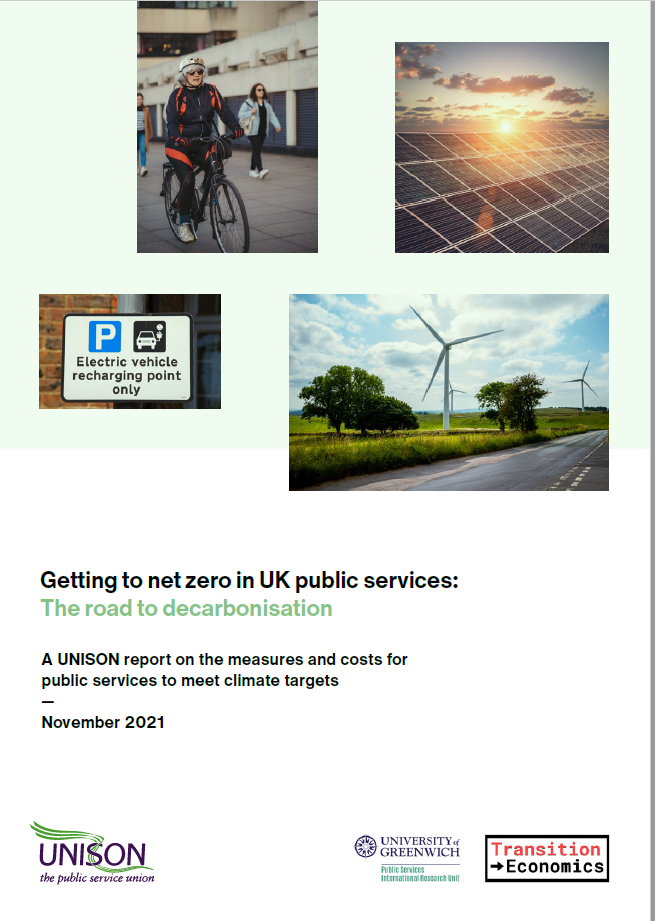
Getting to Net Zero in UK Public Services: The Road to Decarbonisation

By Dr. Vera Weghmann, et. al. - Unison, November 2021

Public services as a whole (excluding transport) represent about 8% of the UK’s direct greenhouse gas emissions. The NHS alone represents about 4% of the UK’s emissions. When procurement, construction, and social housing are taken into account, public services’ impacts are much greater.

Different sectors within the overall framework of public services have declared their decarbonisation plans. Some are ahead of the national targets. The NHS has declared that it will reach net zero by 2040, with an ambition to reach an 80% reduction by 2028 to 2032. More than one-third of local authorities (single- and upper-tier) committed themselves to decarbonise their local area by or before 2030.

The government aims to reduce direct emissions from public sector buildings by 75% against a 2017 baseline by the end of the Sixth Carbon Budget.

This report identified 21 different measures that should be taken across buildings, transport, electricity generation, waste, procurement and land use along with costed measures for each of nine different public services.

In our analysis, the UK’s public services need a capital investment injection of over £140 billion to 2035 to meet their Net Zero obligations. This will set the public sector on track to meet their climate targets and contribute to the UK’s overall carbon reduction aims. The analysis also identified measures that required annual operational expenditures of £1 billion to hit net zero targets. UNISON fully advocates that quality public services are best delivered by public ownership of public services and utilities rather than privatisation, outsourcing or PFI contracting of public services.

As well as improving the quality of life for service users, workers and the wider community, a number of the measures will also result in significant savings to public services’ budgets, through lower energy bills, cheaper to run fleets, and procurement savings. UNISON fully advocates that quality public services are best delivered by public ownership of public services and utilities rather than privatisation, outsourcing or PFI contracting of public services.

Read the text (PDF).

Pages

The Fine Print I:

Disclaimer: The views expressed on this site are not the official position of the IWW (or even the IWW’s EUC) unless otherwise indicated and do not necessarily represent the views of anyone but the author’s, nor should it be assumed that any of these authors automatically support the IWW or endorse any of its positions.

Further: the inclusion of a link on our site (other than the link to the main IWW site) does not imply endorsement by or an alliance with the IWW. These sites have been chosen by our members due to their perceived relevance to the IWW EUC and are included here for informational purposes only. If you have any suggestions or comments on any of the links included (or not included) above, please contact us.

The Fine Print II:

Fair Use Notice: The material on this site is provided for educational and informational purposes. It may contain copyrighted material the use of which has not always been specifically authorized by the copyright owner. It is being made available in an effort to advance the understanding of scientific, environmental, economic, social justice and human rights issues etc.

It is believed that this constitutes a 'fair use' of any such copyrighted material as provided for in section 107 of the US Copyright Law. In accordance with Title 17 U.S.C. Section 107, the material on this site is distributed without profit to those who have an interest in using the included information for research and educational purposes. If you wish to use copyrighted material from this site for purposes of your own that go beyond 'fair use', you must obtain permission from the copyright owner. The information on this site does not constitute legal or technical advice.
