

You are here

climate change

For a Fair and Effective Industrial Climate Transition: Support measures for heavy industry in Belgium, the Netherlands and Germany

By Yelter Bollen, Tycho Van Hauwaert, and Olivier Beys - European Trade Union Institute, August 2021

Europe’s industrial base needs to undergo a swift and persistent transformation towards carbon neutrality and circularity, but this transition must happen in a fair and socially just manner. In this working paper, we evaluate the support mechanisms for heavy industry which have been put in place over the past 20 years, comparing the state of play in the Netherlands, Germany and Belgium.
We also compare recent developments in the industrial policy frameworks of these countries, considering European as well as domestic policy levers. We conclude that policy frameworks have largely been ‘defensive’, have lacked foresight, and have had negative distributional effects. Recent shifts in policy have opened up avenues for progress, but the level of ambition remains insufficient and uneven. Major economic incentives and support measures should cohere with a just transition, at the (sub-)national as well as the EU level.

Read the text (Link).

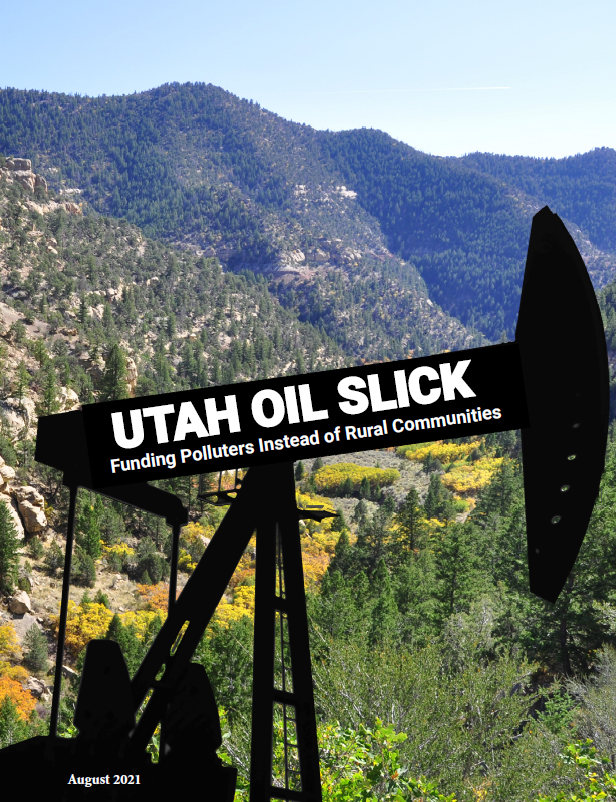
Utah Oil Slick: funding polluters instead of Rural Communities

By Deeda Seed and Adair Kovac - Center for Biological Diversity, et. al., August 2021

Every year Utah receives tens of millions of dollars in federal lease revenues and royalties from oil, gas and mineral extraction as a way to help mitigate the impacts of drilling and mining. Even before scientists linked fossil fuels to the climate crisis, Congress intended this money to be used to help rural communities experiencing rapid growth and infrastructure challenges. The influx of new workers and increased drilling and mining take a toll on communities.

This report from the Utah Clean Infrastructure Coalition shows that, since 2009, the little-known board charged with distributing this public money has funneled more than $109 million to projects that promote or expand fossil fuel extraction in violation of the federal Mineral Leasing Act. That includes more than $2.2 million approved after a state audit found the board was using the public funds improperly.

We examined dozens of public records — including the 2020 audit of the Permanent Community Impact Fund Board by the Utah Legislative Auditor General, meeting minutes, audio tapes and project documents — and found that:

  • Since 2009 the Permanent Community Impact Fund Board, or CIB, has issued $109 million in grants and low- or no-interest loans — all of it public money — to finance road construction, engineering studies, attorney fees and other costs to enable fossil fuel development on public and private land. Beneficiaries include well-connected private firms trying to get approval for the proposed $1.5 billion Uinta Basin Railway.
  • Over the past two years small towns, cities and special improvement districts in two counties have identified more than $60 million for community improvement projects that have not yet been funded. Unfunded projects include water and sewer services, recreation centers, road improvements and public safety equipment. Over this same period, the CIB gave more than $48 million in grants to fossil-fuel related projects.
  • The Utah Legislature failed to oversee the board’s activities. Even worse, in 2021 it changed state law to allow mineral lease revenues and royalties to finance fossil-fuel infrastructure projects, which is illegal under federal law. The new law followed the 2020 state audit criticizing the board’s spending and haphazard decision-making.
  • County governments and local agencies continue to seek public funding for projects that facilitate fossil fuel extraction and enrich private corporations over community needs. Since the audit, Uintah County commissioners approved seeking $39 million in public funds to help a private, Ogden-based oil company build a 640-acre oil refinery in eastern Utah.3 The proposed $1.4 billion Uintah Advantage refinery would have the capacity to refine 40,000 barrels of oil a day, and it may also include a rail yard for the proposed Uinta Basin Railway.

The CIB must stop funding fossil fuel development projects. The Utah Legislature should oversee the board’s grant and loan-making process to ensure it complies with the Mineral Leasing Act, which requires these public funds be used to mitigate harm inflicted on communities by oil, gas and mineral extraction and forbids using the money for economic development. Rural communities should call on legislators to ensure that infrastructure needs are met and public money is spent properly.

As Utah and the western United States experience the devastating consequences of climate change in the form of intense heat, drought and wildfires, it is even more critical that the CIB stop siphoning public funds away from much-needed community projects to finance dangerous fossil fuel extraction that worsens the climate crisis.

Read the text (PDF).

Solidarity with NHS workers from Earth Strike UK

By Staff - Earth Strike UK, July 30, 2021

Earth Strike is a grassroots movement for workers, youth, and community organisers to challenge the root causes of the climate crisis. Our mission is to disrupt the capitalist system that is causing the climate crisis and to fight for a better future for the global working class.

We extend our solidarity to, and practical support in, your struggle for pay rises of at least 15%. We will support you on any potential picket lines. Workers fighting for decent pay and to protect the standards of our healthcare system should be able to take direct action in pursuit of these demands at a time and in a manner of their own choosing. We therefore oppose all legal restrictions on the right to strike.

We are environmentalists supporting and seeking to mobilise for your struggle, and we want to see other environmentalists do the same. Our struggles are much closer than many might imagine. Healthcare jobs are climate jobs, and the refusal to fund and support healthcare properly is a damning indictment of this system’s response to climate breakdown. As air pollution chokes children in the streets of London, disproportionately in working-class and black and brown communities, the hospitals which should mitigate the damage are underfunded, with workers in them underpaid and overworked. As the effects of climate breakdown worsen, it will be healthcare systems having to deal with the impact. Meanwhile, we do not forget the vast wealth inequalities that exist between this country and others, particularly where climate destruction is already felt hardest.

As climate activists, we particularly oppose the ban on strikes over so-called “political” issues, and the ban on strikes in solidarity with other workers. Those laws prevent workers from striking directly to demand radical action on climate change, to oppose NHS privatisation and cuts, and to directly support your demands – as miners, postal workers, dockers, print workers, and others did in the 1980s. Our new “Empower the Unions” initiative aims to highlight the injustice of these restrictive laws, and mobilise both climate and trade union activists against them.

So we say: all power to the NHS workers! Your fight for 15% is a key part of the wider struggle for a genuinely socialised healthcare system, free at the point of use and run by workers and service users, which in turn is part of the struggle for a different kind of society – one in which human and environmental need, rather than the needs of profit, comes first.

An injury to one is an injury to all – solidarity!

Opinion: Public Utility Campaigns Have A Labor Problem

By C.M. Lewis - The Strike Wave, July 28, 2021

Maine Governor Janet Mills’ labor-backed veto of LD 1708—which would have consolidated two private utility corporations into a statewide consumer cooperative, Pine Tree Power—is a sober warning to those fighting for public utilities: neglect unions at your peril.

Mills is no friend to labor. She previously vetoed pro-worker labor reforms and pledged to veto the right to strike for public workers. But her veto, sustained by the legislature, still accomplished the goal of concerned unions like the International Brotherhood of Electrical Workers, Local 567, who were alarmed at a potential change in legal jurisdiction.

Union resistance to progressive proposals can often cause consternation. Culinary 226’s opposition to Medicare for All notably caused a stir during the Nevada caucuses, raising the ire of many progressives. However, an immediate assumption that IBEW was wrong to oppose the bill buries the complicated reality: the bill would’ve tangibly harmed union workers. 

IBEW’s opposition was driven by concern that the bill would move workers from jurisdiction under the National Labor Relations Board to the Maine Labor Relations Board, bringing them into the public sector. Although that superficially sounds like a minor administrative change, and no reason for opposition, it would’ve had severe consequences for their workers—notably losing the statutory right to strike, and the imposition of the open shop through the Janus vs. AFSCME ruling

Viewed through that lens, IBEW’s opposition—while frustrating—is not unreasonable, and it speaks to a difficult problem faced by advocates for public utilities: that under present law, there is little to no way to bring private utilities under public control without stripping union rights from workers.

US Energy Transition Presents Organized Labor With New Opportunities, But Also Some Old Challenges

By Delger Erdenesanaa - Inside Climate News, July 27, 2021

President Biden’s push for “good, union jobs” in clean energy has increased hope that organizing solar and wind workers can close the pay gap between them and fossil fuel workers.

President Biden’s push for “good, union jobs” in clean energy has increased hope that organizing solar and wind workers can close the pay gap between them and fossil fuel workers.

Two years ago, Skip Bailey noticed a lot of trucks from a company called Solar Holler driving around Huntington, West Virginia. A union organizer with the International Brotherhood of Electrical Workers, Bailey saw an opportunity.

“We want to get in on the solar business,” he said, predicting the industry will grow in his home region, which includes historic coal communities in West Virginia, Kentucky and Ohio.

Bailey talked to Solar Holler about unionizing its employees who install photovoltaic panels on homes. IBEW showed the company its local training facility for electricians, and explained the health insurance and pension plans it offers. 

“It wasn’t a hard sell in either direction,” said the company’s founder and CEO, Dan Conant. He was already interested in securing union protections for his employees when Bailey contacted him, he said. The move fit with Solar Holler’s dedication to West Virginia’s legacy of energy production and strong union membership.

“It was not just good business, but it just really spoke to our history as a state,” he said.

Conant and Bailey’s efforts paid off in March 2020, when IBEW Local 317 and Solar Holler signed a contract. It’s just a start—Solar Holler only has about 20 unionized employees—but the agreement is an early example of the future Joe Biden is promising. The president frequently pledges to create millions of jobs while transitioning the U.S. to clean energy. Every time he does, he’s quick to add that these will be “good, union jobs that expand the middle class.”

“It’s a great talking point,” said Joe Uehlein, president of the Maryland-based Labor Network for Sustainability, an advocacy group pushing to unionize green jobs. But he added that Biden faces a difficult balancing act to achieve his pledge. 

Combatting Climate Change, Reversing Inequality: A Climate Jobs Program for Texas

By Lara R. Skinner, J. Mijin Cha, Hunter Moskowitz, and Matt Phillips - ILR Worker Institute, Cornell, July 26, 2021

Texas is currently confronted by three major, intersecting crises: the COVID-19 public health pandemic and ensuing economic crisis; a growing crisis of inequality of income, wealth, race and power; and the worsening climate crisis, which continues to take its toll on Texans through hurricanes, major flood events, wildfires, debilitating heat waves and the significant economic cost of these extreme weather events. These crises both expose and deepen existing inequalities, disproportionately impacting working families, women, Black, Indigenous and people of color (BIPOC) communities, immigrants, and the most vulnerable in our society.

A well-designed recovery from the COVID-19 global health pandemic, however, can simultaneously tackle these intersecting crises. We can put people to work in high-quality, family- and community-sustaining careers, and we can build the 21st century infrastructure we need to tackle the climate crisis and drastically reduce greenhouse gas emissions and pollution. Indeed, in order to avoid the worst impacts of the climate crisis, it is essential that our economic recovery focus on developing a climate-friendly economy. Moreover, there are significant jobs and economic development opportunities related to building a clean energy economy. One study shows that 25 million jobs will be created in the U.S. over the next three decades by electrifying our building and transportation sectors, manufacturing electric vehicles and other low-carbon products, installing solar, wind and other renewables, making our homes and buildings highly-efficient, massively expanding and improving public transit, and much more.

Conversely, a clean, low-carbon economy built with low-wage, low-quality jobs will only exacerbate our current crisis of inequality. The new clean energy economy can support good jobs with good benefits and a pipeline for historically disadvantaged communities to high-quality, paid on-the-job training programs that lead to career advancement. Currently, the vast majority of energy efficiency, solar and wind work is non-union, and the work can be low-wage and low-quality, even as the safety requirements of solar electrical systems, for example, necesitate well-trained, highly-skilled workers.

Read the text (PDF).

Climate jobs and the Unite General Secretary election campaign

By Wendy Smith - The Campaign against Climate Change Trade Union group, July 25, 2021

People have been shocked at the recent news of deaths from extreme heat and flooding across the globe. Three of the world’s wealthiest men have been racing into space in an effort to find new sources of profit. Meanwhile our government here seems determined to rush the UK into a return to pre-pandemic business as usual. There has never been a more urgent need to fight for effective action in the face of climate catastrophe. The COP26 talks in Glasgow in November present our world leaders with a vital and timely opportunity to deliver more than vague targets and future promises.

The Campaign against Climate Change Trade Union group (CaCCTU) will be launching this autumn the eagerly-awaited update to their groundbreaking pamphlet, “One Million Climate Jobs”, first published in 2004. At the heart of this new report is a core model for a new public service – a National Climate Service – that can get the job done by seeing to the integration of training, redeployment, planning and the interface between sectors (e.g., between industries and energy, or the complex planning needed to integrate and balance public transport).

The Climate Jobs campaign argues we need a sustainable transformation of construction, transport and power among other sectors. Several unions organise workers in these industries and, in order to win the changes we need, these unions should get behind these demands, building support for a transition of the economy and for massive investment in well paid jobs which tackle the climate emergency. In particular, Unite, one of the biggest unions in the Britain, can play a crucial role. Unite is in the process of electing a new General Secretary.

Up to now there has been a tendency amongst many within the Unite leadership to take a defensive position regarding climate change activism. Instead of embracing the possibilities for millions of new jobs in the public transport, buildings retrofitting and renewable energy trades, Unite leaders have opted to present the need to defend the status quo of existing jobs in the aviation, nuclear and private vehicle industries.

Many in the climate movement see some of the proposals put forward by various members of the Unite hierarchy as false solutions. Carbon capture and storage (CCS), nuclear power generation, electric vehicles without addressing car dependency, maintaining current levels of aviation: these are all contributing to the problems of carbon emissions and other greenhouse gases. Many climate activists are also Unite members and feel that their voices are not being heard in the higher echelons of the union.

We need to see a greater involvement by rank and file trade unionists and non-unionised workers in shaping their own futures. We recognize that workers have the skills and expertise to play a role in their own just transition to green jobs. Wouldn’t it be a refreshing change to see the leadership candidates putting forward the sort of radical ideas that could make that happen? Whoever wins the election, will the next Unite General Secretary embrace and promote the ideas presented in the new CaCCTU report?

Extreme heat is killing American workers

By Umair Irfan - Vox, July 21, 2021

Abe Carlin held up an instant-read thermometer in the Portland, Oregon, pizzeria where they worked. It showed 103.2 degrees Fahrenheit. Even with half the ovens off and the air conditioning cranked up, the kitchen was desperately hot on June 27, when a heat dome capped the region.

Outside, temperatures were breaking records as a searing late-June heat wave settled across the Pacific Northwest. Portland reached a record high of 112 degrees Fahrenheit, only to be broken the next day. Portlanders, who have rarely felt such heat, didn’t want to turn on the ovens in their own homes.

So as temperatures started rising, more orders came into the pizzeria. The kitchen staff struggled to keep up with the demand using their limited oven space. And staffers who would have helped out couldn’t make it in as cables melted in Portland’s light rail system and left commuters stranded.

Conditions in Carlin’s pizza restaurant were actually better than many in the food industry. Employees were rotated between the cooler dining room and the warmer kitchen. The break room was stocked with cold Gatorade. Workers were told to take frequent breaks and even spend a few minutes in the cooler if needed.

Finally, the owners decided to close the restaurant early.

“Fundamentally, the way that our space was set up was not able to deal with heat,” Carlin said. “Our HVAC system is not meant to handle this.”

Workers at other Portland restaurants were not so lucky. Some closed early while others tried to stay open as long as possible. The heat triggered power outages that shut down air conditioners and coolers in several restaurants, and employees reported symptoms of heat exhaustion. Workers at Voodoo Doughnuts in Portland’s Old Town went on strike because of the heat. The striking workers were then fired.

U.K. Green Jobs Taskforce recommendations address green skills, Just Transition

By Elizabeth Perry - Work and Climate Change Report, July 21, 2021

On July 14, the Independent Green Jobs Taskforce delivered its report to the government of the United Kingdom, making fifteen recommendations on how best to deliver the green jobs and skills of the future. A summary of the report and steps taken to date appear in the government’s press release. The full Report is here, with an Annex called Sectoral Transitions to Net Zero, profiling specific sectors and occupations.

The U.K. Trades Union Congress (TUC), which participated in the Taskforce, reacted with a blog post titled, A greener economy can be positive for workers too, highlighting key recommendations – and pointing out real-world examples of best practice, including the example of collaboration between EDF and Unite, Prospect and GMB in the successful creation of transition pathways for workers at Cottam coal power station before it closed. The Senior Deputy General Secretary of the Prospect union was also member of the Green Jobs Taskforce, and summarized her thoughts in this blog: “It’s time the government moved from lofty climate change ambitions to action”, saying “ I am pleased that the Green Jobs Taskforce not only uses the language of Just Transition, but recommends the establishment of a new national body to help shape this change and ensure that no worker or community is left behind in the race for net zero. That recommendation is one of many that we on the task force have made to the government, including establishing a ‘green careers launchpad’, making sure that the curriculum reflects the green skills we will need in the future, and publishing a comprehensive net zero strategy ahead of November’s COP26 summit.”

The government will not endorse any of the Report’s recommendations immediately but they are promised to feed into the development of the U.K.’s Net Zero Strategy; in the meantime, “ a cross-cutting delivery group” has been established “to oversee the development and delivery of the government’s plans for green jobs and skills. This group will maintain the momentum generated by the Taskforce and drive meaningful action across the green skills agenda.”

The Green Jobs Taskforce was established in November 2020 , and included labour representatives from the TUC and Prospect union, along with academics, business representatives and the training sector, including Construction Industry Training Board, Engineering Construction Industry Training Board, East London Institute for Technology, Retrofit Works, Edinburgh University and National Grid.

Related reports: Unionlearn (part of the TUC) published a labour education document, Cutting Carbon, Growing Skills: Green Skills for a Just Transition in March 2020, providing discussion and case studies.

Teaching climate change in Canada

By Elizabeth Perry - Work and Climate Change Report, July 19, 2021

Education International, which represents 32.5 million educators in 178 countries, launched a “Teach for the Planet” campaign in April 2021, with a Manifesto for Quality Climate Change Education for All . The Canadian Teachers Federation has endorsed the campaign, raising the profile of climate change amongst Canadian educators. Earlier, in January 2020, the Ontario Institute for Studies in Education (OISE) held its first Climate Action Summit in response to youth global climate strikes, which resulted in the launch of OISE’s Sustainability and Climate Action Plan  in February 2021. Although much of that Plan relates to the operation or governance of OISE as a teaching faculty within the University of Toronto, it also sets out goals and strategies to conduct an inventory of sustainability and environmental content in courses, expand sustainability and environmental content in curriculum, encourage research by faculty, and “consider sustainability expertise as an asset in the hiring of new staff and faculty.”

 “Are Canadian schools raising climate-literate citizens?” (Corporate Knights magazine, Summer 2021), states that at best, K–12 sustainability and climate change content in schools is “uneven,”, and provides an overview of grassroots initiatives amongst educators aiming to improve that situation. Ellen Field, an assistant professor in Lakehead University, is quoted: “We have a responsibility, especially for those who are educators, to be honest with young people about the reality of the urgency we are facing”. Field authored an important survey: Canada, Climate Change and Education: Opportunities for Public and Formal Education (2019), which among many findings, reports that teachers identified the three main barriers to more climate education: lack of time to include during class; lack of classroom resources; lack of professional knowledge.

Other examples of grassroots activism regarding climate education: Learning for a Sustainable Future (LSF), housed at York University in Toronto is a national non-profit that promotes environmental awareness and social responsibility for students and teachers, and hosts Resources for Rethinking, an online collection of lesson plans, books, videos related to environmental, social and economic issues. (The B.C. Teachers Federation also offers a collection of lesson plans ).

Climate Education Reform BC is a student-led coalition which published an Open Letter to the provincial education minister in April 2021, recommending 6 points, including revisions to climate change for K-12 curriculum, and support for teacher training.

The Alberta Council for Environmental Education (ACEE) has operated since 2005, and recently adopted the K-12 Environmental Education Guidelines for Excellence, published by the North American Association for Environmental Education. ACEE also maintains an online resource centre of teaching materials related to climate change, including professional development materials such as the quarterly Green Teacher magazine .

Pages

The Fine Print I:

Disclaimer: The views expressed on this site are not the official position of the IWW (or even the IWW’s EUC) unless otherwise indicated and do not necessarily represent the views of anyone but the author’s, nor should it be assumed that any of these authors automatically support the IWW or endorse any of its positions.

Further: the inclusion of a link on our site (other than the link to the main IWW site) does not imply endorsement by or an alliance with the IWW. These sites have been chosen by our members due to their perceived relevance to the IWW EUC and are included here for informational purposes only. If you have any suggestions or comments on any of the links included (or not included) above, please contact us.

The Fine Print II:

Fair Use Notice: The material on this site is provided for educational and informational purposes. It may contain copyrighted material the use of which has not always been specifically authorized by the copyright owner. It is being made available in an effort to advance the understanding of scientific, environmental, economic, social justice and human rights issues etc.

It is believed that this constitutes a 'fair use' of any such copyrighted material as provided for in section 107 of the US Copyright Law. In accordance with Title 17 U.S.C. Section 107, the material on this site is distributed without profit to those who have an interest in using the included information for research and educational purposes. If you wish to use copyrighted material from this site for purposes of your own that go beyond 'fair use', you must obtain permission from the copyright owner. The information on this site does not constitute legal or technical advice.
