

You are here

energy transition

Fighting for Coal Country

By Staff - United Mine Workers of America, June 1, 2021

Clearly, the UMWA's positions on carbon capture and storage (CCS) and so-called "clean coal" stand in contrast (and, for the most part, opposition) with the entirety of the climate justice movement, ecosocialists, green syndicalists, and a good deal of rank-and-file union members not involved in resource extraction (including the more than 60-70% who support something like the Green New Deal). That said, at least the UMWA finally accepts that coal is a dying industry and a just transition is needed. Therefore, this is presented to show where the UMWA stands, not as an endorsement of their positions.

At the end of 2011, there were nearly 92,000 people working in the American coal industry, the most since 1997. Coal production in the United State topped a billion tons for the 21st consecutive year. Both thermal and metallurgical coal were selling at premium prices and companies were making large profits.

Then the bottom fell out. Over the next 4 years, coal prices cratered, especially in metallurgical coal but also in thermal coal. The global economy slowed, putting pressure on steelmaking and metallurgical coal production. Foreign competition from China, Australia, India and elsewhere cut into met coal production.

Domestically, hydraulic fracturing (fracking) of shale formations opened up previously untapped natural gas fields, caused the price of gas to drop below that of coal for the first time in years. Utilities began switching the fuel they used to generate electricity from coal to gas. Environmental regulations coming from the Obama administration also impacted coal employment. By 2016, just 51,800 people were working in the coal industry. 41,000 jobs had been lost.

Companies went bankrupt. Retirees’ hard-won retiree health care and pensions were threatened. Active miners saw their contracts, including provisions that had been negotiated over decades, thrown out by federal bankruptcy courts. From 2012 to today, more than 60 coal companies have filed for either Chapter 11 reorganization bankruptcy or Chapter 7 liquidation. Almost no company has been immune.

“Just since 2015 we have had companies like Peabody, Arch, Alpha Natural Resources, Walter Energy, Westmoreland and Murray Energy all go bankrupt,” President Roberts said. “Patriot Coal went bankrupt twice. Retirees’ health care was on the brink, but we were successful in preserving that in 2017. The 1974 Pension Fund was on the path to insolvency, but we were able to save that in 2019.

“Even though our contracts were thrown out by bankruptcy judges at company after company, we were successful in preserving union recognition, our members’ jobs and reasonable levels of pay and benefits at every company as they emerged from bankruptcy,” Roberts said. “But in no case has the contract that came out of bankruptcy been the same as the one our members enjoyed when a company went into bankruptcy. This has been extremely painful all the way around.”

Can Carbon Capture Save Our Climate— and Our Jobs?

By Jeremy Brecher - Labor Network for Sustainability, June 2021

As storms, heat waves, fires, floods, and other devastating effects of global warming have grown, more and more people have become convinced of the need to reduce greenhouse gases (GHG) emitted into the atmosphere. The Paris Agreement defined the goal of limiting global average temperature increase to 1.5 degrees Celsius above pre-industrial levels. At the April Climate Summit President Joe Biden announced the U.S. will target reducing emissions by 50-52 percent by 2030 compared to 2005 levels and reaffirmed the U.S. commitment to reach net zero emissions by 2050. These goals indicate what the consensus of climate scientists says is necessary to ward off the most destructive possible effects of climate change. The question remains how to realize them.

There are two well established and proven means to reduce GHG emissions. The first is to replace the burning of fossil fuels with renewable energy from solar, wind, hydropower, and geothermal sources. The other is to reduce the amount of energy we need through a myriad proven means ranging from switching from gasoline to electric vehicles to insulating houses. Numerous studies and thousands of implementations lay out the scientific and economic effectiveness of protecting the climate by reducing fossil fuel emissions.

There is a third means that is being promoted: continue burning fossil fuels but capture carbon–the principal greenhouse gas–either in the smokestack or by sucking it out of the air after it has been released. Various techniques for doing this have been developed with various names–carbon capture and storage (CCS), carbon capture and utilization (CCU), bioenergy with CCS (BECCS), and direct air capture with CCS (DACCS). We will refer to them together as “carbon capture.”

There is a debate in the climate and labor movements about the use of carbon capture as a climate solution. Some maintain that carbon capture is necessary to reduce greenhouse gas emissions. They argue as well that it can be a way to save the jobs of coal miners and fossil-fuel power plant workers and provide power needed for industry while still protecting the climate and that it will create large numbers of jobs. Others say that carbon capture is unproven, costly, problematic for health and the environment, more productive of jobs, and ineffective for climate protection. They argue that renewable energy and energy efficiency are superior both for climate and for workers and communities. They maintain that a transition to fossil-free energy is already underway and that organized labor and the climate movement should take the lead in ensuring that transition benefits rather than harms workers.

Read the text (PDF).

Just Transition/Transition to Justice: Power, Policy and Possibilities

By J. Mijin Cha, Manuel Pastor, Cynthia Moreno, and Matt Phillips - Equity Research Institute, June 2021

This report looks at this process of power building for just transition in four states: California, Kentucky, Louisiana, and New York. We combine an analysis of the pillars of just transition – strong governmental support, dedicated funding streams, diverse coalitions, and economic diversification – with an analysis of how to change power at a state level that focuses on the conditions that impact possibilities, the community-level capabilities that facilitate effective voice, and the arenas in which power is contested. Ultimately, the fight for a just transition is a fight for justice. And, while we know it will be hard and long, the stories we heard showed how advocates and organizers, often in the face of great odds, come together and force the change that makes people’s lives better. Building upon these efforts through supporting organizing, coalition building, and empowering communities is the blueprint for advancing a just transition. Through these channels, we can transition from a dirty polluting past to a just and healthy future.
Read the text (PDF).

For Alberta oil workers facing a future of industry volatility- policy options include Just Transition, green tax reform

By Elizabeth Perry - Work and Climate Change Report, May 31, 2021

In Search of Prosperity: The role of oil in the future of Alberta and Canada was released on May 26, that cataclysmic day of bad news for the oil and gas industry when the Dutch courts ordered Royal Dutch Shell to reduce its emissions immediately, and shareholders at Exxon and Chevron defied management to press for climate-friendly policies. The future of the oil and gas industry is also grim in Canada, according to In Search of Prosperity, published by the International Institute for Sustainable Development (IISD). Using economic models, it concludes that “the volatility of the industry poses a much greater threat than low prices to the Alberta economy – more than five times worse than the effect of just low prices.” And further: “….. unless there are innovations in the uses of oil for non-combustion, also known as “bitumen beyond combustion,” the oil sector will contribute less and less to Alberta’s prosperity.” According to the modelling, employment in the oil sector will potentially decrease byan average 24,300 full-time jobs per year toward 2050 ( accompanied by a potential 43% drop in royalties to the Alberta government). 

How to cope with those upcoming job losses? Another report from the International Institute for Sustainable Development (IISD), also released on May 26, suggests the EU Just Transition Mechanism as one of its model strategies for the future. 10 Ways to Win the Global Race to Net-Zero: Global insights to inform Canadian climate competitiveness offers an overview of the global policy literature and describes successful case studies, including the innovation of green steel in Sweden; hydrogen policy in Germany; collaboration in the form of the European Battery Alliance and the European Transition Commission; the Biden “all of government” approach to governance in the U.S.; New Zealand’s consultation with and inclusion of the indigenous Maori; and the EU’s Just Transition Mechanism as part of the European Green New Deal. The report’s conclusion offers five strategies, including that the Canadian government must take action as a “top priority” on its promised Just Transition Act.

The discussion of Just Transition in 10 Ways to Win provides a brief, clear summary of the complexity of the EU Just Transition Mechanism, and states that the EU approach is consistent with the recent report, Employment Transitions and the Phase-Out of Fossil Fuels by Jim Stanford, published by the Centre for Future Work in January 2021. Stanford argues that a gradual transition from fossil fuels is possible without involuntary layoffs, given a “clear timetable for phase-out, combined with generous supports for retirement, redeployment, and regional diversification”.

The IISD also recently published Achieving a Fossil Free Recovery (May 17), an international policy discussion with a focus on ending subsidies and preferential tax treatments for the fossil fuel industry. The report concludes with a brief section on Just Transition as the predominant framework for the transition to a clean energy economy, and calls for a social dialogue approach. As in previous IISD reports (for example, Fossil Fuel Subsidy Reform and the Just Transition in 2017), the authors argue that dollars spent to support and subsidize the fossil fuel industry could be better spent in encouraging clean energy industries. This argument also relates to an April 2021 IISD report, Nordic Environmental Fiscal Reform, which offers case studies of the success of environmental taxes – for example, in the use of tax revenue to support the Danish wind energy industry which now employs 33,000 workers.

Jobs and equitable transition: Bridging the chasm between rhetoric and action

By Sean O'Leary - Ohio River Valley Institute, May 26, 2021

There was a time when the sight of rows of office workers hammering away at their Friden adding machines would have sent me into paroxysms of delight because I, the Victor Comptometer salesman, had a new and better “programmable calculator” that could kick the Friden’s ass.

I was a young 1970s college graduate entering the workforce at the tail end of the era of mechanical business automation. Typewriters, adding machines, and mechanical cash registers were still the workhorses of stores and offices.

Behind all that machinery were companies – Burroughs, Monroe, Friden, Victor – whose names were as familiar then as Cisco, Oracle, and SAP are today. And those companies supported factories, sales offices, and repair facilities that provided living wage jobs to hundreds of thousands of workers and their families.

Then, within a little more than a decade, it was all gone. A year after I fizzled as a Victor salesman, I was playing at home with my new Radio Shack TRS-80 home computer and five years later, instead of an adding machine and typewriter on my desk at work, there sat an Apple II desktop computer, precursor to the Mac.

Gone too were those hundreds of thousands of jobs plunging not only workers and families, but entire communities, into financial crisis. One could argue that Dayton, Ohio, once home to National Cash Register and the business forms giant, Standard Register, never recovered.

The knock-out blow suffered by the office automation industry was as ferocious and sudden as the one that hit the American steel industry a few years earlier, the textile industry a few decades before that, and also as the one that possibly faces workers in the fossil fuel economy today.

So how did we as a society help displaced workers and communities manage the economic consequences of the transition from the mechanical workplace to a digital one? We didn’t. Thanks to the New Deal, we had unemployment insurance and Medicare and Medicaid were brand spanking new. But that was about it – a little help for individuals and families and none whatsoever for communities.

IEA calls for a future without fossil fuel investment

By Elizbeth Perry - Work and Climate Change Report, May 18, 2021

Net Zero in 2050: A roadmap for the global energy system was released by the International Energy Agency on May 18, and has been described as a “bombshell”, and a “landmark”. Why? The normally conservative IEA describes the global energy future bluntly and urgently, calling for “…. from today, no investment in new fossil fuel supply projects, and no further final investment decisions for new unabated coal plants. By 2035, there are no sales of new internal combustion engine passenger cars, and by 2040, the global electricity sector has already reached net-zero emissions.”

This special report claims to be “ the world’s first comprehensive study of how to transition to a net zero energy system by 2050 while ensuring stable and affordable energy supplies, providing universal energy access, and enabling robust economic growth.” It sets out 400 indicators for “an economically productive pathway to 2050”, where energy production will be dominated by renewables instead of fossil fuels. The report also flags and discusses bioenergy, carbon capture, and behavioural changes as “key uncertainties” for the future.

Highlights from the discussion of employment in Chapter 4:

  • In 2021, approx. roughly 40 million people work directly in the oil, gas, coal, renewables, bioenergy and energy network industries . 
  • By 2030 in the Net Zero scenario, 30 million more people will be working in clean energy, efficiency and low‐emissions technologies. 
  • By 2030, employment in oil, gas and coal fuel supply and power plants will decline by around 5 million jobs.
  • Nearly two‐thirds of workers in the emerging clean energy sectors will be highly skilled by 2030, and the majority will require substantial training. 
  • The new jobs created in the net zero economy will have more geographic flexibility. Around 40% are jobs located close to where the work is being done, e.g. building efficiency improvements or wind turbine installation, and the remaining are jobs tied to manufacturing sites. 

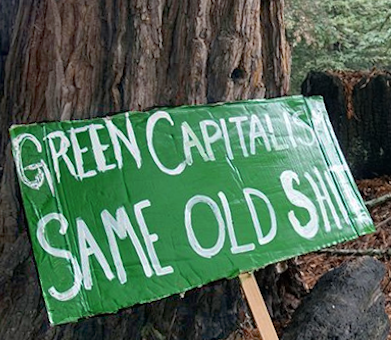
Green Economy, Green Capitalism? The Case Against The Case for Climate Capitalism

By Nick Grover - The Bullet, May 14, 2021

Even now, with a ten-year timeframe left for action, it’s rare for the climate crisis to be treated as the emergency it is. So, credit where due to Tom Rand. In his The Case for Climate Capitalism: Economic Solutions for a Planet in Crisis (Toronto: ECW Press, 2020), Rand calls for a rapid transition away from fossil fuels and toward renewables; he blames the political and business elite for the mess and says they will have to pay the price as markets turn against oil and assets are stranded; he even advocates for expansion of public transit. Where the book gets less refreshing is Rand’s tone toward the people who have been saying these things all along: his secondary enemy, leftists fusing demands for climate action with calls for economic justice.

Rand’s Case for Climate Capitalism aims to preserve and “co-opt” the forces of capitalism to usher in a transition toward green tech. His case is presented as simple pragmatism: the emergency we face affords us no time to discuss economic reforms; we must unite and do what works instead of holding out for a perfect system. His concern is that left ideas like the Green New Deal and Leap Manifesto – which wed strong climate action with job guarantees, labour protections, taxing the rich, and expanding social programs – alienate conservatives and the business class when we need them in our coalition to save the planet.

Congress Should Enact a Federal Renewable Electricity Standard and Reject Gas and False Solutions

By various - (690 Organizations), May 13, 2021

Dear Majority Leader Schumer, Speaker Pelosi, Chairman Manchin, and Chairman Pallone,

On behalf of our millions of members and activists nationwide, we, the undersigned 697 organizations—including climate, environmental and energy justice, democracy, faith, Indigenous, and racial justice groups—urge you to pass a Renewable Electricity Standard (RES) in the infrastructure package and reject gas and other false climate solutions to address the climate emergency.

As Congress prepares to pass a historic infrastructure package and President Biden has globally pledged to slash carbon emissions by 50% below 2005 levels by 2030, we should look to the 28 states, Washington, D.C., and Puerto Rico that have passed Renewable Electricity Standards (also known as renewable portfolio standards), as opposed to only seven states with Clean Electricity Standards (CES). The bold leadership demonstrated in RES-leading states like Hawaii, Vermont, and Washington, D.C. provide a roadmap to building a new renewable energy future. Funding this transition must start with shifting all fossil fuel subsidies to mass renewable energy deployment.

Renewable energy sources are sources that naturally replenish and are most often defined as solar, wind, and geothermal power. In contrast, so-called “clean” energy standards generally encompass these renewable sources but also include other technologies, like gas with or without carbon capture and sequestration, biomass, and nuclear, which are significant sources of pollution and carry a host of health and safety risks. In order to avoid perpetuating the deep racial, social, and ecological injustices of our current fossil-fueled energy system, Congress should ensure that any federal energy standard does not include these dirty energy sources.

Specifically, we write to express our concern that recent Clean Electricity Standard (CES) legislation, including the CLEAN Future Act (H.R. 1512), embed these injustices because they include gas and false solutions. The inclusion of gas and carbon capture and storage as qualifying energies in any CES undermines efforts to end the fossil fuel era and halt the devastating pollution disproportionately experienced by Black, Brown, Indigenous, and other communities of color in this country. Even a partial credit for fossil fuel resources that attempts to factor in lifecycle emissions runs the risk of subsidizing environmental harm for years to come. Allowing dirty energy to be bundled with clean energy under a federal energy standard would prolong the existence of sacrifice zones around dirty energy investments and delay the transition to a system of 100 percent truly clean, renewable energy.

The National Black Climate Summit

Green Energy, Green Mining, Green New Deal?

Pages

The Fine Print I:

Disclaimer: The views expressed on this site are not the official position of the IWW (or even the IWW’s EUC) unless otherwise indicated and do not necessarily represent the views of anyone but the author’s, nor should it be assumed that any of these authors automatically support the IWW or endorse any of its positions.

Further: the inclusion of a link on our site (other than the link to the main IWW site) does not imply endorsement by or an alliance with the IWW. These sites have been chosen by our members due to their perceived relevance to the IWW EUC and are included here for informational purposes only. If you have any suggestions or comments on any of the links included (or not included) above, please contact us.

The Fine Print II:

Fair Use Notice: The material on this site is provided for educational and informational purposes. It may contain copyrighted material the use of which has not always been specifically authorized by the copyright owner. It is being made available in an effort to advance the understanding of scientific, environmental, economic, social justice and human rights issues etc.

It is believed that this constitutes a 'fair use' of any such copyrighted material as provided for in section 107 of the US Copyright Law. In accordance with Title 17 U.S.C. Section 107, the material on this site is distributed without profit to those who have an interest in using the included information for research and educational purposes. If you wish to use copyrighted material from this site for purposes of your own that go beyond 'fair use', you must obtain permission from the copyright owner. The information on this site does not constitute legal or technical advice.
