You are here

energy transition

What’s Missing from the New IEA Report on Mining and the Renewable Energy Transition?

By Raquel Dominguez - Earthworks, June 14, 2021

The International Energy Agency sends a mixed message in its recent reports, urging that we leave fossil fuels in the ground while simultaneously calling for more extraction of metals used in low-carbon technologies. This extractivist push is both problematic and unnecessary: the world can achieve a clean energy transition without the kind of human rights catastrophes and environmental devastation that the mining industry currently considers acceptable. 

The International Energy Agency (IEA) has released two important reports in the past month. The first, Net Zero by 2050, notes that “there is no need for new investment in fossil fuel supply,” a conclusion that many in the climate movement, including Earthworks, have applauded. The second, The Role of Critical Minerals in Clean Energy Transitions, undermines the “keep it in the ground” message of the first report by calling for more extraction in the form of metals mining. 

With the ever-increasing damage and injustices exacerbated by the climate crisis, the renewable energy transition is more urgent than ever. Demand for the “transition” minerals used in renewable energy technologies is in turn projected to increase sharply: according to the IEA, to meet the Paris Agreement goals, demand will rise (over the next 20 years) by more than 40% for copper and rare earth elements (REEs), 60-70% for nickel and cobalt, and more than 89% for lithium. Lithium-ion batteries need lithium, nickel, and cobalt (among other elements), wind turbines use REEs, and copper is used in all electricity-based technologies, due to its high rate of conductivity. 

These aren’t new projections: our own 2019 publication on this issue based on research by the University of Technology, Sydney, pointed to similar trendlines. This steep upward trajectory in minerals demand could be devastating for communities and ecosystems in the regions where these minerals are extracted. Hardrock mining has a long, terrible history as a tool of colonization and imperialism; in the United States alone, mining has accompanied and driven western settlement, which killed untold numbers of Indigenous peoples, breaking multiple treaties with Indigenous peoples, contaminating more than 40% of western watersheds’ headwaters, and directly causing the deaths of many members of mining-affected communities from cancer. Mining is the country’s leading industrial toxic polluter, according to the Environmental Protection Agency, and responsible for 10% of global carbon emissions, according to the UN Environment Programme.

But the social and environmental harm brought on by mining is not a thing of the past: in the Olaroz salt flat in Argentina, Indigenous peoples “that own the land struggle to pay for sewage systems, drinking water and heat for schools” even as Minera Exar anticipates making $250 million per year by mining lithium; in Australia, Rio Tinto blew up the Juukan Gorge, which is sacred to the Puutu Kunti Kuurama and Pinikura peoples and which had evidence of continuous habitation for more than 46,000 years, in pursuit of iron ore. There are hundreds of stories just like these, some of them which are detailed in our recent report, Recharge Responsibly, happening all over the world—and this environmental injustice will continue apace if recycling and reuse, alongside other demand reduction strategies and more responsible primary sourcing, are not prioritized as part of a clean energy transition.

It doesn’t have to be this way...

Read the rest here.

Keystone is Dead!

By Elizabeth Perry - Work and Climate Change Report, June 11, 2021

On June 9, TC Energy issued a press release announcing that the company, in consultation with the Alberta Government, has terminated the Keystone XL Pipeline project, although it will continue “to co-ordinate with regulators, stakeholders and Indigenous groups to meet its environmental and regulatory commitments and ensure a safe termination of and exit from the project.” The Alberta government had invested over $1 billion in the project as recently as March 2020 , and continued to defend it even after U.S. President Biden rescinded the permit in January 2021. The WCR compiled sources and reactions in January in “President Biden’s Executive Orders and Keystone XL cancellation – what impact on Canada?” A new compilation of Alberta Government statements is here . CBC Calgary describes Keystone XL is dead, and Albertans are on the hook for $1.3B.

Climate activists in Canada and the U.S. rejoiced at the latest news: “‘Keystone XL Is Dead!’: After 10-Year Battle, Climate Movement Victory Is Complete” , and activist Bill McKibben (and others) are hammering home a message of “never give up, activism works!”. The article from Common Dreams quotes Clayton Thomas Muller, longtime KXL opponent and currently a senior campaigns specialist at 350.org in Canada: “This victory is thanks to Indigenous land defenders who fought the Keystone XL pipeline for over a decade. Indigenous-led resistance is critical in the fight against the climate crisis and we need to follow the lead of Indigenous peoples, particularly Indigenous women, who are leading this fight across the continent and around the world. With Keystone XL cancelled, it’s time to turn our attention to the Indigenous-led resistance to the Line 3 and the Trans Mountain tar sands pipelines.” The National Observer expands on this with “Keystone XL is dead, but the fight over Canadian oil rages on” (June 10). The Indigenous Environmental Network news chronicles the ongoing resistance to pipeline development, as well as the reaction to the Keystone announcement.

Labor-Backed Report on Path to Equitable Green California

By Staff - Sunflower Alliance, June 10, 2021

Nineteen labor organizations—including unions representing refinery workers in Northern and Southern California and the Alameda Labor Council— have endorsed a detailed plan for an equitable transition to a clean-energy economy in California.

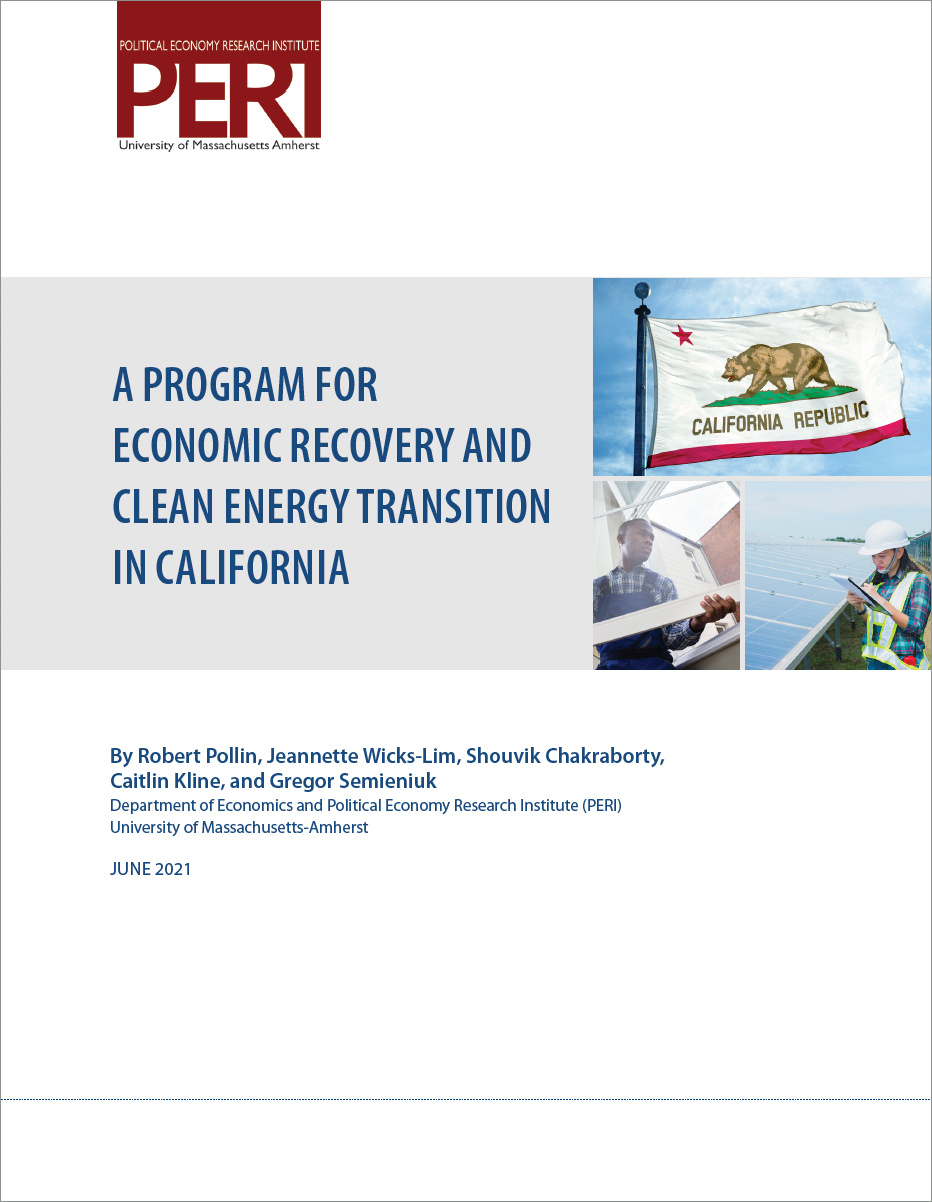
This major new report, A Program for Economic Recovery and Clean Energy Transition in California, details programs for meeting California’s 2030 climate goal (40 percent economy-wide reduction in greenhouse gas emissions from the state’s 1990 level) by creating roughly 418,000 jobs. It argues that state policy should ensure that the jobs created are good-paying jobs with full labor rights and access by historically excluded people.

The same strategies, the report says, could be continued to meet California’s longer-term goal of being carbon-neutral by 2045.

The report was commissioned by the American Federation of State, County and Municipal Employees Local 3299, the California Federation of Teachers, and the United Steelworkers Local 675. Its authors are faculty members of the University of Massachusetts at Amherst, including Robert Pollin, a leading expert on just transition.

The report provides detailed calculations for strategies outlined in an earlier report, Putting California on the High Road, from the UC Labor Center. Both reports emphasize the need for measures to protect fossil fuel industry workers including:

  • Pension guarantee for all workers.
  • Re-employment and income-level guarantees for all displaced workers.
  • Retraining and relocation support as needed.
  • “Glide-path income support” for workers 60 – 64.

The report comes as the Newsom administration is developing a report on Just Transition in California.

'Fossil Fuel Exit Strategy' Shows Transition to Renewable Future Totally Doable

By Andrea Germanos - Common Dreams, June 10, 2021

Ditching fossil fuels in favor of renewable energy in order to keep warming below the 1.5ºC threshold is both "necessary and technically feasible."

That's the conclusion of an analysis released Thursday entitled Fossil Fuel Exit Strategy. Produced by the University of Technology Sydney's Institute for Sustainable Futures in cooperation with the Fossil Fuel Non-Proliferation Treaty Initiative, the report states clearly that "there is no need for more fossil fuels" because the world is overflowing with renewable energy capacity.

Such a pathway, said Sanjay Vashist, director of Climate Action Network South Asia, would avert a "criminal waste of money" that would "have devastating climate and humanitarian consequences."

A key point in the analysis is that simply stopping the industry's planned expansion of fossil fuel projects is insufficient to meet the Paris climate agreement's temperature goal and would actually "push warming well above 1.5ºC."

With this angle, the new analysis goes beyond the International Energy Agency's report last month calling for no oil and gas expansion in order to meet a goal of net zero carbon emissions by 2050. That's because even if there were no expansion, the report's projections show, the world would produce 35% more oil and 69% more coal than is consistent with meeting the 1.5°C target.

As such, Fossil Fuel Exit Strategy lays out a dirty energy phaseout with an annual decline of 9.5% for coal, 8.5% for oil, 3.5% for gas from 2021-2030.

Just Transition in California: Robert Pollin in Conversation with Robert Kuttner

Labor Unions Rally Behind California’s Zero-Emissions Climate Plan

Robert Pollin interviewed by C.J. Polychroniou - Truthout, June 10, 2021

Robert Pollin, distinguished professor of economics and co-director of the Political Economy Research Institute (PERI) at the University of Massachusetts at Amherst, has been spearheading national and international efforts to tackle the climate crisis for more than a decade. Over the past few years, he and a group of his colleagues at PERI have produced green economy transition programs for numerous states. The latest such program is for California, and it is being released today.

The massive study — nearly 200 pages long — shows how California can become a zero emissions economy by 2045 while expanding good job opportunities throughout the state. Nineteen unions have already endorsed the green transition plan, making clear that they reject frameworks that falsely pit labor priorities and the environment against each other, and more are expected to do so in the days and weeks ahead.

In this interview for Truthout, Pollin, co-author with Noam Chomsky of Climate Crisis and the Global Green New Deal: The Political Economy of Saving the Planet (Verso 2020), talks about the climate stabilization project for California and the national implications of union support for a green economy transition.

C.J. Polychroniou: California has been at the forefront of the climate fight for years now, but the truth of the matter is that its efforts have fallen short. Now, you and some colleagues of yours at PERI have just completed a commissioned climate stabilization project for California. How does the project envision the clean energy transition to take place in a manner consistent with the emission targets set out by the UN Intergovernmental Panel on Climate Change (IPCC) in 2018, and how will it be financed?

Robert Pollin: This study presents a recovery program for California that will also build a durable foundation for an economically robust and ecologically sustainable longer-term growth trajectory. California has long been a national and global leader in implementing robust climate stabilization policies. This includes the 2018 Executive Order B-55-18 by then Gov. Jerry Brown. This measure committed the state to cut CO2 emissions by 50 percent as of 2030, to become carbon neutral no later than 2045, and to produce net negative emissions thereafter. These goals are somewhat more ambitious than those set out by the IPCC in 2018. Our study outlines a program through which the state can achieve its own established goals.

Our study shows how these 2030 and 2045 emissions reduction targets can be accomplished in California through phasing out the consumption of oil, coal and natural gas to generate energy in the state, since burning fossil fuels to produce energy is, by far, the primary source of CO2 emissions, and thereby, the single greatest factor causing climate change. The project we propose is to build a clean energy infrastructure to replace the existing fossil fuel-dominant infrastructure. The clean energy infrastructure will require large-scale investments to, first, dramatically raise energy efficiency standards in the state and, second, to equally dramatically expand the supply of clean renewable energy supplies, including solar and wind primarily, with supplemental supplies from low-emissions bioenergy, geothermal and small-scale hydro power. We show how this climate stabilization program for California can also serve as a major new engine of job creation and economic well-being throughout the state, both in the short- and longer run.

A Program for Economic Recovery and Clean Energy Transition in California

By Robert Pollin, Jeannette Wicks-Lim, Shouvik Chakraborty,Caitlin Kline, and Gregor Semieniuk - Department of Economics and Political Economy Research Institute (PERI); University of Massachusetts-Amherst, June 10, 2021

This study presents a robust climate stabilization project for California. It demonstrates that achieving the state’s official CO2 emissions reduction targets—a 50 percent emissions cut by 2030 and reaching zero emissions by 2045—is a realistic prospect. This climate stabilization project can also serve as a major engine of economic recovery and expanding economic opportunities throughout the state. This includes an increase of over 1 million jobs in the state through investment programs in energy efficiency, clean renewable energy, public infrastructure, land restoration and agriculture. The study also develops a detailed just transition program for workers and communities in California that are currently dependent on the state’s fossil fuel industries for their livelihoods. In particular, we focus here on condi­tions in Kern, Contra Costa, and Los Angeles counties.

The study is divided into nine sections:

  1. Pandemic, Economic Collapse, and Conditions for Recovery
  2. California’s Clean Energy Transition Project
  3. Clean Energy Investments and Job Creation
  4. Investment Programs for Manufacturing, Infrastructure, Land Restoration and Agri­culture
  5. Total Job Creation in California through Combined Investment Programs
  6. Contraction of California’s Fossil Fuel Industries and Just Transition for Fossil Fuel Workers
  7. County-level Job Creation, Job Displacement, and Just Transition
  8. Achieving a Zero Emissions California Economy by 2045
  9. Financing California’s Recovery and Sustainable Transition Programs

Nineteen labor unions throughout California have endorsed this study and its findings.

Read the text (PDF).

The True Price of Coal

By Kim Kelly - The Real News, June 8, 2021

It’s been over two months since 1,100 union coal miners in Brookwood, Alabama, hit the picket line, citing unfair labor practices against Warrior Met Coal. The strike itself has gained more national attention, which has also put a spotlight on the harsh tolls that coal mining takes on workers, their bodies, and their families. From work-related diseases like black lung and silicosis to methane explosions and roof cave-ins, coal mining has always been a dangerous job, and coal miners today still face many hazards. In the latest installment of “Battleground Brookwood,” TRNN contributor Kim Kelly continues her coverage of the strike at Warrior Met Coal by investigating the true price of coal production.

Biden Says He Backs a Just Transition for the Climate Crisis. Advocates Say, “Prove It.”

By Rachel M. Cohen - In These Times, June 2, 2021

While the administration has taken some early steps to provide support for energy workers and frontline communities in the transition away from fossil fuels, experts and activists say the crisis demands a more transformative approach.

One of the most difficult problems that political leaders have faced in addressing climate change has not involved the science or technology, but the politics, including bringing key constituencies like energy workers and their labor unions on board. This skepticism and resistance to change is why a so-called ​“just transition” — referring to an ethical and economically secure shift away from a fossil-fuel powered economy — has become so integral to crafting a successful climate plan. 

Figuring out how to provide economic security for both energy workers that have depended on the nation’s fossil fuels and frontline communities has become a leading priority for activists and elected officials alike. The Biden administration, for its part, has thrown its weight behind developing a just transition, though some advocates tell In These Times that federal leaders haven’t gone far enough, or worry the executive branch’s rhetoric won’t deliver real results. Other researchers have called for more careful study of past economic transitions, as well as more firm commitments around social programs such as universal healthcare. 

On January 27, one week after taking office, Biden signed an executive order establishing an interagency working group focused on addressing the economic needs of ​“coal, oil, gas, and power plant communities.” The group, co-chaired by National Economic Council director Brian Deese and National Climate Adviser Gina McCarthy, is a collaboration between 12 federal agencies including the labor, interior, treasury and energy departments. 

In late April the working group published an initial report identifying 25 of the most impacted regions for coal-related declines, and highlighted existing federal programs that could provide nearly $38 billion in funding for relief. The report noted that ​“creating good-paying union jobs in Energy Communities is necessary but not sufficient” and stressed that ​“foundational infrastructure investments” including broadband, water systems, roads, hospitals and other institutions would be necessary to economically revitalize these areas. The group also noted that a just transition would require prioritizing pollution mitigation and environmental remediation, like plugging leaking oil and gas wells and reclaiming abandoned mine land. These objectives hold the potential not only for job creation but also achieving environmental justice priorities.

Driving Destructive Mining: EU Civil Society Denounces EU Raw Materials Plans in European Green Deal

By various - Yes to Life No to Mining, June 2021

A global coalition of 180+ community platforms, human rights and environmental organisations, and academics from 36 nations is calling on the EU to abandon its plans to massively expand dirty mining as part of EU Green Deal and Green Recovery plans.

In a statement released in the middle of EU green week, the coalition explains why, if left unchanged, EU policies and plans will drastically increase destructive mining in Europe and in the Global South, which is bad news for the climate, ecosystems, and human rights around the world.

“The EU is embarking on a desperate plunder for raw materials. Instead of delivering a greener economy, the European Commission’s plans will lead to more extraction beyond ecological limits, more exploitation of communities and their land, and new toxic trade deals. Europe is consuming as if we had three planets available”, says Meadhbh Bolger, Resource Justice Campaigner for Friends of the Earth Europe.

Coordinated by the Yes to Life, No to Mining Network’s European Working Group, the statement’s signatories are united in support of an urgent and rapid transition to renewable energy.

However, they argue that relying on expanding mining to meet the material needs of this transition will replicate the injustices, destruction and dangerous assumptions that have caused climate breakdown in the first place:

“The EU growth and Green Deal plans must consider a deep respect of the rights of affected communities in the Global South, that are opposing the destruction of their lands, defending water and even their lives. A strong collective voice is arising from affected communities around the Planet, denouncing hundreds of new mining projects for European consumption. Their urgent message needs to be heard in the North: Yes to Life No to Mining”, says Guadalupe Rodriguez, Latin American Contact Person for the global Yes to Life, No to Mining solidarity network.

“Research shows that a mining-intensive green transition will pose significant new threats to biodiversity that is critical to regulating our shared climate. It is absolutely clear we cannot mine our way out of the climate crisis. Moreover, there is no such thing as ‘green mining’. We need an EU Green Deal that addresses the root causes of climate change, including the role that mining and extractivism play in biodiversity loss ”, adds Yvonne Orengo of Andrew Lees Trust, which is supporting mining affected communities in Madagascar.

The statement sets out a number of actions the EU can take to change course towards climate and environmental justice, including recognising in law communities’ Right to Say No to unwanted extractive projects and respect for Indigenous Peoples’ right to Free, Prior and Informed Consent.

Read the text (PDF).

Pages

The Fine Print I:

Disclaimer: The views expressed on this site are not the official position of the IWW (or even the IWW’s EUC) unless otherwise indicated and do not necessarily represent the views of anyone but the author’s, nor should it be assumed that any of these authors automatically support the IWW or endorse any of its positions.

Further: the inclusion of a link on our site (other than the link to the main IWW site) does not imply endorsement by or an alliance with the IWW. These sites have been chosen by our members due to their perceived relevance to the IWW EUC and are included here for informational purposes only. If you have any suggestions or comments on any of the links included (or not included) above, please contact us.

The Fine Print II:

Fair Use Notice: The material on this site is provided for educational and informational purposes. It may contain copyrighted material the use of which has not always been specifically authorized by the copyright owner. It is being made available in an effort to advance the understanding of scientific, environmental, economic, social justice and human rights issues etc.

It is believed that this constitutes a 'fair use' of any such copyrighted material as provided for in section 107 of the US Copyright Law. In accordance with Title 17 U.S.C. Section 107, the material on this site is distributed without profit to those who have an interest in using the included information for research and educational purposes. If you wish to use copyrighted material from this site for purposes of your own that go beyond 'fair use', you must obtain permission from the copyright owner. The information on this site does not constitute legal or technical advice.