You are here

green unionism

Who Is Working-Class, and Why It Matters

By Van Gosse - Convergence, April 9, 2022

Many political analysts, including some on the Left, are positing a radically new configuration of class in the United States. Their argument, reduced to its essence, is that the traditional markers of class are no longer relevant, and now the great divide is between those who have graduated from college versus the rest. It is further argued that this new class structure is reshaping our political party system in dramatic ways:  the Democrats are becoming the party of the educated, in addition to traditional constituencies among African Americans and single women. Conversely, the Republicans are becoming a party of the working class—defined as the non-college-educated—across traditional racial and ethnic lines (for a cogent example of this analysis, see Matt Karp’s “The Politics of a Second Gilded Age”).

I think this analysis is wrong in all respects.  We need an analysis of how class functions in the U.S. that is based in our distinct history of stratification (and division) along ethno-racial lines.  Beyond that, we need an accurate reading of the Democratic Party in particular, if we are to advance the struggle for a multiracial democracy against white nationalism.

Illinois prioritizes equitable access to green jobs on its path to 100% clean energy

By Laura Aka - Working Nation, April 8, 2022

WorkingNation’s Green Jobs Now series is looking at green jobs opportunities and the skills needed to get those jobs across the country with a series of state-by-state reports. Next: Illinois.

“We can’t outrun or hide from climate change. There is no time to lose. Illinois is taking action in the fight to stop and even reverse the damage that’s been done to our climate.” With those words, Gov. JB Pritzker signed the state’s ambitious Climate and Equitable Jobs Act (CEJA) last fall.

CEJA aims to get the state to 100% clean energy by 2050. Not only does it address climate change, it also includes significant workforce development components, including an emphasis on building a more diverse workforce with equitable access to the skills needed to get green jobs.

“Illinois is a force for good, for an environmental future we can be proud of. With economic growth and jobs woven into its fabric, this new law is the most significant step Illinois has taken in a generation toward a reliable, renewable, affordable, and clean energy future in a generation,” the governor added.

“It used to be called the Rust Belt. [Illinois] is moving on an industrial scale from the past to the future by way of a green transition,” says Paula DiPerna, a consultant to WorkingNation on the green economy and a special advisor to CDP, a nonprofit that works with its members to manage their environmental impacts.

“The science of climate change has now become almost universally disseminated,” notes DiPerna who says green jobs are more noticeable. “Once you start thinking about it, you suddenly see it everywhere.”

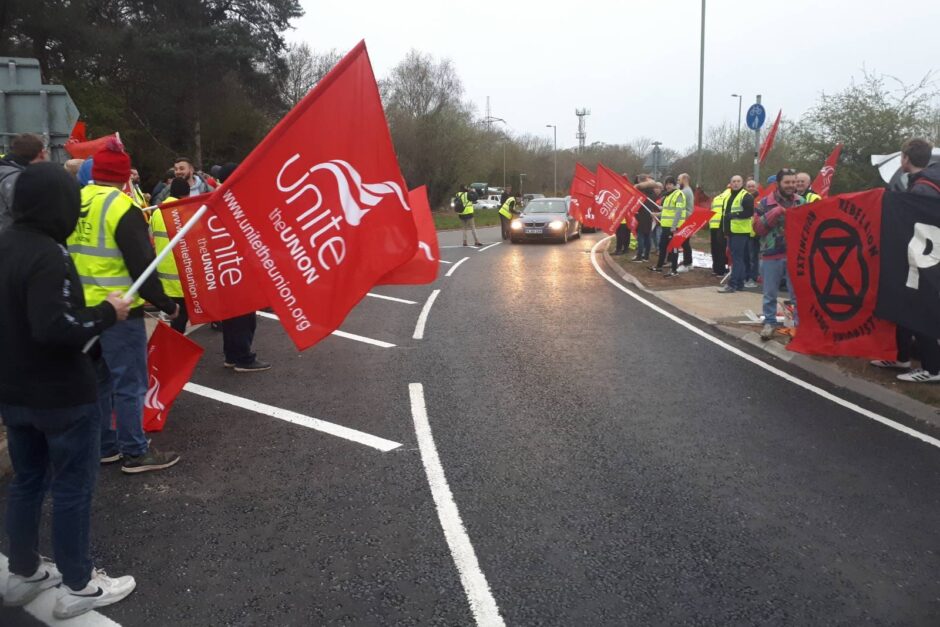
Extinction Rebellion UK statement on strike at Fawley Oil Refinery

By staff - Extinction Rebellion, April 8, 2022

Extinction Rebellion UK stands in solidarity with the 100 or more workers at Fawley Oil Refinery who will be taking strike action on 8th April. The strike is in response to the offer of a “pathetic” 2.5 per cent pay offer and a lack of company sick pay, despite Exxon’s profits in 2021 topping an eye-watering £6.75 billion.

Exxon’s business model is not built to benefit the workers who without which, they wouldn’t be able to make record profits. XR UK recognises that Exxon’s business practices not only destroy the planet but oppress and marginalize the workers that enable their activities. They choose to underpay workers and maintain the fossil fuel economy, rather than seeking to facilitate a just transition, which our own Office for Budget Responsibility says is affordable and would create thousands of jobs and save billions of pounds for the UK public.

Nationalize the U.S. Fossil Fuel Industry To Save the Planet

By Robert Pollin - American Prospect, April 8, 2022

Even as Vladimir Putin’s barbaric invasion of Ukraine proceeds and concerns over the subsequent high gas prices proliferate, we cannot forget that the climate crisis remains a dire emergency. The latest report of the U.N.’s Intergovernmental Panel on Climate Change (IPCC)—the most authoritative source on climate change research—could not be more explicit in reaching this conclusion. U.N. Secretary General António Guterres described the report as a “file of shame, cataloguing the empty pledges that put us firmly on track towards an unlivable world.” This follows several equally vehement studies in recent years, as well as those from other credible climate researchers.

If we are finally going to start taking the IPCC’s findings seriously, it follows that we must begin advancing far more aggressive climate stabilization solutions than anything that has been undertaken thus far, both within the U.S. and globally. Within the U.S., such measures should include at least putting on the table the idea of nationalizing the U.S. fossil fuel industry.

South Africa's Coal Miners’ Union Calls for a Public Pathway Approach to Energy Transition

By staff - Trade Unions for Energy Democracy, April 5, 2022

At its recent 17th National Congress, South Africa’s National Union of Mineworkers (NUM) adopted a bold position in favor of keeping the country’s electrical power utility Eskom fully public.

Attended by roughly 750 delegates, the three-day congress — held in Boksburg, South Africa, from March 30th to April 1st, 2022 — adopted a report titled “Just Transition and the Energy Sector.” The report declares:

As a union with a long history of internationalism, NUM is today part of a global trade union-led effort to secure a Just Transition to a low carbon future. Once championed by unions, the term just transition has been hijacked by capital and its original meaning has been distorted. It is now being used to advance a global “green structural adjustment” agenda, one that is using the climate emergency as cover to advance privatisation and to dismantle public companies and assets.

In recent years, NUM has worked alongside the National Union of Metalworkers of South Africa (NUMSA), TUED, AIDC and the Transnational Institute to repel government-led efforts to break up and privatize the national utility Eskom.

Environment, labour and justice: perspectives from the Global South

'Coal Country' Mines Seam of Class Anger in West Virginia Explosion

By Alain Savard - Labor Notes, April 4, 2022

If Don Blankenship were a fictional character, critics would say he was a cartoon evil capitalist. Unfortunately, he’s real. One of his lesser crimes was to dump toxic coal slurry into disused mineshafts, poisoning the water of his neighbors, all to save $55,000. While they sickened, he piped his own water from the nearby town of Matewan. Yes, that Matewan. He has characterized strikes as “union terrorism.”

As chair and chief executive of Massey Energy, he received production reports from Upper Big Branch mine every half hour, including weekends. And no wonder, Blankenship’s compensation was tied to production, and UBB produced $600,000 worth of top-quality coal every day in a mile-deep operation near Whitesville, West Virginia.

That is, until it exploded in a completely preventable disaster that killed 29 miners on April 5, 2010.

The workers knew something bad was bound to happen. Methane readings were too high, the ventilation and air control systems were a shambles. One day the mine was sweltering, the next freezing cold. They operated in a fog of coal dust and exhaustion. Management threatened anyone who spoke up.

“Coal Country,” a play recently re-opened at Cherry Lane theater in New York, tells the story of the disaster through the words of the miners and their families. They are backed up by stunning original songs by Texas songwriter Steve Earle, who accompanies himself on guitar or banjo from the corner of the stage. “The devil put the coal in the ground,” he growls, and you can believe it. Jessica Blank and Erik Jensen created the play, and Blank directs it.

Performance Coal, the subsidiary of Massey that ran Upper Big Branch, was created specifically to exclude the union. Gary Quarles (played by Thomas Kopache), recalls that when he first hired into the mine, he couldn’t believe how management shouted at the men. That wasn’t tolerated on his union jobs. Unrelieved overtime was another difference.

Managers brought in experienced miners like Quarles for their knowledge about extracting coal, but dismissed their knowledge about how to run a safe mine. Union mines are safer according to Phil Smith of the United Mineworkers of America, "because workers elect their own safety committees and they know they can report hazards without fear of retribution.”

A Vigil and a Victory: A Clean Up Kingspan Update

By staff - Labor Network for Sustainability, April 2, 2022

On the 5 year anniversary of the Grenfell Tower fire that killed 72 people, the Clean Up Kingspan campaign held a vigil in Downtown Los Angeles at a Capitol Group HQ building– one of Kingspan’s largest outside stakeholders. An ongoing UK government Inquiry revealed that for over 14 years, Kingspan’s UK insulation division misrepresented fire safety issues with Kooltherm K15, one of the products used in the Grenfell Tower. The vigil was attended by SMART members, clergy, environmentalists, and local activists.

This tragedy is not the first time the building materials manufacturing company, Kingspan, has betrayed the public’s trust. Kingspan workers in Santa Ana, CA are standing up to Kingspan and its so-called ‘green’ manufacturing processes that are polluting the indoor air and local watershed. These factory workers are organizing to demand safe working conditions, including addressing unhealthy levels of PM2.5 pollution inside the workplace that they measured in collaboration with UC Irvine pollution scientist Dr. Shahir Masri. The workers also blew the whistle on Kingspan for misrepresenting its daily operations and water pollution clean-up efforts to the CalEPA.

The Labor Network for Sustainability was proud to organize a virtual teach-in about the Kingspan factory worker’s efforts for our environmental and climate allies. Together, we gathered over 45 organizational signatures to pressure the Green Buildings Community to stop partnering with Kingspan.

At the vigil, I shared an important update; the pressure worked! The U.S. Green Buildings Council has responded by removing Kingspan from the USGBC-Live Platinum Sponsor list!

Now it’s time for Capitol Group to join them and do the right thing. We call on Capitol Group to divest from Kingspan!

Want Peace? Ditch Fossil Fuels!

By staff - Labor Network for Sustainability, April 2022

The Labor Network for Sustainability has joined more than 610 organizations in 57 countries to call on world governments to ban Russian oil and gas and to rapidly phase out all fossil fuels in the name of peace. The letter was initiated by Ukrainian climate activists and backed by Roman Shakhmatenko, Ukrainian Deputy Minister of Environmental Protection, who said: “We have to stop being indifferent. We should end using gas, oil and coal.” It calls on governments to “End global fossil fuel addiction that feeds Putin’s war machine” once and for all. It calls on governments to “ban any import of fossil fuels from Russia” and “rapidly phase out all fossil fuels,” ending this “fossil fuel addiction.”

With an emerging priority of boycotting Russian oil and gas, fossil fuel expansion must be immediately halted, and nations worldwide must commit to the rapid and just transition away from all fossil fuels. Reliance on coal, oil and gas is the intentional embrace of death, misery, and collapse at a global scale.

Stand with Ukraine,”

How can climate-safe energy start replacing Russian fossil fuel exports right now? Senators Elizabeth Warren, Ed Markey, and other propose an “Energy Marshall Plan” that would use the Defense Production Act to boost manufacturing of electric heat pumps, efficient electric appliances, and renewable energy technology.

For their full proposal, see their letter to President Biden here.

For an Ecosocialist Degrowth

By Michael Löwy, Bengi Akbulut, Sabrina Fernandes and Giorgos Kallis - Monthly Review, April 1, 2022

Degrowth and ecosocialism are two of the most important movements—and proposals—on the radical side of the ecological spectrum. Sure, not everyone in the degrowth community identifies as a socialist, and not everyone who is an ecosocialist is convinced by the desirability of degrowth. But one can see an increasing tendency of mutual respect and convergence. Let us try to map the large areas of agreement between us, and list some of the main arguments for an ecosocialist degrowth:

  1. Capitalism cannot exist without growth. It needs a permanent expansion of production and consumption, accumulation of capital, maximization of profit. This process of unlimited growth, based on the exploitation of fossil fuels since the eighteenth century, is leading to ecological catastrophe, climate change, and threatens the extinction of life on the planet. The twenty-six UN Climate Change Conferences of the last thirty years manifest the total unwillingness of the ruling elites to stop the course toward the abyss.
  2. Any true alternative to this perverse and destructive dynamic needs to be radical—that is, must deal with the roots of the problem: the capitalist system, its exploitative and extractivist dynamic, and its blind and obsessive pursuit of growth. Ecosocialist degrowth is one such alternative, in direct confrontation with capitalism and growth. Ecosocialist degrowth requires the social appropriation of the main means of (re)production and a democratic, participatory, ecological planning. The main decisions on the priorities of production and consumption will be decided by people themselves, in order to satisfy real social needs while respecting the ecological limits of the planet. This means that people, at various scales, exercise direct power in democratically determining what is to be produced, how, and how much; how to remunerate different kinds of productive and reproductive activities that sustain us and the planet. Ensuring equitable well-being for all does not require economic growth but rather radically changing how we organize the economy and distribute social wealth.
  3. A significant degrowth in production and consumption is ecologically indispensable. The first and urgent measure is phasing out fossil fuels, as well as the ostentatious and wasteful consumption of the 1 percent rich elite. From an ecosocialist perspective, degrowth has to be understood in dialectical terms: many forms of production (such as coal-fired facilities) and services (such as advertisement) should not only be reduced but suppressed; some, such as private cars or cattle raising, should be substantially reduced; but others would need development, such as agro-ecological farming, renewable energy, health and educational services, and so on. For sectors like health and education, this development should be, first and foremost, qualitative. Even the most useful activities have to respect the limits of the planet; there can be no such thing as an “unlimited” production of any good.
  4. Productivist “socialism,” as practiced by the USSR, is a dead end. The same applies to “green” capitalism as advocated by corporations or mainstream “Green parties.” Ecosocialist degrowth is an attempt to overcome the limitations of past socialist and “green” experiments.
  5. It is well known that the Global North is historically responsible for most of the carbon dioxide emissions in the atmosphere. The rich countries must therefore take the larger part in the process of degrowth. At the same time, we do not believe that the Global South should try to copy the productivist and destructive model of “development” of the North, but look instead for a different approach, emphasizing the real needs of the populations in terms of food, housing, and basic services, instead of extracting more and more raw materials (and fossil fuels) for the capitalist world market, or producing more and more cars for the privileged minorities.
  6. Ecosocialist degrowth also involves transformation, through a process of democratic deliberation, of existing consumption models—for instance, an end to planned obsolescence and nonrepairable goods; of transport patterns, for instance, by greatly reducing the hauling of goods by ships and trucks (thanks to the relocalization of production), as well as airplane traffic. In short, it is much more than a change of property forms, it is a civilizational transformation, a new “way of life” based on values of solidarity, democracy, equaliberty, and respect for Earth. Ecosocialist degrowth signals a new civilization that breaks with productivism and consumerism, in favor of shorter working time, thus more free time devoted to social, political, recreational, artistic, ludic, and erotic activities.
  7. Ecosocialist degrowth can only win through a confrontation with the fossil oligarchy and the ruling classes who control political and economic power. Who is the subject of this struggle? We cannot overcome the system without the active participation of the urban and rural working class, who make up the majority of the population and are already bearing the brunt of capitalism’s social and ecological ills. But we also have to expand the definition of the working class to include those who undertake social and ecological reproduction, the forces who are now at the forefront of social-ecological mobilizations: youth, women, Indigenous peoples, and peasants. A new social and ecological consciousness will emerge through the process of self-organization and active resistance of the exploited and oppressed.
  8. Ecosocialist degrowth forms part of the broader family of other radical, antisystemic ecological movements: ecofeminism, social ecology, Sumak Kawsay (the Indigenous “Good Life”), environmentalism of the poor, Blockadia, Green New Deal (in its more critical versions), among many others. We do not seek any primacy—we just think that ecosocialism and degrowth have a shared and potent diagnostic and prognostic frame to offer alongside these movements. Dialogue and common action are urgent tasks in the present dramatic conjuncture.

Pages

The Fine Print I:

Disclaimer: The views expressed on this site are not the official position of the IWW (or even the IWW’s EUC) unless otherwise indicated and do not necessarily represent the views of anyone but the author’s, nor should it be assumed that any of these authors automatically support the IWW or endorse any of its positions.

Further: the inclusion of a link on our site (other than the link to the main IWW site) does not imply endorsement by or an alliance with the IWW. These sites have been chosen by our members due to their perceived relevance to the IWW EUC and are included here for informational purposes only. If you have any suggestions or comments on any of the links included (or not included) above, please contact us.

The Fine Print II:

Fair Use Notice: The material on this site is provided for educational and informational purposes. It may contain copyrighted material the use of which has not always been specifically authorized by the copyright owner. It is being made available in an effort to advance the understanding of scientific, environmental, economic, social justice and human rights issues etc.

It is believed that this constitutes a 'fair use' of any such copyrighted material as provided for in section 107 of the US Copyright Law. In accordance with Title 17 U.S.C. Section 107, the material on this site is distributed without profit to those who have an interest in using the included information for research and educational purposes. If you wish to use copyrighted material from this site for purposes of your own that go beyond 'fair use', you must obtain permission from the copyright owner. The information on this site does not constitute legal or technical advice.