

You are here

green unionism

How You Can Join the Green Workers Alliance

By Staff - Labor Network for Sustainability, February 2022

The Green Workers Alliance is a new multiracial organization that fights for more and better green jobs. More than 400 workers have already joined GWA online. On-the-ground organizing will begin in Virginia and other southeastern states this spring.

The GWA is initially focusing on the 100,000 workers in the utility-scale renewable energy field. According to Mathew Mayers, GWA executive director,

These workers travel around the country to work on solar and wind projects. They are usually employed by subcontractors or temp agencies, who are under pressure to lower costs to win contracts from utilities or other companies financing the projects. Too often, health and safety conditions suffer, pay is low, and workers face job insecurity as they are constantly hustling for the next gig.

Mayers says, “Ultimately, it is the electricity utilities who have the power to improve these conditions, as they either finance the projects or buy the electricity which they produce.” The GWA is demanding that the utilities use 80% renewable energy by 2030.

The GWA is already helping workers fight sexual harassment and wage theft on the job. IAnd it is providing trainings on worker rights and job applications for workers who work – or want to work – in renewable energy. Next recruiting target: rooftop solar installers in the West.

All green workers – and anyone who wants to work in this sector – are welcome to join at https://www.facebook.com/groups/greenworkers

All green workers–and anyone who wants to work in this sector–

Sign the GWA petition demanding that the utilities use 80% renewable energy by 2030.

Check out the GWA website: https://www.greenworkers.org

Getting Infrastructure Dollars for Your Union and Community

By Oren Kadosh - Labor Network for Sustainability, February 2022

The federal rollout of the Infrastructure Investment and Jobs Act (“IIJA” – colloquially known as the “Bipartisan Infrastructure Law”) is now beginning.

The IIJA set overall requirements that any construction jobs created with IIJA funding would pay a prevailing rate of wage (the “Davis-Bacon” standard). This can help to ensure a minimum wage rate (a “floor,” so to speak) for construction jobs.

The IIJA also allows Department of Transportation-funded construction projects to require local hiring. The DOT’s first IIJA competitive grant rollout is the Rebuilding American Infrastructure with Sustainability and Equity (RAISE) Grant Program. Eligible applicants include State, local, and Tribal governmental entities, transit agencies, or a consortium of these. Applicants are asked to include information in their applications about how their projects would create good-paying jobs, including through strong labor standards, the use of project labor agreements, and distribution of workplace rights notices. To be the most competitive, applicants are encouraged to utilize registered apprenticeship and local and economic hire agreements.

Grant funds may not be used to support or oppose union organizing — an attempt at requiring employer neutrality. DOT says it will prioritize projects that “address environmental justice, particularly for communities that disproportionately experience climate change” and that “to the extent possible, target at least 40 percent of resources and benefits towards low-income communities, disadvantaged communities, communities underserved by affordable transportation, or overburdened communities.”

It remains to be seen how much force this language will have. A powerful labor-climate movement is can help ensure that projects actually create family-sustaining jobs, halt climate change, and move us closer to racial, environmental, and economic justice.

Climate-Safe Energy Production–From Below

By Jeremy Brecher - Labor Network for Sustainability, February 2022

Climate-safe energy is being produced locally all over the country in ways that also produce jobs and increase racial, social, and economic justice – fulfilling the basic principles of the Green New Deal.

Protecting the climate requires meeting the original Green New Deal proposal’s goal of 100% of national power generation from renewable sources within ten years.[1] That requires greatly expanding climate-safe sources of energy. It involves an unprecedented transformation of the energy system, and that requires national investment and planning. But much of the transformation will actually be composed of local building blocks – and those can begin right now. Indeed, hundreds of local initiatives around the country, ranging from community solar to municipal ownership to local microgrids, are already expanding renewable energy production.

Sunlight, Jobs, and Justice

Solar gardens are sprouting up all over Denver.

On November 3, 2020, Denver voters overwhelmingly approved Ballot Measure 2A, the Climate Protection Fund, to raise approximately $40 million per year dedicated to climate action. As stated in the ballot measure, the intent of this fund is to “fund programs to eliminate greenhouse gas emissions and air pollution and adapt to climate change. Funding should maximize investments in communities of color, under-resourced communities and communities most vulnerable to climate change.”[2]

Community solar gardens use photovoltaic (PV) panels to produce electricity from sunlight for an entire neighborhood. Now such solar gardens are dotting sites owned and financed by the City of Denver, including rooftops, parking lots, and vacant lands. The power generated from the solar gardens will be shared between city facilities, income-qualified residents, and publicly accessible electric vehicle charging stations.

In accord with the principles of the Green New Deal, Denver’s solar garden program has a strong justice dimension. Since Denver owns the project, it can set its own standards. Ten percent of the energy generated by the solar gardens is allocated to low-income housing through the Denver Housing Authority. An additional 10 percent will be allocated to low-income households through Energy Outreach Colorado, and will be exempt from subscription fees. A paid workforce training program available to Denver residents will provide 10 percent of the city and county’s solar workforce.

The solar gardens are designed to contribute to the goal of Denver’s “80 x 50 Climate Action Plan” to transition Denver to 100 percent renewable electricity for municipal buildings by 2025; achieve 100 percent community-wide renewable electricity by 2030; and reduce Denver’s greenhouse gas emissions 80 percent, as compared to a 2005 baseline, by 2050.[3]

Richmond Progressive Alliance Listening Project, Episode 3: Chevron en la Comunidad

California Weighs Help for Oil Workers in Green Future

By Anne C Mulkern - Energy Wire, January 31, 2022

California officials are brainstorming how to help oil industry workers as the state moves to phase out fossil fuels and replace gasoline-powered vehicles with electric cars.

Democratic Gov. Gavin Newsom’s office and legislators are talking to unions representing industry workers, and a new state Assembly document outlines potential solutions. But it’s a complex quandary, raising questions about whether to guarantee workers their current salaries and benefits as their jobs disappear.

“One of the major hurdles in transitioning existing fossil fuels activities to clean energy ones has been the potentially negative economic consequences to workers and communities,” according to a document from the Assembly Office of Policy and Research obtained by E&E News. “As the state implements its ambitious climate goals, there is an opportunity to assist workers impacted by the transition to a green economy.”

Nearly 112,000 people work in 14 fossil fuel and ancillary industries in California as of 2018, according to a report last year from the Political Economy Research Institute (PERI) at University of Massachusetts, Amherst. The total includes oil and gas extraction operations, and support activities, and sectors such as fossil-fuel-based power generation.

What California decides to do about oil industry workers has the potential to ripple beyond the nation’s most populous state, said Catherine Houston, legislative, political and rapid response coordinator with United Steelworkers District 12.That union represents many oil industry workers.

“California typically takes the lead in a lot of these types of things, and we become an example for other states across the nation,” Houston said. “So whatever we do can potentially serve as a federal model.”

Coal River Mountain Watch Workers Ratify First Collective Agreement

By Communications Department - IWW, January 28, 2022

Workers at Coal River Mountain Watch have ratified their first union contract in a unanimous vote.
The 2-year contract, which takes effect Feb 1, 2022, includes a raise for union members, an assurance of at least one month notification to members in the event of layoffs (something that wasn't previously done when funding ended), a process to ensure that travel costs are paid for upfront by the employer for speaking engagements, and job duties clarifications.

Coal River Mountain Watch is a small but respected organization in the southern coalfields, created in 1998 in response to the fear and frustration of people living near or downstream from enormous mountaintop removal sites. From humble beginnings as a small group of volunteers working to organize Southern WV residents to fight for social, economic, and environmental justice, the nonprofit has become a major force in opposition to mountaintop removal.

Workers at non-profits like Coal River Mountain Watch risk their physical and mental safety in the course of doing their job, and they deserve to have a say in how these organizations are run. Even when there may be general agreement around most issues in the workplace between employees and management, negotiating a contract allows workers an opportunity to learn how to function and operate as a union.

“I’m beyond proud to be in a union now, and I’m beyond proud to work for an organization that values my rights as a worker. Here’s to a brighter future for West Virginia and the brave souls who try to make it a better place to live.” — Junior Walk, Coal River Mountain Watch staff member

“I was really happy with how this process turned out. Vernon, the Executive Director, was quick to respond to our requests for information and in only three bargaining sessions, totalling less than five hours altogether, we had a solid draft contract. It signifies to other employers in progressive organizations that this process does not have to be complicated and that unionizing can have significant benefits for an organization's long-term missions.” — Brendan Muckian-Bates, Industrial Workers of the World Organizer

“I think it's really important, after OVEC's stalling to negotiate with the union and ultimately dissolving, that the Coal River Mountain Watch Board voluntarily recognized the union and that Vernon was so quick to respond to the union's requests. Coal River Mountain Watch is highly regarded among many progressive and environmental activists both inside and outside Appalachia. They've been the targets of the coal industry's ire for decades, with employees sometimes having to fear for their life because of this work. However, with this organization now unionized, I think it speaks to the need for all non-profits to formally recognize and negotiate with their staff's union when one is presented. Many workers at these non-profits risk their physical and mental safety to continue to do this work, and they deserve to have a say in how these organizations are run.” — Brendan Muckian-Bates, Industrial Workers of the World Organizer

The Industrial Workers of the World (IWW) is a labor union representing nearly 9,000 workers across North America. Established in 1905, the IWW is known for its high standards of democracy, transparency, multinationalism, and active use of the right to strike.

Why We Need to Be Able to Say No at Work

By Kristof Calvo and Marguerite van den Berg - Green European Journal, January 26, 2022

For most of us, life revolves around our jobs. As a result, efforts to improve people’s lives have focused on improving working conditions rather than challenging the centrality of work in our lives. Sociologist Marguerite van den Berg sets out to do just this in her recent book Werk is geen oplossing [Work is Not a Solution]. In this conversation with Belgian green politician Kristof Calvo, she explains how workers can recognise and assert their power.

Kristof Calvo: You write that everyone is tired and that no one has time, yourself included. Where did you find the time to write this book?

Marguerite van den Berg: I had a six-month fellowship at the Netherlands Institute for Advanced Study, and that gave me time to work on the book. But the pandemic shook things up. Suddenly everything that makes life worth living stopped – except for the work. I had to deal with that craziness. Suddenly I felt even greater urgency to write the book.

Every author has their own method. How did you work? With fixed days for writing or by finishing a short piece each day?

I already had some parts on paper, but I wrote as much as I could in the mornings. Our kids were still at home when my fellowship started in February 2021, but things improved from May onwards.

In your book, you argue for a different view: a shift from “I am tired” to “We are exhausted”. Is this the essence of your story?

Yes. I wanted to show that everyone is struggling on a personal level. Few dare to mention to anyone other than those close to them that they are worried about how they will get through the next week. I felt compelled to acknowledge this collective feeling of exhaustion as well as its political dimension. I specifically did not want to reduce it to the vulnerability and precariousness of certain groups. Exhaustion does not only occur on the “margins”; it is happening across the full breadth of society.

Your message is clear. You don’t spare anyone in your analysis.

I address everyone directly by using “we”. Where I make a distinction, as when I speak of a “boss”, it’s a deliberate choice; I’m not referring to the person but rather the hierarchies at work that demand more and more from us.

Labor Vision TV Green & Healthy Schools Initiative. Climate Jobs Rhode Island

By Autumn Guillotte, Erica Hammond, Mike Roles, Priscilla De La Cruz, and Justin Kelly - Labor Vision RI, January 25, 2022

Richmond Progressive Alliance Listening Project, Episode 2: At Our Expense

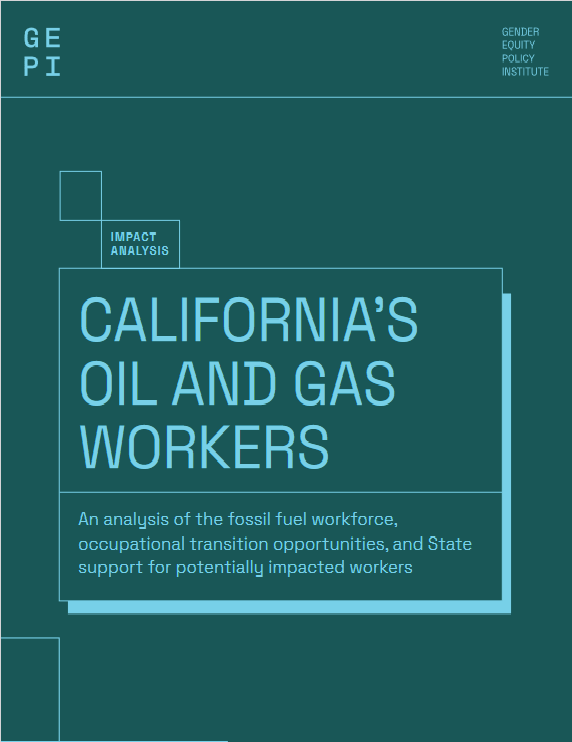
Impact Analysis: California’s Oil and Gas Workers

By Staff - Gender Equity Policy Institute, January 23, 2023

California’s ambitious climate goals, supported by state and federal investment, will create enormous economic opportunity over the coming decades. To meet the 2045 target of carbon neutrality, a 100% clean electric grid, and a 90% reduction in oil consumption and refinery production, the state will need to modernize its electrical grid and build storage capacity to meet increased demand for electricity. Carbon management techniques, plugging orphan wells, and the development of new energy sources such as geothermal will all come into play, providing economic opportunities to workers and businesses alike. Reducing use of polluting fossil fuels will likewise result in significant health benefits to Californians, especially to communities disproportionately burdened by polluting enterprises and proximity to freeways.

Supported by state investment and federal funding through the Infrastructure Investment and Jobs Act and the Inflation Reduction Act, the actions necessary to tackle the challenges of climate change are projected to create 4 million new jobs in the state. California is investing in developing the clean energy workforce, with an equity commitment to recruit and train historically disadvantaged and under- represented communities.

Decarbonizing the economy and accelerating the adoption of clean energy is necessary if we are to preserve a habitable planet. Progress to a carbon neutral future is already well underway in the state. Wind and solar power are less expensive than natural gas or coal powered electricity. A large majority of Californians are concerned about climate change and support action to address its impacts.

However, as with all sectoral economic change, some industries will grow and thrive, while others will shrink, leaving some of their workers behind. Labor unions and trades groups are rightly concerned that workers are not forced to abandon skills developed over their careers and thrown into an inhospitable labor market with no support.

Thus, a key challenge in meeting California’s climate action goals is to devise a fair, equitable, and empirically-based policy to provide support for workers at risk of unemployment and income loss as many factors combine to reduce demand in state for oil and gas products.

Pages

The Fine Print I:

Disclaimer: The views expressed on this site are not the official position of the IWW (or even the IWW’s EUC) unless otherwise indicated and do not necessarily represent the views of anyone but the author’s, nor should it be assumed that any of these authors automatically support the IWW or endorse any of its positions.

Further: the inclusion of a link on our site (other than the link to the main IWW site) does not imply endorsement by or an alliance with the IWW. These sites have been chosen by our members due to their perceived relevance to the IWW EUC and are included here for informational purposes only. If you have any suggestions or comments on any of the links included (or not included) above, please contact us.

The Fine Print II:

Fair Use Notice: The material on this site is provided for educational and informational purposes. It may contain copyrighted material the use of which has not always been specifically authorized by the copyright owner. It is being made available in an effort to advance the understanding of scientific, environmental, economic, social justice and human rights issues etc.

It is believed that this constitutes a 'fair use' of any such copyrighted material as provided for in section 107 of the US Copyright Law. In accordance with Title 17 U.S.C. Section 107, the material on this site is distributed without profit to those who have an interest in using the included information for research and educational purposes. If you wish to use copyrighted material from this site for purposes of your own that go beyond 'fair use', you must obtain permission from the copyright owner. The information on this site does not constitute legal or technical advice.
