You are here

green unionism

Where Do Railroad Workers Go from Here?

By Jay, Marilee Taylor, John Tormey, Matt Parker, and Maximillian Alvarez - In These Times, February 10, 2023

After a three-year saga of stalled contract negotiations between the country’s freight rail carriers and the 12 unions representing over 100,000 railroad workers, ​“pro-union” President Biden and Congress ​“averted” a national rail shutdown by overriding the democratic will of rail workers and forcing a contract down their throats. So, what happens now? 

In December, shortly after the Biden administration and Congress intervened, Working People convened a special all-railroader panel to break down the events of the last week and to discuss where railroad workers and the labor movement go from here.

Panelists include: Jay, a qualified conductor who was licensed to operate locomotives at 19 years old, and who became a qualified train dispatcher before he was 23; Marilee Taylor, who worked on the railroads for over 30 years and retired earlier this year from her post as an engineer for BNSF Railway, but is still an active member of Railroad Workers United; John Tormey, a writer and BMWED-IBT member who works as a track laborer for the commuter rail in Massachusetts; and Matt Parker, a full-time locomotive engineer who’s worked on the railroads for 19 years and also serves part-time as Chairman on the Nevada State Legislative Board of the Brotherhood of Locomotive Engineers and Trainmen.

How To Combat The Cumbria Coalmine and Other Retrograde Energy Projects

The Green Transition

Rail Companies Blocked Safety Rules Before Ohio Derailment

By David Sirota, Julia Rock, Rebecca Burns, and Matthew Cunningham-Cook - The Lever, February 8, 2023

Norfolk Southern helped convince government officials to repeal brake rules — and corporate lobbyists watered down hazmat safety regs.

Before this weekend’s fiery Norfolk Southern train derailment prompted emergency evacuations in Ohio, the company helped kill a federal safety rule aimed at upgrading the rail industry’s Civil War-era braking systems, according to documents reviewed by The Lever.

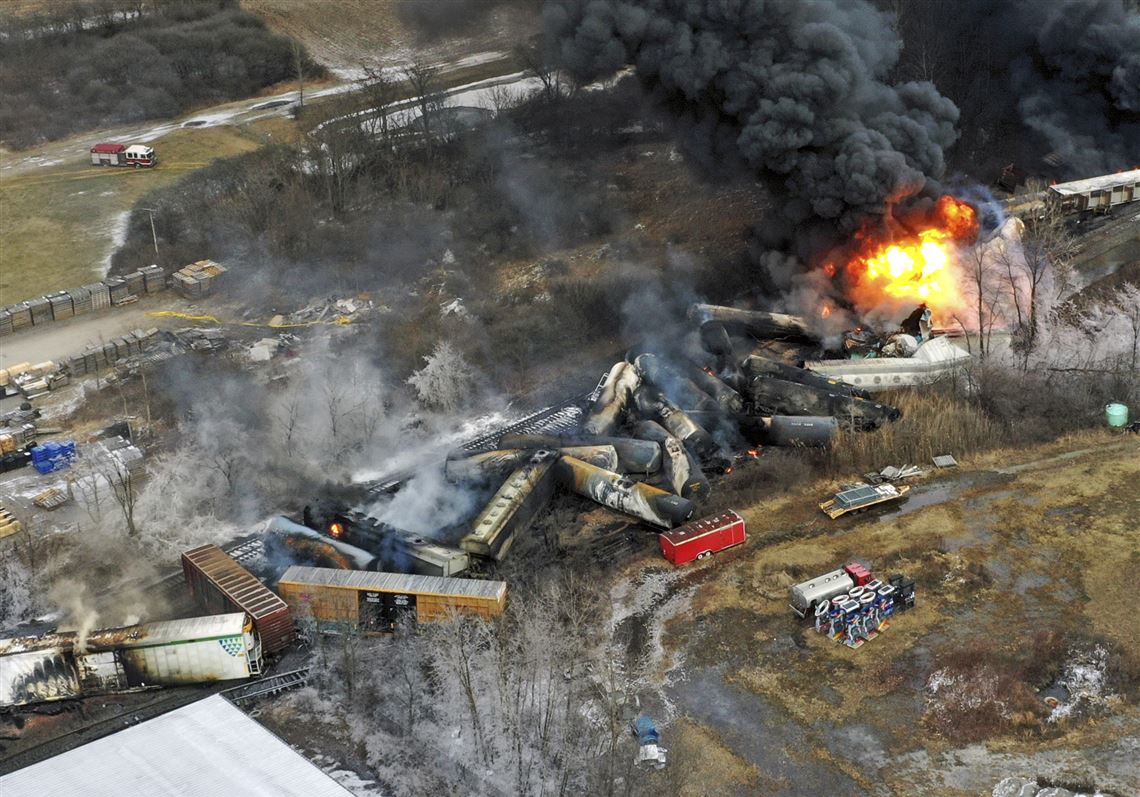
Though the company’s 150-car train in Ohio reportedly burst into 100-foot flames upon derailing — and was transporting materials that triggered a fireball when they were released and incinerated — it was not being regulated as a “high-hazard flammable train,” federal officials told The Lever.

Documents show that when current transportation safety rules were first created, a federal agency sided with industry lobbyists and limited regulations governing the transport of hazardous compounds. The decision effectively exempted many trains hauling dangerous materials — including the one in Ohio — from the “high-hazard” classification and its more stringent safety requirements.

Amid the lobbying blitz against stronger transportation safety regulations, Norfolk Southern paid executives millions and spent billions on stock buybacks — all while the company shed thousands of employees despite warnings that understaffing is intensifying safety risks. Norfolk Southern officials also fought off a shareholder initiative that could have required company executives to “assess, review, and mitigate risks of hazardous material transportation.”

California Aims To Boot Dirty Investment With California Fossil Fuel Divestment Act (SB 252)

By Zachary Shahan - Clean Technica, February 9, 2023

California continues to be a climate and cleantech leader. One of its big recent announcements in this regard is that state policymakers have introduced the California Fossil Fuel Divestment Act (SB 252).

Naturally, this divestment move was stimulated by young adults, students. It was then introduced by Senator Scott Wiener (D-San Francisco), Senator Lena Gonzalez (D-Long Beach), and Senator Henry Stern (D-Los Angeles) in the California Senate. The package actually covers a range of topics. It is “a suite of bills that work together to improve transparency, standardize disclosures, align public investments with climate goals, and raise the bar on corporate action to address the climate crisis.”

One of the shocking stats that the parties use to emphasize the importance of this matter and the stunning reality of human-induced global heating is that 71% of greenhouse gas emissions to date have come from just 100 companies. “Without corporate action to reduce these emissions, California would be unable to meet its climate goals,” the state senators surmise. “At a time when rising anti-science sentiment is driving strong pushback against responsible business practices like risk disclosure and ESG investing, these bills leverage the power of California’s market to continue the state’s long tradition of setting the gold standard on environmental protection for the nation and the world.”

Special Report: Norfolk-Southern Train Derails 50 of 151 Cars in Fiery Crash

By staff - Railroad Workers United, February 7, 2023

As we approach the 10 year anniversary of the deadly train wreck in Lac-Megantic, Quebec on July 5th, 2013, a major fiery train wreck in Ohio this past weekend serves as a reminder of just how potentially dangerous long and heavy trains can be. Add to this the fact that in the last 10 years, the Class One carriers have dramatically increased both the length and tonnage of the average train, while cutting back on maintenance and inspection, and we have a time bomb ticking, just like a decade ago, leading up to the Canadian disaster that destroyed a whole town and took the lives of 47 people. While thousands were and remain evacuated, and property damage to both rail and non-railroad property will no doubt soar into the millions, we dodged a bullet as no rail workers and no trackside residents were killed. This time.

The train, NS 32N, which was built in Madison, IL and headed east to Conway, PA swapped out crews in Decatur, IL. This crew would experience trouble while running their route between Decatur, IL and Peru, IN. In fact, they did not complete their trip to Peru since they outlawed on the federal hours-of-service statute. The train severed a knuckle between two cars at Attica, IN. This occurred while the train was going downhill and while in dynamic braking. Pretty much the only time a train breaks in this scenario is when the train isn’t blocked properly. In order to mitigate in-train forces, railroads prior to PSR would build trains with the heavier cars on the head end and the lighter cars on the rear end. This prevents severe slack run-ins and run-outs throughout the trip and if the train’s emergency brakes are applied, you don’t have heavier cars running into lighter cars which causes jackknifing. This particular train had 40% of it’s weight on the rear 1/3 of the train. Most of this tonnage was made up of loaded tank cars which are very heavy and slosh back and forth when coming to a sudden stop. This sloshing after a stop can continue the pushing of more cars off a track in a jackknifing situation which is what occurred in this Ohio wreck. This block of tank cars was placed directly behind a block of cars that were in the middle of train which were equipped with cushioned draw bars. The draw bars on these cars slide in and out independent of the car body which helps protect the merchandise carried within from damage. These type of draw bars are usually on automobile carriers to prevent the cars/trucks inside from being damaged. Placing cars with these draw bars in the middle of a train creates elasticity. Building a train like this (Head end = locomotives, which are the heaviest part of any train, followed by heavy mixed freight loads, followed by a block of cushioned draw bar cars, followed by a block of heavy tank cars (such as the case with this 32N) is akin to placing two bowling balls on the ends of a rubber band and praying the rubber band doesn’t break. 

Video footage has emerged online showing one of the wheels on this train on fire as it passed by the camera. If this footage is authentic, it’s very likely that car caused the derailment. This damaged car apparently was allowed to leave its initial terminal because it wasn’t inspected properly due to car inspectors being laid-off and time allowed per car inspection being dramatically reduced by the industry. If this did indeed occur this way, the train would’ve gone into emergency and the heavy tank cars on the rear end would’ve slammed into the derailed cars causing the 50 cars to pile up off the track and catch fire. 

"Precision Scheduled Railroading" is more than likely a major culprit in this incident for the following reasons:

  • Inspection times have been cut resulting in the defective car remaining in the consist.
  • Train was excessively long and heavy… 151 cars, 9300 feet, 18,000 tons.
  • Train was not blocked properly because PSR calls for limited car dwell times in terminals. Blocking a train for proper train handling (placing the majority of weight on the head end and ahead of cushioned draw bars) takes longer so this practice has been mostly eliminated by the rail carriers. 

Fiery Ohio Train Wreck the Result of "PSR"

By Fritz Edler, et. al - Railroad Workers United, February 7, 2023

Railroad Workers United (RWU) condemns the dangerous and historically unsafe practices by Class 1 rail carriers that resulted in this catastrophe that will impact the community of East Palestine Ohio for many years, if not forever. The root causes of this wreck are the same ones that have been singled out repeatedly, associated with the hedge fund initiated operating model known as “Precision Scheduled Railroading” (PSR). But risky practices, such as ever longer and heavier trains even precede PSR. The train that wrecked is a case in point, 9300 feet long, 18,000 tons. Other hallmarks of modern day railroading include deep cuts both maintenance and operating employees, poor customer service, deferred maintenance to rolling stock and infrastructure, long working hours and chronic fatigue, limited on-the-job training and high employee turnover. 

Norfolk Southern train NS 32N with 150 cars on the manifest, derailed on Feb. 3 at 8:55pm. It consisted of 3 locomotives 141 loads and 9 empties. The train had a crew of 3 at the time of the wreck, consisting of an Engineer, a Conductor and a Conductor Trainee. 20 of its loaded cars were considered Hazmat by the railroad. 10 of those hazmat cars were involved in the 50-car pileup. Of those 10, 5 cars contained Vinyl Chloride, all of which were damaged and/or burned, with one of those leaking by design to relieve explosive pressure. 

At this time, the immediate cause of the wreck appears to have been a 19th century style mechanical failure of the axle on one of the cars – an overheated bearing - leading to derailment and then jackknifing tumbling cars. There is no way in the 21st century, save from a combination of incompetence and disregard to public safety, that such a defect should still be threatening our communities. 

40% of the weight of NS 32N was grouped at the rear third of the train, which has always been bad practice and made more dangerous with longer heavier trains. This fact almost certainly made the wreck dynamically worse. But increasingly the PSR driven Carriers, driven to cut costs and crew time by any means necessary, cut corners and leave crews and the public at risk.

The crew was able to uncouple the locomotives and move them to safety, preventing an even bigger tragedy. This would not have been possible under the various management schemes now being proposed to operate such trains with single person crews. Further, because Train 32N carried the standard crew of two or more workers, they were able to immediately take the necessary emergency measures to ensure a safe and effective response.

The short-term profit imperative, the so-called “cult of the Operating Ratio” - of NS and the other Class 1 railroads - has made cutting costs, employees, procedures, and resources the top priority. In this case, NS and the other carriers have eliminated many of the critical mechanical positions and locations necessary to guarantee protection against these kinds of failures. Simultaneously, they regularly petition the regulators at the Federal Railway Administration for relief from historically required maintenance and inspections.

The wreck of Train 32N has been years in the making. What other such train wrecks await us remains to be seen. But given the modus operandi of the Class One rail carriers, we can no doubt expect future disasters of this nature.

Chapter 3 : He Could Clearcut Forests Like No Other

By Steve Ongerth - From the book, Redwood Uprising: Book 1

Download a free PDF version of this chapter.
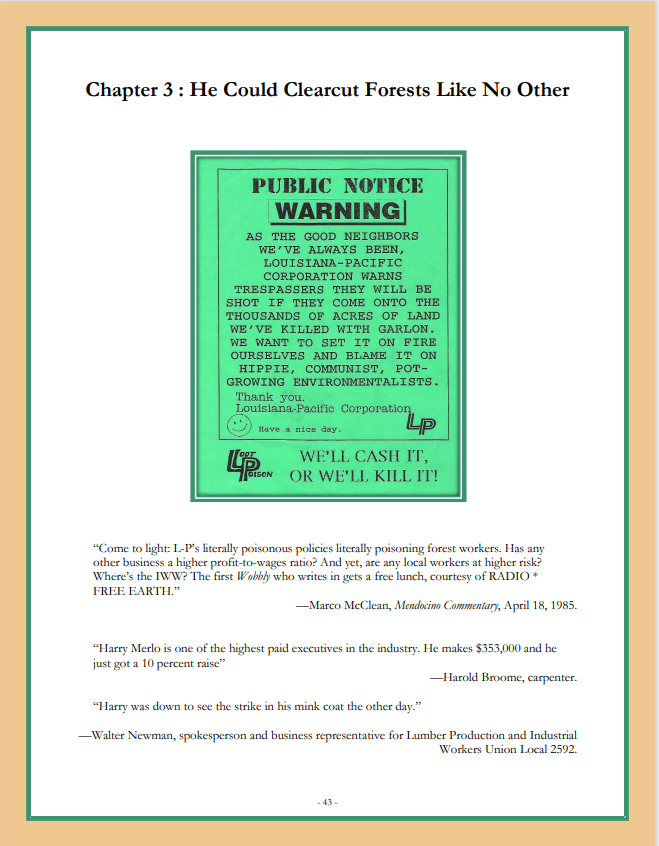
“Come to light: L-P’s literally poisonous policies literally poisoning forest workers. Has any other business a higher profit-to-wages ratio? And yet, are any local workers at higher risk? Where’s the IWW? The first Wobbly who writes in gets a free lunch, courtesy of RADIO * FREE EARTH.”

—Marco McClean, Mendocino Commentary, April 18, 1985.

Harry Merlo is one of the highest paid executives in the industry. He makes $353,000 and he just got a 10 percent raise”

—Harold Broome, carpenter.

“Harry was down to see the strike in his mink coat the other day.”

—Walter Newman, spokesperson and business representative for Lumber Production and Industrial Workers Union Local 2592.

Americans are raised on the mythology of the “self-made man”, the “enterprising go-getter” archetype who creates his own fortune and charts his own destiny. Very often he faces incredible odds, and, armed only with his wits and will to succeed, he alone overcomes disadvantages to become a leader among his fellow Americans. The gender specific pronoun is intentional, because in these stories, women more often than not play a subordinate role. There is an element of “pioneer” spirit within this narrative, and this is not entirely coincidental, because much of the narrative stems from the European-American subjugation of indigenous peoples and the wild. This archetype certainly matches the description of most “captains of industry”, particularly railroad bosses, oil magnates, and timber barons. There is more than folktale about such individuals. Indeed there is a strong ideological component to them, a personification of capitalism, perhaps expressed most unapologetically, albeit crudely, in the narratives of Ayn Rand, particularly Atlas Shrugged or The Fountainhead.

Whether fact or fiction, in these narratives, the entrepreneur is always the hero—virtuous to the core—and he is held up as an example to the rest of us to follow. Very often they not only rely on their own means, they often struggle against a cool and callous society, usually personified by a bureaucratic government, who appropriates some or all of the hero’s self-made fortune to serve its own political ends. What these stories consistently omit, is that most often these “conquering heroes” are neither self-made nor are they virtuous. They often lie, cheat, bend or break the rules, stab those close to them in the back, and rely on the benefits provided by the very same “government” they decry when it doesn’t serve their every need. They appropriate the fruits of others’ labor and call it their own. If there are consequences to their actions, they are shifted to the general public, usually upon the backs of those most unable to resist. And, it is the richest and the most powerful among them who commission the narratives that celebrate their triumphs, sanitizing their own histories so that it is difficult to tell what constitutes fact or fiction.

Harry A. Merlo Jr. was such a man. He began his career as a shipping foreman at a small, independently owned mill, advanced to partner, and then, after the mill was bought out by Georgia Pacific (G-P) he quickly moved up ranks of the G-P corporate structure.[1] Georgia Pacific spun off Louisiana Pacific (L-P) as a result of an antitrust suit brought by Boise Cascade (B-C) against the former for monopolistic practices in 1973. The Federal Trade Commission had threatened to break up the former for monopolizing the timberlands of northwestern California after acquiring holdings formerly held by Boise-Cascade, including the Fort Bragg California mill.[2] Merlo took over as head of the newly created L-P, and, under his management, the latter quickly expanded to become the second largest lumber company in the United States with 110 plants and at least 13,000 employees nationwide, with annual sales in excess of $1 billion.[3] Despite Merlo’s reputation as a self-made man, he received achieved many of his “successes” on the backs of others.

E. Palestine Ohio Train Wreck, Greed & Systemic Crisis In US Rail System With RWU Gabe Christenson

Code Words Hint At Eliminating Jobs & Stifling Renewable Energy Employment

By Carolyn Fortuna - Clean Technica, February 6, 2023

The term “just transition” emerged from the 1970s North American labor movement to become a campaign for a planned energy transition. It includes justice and fairness for workers through united future visions about economic and climate action. These days it’s incredibly contentious.

Wouldn’t you think that renewable energy employment would be uplifting fossil fuel communities and remaking climate politics? Not so fast. Eliminating jobs in the fossil fuel sector has become highly controversial.

Language in headlines and social media posts is reinforcing the place and power of the fossil fuel industry, helping to keep it from becoming little more than stranded assets and from being held accountable for the climate crisis. The words “just transition” are a not-so-secret code that triggers mistrust and confusion among the energy workforce — the same workers who are most likely to benefit from the renewable energy employment marketplace.

Generally, a just transition is defined as programs, services, legislation, and practices that include equity opportunities for all in the move from fossil fuels to renewable energy. I’ve written several times here at CleanTechnica about a just transition and how fears about eliminating jobs are unwarranted (see here, here, here, and here, among others). But what seemed less evident to me then and now a bit naïve now is the degree to which the fossil fuel industry has turned its mighty propaganda forces against renewables while, concurrently, embellishing their professed concern for worker livelihoods.

Pages

The Fine Print I:

Disclaimer: The views expressed on this site are not the official position of the IWW (or even the IWW’s EUC) unless otherwise indicated and do not necessarily represent the views of anyone but the author’s, nor should it be assumed that any of these authors automatically support the IWW or endorse any of its positions.

Further: the inclusion of a link on our site (other than the link to the main IWW site) does not imply endorsement by or an alliance with the IWW. These sites have been chosen by our members due to their perceived relevance to the IWW EUC and are included here for informational purposes only. If you have any suggestions or comments on any of the links included (or not included) above, please contact us.

The Fine Print II:

Fair Use Notice: The material on this site is provided for educational and informational purposes. It may contain copyrighted material the use of which has not always been specifically authorized by the copyright owner. It is being made available in an effort to advance the understanding of scientific, environmental, economic, social justice and human rights issues etc.

It is believed that this constitutes a 'fair use' of any such copyrighted material as provided for in section 107 of the US Copyright Law. In accordance with Title 17 U.S.C. Section 107, the material on this site is distributed without profit to those who have an interest in using the included information for research and educational purposes. If you wish to use copyrighted material from this site for purposes of your own that go beyond 'fair use', you must obtain permission from the copyright owner. The information on this site does not constitute legal or technical advice.