You are here

green unionism

Young Workers’ Trajectory of Climate Consciousness

By staff - Labor Network for Sustainability, February 2023

The Young Worker Listening Project interviewed 70 young workers in all parts of the country about the ways climate change impacts how they do and think about work, and how their work informs their understanding of the climate crisis and potential solutions. They ranged from 16-year-olds who were just starting to think about what kind of work they might do to 35-year-olds with 20 years experience as construction workers, government employees, teachers, and nonprofit workers.

Many young workers shared common trajectories in developing their consciousness around climate change. While most interviewees never received formal education about workers and unions, almost everyone shared memories of learning about climate change as children. Folks talked about recycling and measuring their carbon footprints; watching An Inconvenient Truth; and seeing the news about Hurricanes Katrina and Sandy. Many of them perceived that the scale of the solutions they were being offered didn’t match the scale of the crises they were witnessing. Learning about climate change through the lens of individual responsibility often led to an understanding that urgent action must be taken – combined with feelings of anxiety and depression and a general sense of paralysis.

Generational consciousness-shaping events came up over and over again: 9/11 and the invasions of Iraq and Afghanistan; the Great Recession and the Occupy movement; direct action at Standing Rock in 2016, at the Trump Inauguration on J20, in the Youth Climate Strikes, and during the George Floyd uprisings.

Economic and environmental uncertainty have been the backdrop of young workers’ entire lives, and they have an intuitive understanding of how deeply linked these issues are to each other, as well as to issues of racial inequality, militarism and imperialism, and gender equity.

This has led many young workers to seek out education about and participation in collective action. They are seeking economic stability, a sense of community, and the opportunity to effect political change, and have realized worker activism and union participation can provide avenues for achieving all of these at once. This is the foundation of a shared and unrelentingly intersectional analysis that has brought many young workers to the Young Worker Project and on which we hope to build deeper coordination for a powerful labor-climate movement.

In Maine, coalition works to make sure organized labor has role in offshore wind

By Sarah Shemkus - Energy News, February 1, 2023

A group of environmental and labor organizations want a state offshore wind advisory committee in its final plan to include more specific language recommending project labor and labor peace agreements.

As Maine comes close to finalizing its roadmap for the development of offshore wind, a coalition of labor and environmental groups is asking the state to strengthen its commitment to supporting union jobs in the burgeoning industry. 

A group of 12 environmental and labor organizations has sent a letter to the Maine Offshore Wind Roadmap Advisory Committee asking that the final plan, expected by early February, incorporate explicit language recommending the use of project labor agreements and labor peace agreements as the offshore wind sector develops in Maine. Many of the same advocates are supporting a bill, announced by Democratic state Sen. Mark Lawrence last month, that would require union labor agreements on offshore wind projects. 

“Organized labor needs to be a crucial part of this investment,” said Kelt Wilska, energy justice manager for Maine Conservation Voters. “And we need to make sure working families, both coastal and inland, benefit from this.”

As states from New England down to North Carolina work on their own plans for implementing offshore wind projects, Maine is expected to be a major player in the growing industry. With strong, consistent winds, the Gulf of Maine is widely considered to be one of the most promising areas for offshore wind development.

Maine convened its Offshore Wind Roadmap Advisory Committee in July 2021 with the mission of creating an economic development plan for the fast-emerging industry. The panel — which includes 25 members representing state and municipal governments, private business, community and environmental nonprofits, and organized labor — released its draft plan in early December. 

The document outlines strategies for investing in infrastructure and workforce development; reducing costs and increasing resilience through renewable power; advancing Maine-based innovation; and protecting and supporting the seafood industry, coastal communities and the ocean ecosystem. Labor and environmental groups have praised much of the plan, particularly its focus on comprehensive planning, workforce and supply chain investment, and environmental monitoring and mitigation. 

The Green New Deal: The Current State of Play

By Jeremy Brecher - Labor Network for Sustainability, February 2023

For the past year I have been researching and writing about initiatives around the country to implement the core ideas of the Green New Deal at a community, state, and local level – what I call the “Green New Deal from Below.” I have discovered hundreds of projects, policies, programs, and new laws that embody the principles of the Green New Deal at a sub-national level. But as I begin to tell people about what I am finding, I often get a response that I could paraphrase as “The Green New Deal – isn’t that just last-decade’s fad?” That is often followed with the question, “What’s left of the Green New Deal?” That’s the question I address in this Commentary.

Green New Deal – the Backstory

The Green New Deal is a visionary program to protect the earth’s climate while creating good jobs, reducing injustice, and eliminating poverty. Its core principle is to use the necessity for climate protection as a basis for realizing full employment and social justice. It became an overnight sensation with a 2018 occupation of Nancy Pelosi’s office by the youth climate movement Sunrise supporting a congressional resolution by newly elected Rep. Alexandria Ocasio-Cortez calling for a Green New Deal. A poll released December 14, 2018 by the Yale Program on Climate Change Communication found that 40% of registered voters “strongly support” and 41% “somewhat support” the general concepts behind a Green New Deal.[1]

Soon after the occupation of Pelosi’s office, a wide swath of public interest organizations endorsed the Green New Deal, which also instantly became a prime whipping boy for the Right. Its core ideas were embodied in legislation by Alexandria Ocasio-Cortez and Sen. Edwin Markey, which divided the Democratic Party into pro- and anti-Green New Deal factions. Democratic presidential candidate Joe Biden convened a Unity Task Force that included Bernie Sanders, AOC, and the head of Sunrise, which came up with a plan incorporating many elements of the Green New Deal but eschewing the name. Biden called his program Build Back Better, and after the 2020 elections this became the nomenclature of Democratic Party and allied climate, jobs, and justice programs. A broad coalition of organizations called the Green New Deal Network, for example, developed and promoted an extensive legislative program, described on its website as “in line with the Green New Deal vision,” which it dubbed the THRIVE Agenda.[2] Supported by more than 100 members of Congress and 280 organizations, the THRIVE Act was introduced in Congress in the fall of 2020.

‘Robin Hood’ Strikes in France: Workers Provide Free Energy for Hospitals, Schools, and Low-Income Homes

By Otto Fors - Left Voice, February 1, 2023

Last week, energy workers in France provided free energy for hospitals, schools, low-income households, and libraries. They show that the working class holds the keys to the economy, and can put these resources in the service of society.

France has been roiled by protests over President Emmanuel Macron’s proposal to raise the retirement age. On both January 19 and 31, over a million people across the country took part in demonstrations, and last week, workers with the CGT union took a more radical approach: they provided free energy as part of so-called “Robin Hood” operations.

Many members of the CGT, one of France’s largest labor unions, work in key energy sectors like oil refineries and power grids. In workers’ assemblies in Paris, Marseilles, Lille, and other cities, they unanimously decided to provide free energy for low-income households, hospitals, schools, and other public buildings and services. Workers also cut power for several hours to the office of a lawmaker from Macron’s party, disabled speed cameras, and manipulated electricity and gas meters to reduce bills for small business owners.

The protests against pension reforms and the CGT’s actions come as workers in France face a cost-of-living crisis. Inflation stands at 7 percent, while energy prices have risen by 15 percent since the start of 2023.

Chapter 2 : Pollution, Love it or Leave it!

By Steve Ongerth - From the book, Redwood Uprising: Book 1

Download a free PDF version of this chapter.
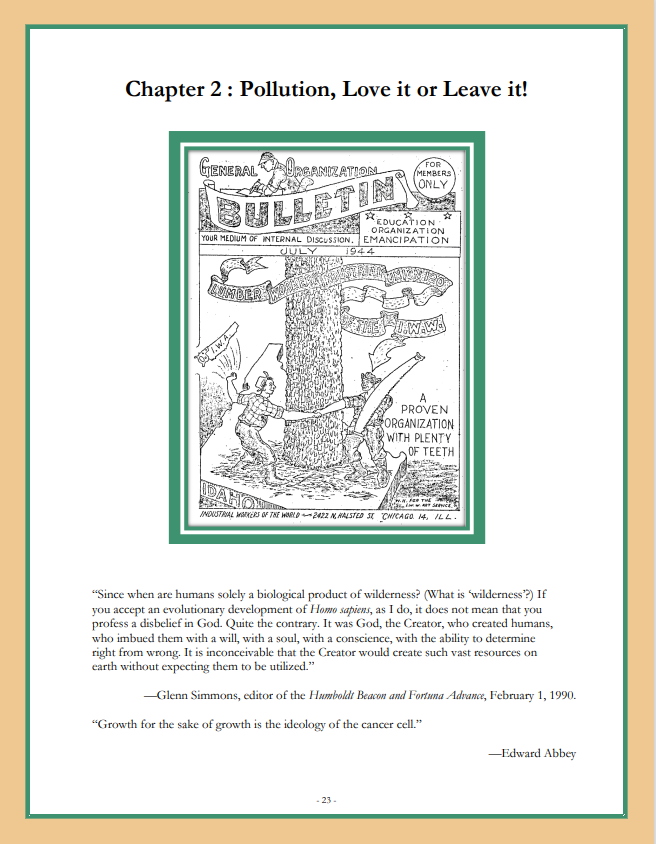
"Since when are humans solely a biological product of wilderness? (What is ‘wilderness’?) If you accept an evolutionary development of Homo sapiens, as I do, it does not mean that you profess a disbelief in God. Quite the contrary. It was God, the Creator, who created humans, who imbued them with a will, with a soul, with a conscience, with the ability to determine right from wrong. It is inconceivable that the Creator would create such vast resources on earth without expecting them to be utilized."

—Glenn Simmons, editor of the Humboldt Beacon and Fortuna Advance, February 1, 1990.

"Growth for the sake of growth is the ideology of the cancer cell.

—Edward Abbey

Earth shattering though it may have seemed, the IWW’s victory was both transitory and incomplete, and historical currents would never again mesh as perfectly. To begin with, the strike on the job had taken place only in the Pacific Northwest, and had excluded California at that. The Wobblies recognized one strategic weakness in this situation in noting that the employers could have eventually organized a lockout of that region and relied instead on wood production from the southern or eastern United States. They knew—in the abstract at least—that their victory would never be complete until they organized all lumber workers nationally and internationally.[1] The Wobblies inability to make inroads among the highly skilled redwood loggers of California’s North Coast was especially troublesome, and it portended their undoing. Two companies, Pacific Lumber (P-L) and Hammond Lumber Company (HLC) had each adopted separate techniques that had kept the IWW out and would soon be duplicated by the Lumber Trust elsewhere. That combined with the much larger shockwaves brought on by the Russian Revolution in 1917 conspired against the One Big Union and led to the eventual decline of the American working class as an adversarial force and the liquidation of the forests of the Pacific Northwest.

Although most corporations comprising the Lumber Trust had refused to budge, lest they embolden the Wobblies, there were those that adopted “welfare capitalism” on their own initiative, in which they would provide amenities and benefits to their workers—union or not—in an attempt to win over their loyalty. It was in the crucible of timber worker unionism, Humboldt County, where this was first attempted with any lasting success, by the Pacific Lumber Company (P-L), based in Scotia, beginning in 1909. P-L had discovered that by creating a wide variety of social programs, employee benefits, and community based events, it was able to secure the loyalty and stability of its workforce. P-L general manager A. E. Blockinger described these efforts in great detail in an article featured in the Pioneer Western Lumberman:

"A reading room with facilities for letter writing and any games, except gambling, is easily and cheaply put into any camp. Arrange subscription clubs for papers and periodicals or let the company do it for the men. If you can have a circulating library among your camps and at the mill plant, it will be much appreciated. Let the daily or weekly papers be of all nationalities as represented in your camp. Lumber trade journals are especially interesting to the men and they can and will readily follow the markets for lumber and appreciate that you have some troubles of your own.

“Organize fire departments among your men. The insurance companies will give you reductions in rates for such additional protection while it offers another opportunity for your men to relax and enjoy themselves.

“Shower baths at the camps or mill are easily and cheaply installed. They will be used and appreciated after a hot, dusty day’s work.

“Get your men loyal and keep them so. Let this replace loyalty to a union. The spirit is what you want in your men. Ten good men will accomplish as much as fifteen ordinary laborers if the spirit and good will is there. Treat them right and they will treat you right.”[2]

The employers’ introduction of paternalism achieved its intended goal. The Secretary of the Pacific Logging Congress, an employers’ association had declared in his 1912 report, “The best cure for the IWW plague—a people without a country and without a God—is the cultivation of the homing instinct in men.”[3] When the IWW campaign for the eight hour day ensued in 1917, P-L simply added more programs. Carleton H. Parker, a onetime U.C. Berkeley economics professor working for the War Department as a mediator during the lumber workers’ strike, had previously conducted sociological studies on workers, including agricultural and timber laborers. Parker was familiar with P-L, and had some fairly extensive knowledge of the Wobblies.[4] Some of the latter had been gained through first-hand studies by two of his assistants, Paul Brissenden[5] and F. C. Mills[6] who had posed as IWW members and later produced extensive studies on the organization. Using this knowledge, Parker offered many suggestions to Disque which the latter somewhat reluctantly adopted. The LLLL created social halls for its members and replaced the employment sharks with free employment agencies. The IWW quite rightly recognized these amenities as a means to buy the workers’ loyalty and likely to be liquidated when the employers drive for profits once again accelerated, but this process would take a long time, and convincing the workers of a threat that could take one or more generations to manifest proved futile.[7]

How Unions Are Fighting for Public Pension Fossil Fuel Divestment

Victory Against Polluter Points Way to Clean, Green, and Fully Funded Schools

By Lauren Bianchi - Labor Notes, January 31, 2023

For two years, teachers and staff in my workplace, George Washington High School, helped lead a community campaign to stop a hazardous industrial metal shredder, General Iron, from moving a few blocks from our school.

Repeating a historic pattern, city officials facilitated General Iron’s planned move from the wealthy and white Lincoln Park neighborhood where it had operated for decades to the working-class, majority Latino Southeast Side.

Our campaign won a major victory when we pressured Mayor Lori Lightfoot and the Chicago Department of Public Health into denying the final operating permit for General Iron. It took years of mobilizing, street protest, and a month-long hunger strike to force the mayor to do the right thing.

The experience of Chicago Teachers Union members in the #StopGeneralIron campaign highlights the power of union members when we stand shoulder to shoulder with environmental justice activists to demand safe living and working conditions.

Is Bristol Airport Big Enough?

By staff - Safe Landing, January 31, 2023

Today, the UK High Court has ruled that the expansion of Bristol Airport will be allowed to go ahead, in the latest twist in a rollercoaster legal campaign featuring tough local opposition and environmental scrutiny.

In 2018, Bristol Airport submitted plans to expand from 10 to 12 million passengers per year. This would result in an extra 23,800 flights, including an extra 4,000 night flights.

After North Somerset Council declared a climate emergency in 2019, planning permission for expanding the airport was refused in February 2020. Later that year, Bristol Airport announced that it would be appealing this decision and requested an inquiry, led by a planning inspector.

Bristol Airport Action Network (BAAN) was formed as a coalition of local groups and individuals working to oppose Bristol Airport’s expansion plans. BAAN became a Rule 6 party and was a significant contributor to the 10-week Public Inquiry which ended in October 2021.

They enlisted Safe Landing Co-Founder, Finlay Asher, to provide expert evidence during the inquiry.

Railroads Must Be Brought Under Public Ownership

By General Executive Board - United Electrical Workers, January 30, 2023

Statement of the UE General Executive Board

Railroads are a crucial part of our nation’s infrastructure. Nearly every sector of our economy depends on goods shipped by the railroads, which haul forty percent of all long-distance freight in the U.S., measured by ton-miles. A third of all exports travel by rail. Furthermore, the greater fuel efficiency of using rail to move both people and freight means that moving more of our transportation onto the railroads will be necessary to address the existential threat of climate change.

Yet the private owners of our nation’s Class 1 railroads have shown themselves utterly incapable of facing the challenge of the climate crisis, dealing fairly with their own workers, or even meeting the most basic needs of their customers. The railroad companies cannot even be said to be in the business of moving freight; they are merely in the business of using their monopoly control over the nation’s rail infrastructure to squeeze as much profit as possible from customers and workers at the behest of their Wall Street shareholders.

Therefore, we demand that Congress immediately begin a process of bringing our nation’s railroads under public ownership. Public ownership of part or all of their rail systems has allowed many other countries to create rail systems that can move people and goods quickly, affordably, and in an environmentally sound way. With public ownership, governments can take the long view and make crucial infrastructure investments — and prevent price-gouging.

Railroads are, like utilities, “natural monopolies.” The consolidation of the Class 1 railroads in the U.S. into five massive companies over the past several decades has made it clear that there is no “free market” in rail transportation. With most customers having no other choice, and no central authority mandating long-term planning, each individual railroad company has little incentive to make investments in infrastructure and every temptation to take as much of their income as possible as profits. Even Martin Oberman, chair of the Surface Transportation Board, the federal agency that regulates rail, has called the railroads “monopolists” who are cutting services and raising prices because “that’s the easiest way for them to get rich.”

In their endless thirst for profit, the railroads have implemented a system called “precision scheduled railroading,” which simply means operating with as few staff as possible — speed-up by another name. Shippers have been complaining about the resulting poor service for years, and during the pandemic our entire economy paid the price with snarled supply lines leading to shortages and price hikes. The railroads do not even seem interested in expanding their share of the freight market, instead seeking to extract more and more short-term profit out of customers for whom rail is the only feasible way to ship their products.

The effect on railroad workers has been even more severe. In order to implement precision scheduled railroading, the companies have imposed draconian attendance policies which make it virtually impossible for railroad workers to take any time off, even for medical reasons. This intolerable state of affairs almost led to a railroad strike at the end of last year, until President Biden and Congress — clearly willing to intervene in the “market” when workers threaten to withdraw their labor — imposed a contract on the workers that did not even contain the workers’ bottom-line demand of adequate sick leave.

Howie Hawkins (Ukraine Solidarity Network US): ‘The anti-imperialist position is to support the national liberation struggle of the Ukrainian people’

By Howie Hawkins and Federico Fuentes - Links, January 28, 2023

Howie Hawkins is a retired Teamsters union warehouse worker, the US Green Party 2020 presidential candidate and an ecosocialist. Together with a range of other leftists, socialists, unionists and academics, he recently helped set up the Ukraine Solidarity Network (US). Hawkins spoke to Federico Fuentes about the initiative and the challenges of building solidarity with Ukraine while opposing US imperialism.

Could you tell us a bit about how and why the Ukraine Solidarity Network came about, and what the fundamental aim of the network is? What practical solidarity does the network plan to carry out?

The Ukraine Solidarity Network was initiated at a meeting at the Socialism 2022 conference in Chicago in early September. We convened following a talk on “Ukraine, Self-Determination, and Imperialist War” by Yuliya Yurchenko of Sotsialnyi Rukh (Social Movement), a democratic socialist organisation in Ukraine. Though initiated by socialists, we agreed to build a broader network of people to support the Ukrainian people’s national liberation struggle. Our fundamental aim is to build moral, political and material support in labour and social movements for the people of Ukraine in their resistance to Russia’s invasion and their struggle for independence, democracy and social justice. We want to nurture links between progressive labor and social organizations in Ukraine and the United States.

Public education is an immediate priority. We want to counter the narratives of significant parts of the old left and the peace movement in the United States who have decided that if the US is sending arms to Ukraine, they must automatically oppose that support. Given the vicious history of US imperialism, that stance may be understandable. But a one-size-fits-all conclusion is not justified without a critical examination of each conflict. Would these people have opposed US military aid to the anti-fascist forces in the Spanish Civil War because it came from the US imperialist state? Or the military aid the US gave to the Soviet Union in World War II? Or the US arms and special forces the US sent to the Viet Minh resisting the Japanese invasion during that war? In the case of Ukraine, the knee-jerk conclusion of no US aid to the Ukrainian national liberation struggle reveals a US-centric colonial mindset. It sees US imperialism as the cause of what they call “the US proxy war on Russia.” It renders the Ukrainians invisible. Ukrainian perspectives on the causes of the war and why they want arms for self-defence are ignored, including the views of progressive trade union, socialist, anarchist, feminist, LGBT and environmental movements in Ukraine.

The Ukraine Solidarity Network wants to be a voice on the US left that opposes all imperialisms — Russian as well as US — and supports the right of historically colonised and oppressed nations like Ukraine to self-determination and to self-defence against aggression. We are concerned that those on the US left who oppose aid to Ukraine and, in some quarters, openly support a Russian victory, are alienating progressive- and peace-minded people in the US and internationally from the left.

While US military and economic support for Ukraine currently has wide support in the political centre and left, it is fast eroding in the Republican Party. The US right admires Putin’s authoritarian strongman rule and his conservative Christian, ethnonationalist, patriarchal, anti-gay, anti-trans and climate change-denying policies and pronouncements. US aid to Ukraine will be challenged by the Republican majority in the House of Representatives when the next round of funding is considered later this year. By next fall, far-right “peace” candidates, who will campaign on cutting aid to Ukraine and redirecting those military resources to Pacific deployments against China and Mexican border deployments against migrants, are likely to gain traction in the Republican presidential primaries. I hope the Ukraine Solidarity Network will have a significant influence on the Ukraine debate in US politics with a progressive perspective that support’s Ukraine’s self-determination and opposes both Russian and US imperialism.

Pages

The Fine Print I:

Disclaimer: The views expressed on this site are not the official position of the IWW (or even the IWW’s EUC) unless otherwise indicated and do not necessarily represent the views of anyone but the author’s, nor should it be assumed that any of these authors automatically support the IWW or endorse any of its positions.

Further: the inclusion of a link on our site (other than the link to the main IWW site) does not imply endorsement by or an alliance with the IWW. These sites have been chosen by our members due to their perceived relevance to the IWW EUC and are included here for informational purposes only. If you have any suggestions or comments on any of the links included (or not included) above, please contact us.

The Fine Print II:

Fair Use Notice: The material on this site is provided for educational and informational purposes. It may contain copyrighted material the use of which has not always been specifically authorized by the copyright owner. It is being made available in an effort to advance the understanding of scientific, environmental, economic, social justice and human rights issues etc.

It is believed that this constitutes a 'fair use' of any such copyrighted material as provided for in section 107 of the US Copyright Law. In accordance with Title 17 U.S.C. Section 107, the material on this site is distributed without profit to those who have an interest in using the included information for research and educational purposes. If you wish to use copyrighted material from this site for purposes of your own that go beyond 'fair use', you must obtain permission from the copyright owner. The information on this site does not constitute legal or technical advice.


