You are here

green unionism

Railroad and UC Workers Solidarity

By That Green Union Guy (with suggestions from Baltimore Red)- IWW Environmental Union Caucus, December 6, 2022

I gave the following speech at a rally on the UC Berkeley Campus (a video of the rally follows)

Fellow Workers, Comrades, and Friends:

I am a union mariner of over a quarter century (I am a member of the IBU, an ILWU affiliate, and the IWW); I grew up in a railroad family, and I graduated from UC Berkeley in 1994.

I am here today to deliver a message on behalf of Railroad Workers United (of which I am a solidarity member):

The Class One freight railroad bosses:

  • Have been reaping record profits for 25 years, and yet...
  • they are moving less freight than at any time since 2006;
  • they are swimming in money, while industry is contracting when it should be expanding due to its efficiency, and its potential as a major climate solution;
  • meanwhile, during that time, 30% of workforce has been lost in the last 4-5 years;
  • in spite of the potential for rail as a climate solution, the freight bosses are hostile to expansion of passenger trains;
  • in fact, the greed of the capitalist railroad bosses has grown so egregious, that the Class Ones have possessed off every major shipping group with their BS, thus even turning much of the capitalist class against them;

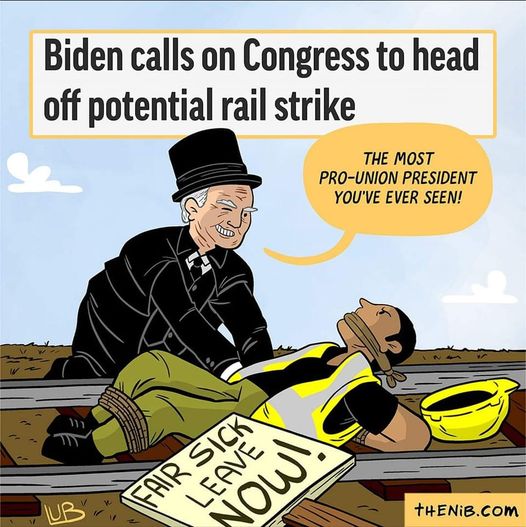
The "deal" brokered by Biden and rammed down the throats of the working class by the Republicans and Democrats alike won't solve the problem.

This is not only naked class war, it's a recipe for the complete implosion and meltdown of the nation's rail system.

Climate Change As Class War: A Review

By Tom Wetzel - Ideas and Action, December 6, 2022

As the burning of fossil fuels continues to pump up the size of the carbon dioxide layer in the atmosphere, the global warming crisis becomes ever more acute. In its “Code Red for Humanity” warning in 2021, the UN’s Intergovernmental Panel on Climate Change said: “The alarm bells are deafening, and the evidence is irrefutable: greenhouse gas emissions from fossil-fuel burning and deforestation are choking our planet and putting billions of people at immediate risk. Global heating is affecting every region on Earth…”

But we’re losing the climate battle thus far. In Climate Change as Class War, Marxist geographer Matthew Huber argues that the climate movement is losing because it is rooted in the “professional class.” He argues that this class lacks the power to defeat the powerful capitalist interests that drag their heals against the kind of drastic cutting back of fossil-fuel burning that is needed. For Huber, the climate movement needs to be rooted in the working class to have sufficient power to enact radical structural reforms needed to effectively fight global warming. 

Huber analyses the existing climate movement as consisting of three layers. First, there are the “science communicators” like James Hansen who try to do popular education about climate change science. A second group are “policy technocrats” with expertise in law or policy studies and work in think tanks, the university world, or non-profits. Their orientation is to craft “smart” policy solutions. A third group are the “anti-system radicals” whose exposure to the science of environmental devastation “leads to a kind of political radicalization.” Huber views these groups as part of the “professional class” and tries to use his theory of this class to explain the politics of the climate movement. Huber pinpoints two features of the climate movement that he sees as sources of weakness: (1) The emphasis on high levels of personal consumption as a factor in global warming, thus leading to a “politics of less” — especially a feature of “degrowth” politics; and (2) an emphasis on science education. “Making climate politics purely about science evades the question of power. It allows us to attribute…inaction on climate change as simply due to misinformation rather than a lack of power.”

Huber appeals to the theory of the “Professional-Managerial Class” (proposed by Barbara and John Ehrenreich) to try to explain the origin of these features of the “professional class” climate movement. Here he points to the centrality of credentials which mediates the access of the “professional class” to the labor market. This includes “the existence of a specialized body of knowledge, accessible only by lengthy training,” degree and licensing programs, professional associations, which he regards as “forms of class organization.” This tends to encourage acceptance of meritocratic ideology which favors decision-making power for managers and professionals. This emphasis on the importance of knowledge and the role of professionals tends to favor the science education emphasis of the climate movement, as Huber sees it.

In the Ehrenreichs’ theory of the PMC their class position is based on their control over cultural and social reproduction. This is how teachers and writers are included in the class. Among both Marxists and libertarian socialists, however, class has historically been seen as an institutional group-to-group power relation in social production, as in Marx’s concept of capital as a social power relation. Looking at it from this point of view, I think the PMC theory tends to paper over a distinction between two different class groups. First, there is a group I call the bureaucratic control class. This group’s class position is based on their relative monopoly of decision-making power, via bureaucratic hierarchies that exist to control labor and run corporations and government agencies day-to-day. This includes not only salaried managers but high-end professionals who work closely with management to control labor and defend corporate interests, such as corporate lawyers, HR experts, and industrial engineers who design jobs and work organization. This class power relation is the basis of the clear antagonism between this layer and the working class. 

It’s noteworthy that school teachers, newspaper reporters, script writers, and nurses all form unions and occasionally go on strike. These lower level professional employees are not usually part of the management apparatus, and don’t manage other workers. As such, they have a structural position like the core working class of manual workers, not the bureaucratic control class. The people in this lower professional layer often have college degrees, and sometimes do show elitism towards the core manual working class. They also tend to have more autonomy in their work. However, the “skilled trades” in the early 20th century often showed elitism towards less skilled manual workers and often had relative autonomy in their work. But we generally regard skilled blue collar workers (such as tool and die makers) as part of the working class. 

Lower level professional employees may be tempted to middle class meritocratic ideology. As such they will be in a conflicted position, as they also share the subordination of the working class position. This is why Erik Olin Wright’s phrase “contradictory class location” is appropriate for this group — a point that Huber concedes.

Carbon Removal Is Coming to Fossil Fuel Country. Can It Bring Jobs and Climate Action?

By Nicholas Kusnetz - Inside Climate News, December 4, 2022

Scientists have debated whether a new technology is a critical climate solution or would carry unacceptable risks. A project in Wyoming’s coal region could begin to provide answers.

ROCK SPRINGS, Wyo.—In early fall, residents of this desolate corner of southwestern Wyoming opened their mailboxes to find a glossy flyer. On the front, a truck barreled down a four-lane desert highway with a solar farm on one side and what looked like rows of shipping containers on the other. On the back was an invitation.

“CarbonCapture Inc. is launching Project Bison,” it read, announcing a “direct air capture facility” set to begin operations here next year. “Join us at our town hall event to learn more.”

Few had heard about the proposal before receiving the flyer, let alone had any idea what a direct air capture facility was. So the following week, about 150 people packed into a large classroom at Western Wyoming Community College in Rock Springs to find out.

“We are a company that takes CO2 out of the air and stores it underground,” said Patricia Loria, CarbonCapture’s vice president of business development, in opening the meeting.

Loria described a plan to deploy a series of units—the shipping container-like boxes pictured on the flyer—that would filter carbon dioxide from the air and then compress the greenhouse gas for injection underground, where it would remain permanently.

The Case for Public Ownership of the Rails in the US

What kinds of jobs will be created by offshore wind farms?

Working Paper 16: Towards a Public Pathway Approach to a Just Energy Transition for the Global South

By staff - Trade Unions for Energy Democracy, December 2022

This TUED Working Paper was written to inform discussion at the launch of “TUED South” meeting that took place in Nairobi, Kenya, during October 11th-13th, 2022.

In the weeks following the meeting, it was revised to reflect the discussions that took place. The Nairobi meeting occurred at a time of geopolitical turbulence due to the war in the Ukraine. In many countries, energy has become front page news as prices rise and the major economies rush to secure new sources of gas, coal, and oil. Energy-related anxieties have been accompanied by growing concerns about climate change. The year 2022 produced several headline-making extreme weather events, with devastating floods in Pakistan and in South Africa’s KwaZulu-Natal province together claiming the lives of more than 2,000 people and leaving hundreds of thousands of poor people homeless. Europe’s record-breaking heatwave and wildfires killed 16,000 people, and China’s summer produced a heatwave more severe than any in recorded history.

Today it is widely recognized that the impact of climate change on the poorest countries is already more severe than it is for the richer countries, and that inadequate public services are contributing to its many damaging effects.

In 2019 the UN’s Special Rapporteur on extreme poverty and human rights noted “hundreds of millions will face food insecurity, forced migration, disease, and death.”

Climate change is a huge threat to jobs, livelihoods, and security to workers everywhere. But it is the working class and poor people of the South who will be hit the first and the hardest.

Download this document (PDF).

Real Climate Solutions are No Mystery

Sunflower Alliance Webinar: California Climate Justice Plan

How to Pass a CTA Divestment Resolution Webinar

Major Strike Looms as Largest Rail Union in US Rejects White House-Brokered Contract

By Jake Johnson - Common Dreams, November 21, 2022

"It's about attendance policies, sick time, fatigue, and the lack of family time," said one union official. "A lot of these things that cannot be seen but are felt by our membership. It's destroying their livelihoods."

The largest railroad workers union in the United States announced Monday that its members voted to reject a contract negotiated with the help of the Biden White House, once again raising the prospect of a major strike or lockout as employees revolt over profitable rail giants' refusal to provide adequate paid sick leave.

The Transportation Division of the International Association of Sheet Metal, Air, Rail, and Transportation Workers (SMART-TD) said in a statement that just over 50% of its members voted to reject the proposed contract. Members of the Brotherhood of Locomotive Engineers and Trainmen (BLET)--the second-largest rail union in the U.S.--voted to ratify the contract, the union said Monday.

If any of the rail unions decide to strike, the others have vowed to honor their picket lines. SMART-TD said a strike or lockout could begin as soon as December 9.

"SMART-TD members with their votes have spoken, it's now back to the bargaining table for our operating craft members," said Jeremy Ferguson, the union's president. "This can all be settled through negotiations and without a strike. A settlement would be in the best interests of the workers, the railroads, shippers, and the American people."

"The ball is now in the railroads' court. Let's see what they do. They can settle this at the bargaining table," Ferguson added. "But, the railroad executives who constantly complain about government interference and regularly bad-mouth regulators and Congress now want Congress to do the bargaining for them."

Pages

The Fine Print I:

Disclaimer: The views expressed on this site are not the official position of the IWW (or even the IWW’s EUC) unless otherwise indicated and do not necessarily represent the views of anyone but the author’s, nor should it be assumed that any of these authors automatically support the IWW or endorse any of its positions.

Further: the inclusion of a link on our site (other than the link to the main IWW site) does not imply endorsement by or an alliance with the IWW. These sites have been chosen by our members due to their perceived relevance to the IWW EUC and are included here for informational purposes only. If you have any suggestions or comments on any of the links included (or not included) above, please contact us.

The Fine Print II:

Fair Use Notice: The material on this site is provided for educational and informational purposes. It may contain copyrighted material the use of which has not always been specifically authorized by the copyright owner. It is being made available in an effort to advance the understanding of scientific, environmental, economic, social justice and human rights issues etc.

It is believed that this constitutes a 'fair use' of any such copyrighted material as provided for in section 107 of the US Copyright Law. In accordance with Title 17 U.S.C. Section 107, the material on this site is distributed without profit to those who have an interest in using the included information for research and educational purposes. If you wish to use copyrighted material from this site for purposes of your own that go beyond 'fair use', you must obtain permission from the copyright owner. The information on this site does not constitute legal or technical advice.