You are here

renewable energy

Job Creation for a Clean Jumpstart

By Amanda Novello - Data for Progress, July 2021

Government stimulus is sorely needed: more than a year into the pandemic recession, nearly 10 percent of Black workers are unemployed, and over 6 percent of all workers are unemployed. There are still more than 7 million fewer jobs than there were last June, and nearly 40% of all unemployed workers are long-term unemployed. A majority of those out of work have no college degree. In addition, there are 5 million fewer people in the labor force than pre-pandemic, including 3 million women who left the labor force since last February, and 2 million men.

Decarbonizing the economy in tandem with a full, job centered green recovery, will require many different plans to be executed at all levels of government and society. That’s why, this March, Data for Progress and Evergreen Action released the Clean Jumpstart 2021 report that offers 39 policy priorities for how to carry out our existing commitments, while increasing ambition and creating good jobs that Americans desperately need, in communities that need them most. All components of this plan are popular with likely voters. The Clean Jumpstart 2021 plan represents how a bold climate investment package, like the American Jobs Plan, could tackle the climate crisis and build a clean energy economy.

The Clean Jumpstart 2021 plan would invest a total of $2.3 trillion over four years. Some investments would create jobs more or less immediately, while others will take longer to realize full job-creation effects. Therefore, in this memo, we estimate that the plan would create an average of 2.7 million jobs annually for the first five years. But the job benefits of the plan don’t end there. The policies in Clean Jumpstart would also create up to 960,000 jobs annually for five years following (year 6-10 after investments begin). Approximately 40 percent of all jobs created would be “direct” jobs, or employment working directly toward these policy goals, and the rest would be due to additional work generated along supply chains and in communities due to the multiplied impacts of increased demand.

Read the text (PDF).

Green Left Show #14: Why nuclear is NOT a climate solution

What Might an Ecosocialist Society Look Like?

By David Klein - System Change not Climate Change, June 27, 2021
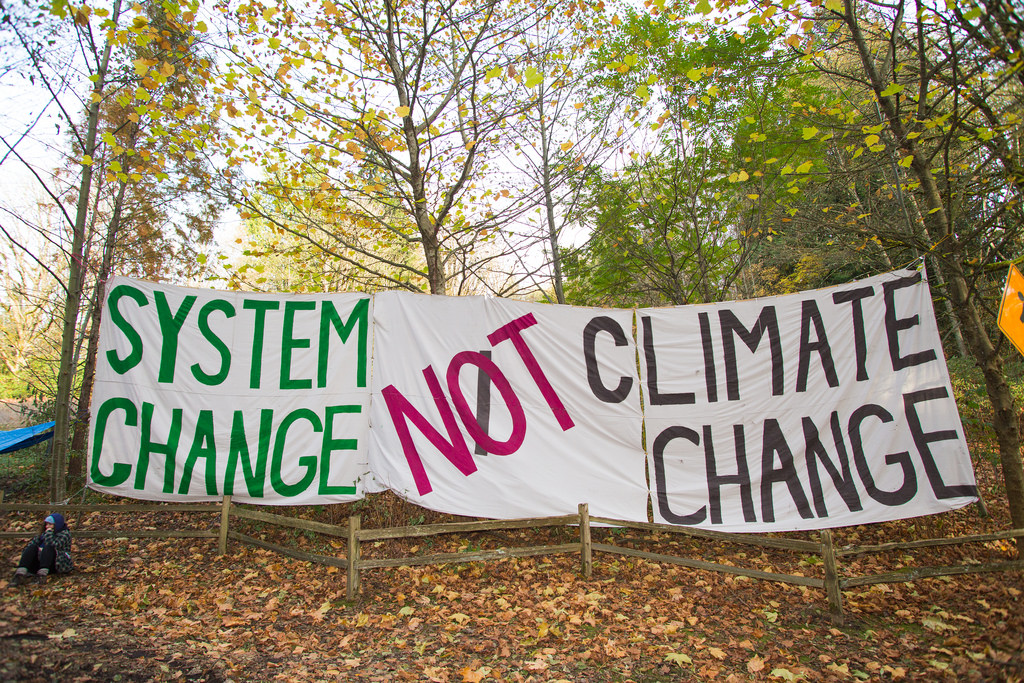
Why can’t the problems that ecosocialism would solve also be remedied within the current global capitalist system?

Before describing possible features of a future ecosocialism, it is worthwhile to consider why such a system is even needed. Why can’t the problems that ecosocialism would solve also be remedied within the current global capitalist system? Part I of this essay addresses that question by summarizing recent scientific reports on the state of the climate and extent of the ecological crisis; reviewing available methods and technologies that could be used to address the climate and ecological crises; and briefly describing capitalism’s structural inability to provide solutions at the scale of the crises. Part II then takes up the subject of the title, ecosocialism, along with strategies to move in that direction. 

Part I: Context and Background

The threat to life on Earth posed by the climate and ecological crises can hardly be overstated. A 2019 Nature article warned that up to a million species of plants and animals are on the verge of extinction, and a United Nations study the same year identified global warming as a major driver of wildlife decline. Much of the devastation to date was catalogued in the 2020 WWF Living Planet report, which recorded a 68 percent decline in the population of vertebrates around the world, in just the past five decades. More succinctly, scientists report that Earth is experiencing a sixth mass extinction. (The previous mass extinction, 66 million years ago, ended the dinosaurs).

The scale of the environmental crisis is unprecedented in human history. At stake are human civilization and billions of lives. An article last year in Proceedings of the National Academy of Sciences predicted that for every additional 1̊C rise beyond the 2019 global average, a billion people will be forced to abandon their locations or endure insufferable heat. The paper warns that under a scenario of increasing emissions, areas now home to a third of the world’s population could experience the same temperatures as the hottest parts of the Sahara within 50 years. 

Summing up the findings of some 150 scientific studies, a 2021 paper authored by 17 scientists warned that the “scale of the threats to the biosphere and all its life forms –- including humanity –- is in fact so great that it is difficult to grasp even for well-informed experts.” Adding further urgency, 101 Nobel laureates released an open letter in April 2021 in which they wrote, “We are seized by the great moral issue of our time: the climate crisis and commensurate destruction of nature.” The laureates called for a worldwide fossil fuel non-proliferation treaty

Global heating is driven by greenhouse gases in the atmosphere, and yet emissions continue at high levels despite the chorus of promises by “climate leaders” in governments. In 2020 global emissions decreased by a meager 5.8 percent due to Covid-19 lockdowns, but they were already on the rebound by the end of the year. For the current year, 2021, the International Energy Agency (IEA) forecasts the second largest annual increase in history of greenhouse gas emissions, as global economies recover from the Covid-19 recession. In May 2021 a record-breaking monthly average concentration of 419 parts per million (ppm) of CO2 was measured in Mauna Loa, Hawaii, breaking the previous May 2020 record of 417 ppm. 

The drivers of ecocide, more generally, include not only climate change, but also habitat destruction, toxic dumping, plastic pollution in the oceans, radiation poisoning, and other customary byproducts of the global capitalist economy. All of this destruction continues unabated despite the flood of warnings from scientists, lobbying by environmental activists, and even warnings from institutions deeply rooted in the capitalist economy. 

Consider, for example, that in May 2021 the IEA released an unprecedented call to the world to rapidly reach zero emissions in its report, Net Zero by 2050: A Roadmap for the Global Energy Sector. Widespread news coverage and expressions of optimism followed. Yet from February to the end of April 2021, the Biden administration approved nearly 1200 drilling permits on federal lands, along with more than 200 offshore permits, and defended in court the ConocoPhillips Willow project in Alaska, which is expected to emit 260 million metric tons of CO2 during the next 30 years, the equivalent of 66 coal-fired plants. And Biden is far from alone among world leaders in his support of fossil fuel expansions.

10 reasons why climate activists should not support nuclear

By Simon Butler - Climate and Capitalism, June 23, 2021

In a recent Guardian article, Jacobin magazine’s founding editor Bhaskar Sunkara declared that “If we want to fight the climate crisis, we must embrace nuclear power.” He praised nuclear as a clean and reliable and suggested that opponents of nuclear power are either gripped by “paranoia … rooted in cold war associations” or are relying on “outdated information.”

I disagree entirely. Here are 10 reasons why nuclear power is still no solution for climate change.

1. Nuclear is dangerous. Building many new nuclear power plants around the globe means a higher risk of unpredictable Fukushima-type accidents. We know more extreme weather events are locked in due to climate change, adding to the danger as time passes.

What if a nuclear power plant had been in the path of Australia’s huge bushfires in 2020? What nuclear power plant could withstand super typhoons like the one that flattened Tacloban City in the Philippines in 2013? What if a nuclear plant was submerged by unexpectedly massive floods, like those in Mozambique for the past three years in a row?

Planning for a hotter future means switching to safer, resilient technologies. Building more nuclear power plants in this context is reckless.

2. Nuclear wastes water. Nuclear power is an incredibly water-guzzling energy source compared with renewables like solar and wind. We know climate change-induced droughts and floods will make existing freshwater shortages a lot worse. So it’s a bad idea to waste so much water on more nuclear.

Uranium mining can also make nearby groundwater unusable forever. Half of the world’s uranium mines use a process called in-situ leaching. This involves fracking ore deposits then pumping down a cocktail of acids mixed with groundwater to dissolve the uranium for easier extraction. This contaminates aquifers with radioactive elements. There are no examples of successful groundwater restoration.

All Hands on Deck: An assessment of provincial, territorial and federal readiness to deliver a safe climate

By Nichole Dusyk, Isabelle Turcotte, Thomas Gunton, Josha MacNab, Sarah McBain, Noe Penney, Julianne Pickrell-Barr, and Myfannwy Pope - Pembina Institute, July 22, 2021

Unlocking a prosperous future for all will require bold, ambitious action on climate from governments across Canada.

To measure readiness to act on climate, Pembina Institute in collaboration with Simon Fraser University’s School of Resource and Environmental Management assessed the performance of provinces, territories, and the federal government on 24 policy indicators across 11 categories. The indicators represent foundational climate policies and measures to reduce emissions in key sectors of the economy. Governments were invited to review the accuracy and completeness of the data and summary for their region prior to publication.

The assessment shows that there have been important examples of climate leadership and success across the country. Yet, progress made — for example with economy-wide carbon pricing and the phase-out of coal-fired electricity — has been offset by emissions increases elsewhere. In particular, emissions from transportation and oil and gas production have been on a steady upward trajectory since 2005. As a result, Canada’s overall greenhouse gas (GHG) emissions have dropped by only 1% between 2005 and 2019. Modelling that includes the federal climate policy published in December 2020 shows a national emissions reduction of 36% below 2005 levels by 2030 — still short of the federal government’s commitment to reduce emissions by 40-45% by 2030.

Read the Report (PDF).

‘It’s virtually impossible’: Transition to renewables at risk as oil and gas workers struggle to access green jobs

By Daisy Dunne - The Independent., June 22, 2021

The UK’s transition away from fossil fuels to renewable power could be put at risk by barriers facing oil and gas workers looking to move into green jobs, campaigners say.

A survey of 600 offshore workers found that those looking to move from the fossil fuel industry into green jobs in renewable power currently face costly training fees, discouraging them from making the transition.

Workers responding to the poll said they are routinely forced to pay out thousands of pounds of their own cash for training courses when moving between one employer and another in the offshore sector, some of which they have already paid to take part in for their current positions.

One 42-year-old who has worked in the oil and gas sector for 20 years said the cost of training could be putting workers off trying to move into green jobs.

“People really need help to make the transition because it’s just virtually impossible to do it yourself with the way things are at the moment,” he told The Independent. None of the oil and gas workers interviewed wanted to provide their names, for fear of losing work.

He added he was hoping to see more opportunities in renewable power as the country transitions away from using fossil fuels.

“For me, it’s about moving forward in my career and about moving forward for the environment at the same time. I’ve got two young children and I can see the changes that are happening to the climate, it’s obvious to me.”

One 43-year-old who has worked in the sector for 24 years said that he would “love” to see more opportunities in renewable energy.

“I was one of the people living in a bubble thinking ‘that might not be quite right’ when it came to climate change. But it’s really my kids that brought it home to me,” he told The Independent.

Job growth in clean energy will more than offset fossil fuel losses

By Elizabeth Perry - Work and Climate Change Report, June 21, 2021

Clean Energy Canada released a new report on June 17, projecting that Canada’s clean energy sector will grow by almost 50% (over 200,000 jobs) by 2030, to reach 639,200 jobs. The report states that this will far exceed the 125,800 jobs expected to be lost in fossil fuels. Surprisingly, the province with the greatest increase in clean energy jobs will be Alberta – forecast to increase by 164% by 2030. As the introduction concludes: “Oil and gas may have dominated Canada’s energy past, but it’s Canada’s clean energy sector that will define its new reality.”

The New Reality report is the latest in the “Tracking the Energy Transition” series, updating the 2019 report. It is based on modelling by Navius Research – presented in a technical report here. Employment and GDP numbers are considered under two policy scenarios: the Pan-Canadian Framework for Clean Growth and Climate Change (the Liberal government’s previous policy) , and the Healthy Environment, Healthy Economy policy, unveiled in December 2020. The definition of “clean energy jobs” is broad, and forecasting breaks down into industry sectors – for example, stating that jobs in electric vehicle technology are on track to grow 39% per year, with 184,000 people set to be employed in the industry in 2030—a 26-fold increase over 2020. The report also highlights specific examples of the pioneering clean energy companies in Canada.

Just Minerals: Safeguarding protections for community rights, sacred places, and public lands from the unfounded push for mining expansion

By staff - Earthworks, June 17, 2021

Mining has harmful climate, equity, and resource impacts that, without reform, may ultimately undermine the benefits of transitioning to renewable energy. Building a sustainable economy based on clean energy gives us an historic opportunity to confront the legacy of injustice to Indigenous communities and damage to the public lands held in trust for future generations.

This report outlines how current federal minerals policy conflicts with the Biden-Harris administration’s clean energy and environmental justice agendas, and how those policies must change to ensure minerals are sourced in a way that better protects marginalized communities and the environment. The infrastructure to support the transition to low-carbon energy requires a variety of minerals—cobalt and lithium, among others. Just Minerals encourages government officials to prioritize recycling, reusing and substituting minerals needed for renewable energy technology over new extraction.

Among the report’s key findings:

  • Updating the rules that govern mining on public lands must be an integral part of this administrations’ environmental justice agenda, until Congress acts to reform the antiquated 1872 Mining Law. Even without Congressional action, the Biden administration has a variety of policy tools available to reduce the pressure to source minerals from irresponsible mines.
  • There is significant untapped mineral recycling and reuse potential available using current technology. With the right policies in place, we can create a more circular economy that may approximately halve global demand for certain minerals, like cobalt, lithium, and nickel, key to the clean energy transition.
  • Major consumers, including automakers and electronics companies, have also directed their suppliers to source more responsibly. Ford, Microsoft, BMW, and Daimler-Benz, among others, have committed to the Initiative for Responsible Mining Assurance (IRMA), which independently audits and certifies environmental and social performance at mines.

Read the text (Link).

Webinar: "Clean" Energy Proposals and Real Climate Solutions

By staff - Food and Water Watch, June 17, 2021

There’s been a lot of debate recently about President Biden’s climate agenda, especially something called a Clean Electricity Standard. Sounds great, right? It’s not quite as simple as it sounds, and it all depends on your definition of “clean”. Join experts and advocates for an educational webinar on the nuances of these climate policies and how we can fight for meaningful solutions to the climate crisis.

Clean energy jobs as a transition destination

By Elizabeth Perry - Work and Climate Change Report, June 15, 2021

Released on June 3, Responding to Automation: Building a Cleaner Future is a new analysis by the Conference Board of Canada, in partnership with the Future Skills Centre. It investigates the potential for clean energy jobs as a career transition destination for workers at high risk of losing their jobs because of automation. The clean energy occupations were identified from three areas: clean energy production, energy efficiency , and environmental management and the “rapid growth” jobs identified range from wind turbine technicians and power-line installers to industrial engineers, sheet metal workers, and geospatial information scientists. Based on interviews with clean economy experts, as well as the interview responses from over five hundred workers across Canada, the analysis identifies the structural barriers holding employers and workers back from transition:

  • Lack of consistent financial support for workers to reskill
  • Employer hesitancy to hire inexperienced workers
  • Current demand for relevant occupations which makes change less attractive
  • Lack of awareness around potential transition opportunities
  • Personal relocation barriers, such as high living costs in new cities, and family commitments.

None of the recommended actions to overcome the barriers include a role for unions, with the burden for action falling largely on the individual employee. Only summary information is presented as a web document, but this research is part of a larger focus on automation, so it can be hoped that a fuller report will be published – if so, the partner group, Future Skills, maintains a Research website where it will likely be available.

Other news about renewable energy jobs:

“Renewable Energy Boom Unleashes a War Over Talent for Green Jobs” appeared in Bloomberg Green News (June 8), describing shortages of skilled workers in renewable energy, mainly in the U.S.. It also summarizes a U.K. report which forecasts a large need for workers in the U.K. offshore industry, which is expected to be met by people transferring from the oil and gas sector.

A report by the Global Wind Energy Council forecasts a growth of 3.3 million wind jobs worldwide by 2025, and suggests that offshore wind energy jobs could offer a natural transition for workers dislocated from offshore oil and gas and marine engineering workers. According to the analysis, in 2020, there were approximately 550,000 wind energy workers in China, 260,00 in Brazil, 115,000 in the US and 63,000 in India. A related report, The Global Wind Workforce Outlook 2021-2025 forecasts a large training gap: the global wind industry will need to train over 480,000 people in the next five years to construct, install, operate and maintain the world’s growing onshore and offshore wind fleet. That report is available for download here (registration required), and is summarized in this press release.

And forthcoming: Clean Energy Canada will release its research on the clean energy labour market in Canada on June 17. Their last jobs report, The Fast Lane: Tracking the Energy Revolution, was released in 2019.

Pages

The Fine Print I:

Disclaimer: The views expressed on this site are not the official position of the IWW (or even the IWW’s EUC) unless otherwise indicated and do not necessarily represent the views of anyone but the author’s, nor should it be assumed that any of these authors automatically support the IWW or endorse any of its positions.

Further: the inclusion of a link on our site (other than the link to the main IWW site) does not imply endorsement by or an alliance with the IWW. These sites have been chosen by our members due to their perceived relevance to the IWW EUC and are included here for informational purposes only. If you have any suggestions or comments on any of the links included (or not included) above, please contact us.

The Fine Print II:

Fair Use Notice: The material on this site is provided for educational and informational purposes. It may contain copyrighted material the use of which has not always been specifically authorized by the copyright owner. It is being made available in an effort to advance the understanding of scientific, environmental, economic, social justice and human rights issues etc.

It is believed that this constitutes a 'fair use' of any such copyrighted material as provided for in section 107 of the US Copyright Law. In accordance with Title 17 U.S.C. Section 107, the material on this site is distributed without profit to those who have an interest in using the included information for research and educational purposes. If you wish to use copyrighted material from this site for purposes of your own that go beyond 'fair use', you must obtain permission from the copyright owner. The information on this site does not constitute legal or technical advice.

