

You are here

jobs

Job growth in clean energy will more than offset fossil fuel losses

By Elizabeth Perry - Work and Climate Change Report, June 21, 2021

Clean Energy Canada released a new report on June 17, projecting that Canada’s clean energy sector will grow by almost 50% (over 200,000 jobs) by 2030, to reach 639,200 jobs. The report states that this will far exceed the 125,800 jobs expected to be lost in fossil fuels. Surprisingly, the province with the greatest increase in clean energy jobs will be Alberta – forecast to increase by 164% by 2030. As the introduction concludes: “Oil and gas may have dominated Canada’s energy past, but it’s Canada’s clean energy sector that will define its new reality.”

The New Reality report is the latest in the “Tracking the Energy Transition” series, updating the 2019 report. It is based on modelling by Navius Research – presented in a technical report here. Employment and GDP numbers are considered under two policy scenarios: the Pan-Canadian Framework for Clean Growth and Climate Change (the Liberal government’s previous policy) , and the Healthy Environment, Healthy Economy policy, unveiled in December 2020. The definition of “clean energy jobs” is broad, and forecasting breaks down into industry sectors – for example, stating that jobs in electric vehicle technology are on track to grow 39% per year, with 184,000 people set to be employed in the industry in 2030—a 26-fold increase over 2020. The report also highlights specific examples of the pioneering clean energy companies in Canada.

Clean energy jobs as a transition destination

By Elizabeth Perry - Work and Climate Change Report, June 15, 2021

Released on June 3, Responding to Automation: Building a Cleaner Future is a new analysis by the Conference Board of Canada, in partnership with the Future Skills Centre. It investigates the potential for clean energy jobs as a career transition destination for workers at high risk of losing their jobs because of automation. The clean energy occupations were identified from three areas: clean energy production, energy efficiency , and environmental management and the “rapid growth” jobs identified range from wind turbine technicians and power-line installers to industrial engineers, sheet metal workers, and geospatial information scientists. Based on interviews with clean economy experts, as well as the interview responses from over five hundred workers across Canada, the analysis identifies the structural barriers holding employers and workers back from transition:

  • Lack of consistent financial support for workers to reskill
  • Employer hesitancy to hire inexperienced workers
  • Current demand for relevant occupations which makes change less attractive
  • Lack of awareness around potential transition opportunities
  • Personal relocation barriers, such as high living costs in new cities, and family commitments.

None of the recommended actions to overcome the barriers include a role for unions, with the burden for action falling largely on the individual employee. Only summary information is presented as a web document, but this research is part of a larger focus on automation, so it can be hoped that a fuller report will be published – if so, the partner group, Future Skills, maintains a Research website where it will likely be available.

Other news about renewable energy jobs:

“Renewable Energy Boom Unleashes a War Over Talent for Green Jobs” appeared in Bloomberg Green News (June 8), describing shortages of skilled workers in renewable energy, mainly in the U.S.. It also summarizes a U.K. report which forecasts a large need for workers in the U.K. offshore industry, which is expected to be met by people transferring from the oil and gas sector.

A report by the Global Wind Energy Council forecasts a growth of 3.3 million wind jobs worldwide by 2025, and suggests that offshore wind energy jobs could offer a natural transition for workers dislocated from offshore oil and gas and marine engineering workers. According to the analysis, in 2020, there were approximately 550,000 wind energy workers in China, 260,00 in Brazil, 115,000 in the US and 63,000 in India. A related report, The Global Wind Workforce Outlook 2021-2025 forecasts a large training gap: the global wind industry will need to train over 480,000 people in the next five years to construct, install, operate and maintain the world’s growing onshore and offshore wind fleet. That report is available for download here (registration required), and is summarized in this press release.

And forthcoming: Clean Energy Canada will release its research on the clean energy labour market in Canada on June 17. Their last jobs report, The Fast Lane: Tracking the Energy Revolution, was released in 2019.

Labor-Backed Report on Path to Equitable Green California

By Staff - Sunflower Alliance, June 10, 2021

Nineteen labor organizations—including unions representing refinery workers in Northern and Southern California and the Alameda Labor Council— have endorsed a detailed plan for an equitable transition to a clean-energy economy in California.

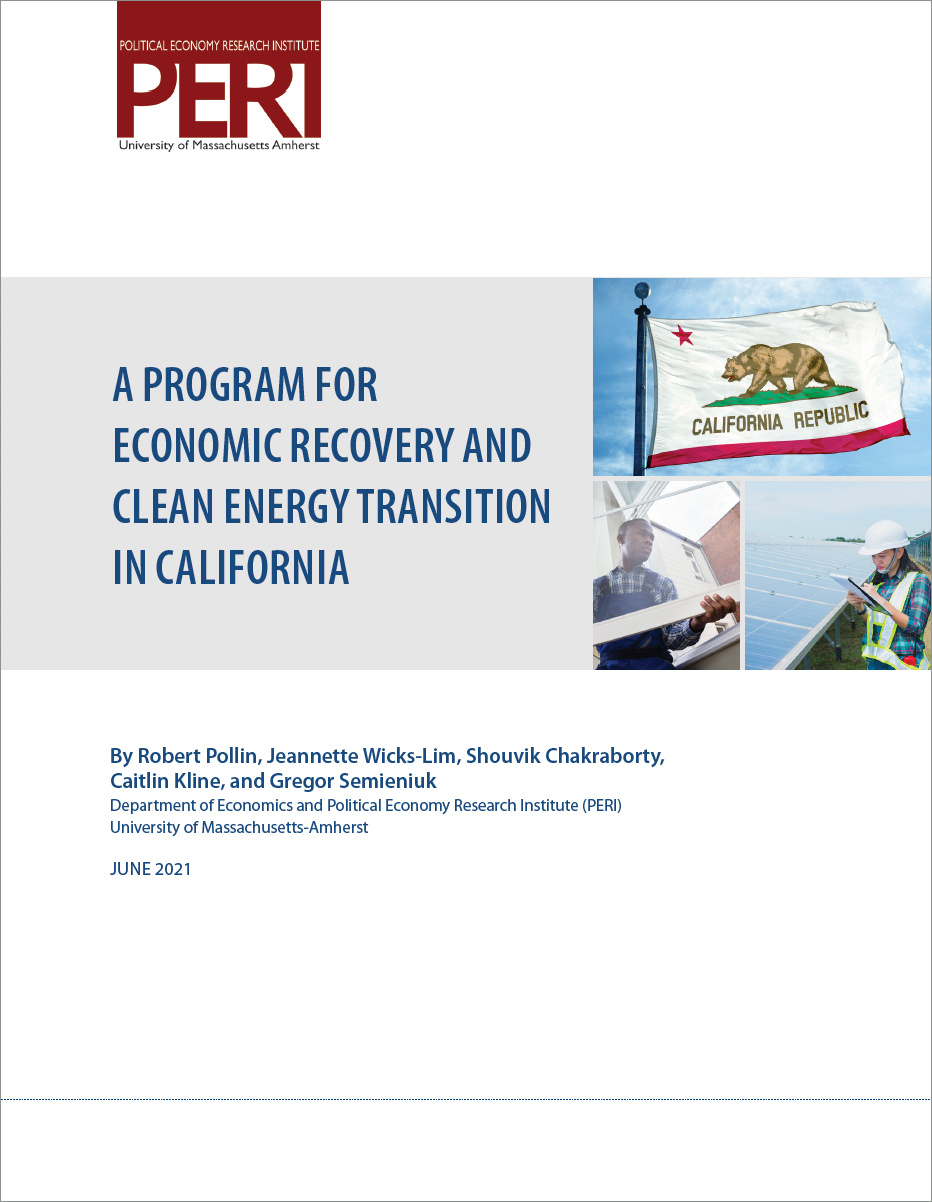
This major new report, A Program for Economic Recovery and Clean Energy Transition in California, details programs for meeting California’s 2030 climate goal (40 percent economy-wide reduction in greenhouse gas emissions from the state’s 1990 level) by creating roughly 418,000 jobs. It argues that state policy should ensure that the jobs created are good-paying jobs with full labor rights and access by historically excluded people.

The same strategies, the report says, could be continued to meet California’s longer-term goal of being carbon-neutral by 2045.

The report was commissioned by the American Federation of State, County and Municipal Employees Local 3299, the California Federation of Teachers, and the United Steelworkers Local 675. Its authors are faculty members of the University of Massachusetts at Amherst, including Robert Pollin, a leading expert on just transition.

The report provides detailed calculations for strategies outlined in an earlier report, Putting California on the High Road, from the UC Labor Center. Both reports emphasize the need for measures to protect fossil fuel industry workers including:

  • Pension guarantee for all workers.
  • Re-employment and income-level guarantees for all displaced workers.
  • Retraining and relocation support as needed.
  • “Glide-path income support” for workers 60 – 64.

The report comes as the Newsom administration is developing a report on Just Transition in California.

Just Transition in California: Robert Pollin in Conversation with Robert Kuttner

Labor Unions Rally Behind California’s Zero-Emissions Climate Plan

Robert Pollin interviewed by C.J. Polychroniou - Truthout, June 10, 2021

Robert Pollin, distinguished professor of economics and co-director of the Political Economy Research Institute (PERI) at the University of Massachusetts at Amherst, has been spearheading national and international efforts to tackle the climate crisis for more than a decade. Over the past few years, he and a group of his colleagues at PERI have produced green economy transition programs for numerous states. The latest such program is for California, and it is being released today.

The massive study — nearly 200 pages long — shows how California can become a zero emissions economy by 2045 while expanding good job opportunities throughout the state. Nineteen unions have already endorsed the green transition plan, making clear that they reject frameworks that falsely pit labor priorities and the environment against each other, and more are expected to do so in the days and weeks ahead.

In this interview for Truthout, Pollin, co-author with Noam Chomsky of Climate Crisis and the Global Green New Deal: The Political Economy of Saving the Planet (Verso 2020), talks about the climate stabilization project for California and the national implications of union support for a green economy transition.

C.J. Polychroniou: California has been at the forefront of the climate fight for years now, but the truth of the matter is that its efforts have fallen short. Now, you and some colleagues of yours at PERI have just completed a commissioned climate stabilization project for California. How does the project envision the clean energy transition to take place in a manner consistent with the emission targets set out by the UN Intergovernmental Panel on Climate Change (IPCC) in 2018, and how will it be financed?

Robert Pollin: This study presents a recovery program for California that will also build a durable foundation for an economically robust and ecologically sustainable longer-term growth trajectory. California has long been a national and global leader in implementing robust climate stabilization policies. This includes the 2018 Executive Order B-55-18 by then Gov. Jerry Brown. This measure committed the state to cut CO2 emissions by 50 percent as of 2030, to become carbon neutral no later than 2045, and to produce net negative emissions thereafter. These goals are somewhat more ambitious than those set out by the IPCC in 2018. Our study outlines a program through which the state can achieve its own established goals.

Our study shows how these 2030 and 2045 emissions reduction targets can be accomplished in California through phasing out the consumption of oil, coal and natural gas to generate energy in the state, since burning fossil fuels to produce energy is, by far, the primary source of CO2 emissions, and thereby, the single greatest factor causing climate change. The project we propose is to build a clean energy infrastructure to replace the existing fossil fuel-dominant infrastructure. The clean energy infrastructure will require large-scale investments to, first, dramatically raise energy efficiency standards in the state and, second, to equally dramatically expand the supply of clean renewable energy supplies, including solar and wind primarily, with supplemental supplies from low-emissions bioenergy, geothermal and small-scale hydro power. We show how this climate stabilization program for California can also serve as a major new engine of job creation and economic well-being throughout the state, both in the short- and longer run.

A Program for Economic Recovery and Clean Energy Transition in California

By Robert Pollin, Jeannette Wicks-Lim, Shouvik Chakraborty,Caitlin Kline, and Gregor Semieniuk - Department of Economics and Political Economy Research Institute (PERI); University of Massachusetts-Amherst, June 10, 2021

This study presents a robust climate stabilization project for California. It demonstrates that achieving the state’s official CO2 emissions reduction targets—a 50 percent emissions cut by 2030 and reaching zero emissions by 2045—is a realistic prospect. This climate stabilization project can also serve as a major engine of economic recovery and expanding economic opportunities throughout the state. This includes an increase of over 1 million jobs in the state through investment programs in energy efficiency, clean renewable energy, public infrastructure, land restoration and agriculture. The study also develops a detailed just transition program for workers and communities in California that are currently dependent on the state’s fossil fuel industries for their livelihoods. In particular, we focus here on condi­tions in Kern, Contra Costa, and Los Angeles counties.

The study is divided into nine sections:

  1. Pandemic, Economic Collapse, and Conditions for Recovery
  2. California’s Clean Energy Transition Project
  3. Clean Energy Investments and Job Creation
  4. Investment Programs for Manufacturing, Infrastructure, Land Restoration and Agri­culture
  5. Total Job Creation in California through Combined Investment Programs
  6. Contraction of California’s Fossil Fuel Industries and Just Transition for Fossil Fuel Workers
  7. County-level Job Creation, Job Displacement, and Just Transition
  8. Achieving a Zero Emissions California Economy by 2045
  9. Financing California’s Recovery and Sustainable Transition Programs

Nineteen labor unions throughout California have endorsed this study and its findings.

Read the text (PDF).

Over Fifty Organizations Release Green New Deal Plan for Pacific Northwest Forests

By Dylan Plummer - Cascadia Wildlands, June 9, 2021

Today, dozens of forest and climate justice organizations across northern California, Oregon, and Washington released a sweeping Green New Deal for Pacific Northwest Forests platform calling for the transformation of current forest practices on private, state, and federal land in the face of the climate crisis and ecological collapse. The platform emphasizes the critical role that the forests of the Pacific Northwest must play in efforts to mitigate climate change and to safeguard communities from climate impacts such as wildfire and drought. The six pillars of the Green New Deal for Pacific Northwest Forests address the intersecting issues of industrial logging, climate change, species collapse, economic injustice and the disempowerment of frontline communities.

Matt Stevenson, a high-schooler, and the leader of the Forest Team of Sunrise Movement PDX, a youth organization focused on climate justice, said:

As a high schooler, I have grown up without much hope for my future, and with the knowledge that my generation may inherit a broken and desolate earth. Industrial forestry practices and the timber industry is one of the largest causes of this hopelessness, one of the leading destructive forces of the Pacific Northwest, and the single largest carbon emitter in Oregon. If I, or my generation, wants any hope of a liveable future we must fundamentally transform the way we treat our forests.

Biden Says He Backs a Just Transition for the Climate Crisis. Advocates Say, “Prove It.”

By Rachel M. Cohen - In These Times, June 2, 2021

While the administration has taken some early steps to provide support for energy workers and frontline communities in the transition away from fossil fuels, experts and activists say the crisis demands a more transformative approach.

One of the most difficult problems that political leaders have faced in addressing climate change has not involved the science or technology, but the politics, including bringing key constituencies like energy workers and their labor unions on board. This skepticism and resistance to change is why a so-called ​“just transition” — referring to an ethical and economically secure shift away from a fossil-fuel powered economy — has become so integral to crafting a successful climate plan. 

Figuring out how to provide economic security for both energy workers that have depended on the nation’s fossil fuels and frontline communities has become a leading priority for activists and elected officials alike. The Biden administration, for its part, has thrown its weight behind developing a just transition, though some advocates tell In These Times that federal leaders haven’t gone far enough, or worry the executive branch’s rhetoric won’t deliver real results. Other researchers have called for more careful study of past economic transitions, as well as more firm commitments around social programs such as universal healthcare. 

On January 27, one week after taking office, Biden signed an executive order establishing an interagency working group focused on addressing the economic needs of ​“coal, oil, gas, and power plant communities.” The group, co-chaired by National Economic Council director Brian Deese and National Climate Adviser Gina McCarthy, is a collaboration between 12 federal agencies including the labor, interior, treasury and energy departments. 

In late April the working group published an initial report identifying 25 of the most impacted regions for coal-related declines, and highlighted existing federal programs that could provide nearly $38 billion in funding for relief. The report noted that ​“creating good-paying union jobs in Energy Communities is necessary but not sufficient” and stressed that ​“foundational infrastructure investments” including broadband, water systems, roads, hospitals and other institutions would be necessary to economically revitalize these areas. The group also noted that a just transition would require prioritizing pollution mitigation and environmental remediation, like plugging leaking oil and gas wells and reclaiming abandoned mine land. These objectives hold the potential not only for job creation but also achieving environmental justice priorities.

Turbulence Ahead: What LAX’s Expansion Means for the City of Los Angeles’ Legacy on Racial Equity and Environmental Justice

By staff, editor, et. al - SEIU United Service Workers West, June 2021

Right now, Los Angeles International Airport (LAX) is charging ahead on an expansion project of a scale not seen for decades. Los Angeles World Airports (LAWA), the organization that owns and operates LAX, quietly released a draft Environmental Impact Report late last year that reveals a project with a host of alarming implications for communities near the airport. If the City of Los Angeles and its elected officials are serious about leadership on environmental justice and equity, resolving the issues presented by this project will be critically important.

As it stands, the proposed development is poised to worsen traffic in an area already infamous for it, expose thousands of new residents to the noise of one of the busiest airports in the world, and intensify the air quality impact of a facility that is already a statewide leader in air pollution. Worse still, these outcomes are set to be concentrated within Black and Brown communities near LAX that already grapple with a longstanding history of environmental racism—communities that have suffered disproportionately from the health and economic fallout of the COVID pandemic.

LAWA’s current approach signals that the airport is not only failing to adequately protect the community from the consequences of LAX’s largest expansion in decades, but is, in effect, concealing the real, long-term effects of that expansion as it rushes toward approval as early as this year. The City of Los Angeles, LAWA, and the airlines that will occupy the new terminals have an obligation to do better and ensure that this project is carried out equitably, that it will not become another sad chapter in the story of environmental injustice in South Los Angeles and the continued exploitation of essential workers as the city emerges from the pandemic.

In this report, we take a deeper look at the proposed development and what the draft Environmental Impact Report does and doesn’t reveal about the consequences of LAWA’s plans for the airport. We will contextualize this project and what it means for workers, families and communities—particularly communities of color—as well as the direction of the City of Los Angeles as a whole. Finally, we will lay down a foundation for how the airport can approach this project as a real, positive opportunity for the region, and not a cautionary tale of corporate greed and bureaucratic complicity in the making. In the coming years, the City of Los Angeles will prepare to host major events—the Super Bowl, the 2028 Summer Olympics, the World Cup—and enjoy global attention. It is critical that the city and its leaders take every opportunity to be a leading model for an equitable and just economy. With the whole world watching, showing how LAX’s development can be done without harm to communities of color will be an excellent place to start.

Read the text (PDF).

Fighting for Coal Country

By Staff - United Mine Workers of America, June 1, 2021

Clearly, the UMWA's positions on carbon capture and storage (CCS) and so-called "clean coal" stand in contrast (and, for the most part, opposition) with the entirety of the climate justice movement, ecosocialists, green syndicalists, and a good deal of rank-and-file union members not involved in resource extraction (including the more than 60-70% who support something like the Green New Deal). That said, at least the UMWA finally accepts that coal is a dying industry and a just transition is needed. Therefore, this is presented to show where the UMWA stands, not as an endorsement of their positions.

At the end of 2011, there were nearly 92,000 people working in the American coal industry, the most since 1997. Coal production in the United State topped a billion tons for the 21st consecutive year. Both thermal and metallurgical coal were selling at premium prices and companies were making large profits.

Then the bottom fell out. Over the next 4 years, coal prices cratered, especially in metallurgical coal but also in thermal coal. The global economy slowed, putting pressure on steelmaking and metallurgical coal production. Foreign competition from China, Australia, India and elsewhere cut into met coal production.

Domestically, hydraulic fracturing (fracking) of shale formations opened up previously untapped natural gas fields, caused the price of gas to drop below that of coal for the first time in years. Utilities began switching the fuel they used to generate electricity from coal to gas. Environmental regulations coming from the Obama administration also impacted coal employment. By 2016, just 51,800 people were working in the coal industry. 41,000 jobs had been lost.

Companies went bankrupt. Retirees’ hard-won retiree health care and pensions were threatened. Active miners saw their contracts, including provisions that had been negotiated over decades, thrown out by federal bankruptcy courts. From 2012 to today, more than 60 coal companies have filed for either Chapter 11 reorganization bankruptcy or Chapter 7 liquidation. Almost no company has been immune.

“Just since 2015 we have had companies like Peabody, Arch, Alpha Natural Resources, Walter Energy, Westmoreland and Murray Energy all go bankrupt,” President Roberts said. “Patriot Coal went bankrupt twice. Retirees’ health care was on the brink, but we were successful in preserving that in 2017. The 1974 Pension Fund was on the path to insolvency, but we were able to save that in 2019.

“Even though our contracts were thrown out by bankruptcy judges at company after company, we were successful in preserving union recognition, our members’ jobs and reasonable levels of pay and benefits at every company as they emerged from bankruptcy,” Roberts said. “But in no case has the contract that came out of bankruptcy been the same as the one our members enjoyed when a company went into bankruptcy. This has been extremely painful all the way around.”

Pages

The Fine Print I:

Disclaimer: The views expressed on this site are not the official position of the IWW (or even the IWW’s EUC) unless otherwise indicated and do not necessarily represent the views of anyone but the author’s, nor should it be assumed that any of these authors automatically support the IWW or endorse any of its positions.

Further: the inclusion of a link on our site (other than the link to the main IWW site) does not imply endorsement by or an alliance with the IWW. These sites have been chosen by our members due to their perceived relevance to the IWW EUC and are included here for informational purposes only. If you have any suggestions or comments on any of the links included (or not included) above, please contact us.

The Fine Print II:

Fair Use Notice: The material on this site is provided for educational and informational purposes. It may contain copyrighted material the use of which has not always been specifically authorized by the copyright owner. It is being made available in an effort to advance the understanding of scientific, environmental, economic, social justice and human rights issues etc.

It is believed that this constitutes a 'fair use' of any such copyrighted material as provided for in section 107 of the US Copyright Law. In accordance with Title 17 U.S.C. Section 107, the material on this site is distributed without profit to those who have an interest in using the included information for research and educational purposes. If you wish to use copyrighted material from this site for purposes of your own that go beyond 'fair use', you must obtain permission from the copyright owner. The information on this site does not constitute legal or technical advice.
