You are here

reports

Unifor's Road Map for a Fair, Inclusive and Resilient Economic Recovery

By staff - Unifor, June 2020

Unifor is Canada’s largest union in the private sector, representing 315,000 workers in every major area of the economy.

The union advocates for all working people and their rights, fights for equality and social justice in Canada and abroad, and strives to create progressive change for a better future.

Unifor brings a modern approach to unionism: adopting new tools, involving and engaging our members, and always looking for new ways to develop the role and approach of our union to meet the demands of the 21st century.

Every person of working age in Canada has a right to a good job and the benefits of economic progress.

Unifor is presenting this plan in June 2020, four months after the novel coronavirus arrived in Canada, at a time when restric-tions on movement, activities and business operations are begin-ning to lift, but infection rates and illness continue to grow.

Read the report (PDF).

On The Front Lines: Climate Change Threatens the Health of America's Workers

A Fair and Sustainable Economic Recovery Program for California

By Robert Pollin - Political Economy Research Institute (PERI), June 2020
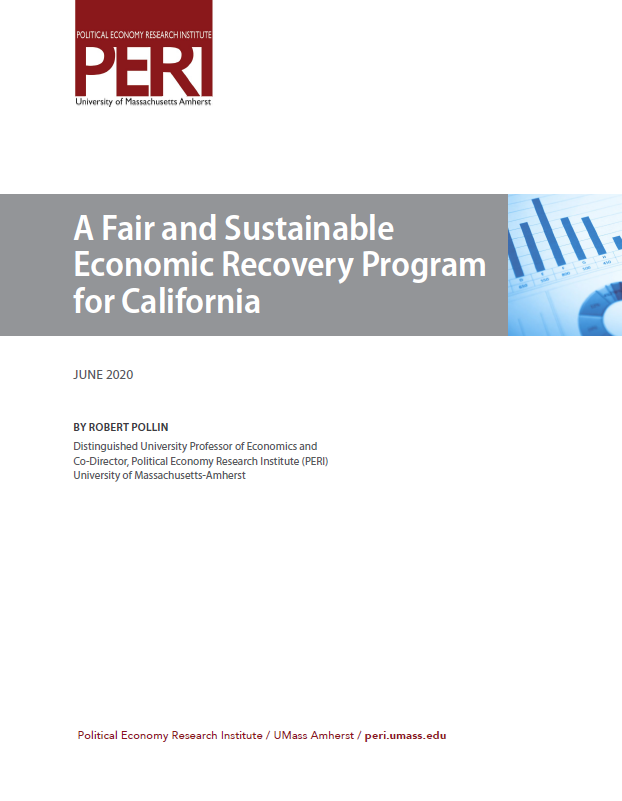
The COVID-19 pandemic has generated severe public health and economic impacts in California, as with most everywhere else in the United States. This report proposes a recovery program for California that is capable of exerting an effective counterforce against the state’s economic collapse in the short run while also building a durable foundation for an economically viable and ecologically sustainable longer-term recovery. This is an anti-austerity recovery agenda, including the following main elements:

Establishing Effective Public Health Interventions. This will generate millions of jobs through allowing the state to recover safely. Some of the industries in which workers have been hardest hit include restaurants and hotels, in-person retail trade, and health care. Workers in these industries all need to be provided with adequate Personal Protection Equipment so they can perform their jobs safely. They also need their rights at work to be fully protected, including the right to paid sick leave.

Upgrading California’s Public Infrastructure. California’s economy would receive a major boost, both in terms of short-run stimulus and longer-term productivity, by undertaking a large-scale public infrastructure investment program now. The study estimates that $25 billion in annual infrastructure investments in California will generate about 315,000 jobs within the state. Roughly half of these jobs will be in the construction industry, including new opportunities for carpenters, electricians, glaziers, plumbers, pipefitters, and construction laborers. Most of the rest of the jobs will be in manufacturing and a range of services.

Clean Energy Investments and High Road Job Creation. This study estimates that public and private investments in California to achieve the state’s mandated emissions and climate stabilization goals are capable of generating about 725,000 jobs in 2020 – 2021 through $80 billion in public and private investments in 2020 – 2021, and larger numbers thereafter to 2030. These investments will entail both: 1) greatly enhancing the state’s level of energy efficiency, including through deep energy retrofits to public buildings; and 2) massively expanding the state’s supply of clean renewable energy sources, starting with solar and wind power. New job opportunities will open for, among other occupations, carpenters, machinists, environmental scientists, secretaries, accountants, truck drivers, roofers and agricultural laborers.

Just Transition for All Displaced Workers. Some workers in California’s oil and gas industry will experience displacement over time through the state’s clean energy transition. This study estimates that about 1,400 oil and gas workers will be displaced per year between 2021 – 2030 and another 1,400 will voluntarily retire each year. All of these workers require Just Transition support, including pension guarantees, health care coverage, wage insurance, and retraining support, as needed. In addition to the oil and gas industry, a substantial share of jobs in hard-hit service industries such as restaurants, hotels and retail are likely to not return in the aftermath of the recession. Workers in these industries also need just transition support, including the extension of 100 percent unemployment insurance, Medicare health insurance coverage while unemployed, wage insurance, and high-road job training and placement support.

Download (PDF).

Reimagined Recovery: Black Workers, the Public Sector, and COVID-19

By Deja Thomas, Lola Smallwood-Cuevas, and Saba Waheed - Center for the Advancement of Racial Equity (CARE) at Work - June 2020

This report highlights the validity of public sector work as a solution in the response and recovery to the Covid-19 pandemic on Black people across communities in Los Angeles County. Covid-19 disproportionately impacts Black workers and communities. History shows that even once a disaster is over, Black workers and Black people across communities continue to disproportionately feel its impact far longer than other communities.

Through the most recent government data and relevant literature, this report demonstrates why and how public sector jobs should be a tool used to address the Black jobs crisis and the recovery from Covid-19, particularly in Los Angeles County.

Download (PDF).

A Better Recovery: Learning the lessons of the corona crisis to create a stronger, fairer economy

By staff - Trades Union Congress - May 20, 2020

A plan to get Britain growing out of the crisis – and stop mass unemployment

The pandemic alone did not cause this economic crisis. It was made worse by a decade of austerity and the government’s failure to strengthen the UK’s economy. Choosing the wrong approach to recovery now risks embedding low growth, long-term unemployment and all the social ills that go alongside.

An investment for growth approach means taking action on six key areas:

  • Decent work and a new way of doing business: New business models based on fairer employment relationships. A fairer share for workers of the wealth they create, with a higher minimum wage and new collective bargaining rights.
  • Sustainable industry: Economic stimulus for a just transition to net zero carbon. Rebuilding the UK’s industrial capacity with modern tech and training in new skills.
  • A real safety net: Reforms to social security to provide help faster and prevent poverty. A job guarantee scheme so everyone can work and long-term unemployment does not take hold.
  • Rebuilding public services: Bringing our public services back to full strength, with decent pay for those who looked after us in the crisis, and a new focus on good jobs and direct employment in social care.
  • Equality at work: Specific actions to make sure women, disabled people and BME groups do not suffer disproportionately from the impact of the coronavirus recession.
  • Rebuilding internationalism: New international rules must prioritise decent jobs and public services for all.

The evidence from the post-war recovery is that this investment for growth recovery plan can pay for itself. Millions of working families with higher disposable income create the economic demand needed for strong growth and healthy public finances. Stronger public services and an effective safety net will support people to start and grow businesses, and will better protect against a future pandemic.

Read the report (PDF).

Rebuilding our Economy for All: BC Federation of Labour Submission to the Economic Recovery Taskforce

By staff International BC Labor Federation, May 2020

The economic shutdown resulting from this pandemic is historically unprecedented. Never before have we collectively decided to close entire sectors of our economy, and dramatically curtail others in service of a greater good – our collective health. BC has weathered both this pandemic and the ensuing lockdown in large part because of the sacrifices and courage of working people. They have continued to do the important work of treating the sick, providing vital public services, and ensuring we can continue to have the necessities of life. COVID-19 has revealed that essential portions of BC’s economy depend on frontline workers.

But as public respect for the value of their work has grown, so has our recognition of the many gaps this pandemic has exposed. For example, we better understand the paramount importance of workplace safety and standards, the need for robust public services and social supports, and our collective responsibility to address the continued marginalization of vulnerable populations.

We have the chance as our economy emerges from hibernation to address those gaps, and to do much more. The choices we make in the coming weeks and months can help us build an economy – and a province – equipped to address climate change while prospering along the way. Our choices must acknowledge and genuinely embrace reconciliation with Indigenous peoples and communities. Our choices must secure opportunities and equity in every community of this province.

There will always be voices who suggest we move in the opposite direction: that the public sector should retreat from the economy and the community; that working people who were this province’s lifeline revert back to less protections, poorer working conditions and lower wages; that vulnerable populations remain vulnerable; that we should abandon years of progress toward reconciliation. They will argue that all of this will make business more competitive and generate jobs.

But even in an unprecedented situation, we can learn from history. And history tells us again and again – from the Great Depression through countless recessions and downturns – that ’austerity‘ only serves to freeze out working people and the most vulnerable, enriching a handful of already-wealthy people while hollowing our communities and leaving most of us to fend for ourselves. Austerity, in fact, is why we have many of the gaps this pandemic has so glaringly exposed in the first place. We also know that this pandemic will not impact people or communities equally, and thus our response must work to decrease these inequities, rather than exacerbate them. We can’t cut and slash our way back to where we were before – let alone to a better, fairer, more sustainable and more prosperous future.

Read the text (PDF).

Understanding and Responding to the Changing Nature of Work in the Bay Area

By various - ReWork the Bay, Working Partnerships USA, and Jobs with Justice San Francisco, May 2020

New technologies, accelerating climate change, shifting migration patterns, changes in economic and political norms, and a host of other trends are likely to impact—and indeed already are impacting—key features of work and employment, including management relationships, the types of jobs available, compensation patterns, and other issues that shape the day-to-day lives of working people.

This report presents a framework for understanding why and how work is changing in the San Francisco Bay Area. It provides a scan of strategies that Bay Area workers, communities, businesses, educators and elected leaders are deploying to address changes, and offers a suggested rubric for evaluating the potential effects of such strategies.

In the Bay Area and Silicon Valley, a global epicenter of innovation and extraordinary wealth, low-income communities and communities of color struggle with crises in housing and economic stability, and climate change makes itself felt through increasingly destructive wildfires. If Bay Area funders, advocates, policymakers, and worker organizations ever hope to realize quality, empowered jobs for all, we must be able to articulate how work is changing and identify the systemic interventions that will push change to benefit working people.

Read the text (PDF).

Still Digging: G20 Governments Continue to Finance the Climate Crisis

By Bronwen Tucker and Kate DeAngelis - Oil Change International and Friends of the Earth - May 2020

In 2015, governments around the world committed to hold global warming to well below 2 degrees Celsius (°C) and to strive to limit warming to 1.5°C by adopting the Paris Agreement. This analysis shows that since the Paris Agreement was made, G20 countries have acted directly counter to it by providing at least USD 77 billion a year in finance for oil, gas, and coal projects through their international public finance institutions. These countries provided more than three times as much support for fossil fuels as for clean energy.

With the health and livelihoods of billions at immediate risk from COVID-19, governments around the world are preparing public spending packages of a magnitude they previously deemed unthinkable. In normal times, development finance institutions (DFIs), export credit agencies (ECAs), and multilateral development banks (MDBs) already had an outsized impact on the overall energy landscape and more capacity than their private sector peers to act on the climate crisis. In the current moment, their potential influence has multiplied, and it is imperative that they change course. The fossil fuel sector was showing long-term signs of systemic decline before COVID-19 and has been quick to seize on this crisis with requests for massive subsidies and bailouts.1 We cannot afford for the wave of public finance that is being prepared for relief and recovery efforts to prop up the fossil fuel industry as it has in the past. Business as usual would exacerbate the next crisis— the climate crisis—that is already on our doorstep.

Read the report (PDF).

Equity, Climate Justice, and Fossil Fuel Extraction: Principles for a Managed Phase Out

By Gregg Muttitt and Sivan Kartha - Oil Change International, April 28, 2020

The Paris Agreement goals require most fossil fuel use to be ended within a generation. This paper looks at where and how to equitably phase out oil, gas and coal, and proposes five principles to help democratic actors work through the equity issues that arise from winding down fossil fuel extraction.

Equity issues have long been debated within international climate politics, focused on fairly distributing reductions in territorial emissions and fossil fuel consumption. There is a growing recognition among scholars and policymakers that curbing fossil fuel supply (as well as demand) can be a valuable part of the climate policy toolbox; this raises the question of where and how the tool should be applied.

This paper explores how to equitably manage the social dimensions of a rapid transition away from fossil fuel extraction. Fossil fuel extraction leads to benefits for some people (such as extraction workers) and harms for others (such as pollution-affected communities). A transition must respect and uphold the rights of both groups, while also staying within climate limits, as climate impacts will fall most heavily on the world’s poor.

This paper begins by reviewing how extraction affects economies and communities and the different transitional challenges they face. Based on that review, it then examines three common equity approaches — economic efficiency, meeting development needs, and effort-sharing. Drawing lessons from the strengths and weaknesses of these approaches, the paper proposes five principles as a basis for equitably curbing fossil fuel extraction within climate limits:

  1. Phase down global extraction at a pace consistent with limiting warming to 1.5°C;
  2. Enable a just transition for workers and communities;
  3. Curb extraction consistent with environmental justice;
  4. Reduce extraction fastest where doing so will have the least social costs;
  5. Share transition costs fairly, according to ability to bear those costs.

Key policy insights:

  • Fossil fuel extraction is unlikely to be a viable path to development because the Paris Agreement goals require most fossil fuel use to be ended within a generation;
  • Extraction should be phased out fastest in diversified, wealthier economies that can better absorb the transitional impacts;
  • Governments of extracting countries should enact ambitious industrial policy to diversify their economies, alongside economic and employment policies to enable a just transition;
  • The costs of a just transition should be borne by those most able to bear it: poorer countries can reasonably demand financial support.

Download (PDF).

Resilient Societies or Fossil Fuel Bailouts?

By staff - Oil Change International - April 22, 2020

The COVID-19 crisis poses a threat to people’s health, their jobs and their lives, and like all crises, exacerbates already existing inequalities. Trillions in public finance will be needed to get through the current pandemic. This briefing outlines why continuing to rely on fossil fuels, in particular oil and gas, is not compatible with long-term recovery. It does not make sense to use the COVID-19 stimulus packages to try to revive a sunsetting industry which will not deliver on economic recovery, only to shut it down a few years later to meet climate goals.

Governments now face a choice: fund a just transition away from fossil fuels that protects workers, communities, and the climate — or continue funding business-as-usual toward climate disaster. Governments should invest in a green recovery that protects and creates long lasting jobs, resilient economies and accelerates climate action. This briefing details why this is the most effective route for recovery and lays out the dos and don’ts for governments in their response to the current crisis.

Key Recommendations (DO’s):

  • Ensure national and international equity and a just transition is at the heart of any government response to the current crisis.
  • Protect workers and communities affected by the crisis, including those in the oil and gas sector, and create long-lasting green jobs by investing in resilient infrastructure and emerging low carbon industries that will continue to create jobs for decades.
  • Ensure Green New Deal frameworks provide the basis for stimulus packages to help rewrite the social contract in a people-centered response to the current crisis. 
  • End fossil fuel subsidies and finance and ensure any carbon price reflects climate and equity imperatives in order to ensure renewables remain competitive and incentivize efficient energy use in light of low oil prices while supporting a just transition.
  • Introduce oil and gas production caps as a first step to limiting emissions. The world is running out of storage capacity and production limits are needed to ensure a managed decline of the industry.
  • Make decision-making processes and response measures transparent in order to allow public scrutiny.
  • Bring the oil and gas industry into public ownership in the right circumstances, as it may be the most straightforward path to ensure a just transition for workers and communities and a managed phase-out.
  • Link any support provided to the industry to a requirement to align with climate goals and plan for a managed decline.
  • Ensure the polluter pays principle is upheld. Broadly speaking, over the past few decades, the financial rewards of the industry have been privatized, while the risks have been socialized.

Key Pitfalls to Avoid (DON’Ts):

  • DON’T bail out oil and gas companies or increase fossil fuel subsidies.
  • DON’T bail out other polluting industries, such as the aviation and shipping industries.
  • DON’T continue the construction or operation of fossil fuel infrastructure at the expense of the health of workers and communities.
  • DON’T roll back existing policies or regulations, or extend licensing agreements.
  • DON’T delay responses to the climate crisis amid the flurry of immediate priorities. If anything, the current pandemic has shown that a crisis demands a timely response to prevent it from escalating further.

While the fossil fuel sector may struggle to return to business as usual, without policies aimed at emerging from the crisis with a cleaner energy system, surviving companies may be in a position to capitalize on rising oil prices as the cycle turns. There are currently no safeguards against a future price spike and subsequent return to the volatile boom-bust cycle. This briefing advises governments to adopt recovery measures that will ensure a just transition off oil and gas, accelerate climate goals and build resilient societies, and center people instead of corporate executives and shareholders — all while tackling today’s parallel health, economic, and climate crises at once.

Read the report (PDF).

Pages

The Fine Print I:

Disclaimer: The views expressed on this site are not the official position of the IWW (or even the IWW’s EUC) unless otherwise indicated and do not necessarily represent the views of anyone but the author’s, nor should it be assumed that any of these authors automatically support the IWW or endorse any of its positions.

Further: the inclusion of a link on our site (other than the link to the main IWW site) does not imply endorsement by or an alliance with the IWW. These sites have been chosen by our members due to their perceived relevance to the IWW EUC and are included here for informational purposes only. If you have any suggestions or comments on any of the links included (or not included) above, please contact us.

The Fine Print II:

Fair Use Notice: The material on this site is provided for educational and informational purposes. It may contain copyrighted material the use of which has not always been specifically authorized by the copyright owner. It is being made available in an effort to advance the understanding of scientific, environmental, economic, social justice and human rights issues etc.

It is believed that this constitutes a 'fair use' of any such copyrighted material as provided for in section 107 of the US Copyright Law. In accordance with Title 17 U.S.C. Section 107, the material on this site is distributed without profit to those who have an interest in using the included information for research and educational purposes. If you wish to use copyrighted material from this site for purposes of your own that go beyond 'fair use', you must obtain permission from the copyright owner. The information on this site does not constitute legal or technical advice.

