You are here

reports

Defending Tomorrow: The climate crisis and threats against land and environmental defenders

By staff - Global Witness, July 2020

For years, land and environmental defenders have been the first line of defence against climate breakdown. Yet despite clearer evidence than ever of the crucial role they play, far too many businesses, financiers and governments fail to safeguard their vital and peaceful work. 

The climate crisis is arguably the greatest global and existential threat we face. As it escalates, it serves to exacerbate many of the other serious problems in our world today – from economic inequality to racial injustice and the spread of zoonotic diseases.

For years, land and environmental defenders have been the first line of defence against the causes and impacts of climate breakdown. Time after time, they have challenged those companies operating recklessly, rampaging unhampered through forests, skies, wetlands, oceans and biodiversity hotspots.

Yet despite clearer evidence than ever of the crucial role they play and the dangers they increasingly face, far too many businesses, financiers and governments fail to safeguard their vital and peaceful work. 

Our annual report into the killings of land and environmental defenders in 2019 shows the highest number yet have been murdered in a single year. 212 land and environmental defenders were killed in 2019 – an average of more than four people a week.

Read the text (PDF).

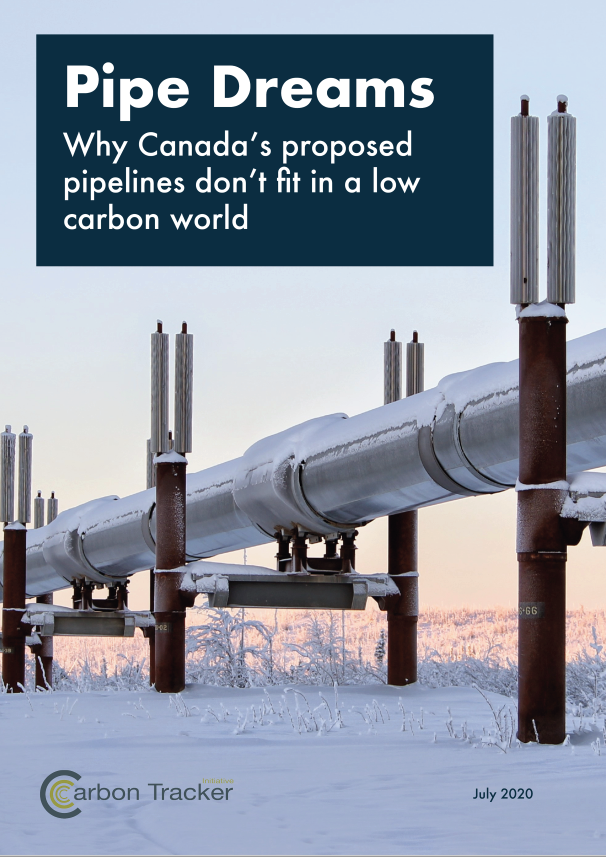
Pipe Dreams: Why Canada’s proposed pipelines don’t fit in a low carbon world

By Axel Dalman and Andrew Grant - Carbon Tracker - July 2020

Carbon Tracker’s modelling shows no new oil sands are needed in a low carbon world.

Prospective pipeline projects represent a significant expansion of capacity, with taxpayer support. However, new pipelines are surplus to requirements under Paris Agreement demand levels.

Canadian authorities face the challenge of trying to reconcile their natural resources development plans with their positioning on climate. Canada has previously having shown leadership on climate change issues, but its government support for pipelines – which are reliant on the failure of the Paris Agreement – risks damaging its credibility.

Key Findings:

Our research has previously shown that no new oil sands projects are needed in a low carbon world. All unsanctioned oil sands projects are uncompetitive under both the International Energy Agency’s 1.7-1.8°C Sustainable Development Scenario (SDS) and c.1.6°C Beyond 2 Degrees Scenario (B2DS).

All proposed new pipelines from Western Canada, in particular Keystone XL and Trans Mountain expansion, are surplus to requirements in a Paris-compliant world. Pipeline capacity may have proved a constraint in recent years, but under SDS, all future oil supplies from Western Canada can be accommodated by upgrades and replacements to existing pipelines, local refining and limited rail freight.

Even if discounts for Canadian crude narrow, new oil sands projects remain uneconomic. Western Canadian heavy oil trades at a steep discount to international benchmarks due to quality and transport challenges, averaging $25 below Brent over the last decade. Even if greater pipeline capacity reduces this to $10 in the future, in line with levels seen during previous periods of unconstrained supply, new projects still remain uneconomic under the SDS. Indeed, even if Canadian heavy oil were to trade at parity with Brent, which is extremely unlikely due to its lower quality, there would still be no new oil sands production under the B2DS and just 120,000 bbl/d would enter the market in the SDS – a level which would be covered by existing rail capacity.

Investors in oil sands face depressed cash flows in a low carbon world of falling oil demand and weak pricing, but will be forced to produce or pay the price due to inflexible “take-or-pay” transport fees for excess new pipeline capacity.

While take-or-pay contracts spread the impacts, pipeline investors still face financial risks as upstream production weakens. Uncontracted capacity will probably remain unused by producers, and contracts may cannibalise tariffs from other pipelines. Even take-or-pay commitments are subject to counterparty risk in a falling oil market.

The Canadian government’s stakes in Keystone XL and Trans Mountain could well prove to be a drain on the public purse. Under the SDS, government tax revenues and the value of the assets are unlikely to reach the levels anticipated at the time of sanction.

Canada’s leadership position on climate change may be undermined by its support for projects reliant on the failure of the Paris Agreement.

Read the report (Link).

Exposing a Ticking Time Bomb: How fossil fuel industry fraud is setting us up for a financial implosion, and what whistleblowers can do about it

By John Kostyack, Karen Torrent, Laura Peterson, and Carly Fabian - National Whistleblower Center - July 2020

In the past several years, U.S. states, cities, counties and individuals concerned about climate change have filed important lawsuits against fossil fuel companies, asserting that the companies are responsible for climaterelated damage due to their carbon pollution. These cases confront “what might be the greatest scam in history,” in the words of historian Naomi Oreskes: the massive disinformation campaign designed to stall action on climate change by persuading decision makers and the public that it is not a problem to be taken seriously.

In this report, the National Whistleblower Center focuses on a related deception that, with a small handful of notable exceptions, is unaddressed in the climate change lawsuits filed to date: the dramatic understatement of risks posed by climate change to fossil fuel companies’ own financial condition and to the economy at large. We describe an important pathway to ensuring proper disclosures of climate risks: collaborative work by whistleblowers, prosecutors and regulators to enforce anti-fraud laws.

This report is a call to action for executives of fossil fuel companies and others with knowledge of improper accounting and disclosure practices, such as external auditors, to take the steps needed to obtain protected whistleblower status and work with the Securities and Exchange Commission (SEC), other regulators and law enforcement officials to help expose and prosecute fraud. For the first time, legal strategies are provided for whistleblowers and others to expose and prosecute climate risk fraud in the fossil fuel industry. This is also the first report to use the methods of professional fraud investigators to identify fossil fuel industry financial disclosure practices that are likely to be fraudulent.

Climate risks—comprised of “transition risks,” the financial risks to some companies due to the world’s shift away from fossil fuels, and “physical risks,” those associated with climate change- related damage to property— uniquely threaten the finances of fossil fuel companies. Fossil fuel companies, fearful of losing access to investment capital and loans, are therefore highly motivated to conceal their exposure to these risks.

Concealment of climate risks is a matter of great public interest because when it is successful, it harms investors, the environment and the economy. Investors who provide capital to these companies suffer because they invest based on a false sense of the companies’ readiness for the transition to a low-carbon economy and for the physical shocks of climate change. This deception undercuts efforts to address climate change because it slows the shift of investments to businesses developing and deploying low-carbon technologies. It harms the economy by leaving financial institutions such as banks and insurers less prepared for the stresses of rapid asset deflation.

Read the report (PDF).

A Fair Climate Policy for Workers: Implementing a just transition in various European countries and Canada

By Pia Björkbacka - The Central Organisation of Finnish Trade Unions SAK, June 26, 2020

Both the Paris Agreement on Climate Change and the target of carbon neutrality by the year 2035 set out in the government programme of Finnish Prime Minister Sanna Marin refer to a just transition for workers towards a low-carbon society. Such a just transition has long been sought by the trade union movement and is an important condition for achieving ambitious climate policy objectives.

The programme of the Marin government states that the government will work with labour market organisations to harmonise economic and labour market policies. Achieving climate objectives will also require co-operation with the social partners, and sectoral assessments in particular.

A just transition has been selected as one approach to reaching the target of a carbon neutral Finland by 2035. The government will pledge to implement emission reduction measures in a socially and regionally equitable way that involves all sectors of society. The government programme envisages establishing a round table on climate policy in Finland under the committee on sustainable development. Bringing together the various actors in society will ensure that climate measures serve the general interests of society and enjoy broad public support.

(Government Programme of Prime Minister Marin 2019)

The implementation of climate policy is causing restructuring in various sectors, meaning that climate policy decisions and actions also have social implications.

The European Commission has estimated that mitigating climate change will create more jobs in the European Union than it will cost (European Commission, 2019), but the changes will be sectoral. Even though labour market restructuring – which is also guided by climate policy - is creating new employment opportunities, it also brings fears of unemployment.

Realising employment opportunities requires substantial investment in employee skills and innovation. It is very important for the benefits and costs of low-carbon restructuring to be evenly shared across various sectors, occupations, population groups and regions. Successfully transitioning to a carbon-neutral society will not only require emission reduction measures and business and energy policies, but also employment, social welfare, education and regional policies.

The principle of a just transition will seek to meet these challenges. This means implementing emission reductions in a way that is fair to workers. It is about creating new, decent and sustainable jobs, in-service training for new employment, and security of earnings. The goal of a just transition is to increase the participation and commitment of workers in deciding policies for mitigating climate change nationally, regionally and within businesses, thereby promoting a smooth transition to a carbon-neutral society.

Read the text (PDF).

National Economic Transition Platform: A Visionary Proposal for an Equitable Future

By staff - Just Transition Fund, Summer 2020

Workers and families affected by the changing coal economy are facing a profound crisis complicated by unique difficulties. Prior to the COVID-19 pandemic and economic decline, coal facility closures, layoffs, and cuts to vital services were devastating to people and places dependent on the coal economy—many of whom are still struggling following earlier economic declines, the loss of manufacturing jobs, or inequality and widespread poverty.

For low-income communities and communities of color already disproportionately left behind by the status quo, the need for equitable and inclusive economic growth is vital. But, now, with COVID-19, these unique challenges are exacerbated. The closure of even more coal facilities is accelerated, giving communities little time to plan for the disappearance of their largest employer and the erosion of the tax base, which provides critical funding for public services, local education, and health care systems.

Read the text (PDF).

Cracked: The Case for Green Jobs Over Pterochemicals in Pennsylvania

By staff - Food and Water Watch, September 2020

While the national economy struggled to recover from the Great Recession, wage and employment growth in Pennsylvania was anemic. This experience mirrored national trends of increasing inequality and a hollowing out of the middle class. Despite the state’s aggressive embrace of fracking as a driver of economic growth, fracking jobs remain scarce and temporary. As frackers suffocate in a glut of natural gas (including ethane) and as Pennsylvanians struggle with the environmental damage wrought by fracking and other dirty industries, Pennsylvania lawmakers are attempting to artificially sustain the boom by offering lucrative concessions to mega-corporations and dirty petrochemical producers.

Doubling down on toxic industries won’t fix the region’s economic woes, but will instead foreclose opportunities for long-term, sustainable growth through green energy manufacturing. Given the economic uncertainties of the coronavirus pandemic, an aggressive commitment to public works investment in green energy is more important now than ever. Solar, wind and energy efficiency are necessary to avert catastrophic climate change. Wind and solar manufacturing would also employ more people than comparable investments in oil, gas, coal or plastics.

Read the text (Linked PDF).

Decline and Fall: The Size & Vulnerability of the Fossil Fuel System

By Kingsmill Bond, Ed Vaughan, and Harry Benham - Carbon Tracker, June 4, 2020

Renewable costs are below those of fossil fuels. Five years ago, fossil fuels were the cheapest baseload. The collapse in renewable costs means that for 85% of the world, renewable electricity is the cheapest source of new baseload. By the early 2020s it will be every major country. Because of the rise of cheap renewables, the fossil fuel system is ripe for disruption. This disruption will be have profound financial implications for investors as a quarter of equity markets and half of corporate bond markets are ‘carbon entangled’.

Those responsible for our pension schemes should sit up and take notice; but even greater concern should be felt by financial regulators, as they grapple with finding the right tools to manage the risks of a deflating ‘carbon bubble’.

The world faces two contrasting pathways. Either it can secure the ‘trillion dollar green gigafall’, the trillions that can be generated at low cost from the sun and the wind – particularly benefiting the poorest inhabitants of the world currently dependent upon high cost fossil fuel imports. Or it can stay locked into business as usual, tied into a declining industry that both threatens the global economy with the worst effects of a warming planet, and damages investors with losses, low returns and destabilised equity and credit markets.

In Carbon Tracker’s first report, some ten years ago, entitled ‘Unburnable Carbon – are the World’s Financial Markets Carrying a Carbon Bubble’ we highlighted that listed fossil fuel companies have the potential to develop enough reserves to take the world way beyond 3˚C. Our second report, ‘Unburnable Carbon – Wasted Capital and Stranded Assets’, noted that if we can’t burn what we have already found, why continue to invest in the fossil fuel industry’s expansion? Yet today, we know that some $1 trillion is spent annually on expanding supply and this report goes more into these numbers. Before we wind down the fossil fuel system, we need to stop expanding it.

Some argue that ‘fossil fuels will go away of their own accord’ as the result of the rapid progress made by cleaner technologies and the collapse in demand for fossil fuels driven by the terrible COVID-19 epidemic. Unfortunately, as this report makes clear, financial markets are still heavily tied in to the fossil fuel system.

Read the report (PDF).

A Pathway to a Regenerative Economy

By various - United Frontline Table, June 2020

The intersecting crises of income and wealth inequality and climate change, driven by systemic white supremacy and gender inequality, has exposed the frailty of the U.S. economy and democracy. This document was prepared during the COVID-19 pandemic which exacerbated these existing crises and underlying conditions. Democratic processes have been undermined at the expense of people’s jobs, health, safety, and dignity. Moreover, government support has disproportionately expanded and boosted the private sector through policies, including bailouts, that serve an extractive economy and not the public’s interest. Our elected leaders have chosen not to invest in deep, anti-racist democratic processes. They have chosen not to uphold public values, such as fairness and equity, not to protect human rights and the vital life cycles of nature and ecosystems. Rather, our elected leaders have chosen extraction and corporate control at the expense of the majority of the people and the well-being and rights of Mother Earth. Transforming our economy is not just about swapping out elected leaders. We also need a shift in popular consciousness.

There are moments of clarity that allow for society to challenge popular thinking and status quo solutions. Within all the challenges that this pandemic has created, it has also revealed what is wrong with the extractive economy while showcasing the innate resilience, common care, and original wisdom that we hold as people. Environmental justice and frontline communities are all too familiar with crisis and systemic injustices and have long held solutions to what is needed to not only survive, but also thrive as a people, as a community, and as a global family. We cannot go back to how things were. We must move forward. We are at a critical moment to make a downpayment on a Regenerative Economy, while laying the groundwork for preventing future crises.

To do so, we say—listen to the frontlines! Indigenous Peoples, as members of their Indigenous sovereign nations, Asian and Pacific Islander, Black, Brown and poor white marginalized communities must be heard, prioritized, and invested in if we are to successfully build a thriving democracy and society in the face of intersecting climate, environmental, economic, social, and health crises. A just and equitable society requires bottom-up processes built off of, and in concert with, existing organizing initiatives in a given community. It must be rooted in a people’s solutions lens for a healthy future and Regenerative Economy. These solutions must be inclusive—leaving no one behind in both process and outcome. Thus, frontline communities must be at the forefront as efforts grow to advance a Just Transition to a Regenerative Economy.

A People’s Orientation to a Regenerative Economy offers community groups, policy advocates, and policymakers a pathway to solutions that work for frontline communities and workers. These ideas have been collectively strategized by community organizations and leaders from across multiple frontline and grassroots networks and alliances to ensure that regenerative economic solutions and ecological justice—under a framework that challenges capitalism and both white supremacy and hetero-patriarchy—are core to any and all policies. These policies must be enacted, not only at the federal level, but also at the local, state, tribal, and regional levels, in US Territories, and internationally.

Read the text (PDF).

Green Strings: Principles and conditions for a green recovery from COVID-19 in Canada

By Vanessa Corkal, Philip Gass, and Aaron Cosbey International Institute for Sustainable Development, June 2020

Key Messages

  • The COVID-19 crisis, while difficult and tragic, also provides a critical opportunity to align efforts to meet Canada’s climate goals with the challenge of economic reconstruction post-pandemic.
  • IISD has developed seven "green strings" recommendations: key principles, criteria, and conditionalities that should be applied to government measures for economic recovery from COVID-19 to ensure a green recovery.
  • Canada’s leading environmental groups, representing close to two million people, have signed on to the recommendations, including the Pembina Institute, Climate Action Network Canada, David Suzuki Foundation, Environmental Defence, Greenpeace Canada, Équiterre, Ecojustice, Ecology Action Centre, Conservation Council of New Brunswick, Stand.earth, Leadnow, Sierra Club Canada Foundation, and Wilderness Committee.

The reasons to set and apply "green strings" are clear:

  • Conditions in the public interest are the government’s right and duty.
  • The benefits of green stimulus and recovery measures are backed by evidence. 
  • We need a new economic model for the workers of today and tomorrow.
  • Urgent action is needed to address the climate crisis. 
  • Health and climate change imperatives go hand in hand. 
  • There is strong public support for ensuring a green recovery. 

The following seven “green strings” should be attached to COVID-19 recovery measures announced by Canada’s government:

  1. Support only companies that agree to plan for net-zero emissions by 2050.
  2. Make sure funds go towards jobs and stability, not executives and shareholders.
  3. Support a just transition that prepares workers for green jobs.
  4. Build up the sectors and infrastructure of tomorrow.
  5. Strengthen and protect environmental policies during recovery.
  6. Be transparent and accountable to Canadians.
  7. Put people first and leave no one behind.

We can no longer continue with the status quo, worsening the climate and biodiversity crises and locking our country and the global community in to stark health, environmental, and economic outcomes. We must seize this difficult moment to transform our economy and our institutions to serve vital public policy goals from environment to equity. The stakes are high.

Read the text (Linked PDF).

Putting California on the High Road: a Jobs and Climate Action Plan for 2030

By Carol Zabin, et. al. - University of California, Berkeley Center for Labor Research and Education, June 2020

Over the last 15 years, California has emerged as a national and world leader in the fight to avoid climate disaster, passing a comprehensive and evolving suite of climate measures to accelerate the transition to a carbon- neutral economy. The state has also emerged as a national leader in embracing economic equity as a goal for state policy, charting a path towards a new social compact for shared prosperity in a rapidly changing world. Meaningful commitment to both of these goals—ensuring that all Californians thrive in the transition to a carbon-neutral economy—requires the development and implementation of a bold agenda that aligns California’s ambitious climate and workforce action plans. This report presents a framework for California to advance that agenda.

Assembly Bill 398 (E. Garcia, Chapter 135, Statutes of 2017) required that the California Workforce Development Board (CWDB) present a report to the Legislature on strategies “to help industry, workers, and communities transition to economic and labor-market changes related to statewide greenhouse gas emissions reduction goals.” To fulfill this mandate, the CWDB commissioned the Center for Labor Research and Education at the University of California, Berkeley, to review the existing research in the field and prepare this report. The summary presented here describes the key concepts, findings, and recommendations contained in UC Berkeley’s full work.

The statutory language of AB 398 makes clear that this report should address workforce interventions to ensure that the transition to a carbon-neutral economy:

  • Creates high-quality jobs;
  • Prepares workers with the skills needed to adapt to and master new, zero- and low-emission technologies;
  • Broadens career opportunities for workers from disadvantaged communities; and
  • Supports workers whose jobs may be at risk.

This report presents a comprehensive strategy that identifies roles for state and local climate, economic development, and workforce development agencies in achieving these goals, alongside key partners such as business, labor, community, and education and training institutions. All recommendations align with the CWDB’s Unified Strategic Workforce Development Plan, which has put forth a set of actions to leverage and coordinate the state’s myriad workforce and education programs to support high-quality careers for Californians. In keeping with the statutory directive, the report discussion is further enriched by comments provided to the CWDB through a series of stakeholder meetings held in July and August 2018.

This report builds upon the framework established in California’s 2017 Climate Change Scoping Plan (Scoping Plan), which presents a roadmap of policies and programs to reach the climate protection target in Senate Bill 32 (Pavley, Chapter 42, Statutes of 2016) of a 40 percent reduction in greenhouse gas emissions by 2030 from 1990 levels. The Scoping Plan is organized into sectors based on the state’s major sources of greenhouse gas emissions and corresponding climate action measures: Transportation, Industry, Energy, Natural and Working Lands (including Agricultural Lands), Waste, and Water. This report organizes the available information from existing academic research, economic models, and industry studies for the Scoping Plan sectors and presents for each of them:

  • Information about current labor conditions and the impact on jobs of the major climate measures;
  • Guidance for policymakers, agencies, and institutions that implement climate and/or workforce policy on how to best generate family-supporting jobs, broaden career opportunities for disadvantaged workers, deliver the skilled workforce that employers need to achieve California’s climate targets, and protect workers in declining industries; and
  • Examples of concrete, scalable strategies that have connected effective climate action with workforce interventions to produce good outcomes for workers.

Pages

The Fine Print I:

Disclaimer: The views expressed on this site are not the official position of the IWW (or even the IWW’s EUC) unless otherwise indicated and do not necessarily represent the views of anyone but the author’s, nor should it be assumed that any of these authors automatically support the IWW or endorse any of its positions.

Further: the inclusion of a link on our site (other than the link to the main IWW site) does not imply endorsement by or an alliance with the IWW. These sites have been chosen by our members due to their perceived relevance to the IWW EUC and are included here for informational purposes only. If you have any suggestions or comments on any of the links included (or not included) above, please contact us.

The Fine Print II:

Fair Use Notice: The material on this site is provided for educational and informational purposes. It may contain copyrighted material the use of which has not always been specifically authorized by the copyright owner. It is being made available in an effort to advance the understanding of scientific, environmental, economic, social justice and human rights issues etc.

It is believed that this constitutes a 'fair use' of any such copyrighted material as provided for in section 107 of the US Copyright Law. In accordance with Title 17 U.S.C. Section 107, the material on this site is distributed without profit to those who have an interest in using the included information for research and educational purposes. If you wish to use copyrighted material from this site for purposes of your own that go beyond 'fair use', you must obtain permission from the copyright owner. The information on this site does not constitute legal or technical advice.