

You are here

California

Obama Administration Orders Speedy Completion of Delta Tunnels Plan

By Dan Bacher - CounterPunch, January 16, 2017

Rejecting the call by fishermen, Tribes, conservationists, family farmers and environmental justice advocates to terminate the Delta Tunnels plan, Interior Secretary Sally Jewell on January 4 issued a Secretarial Order that will mandate the completion of Governor Jerry Brown’s controversial California WaterFix process “in a timely manner.”

The final Biological Opinion will be issued by April 2017 — and the decision to sign a Record of Decision will be made by the next Secretary under the Trump administration, according to the order.

The Obama administration order directs the Department of Interior and its agencies to “take timely actions to help address the effects of drought and climate change on California’s water supply and imperiled wildlife.”

Regarding the Delta Tunnels project, the order directs Interior’s Bureau of Reclamation and U.S. Fish and Wildlife Service (FWS) “to allocate available resources, as necessary, to complete in a timely manner the Biological Opinions under Section 7 of the Endangered Species Act and a Record of Decision on the environmental documents for California WaterFix.”

The Secretarial Order directs the Fish and Wildlife Service to “take all necessary actions” to issue an initial Draft Biological Opinion in January 2017 and a final Draft Biological Opinion by March 2017 after incorporating the results of “independent scientific peer reviews.” Following these reviews, a final Biological Opinion will be issued by April 2017.

The order also specifies that the Department, working with the State and others, “will promptly review and consider any information received after publication of the Final EIR/EIS and issuance of the Biological Opinions, and will then be prepared to sign a Record of Decision. This decision will be made by the next Secretary.”

In a press release, Deputy Secretary Michael L. Connor claimed, “This Secretarial Order is a practical and broad-based strategy to help protect California’s water lifeline for present and future generations. This order will ensure the integration of the Department’s actions with those of the State of California to provide a reliable drinking water supply for the public, sustain California’s agriculture, and continue to protect the Bay Delta ecosystem and enhance the conservation of species.”

Governor Jerry Brown lauded the Interior Secretary’s order, referring to the WaterFix’s so-called coequal goals of water reliability and ecosystem restoration.

“Today’s action tracks closely with the state’s multi-pronged Water Action Plan and commits the federal government to a timely review of the California WaterFix project,” said Brown. “This state-federal partnership is what’s needed to improve water reliability for residents and farmers and protect vulnerable ecosystems.”

In addition to the section of the order directing the the speedy completion of the California WaterFix, the agency ordered other related actions, including: a collaborative Delta science engagement process; a Delta smelt “resiliency” strategy; reinitiation of consultation under the Endangered Species Act on coordinated long term operations on the Central Valley Project and State Water project; active engagement in the development for flow requirements and coordination on flows with ESA requirements; and a winter-run Chinook “Species in the Spotlight” Action Plan.

Transformative Climate Communities: Community Vision And Principles For A Successful Program

By staff - California Environmental Justice Alliance, December 2016

Transformative Climate Communities (TCC) is a groundbreaking new program that will develop comprehensive, cross-cutting, and transformative climate investments at a neighborhood scale to achieve multiple greenhouse gas, public health and economic benefits in our state’s most vulnerable communities. CEJA is deeply engaged in the implementation and working with our members to ensure the program truly meets community needs through a strong, transparent, and community-led process.

In our new report, Transformative Climate Communities: Community Vision And Principles For A Successful Program, we draw from CEJA’s members, partners, and allies to provide a snapshot of what TCC could look like in both urban and rural environmental justice neighborhoods across California. From transforming the goods movement in San Bernardino to comprehensive land use planning in Fresno, the wide range of community-led plans for place-based transformation are all grounded in an integrated, collaborative approach to reducing climate change while comprehensively addressing a legacy of environmental pollution and disinvestment in the most highly impacted communities.

The TCC program can help community-based organizations in crafting sustainability plans and leverage existing ones that address long-standing environmental health and justice challenges, while catalyzing equitable economic development at the neighborhood level. The program will achieve this by awarding large grants to develop and implement neighborhood-level climate sustainability plans drawing from deep resident engagement and in partnership with other important stakeholders.

In order to ensure the long-term successful implementation of the program, we lay out the key principles of the Transformative Climate Communities program in our report:

  1. Direct and extensive community engagement
  2. Equity for most impacted residents
  3. Multiple, integrated benefits
  4. Showcase equitable, sustainable land use planning
  5. Catalytic, leveraged investments
  6. Investment without displacement
  7. Creating a pipeline of communities

In addition, we provide some of the indicators for environmental, health, socioeconomic, community and political transformation that can be achieved though comprehensive, cross-cutting climate investments from the TCC.

CEJA’s work on the TCC program grows out of our Green Zones Initiative, where we recognized early on that in order for place-based models to be successful, communities need to have the power to guide development and investments. Green Zones require closely coordinated and leveraged public spending targeted to our most overburdened communities, with deep resident engagement to direct investment. The Transformative Climate Communities program is this vision come to life.

Through its community-level planning and investments, the TCC program can help to achieve a just transition away from inequitable and polluting development patterns that have plagued so many communities. It can help us maintain California’s global climate leadership and move us toward a new future that weaves together environmental and climate sustainability, economic opportunities, and strengthened local democracies.

Download PDF Here.

Over 500 people in Sacramento stand in solidarity with Standing Rock Sioux

By Dan Bacher - Indybay.Org, November 18, 2016

Over 500 Sacramento area residents, including Native Americans, social justice advocates and environmentalists, joined tens of thousands of others throughout the world on November 15 to demand that the Obama administration and U.S. Army Corps of Engineers halt the controversial Dakota Access Pipeline (DAPL).

They lined both sides of the street in front of the U.S. Army Corps of Engineers office on J Street, proclaiming their solidarity with the struggle of Standing Rock Sioux Tribe in North Dakota and their allies to stop the pipeline that carries fracked crude Bakken oil. Many drivers passing by on the busy street honked their horns in support of the protesters.

The protest took place the day after the Corps announced it is delaying an easement for the Dakota Access Pipeline project until it conducts further environmental review and discussion with the Standing Rock Sioux Tribe. The Corps said “construction on or under Corps land bordering Lake Oahe cannot occur because the Army has not made a final decision on whether to grant an easement.”

The Standing Rock Sioux and the water protectors opposing the pipeline are worried that the final Corps decision won’t be made until next year after Donald Trump is inaugurated. Trump’s transition team has vowed to expand offshore and offshore oil production throughout the nation.

Even more worrisome, Trump has invested between $500,000 and $1 million in Energy Transfer Partners, the company building the pipeline, according to financial disclosure forms, Wes Enzinna of Mother Jones reported. Energy Transfer Partners CEO Kelcy Warren also donated more than $100,000 to help elect Trump.

“Trump also owns stock worth between $500,000 and $1 million in Phillips 66, which will own a 25 percent share of the finished pipeline. One of Trump's key energy advisers is North Dakota Rep. Kevin Cramer, who has encouraged him to dismantle key aspects of the Clean Water Act, which gives the Army Corps and the Environmental Protection Agency authority to regulate the nation's waterways and wetlands,” Ezinna wrote.

Tuesday’s protest was one of the largest regarding an indigenous struggle ever held in the Capital City. “We had an incredible turnout at our event,” said Chris Brown, an organizer from the Sacramento Climate Coalition. “A special shout out goes to the Nevada County protectors of water, who came out in droves.”

Brown noted that the Corps approved the construction pipeline without proper consultation or adequate environmental studies.

“The Standing Rock Sioux are resisting the DAPL, which threatens their water, ancestral burial sites, and Native sovereignty,” according to Brown. “They have been met with militarized police using automatic rifles, sound cannons, tear gas and mace, flash-bang grenades, bean bag rounds, and rubber bullets. The courage of the Water Protectors has inspired people all over the world.”

Cosponsors of the local action included Sacramento Area Friends and Relatives of the Lakota Nation, Sacramento Climate Coalition, 350 Sacramento, Davis MoveOn, Davis Stands with Standing Rock, Raging Grannies of Sacramento, Sacramento Stands with Standing Rock, Alianza, and Jewish Voice for Peace.

"The state of North Dakota has deployed the National Guard, State and Local Police and police from several other states as well as the FBI to protect Energy Transfer Partners, a privately owned pipeline construction corporation,” said Francisco Dominguez (Tarahumara) of Sacramento Area Friends and Relatives of the Lakota Nation. “The last time I checked we were still a Democracy."

Mariana Rivera from the Zapatista Coalition noted the links between the Sioux Tribe’s struggle in North Dakota and struggles of indigenous peoples and their allies to stop the raising of Shasta Dam, the environmentally destructive Delta Tunnels of Governor Jerry Brown and fracking in California.

“Native people are taking the lead on something that concerns us all, protecting our water and land. All of us to need to take a stand with Standing Rock now,” said Rivera.

“Extracting fossils fuels jeopardizes water systems and native rights — and that’s why we’re here in solidarity with them,” explained Alicia Esquivido, a local Greenpeace activist, who was there with fellow activist Trent Pearson.

Rick Guerrero, an SEIU organizer and former president of the Environmental Council of Sacramento (ECOS) Board said, “I'm here to stand with our brothers and sisters in North Dakota. Last week’s election crystallized how our resistance needs to be immediate and sustainable. This destruction needs to be be stopped not only for native people, but for the earth and all workers.”

The Chevron Way: Polluting California and Degrading California

By various - International Transport Federation, et. al., November 2016

In the recent election, Chevron-backed campaigns lost bigtime, despite the $61 million the company has spent to influence California elections since 2009. That’s far more than any other oil company spend in state elections. The report, by the International Transport Workers Federation, was released Nov. 17 at the Chevron gates by a coalition including the Richmond Progressive Alliance (RPA), Alliance of Californians for Community Empowerment (ACCE), Communities for a Better Environment (CBE), and more.
Members of the coalition said the report, The Chevron Way: Polluting California and Degrading Democracy, will educate the public about the corrupting influence of corporate money and alert politicians that they will be judged on whether they act in the public interest or in Chevron’s interest.

In this election, in State Assembly and State Senate races, candidates heavily backed by Chevron lost. In Monterey County, Chevron spent $1.5 to oppose a ballot measure to ban fracking and expanded oil drilling. Despite being outspent 33 to 1, the measure passed.

In Richmond, Chevron sat out this election, having spent $3 million in the last election, when its candidates lost anyway. This year, two additional progressive candidates won seats on the city council and a longstanding Chevron candidate was voted out.

Chevron makes billions in profits from its huge retail and refining business in California, but has aggressively cut tax payments to federal, state and local governments. In 2015, the company paid no net income tax in the US, but instead banked nearly $1.7 billion in tax credits.

In 2015, Chevron had over $45 billion stashed in offshore accounts, including the company’s 211 active Bermuda subsidiaries, and the company’s global effective tax rate fell to below 3%.

Read the report (PDF).

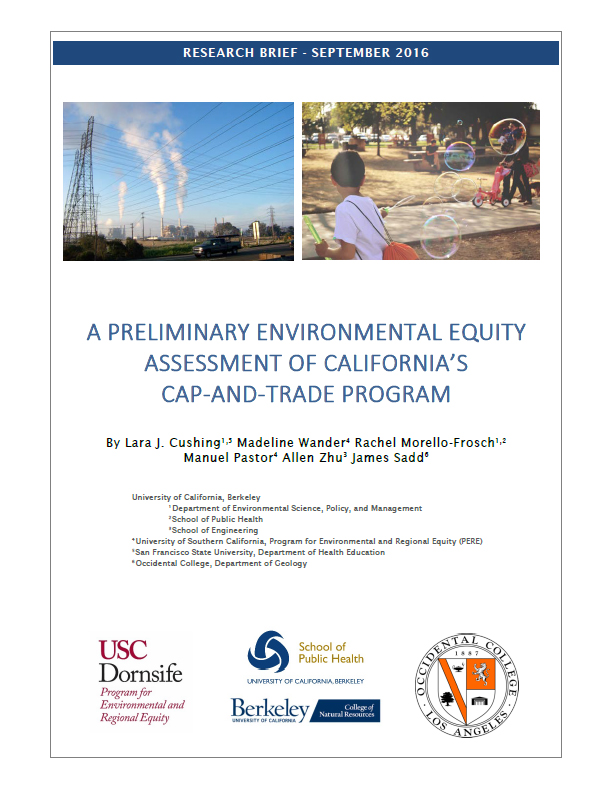
“A Preliminary Environmental Equity Assessment of California’s Cap-And-Trade Program

By Rachel Morello-Frosch, Manuel Pastor, James Sadd, Lara Cushing, Madeline Wander, and Allen Zhu - California Environmental Justice Alliance, September 2016

California’s cap-and-trade program is a key strategy for achieving reductions in greenhouse gas (GHG) emissions under AB32, the California Global Warming Solutions Act. For residents living near large industrial facilities, AB32 offered the possibility that along with reductions in GHGs, emissions of other harmful pollutants would also be decreased in their neighborhoods. Carbon dioxide (CO2), the primary GHG, indirectly impacts health by causing climate change but is not directly harmful to health in the communities where it is emitted. However, GHG emissions are usually accompanied by releases of other pollutants such as particulate matter (PM10) and air toxics that can directly harm the health of nearby residents.

In this brief, we assess inequalities in the location of GHG-emitting facilities and in the amount of GHGs and PM10 emitted by facilities regulated under cap-and-trade. We also provide a preliminary evaluation of changes in localized GHG emissions from large point sources since the advent of the program in 2013. To do this, we combined pollutant emissions data from California’s mandatory GHG and criteria pollutant reporting systems, data on neighborhood demographics from the American Community Survey, cumulative environmental health impacts from the California Environmental Protection Agency’s CalEnviroScreen tool, and information from the California Air Resources Board (CARB) about how regulated companies fulfilled their obligations under the first compliance period (2013-14) of the cap-and-trade program. Our methodology is described in greater detail in the appendix to this report.

In this analysis, we focus primarily on what are called “emitter covered emissions,” which correspond to localized, in-state emissions (derived mostly from fossil fuels) from industries that are subject to regulation under cap-and-trade. The cap-and-trade program also regulates out-of-state emissions associated with electricity imported into the state and, beginning in 2015, began regulating distributed emissions that result from the burning of fuels such as gasoline and natural gas in off-site locations (e.g., in the engines of vehicles and in homes).

We found that regulated GHG-emitting facilities are located in neighborhoods with higher proportions of residents of color and residents living in poverty. In addition, facilities that emit the highest levels of both GHGs and PM10 are also more likely to be located in communities with higher proportions of residents of color and residents living in poverty. This suggests that the public health and environmental equity co-benefits of California’s cap-and-trade program could be enhanced if there were more emissions reductions among the larger emitting facilities that are located in disadvantaged communities. In terms of GHG emission trends, in-state emissions have increased on average for several industry sectors since the advent of the cap-and-trade program, with many high emitting companies using offset projects located outside of California to meet their compliance obligations. Enhanced data collection and availability can strengthen efforts to track future changes in GHG and co-pollutant emissions and inform decision making in ways that incentivize deeper in-state reductions in GHGs and better maximize public health benefits and environmental equity goals.

Read the report (PDF).

Just Transition: Joint Proposal of PG&E, Friends of the Earth, NRDC, IBEW Local 1245, et. al. to Retire Diablo Canyon Nuclear Power Plant

By Various - June 20, 2016

This document is an example of an actual "Just Transition" agreement hammered out through negotiations after years of organizing by environmental organizations and dialog with unions. While it's no doubt far from perfect, it still represents a starting point for similar campaigns elsewhere, and like a union contract, it's the product of negotiations following struggle. To secure better deals, the unions and ecological movements need to keep organizing and building their collective power.

Read the report (PDF).

Nurses join with partner environmental groups to demand climate justice now

Press Release - National Nurses United, December 3, 2015

More than 1,200 California Nurses Association/National Nurses Organizing Committee registered nurses, environmental and healthcare activists, and students on Dec. 3 marched and rallied in Los Angeles to demand that the world’s leaders, now convening in Paris for the United Nations Conference on Climate Change, adopt a binding and enforceable climate treaty, commit resources to fund the transformation to clean, renewable energy including a just transition program for those who now work in the fossil fuel industry, and call on wealthy, developed countries to provide resources for the less-developed countries to act on climate, with funding coming from a carbon tax and the Robin Hood tax.

“I’m a registered nurse and our planet is my patient, and it is on life support,” said Malinda Markowitz, RN and a CNA/NNOC copresident and vice-president of National Nurses United, to the crowd assembled in downtown Los Angeles’ Pershing Square. “As nurses, we see the health consequences from the effects of pollution created by fossil fuels. We deal with the human fallout of climate injustice. Enough is enough. As nurses we know we must respond by giving care and by protest, protest, protest! We will never stop protesting.”

In a march leading up to the rally, nurses chanted “No more Chevron, No BP! Energy democracy!” and “Hey hey! Ho ho! Fossil fuel has got to go!” As they crossed the 110 freeway, they dropped a banner from the overpass that read, “Last exit ahead. Climate action now!” to underscore how dire the crisis has become.

The public health dimensions of the global climate crisis are extensive and far-reaching, nurses say. According to the World Health Organization, more than 8 million deaths worldwide are directly attributable to air pollution, primarily from the burning of fossil fuels and lack of access to clean energy. Infectious and vector-born diseases, such as malaria, dengue, yellow fever, and Lyme, will spike as temperatures increase. Further global warming and climate change will magnify the already catastrophic health impacts of: fossil fuel pollution, hunger and malnutrition due to desertification and devastation and displacement from severe weather events and sea level rise.

Governor Jerry Brown under fire for firing state oil regulators

By Dan Bacher - Elk Grove Citizen, September 6, 2015

Disclaimer: The views expressed here are not the official position of the IWW (or even the IWW’s EUC) and do not necessarily represent the views of anyone but the author’s.

Jerry Brown continually attempts to portray himself as a “climate leader” and “green Governor” at environmental conferences and photo opportunities across the globe, but new court documents obtained by the Associated Press bolster the claims by many anti-fracking activists that the California Governor is in reality “Big Oil Brown.”

In these documents, two former senior level officials in California Governor Jerry Brown’s administration reveal that they were fired on November 3, 2011, one day after warning the governor that oil drilling would imperil the state’s groundwater.

In a declaration, Derek Chernow, Brown’s fired acting director of the state Department of Conservation, told the Brown Administration that granting permits to oil companies for oilfield injection wells would violate safety provisions of the federal Safe Drinking Water Act, reported Ellen Knickmeyer of the Associated Press.

“Chernow’s declaration, obtained by The Associated Press, was contained in an Aug. 21 court filing in a lawsuit brought by a group of Central Valley farmers who allege that oil production approved by Brown’s administration has contaminated their water wells. The lawsuit also cites at least $750,000 in contributions that oil companies made within months of the firings to Brown’s campaign for a state income tax increase,” according to Knickmeyer.

You can read the full story here.

The Committee to Protect Agricultural Water filed their civil Racketeer Influenced and Corrupt Organizations (RICO) lawsuit in Federal Court on June 3, 2015. On the following day, Mark Nechodom, the controversial director of the California Department of Conservation that replaced Chernow, resigned.

Rail workers score big safety win in California

By Mark Gruenberg - People's World, August 26, 2015

Disclaimer: The views expressed here are not the official position of the IWW (or even the IWW’s EUC) and do not necessarily represent the views of anyone but the author’s.

Rail workers scored a big safety win in California on August 21 as state lawmakers gave final approval to a bill mandating two-person crews on all freight trains.

The measure, pushed by the Teamsters and their California affiliates, the Rail Division of SMART - the former United Transportation Union - and the state labor federation, now goes to Gov. Jerry Brown, D-Calif., who is expected to sign it.

Rail unions nationwide have been pushing for the two-person crews while the rail carriers have been pushing for just one, an engineer. Several months ago, the head of one carrier, the Burlington Northern, advocated crewless freights.

The unionists told lawmakers presence of a second crew member would cut down on horrific crashes such as the one that obliterated downtown Lac-Megantic, Quebec, two years ago. Then, a runaway oil train crashed and exploded, killing 47 people. That train had only an engineer. There has been a string of similar U.S. accidents since, especially of oil-carrying trains. Recent oil train accidents were near Galena, Ill., Lynchburg, Va., and in West Virginia.

The proposed California statute requires trains and light engines carrying freight within the nation's largest state - home to one of every eight Americans - to be operated with "an adequate crew size," reported Railroad Workers United, a coalition of rank-and-file rail workers from SMART, the Teamsters and other unions.

The minimum adequate crew size, the bill says, is two. Railroads that break the law would face fines and other penalties from the state Public Utilities Commission. The commission supported the bill, SB730.

Strawberry Jam

By Frank Bardacke - Stansbury Forum, August 12, 2015

Disclaimer: The views expressed here are not the official position of the IWW (or even the IWW’s EUC) and do not necessarily represent the views of anyone but the author’s.

In April, 1993 Cesar Chavez died. In October, 1995, John Sweeney became the President of the AFL-CIO. Although the Arturo Rodriguez-led UFW was a minor supporter of Sweeney at the convention that elected him, nothing connected Cesar’s death to Sweeney’s election. But without the conjunction of those two events, there would have been no UFW/AFL-CIO strawberry campaign. Its very existence was rooted in happenstance. That should not surprise anyone interested in politics. Machiavelli claimed that half of politics was luck, or as he called it, fortuna. In the case of the strawberry campaign, at first it seemed like good luck, but by the end, for those who hoped for UFW and AFL-CIO renewal, it was surely bad.

In her eulogy at Cesar’s funeral, Dolores Huerta declared that Cesar died so that the UFW might live. It is a dubious claim—there is no indication of a Chavez suicide—but her meaning was not lost on many of the mourners. Under Cesar’s direction, the UFW had backed off organizing farm workers in the late 1970s and early 1980s, had lost most of its contracts by the mid-80s, and was, at the time of his death, no longer a force in the fields but rather a cross between a farm worker advocacy group and a mid-sized family business. As long as Chavez was alive that was not likely to change. Once he was gone, the UFW was free to make an effort to get back in the fields again.

They began, as they had to, by trying to improve their reputation among undocumented workers. Originally a union of mostly Mexican-American grape pickers, they had officially opposed “illegals” in the fields before 1975, championing the use of the Border Patrol against them and even setting up their own patrol on the Arizona border for a few months in 1974. That policy changed in 1975 with the passage of the California Agricultural Labor Relations Act (ALRA), which made all farm workers, including the undocumented, eligible to vote in farm worker elections. But the changed policy never completely undid the original damage, and since the leadership of the union in the early 1990s continued to be Mexican-American and there were, by then, few Mexican farm workers left in the union, the UFW was considered by many farm workers, a “pocho” (slang used by Mexicans to describe Mexican-Americans) organization.

Thus, the UFW’s first step back into the fields was to take a leadership role against Proposition 187, the 1994 California initiative that denied State benefits to the undocumented and their children. Having made their new sympathy for the undocumented clear, the union won a new contract in the Central Valley roses, fought a victorious campaign in the mushrooms, and even signed a vegetable contract with their old nemesis, Bruce Church Inc. (although on close inspection the contract seemed to cover only a small percentage of Bruce Church workers). In 1995, the UFW leadership was lathered up, in the starting gate, and ready to race.

John Sweeney was also ready to go. Having won the AFL-CIO presidency with a rousing pledge to replace the conservative ways of the old bureaucracy with a new aggressive campaign to organize the unorganized, he was looking for an easy early victory. The UFW seemed to promise one. Relying on Rodriguez’s account of UFW popularity in the fields, and with no alternative assessment available, he went all in, put other organizing on hold, and committed his troops to what promised to be an opening victory for the New Voice coalition. As Gilbert Mireles, author of a pretty good (but also the only) book on the campaign, puts it: “It was almost inconceivable [to the strategists at the top] that workers would not be in favor of the union.”

Pages

The Fine Print I:

Disclaimer: The views expressed on this site are not the official position of the IWW (or even the IWW’s EUC) unless otherwise indicated and do not necessarily represent the views of anyone but the author’s, nor should it be assumed that any of these authors automatically support the IWW or endorse any of its positions.

Further: the inclusion of a link on our site (other than the link to the main IWW site) does not imply endorsement by or an alliance with the IWW. These sites have been chosen by our members due to their perceived relevance to the IWW EUC and are included here for informational purposes only. If you have any suggestions or comments on any of the links included (or not included) above, please contact us.

The Fine Print II:

Fair Use Notice: The material on this site is provided for educational and informational purposes. It may contain copyrighted material the use of which has not always been specifically authorized by the copyright owner. It is being made available in an effort to advance the understanding of scientific, environmental, economic, social justice and human rights issues etc.

It is believed that this constitutes a 'fair use' of any such copyrighted material as provided for in section 107 of the US Copyright Law. In accordance with Title 17 U.S.C. Section 107, the material on this site is distributed without profit to those who have an interest in using the included information for research and educational purposes. If you wish to use copyrighted material from this site for purposes of your own that go beyond 'fair use', you must obtain permission from the copyright owner. The information on this site does not constitute legal or technical advice.