

You are here

renewable energy workers

Alberta’s Roadmap to the New Energy Economy

By Simon Dyer - Pembina Institute, February 21, 2023

Alberta has always been an international leader on energy. Our abundant natural resources, coupled with our proud history of technological innovation in the oil and gas sector— particularly the oilsands—means we are renowned for our ability to use a skilled labour force to reach new frontiers in energy production.
In 2023, Alberta has an opportunity to build on that history and move towards a new energy future. In doing so, it can begin to capitalize on the multiple opportunities associated with the globally emerging clean economy.

To achieve this, Alberta needs a robust, credible plan on climate and energy. The number of governments worldwide that are legislating emissions reduction targets and policy measures to deliver them is rapidly growing each year, and it is time that Alberta joined them. This province — home to some of the world’s foremost experts on carbon capture technology, methane reduction techniques, wind and solar power, and so many other clean energy solutions— has much to offer to the energy transition, and much to gain. The International Energy Agency, for example, estimates 14 million new energy jobs and 16 million new jobs in energy efficiency will be created, worldwide, between now and 2050.

To take advantage of these opportunities, Alberta must also be willing to confront the realities of the global shift towards low-carbon energy sources, and take steps to adapt and futureproof its economy and workforce. The global outlook for fossil fuels, for example, has fundamentally shifted in the last twelve months. In 2022, for the first time, a range of assessments — including from within the oil industry — projected that the current level of worldwide policy momentum on emissions reductions will result in a sustained decline in global demand for oil, beginning this decade. If the world successfully achieves its goal of reaching net-zero emissions by 2050 and avoiding the worst effects of climate change, that demand decline will begin sooner and be steeper — and will have a significant impact on Alberta’s industry. 

Acknowledging these realities, and choosing to show leadership on climate and energy policy, is integral to Alberta’s overall attractiveness as an investment destination. Now more than ever before, companies are looking for opportunities to invest in climate solutions, and for jurisdictions where they can operate while meeting their own climate goals. Choosing instead to remain out of step with the global trend towards low-emissions economies would leave Alberta at a significant disadvantage in the years ahead.

The Pembina Institute is, and has always been, proudly headquartered in Alberta; this is our home. We are committed to seeking out effective, evidence-based policy solutions that can support this province’s communities, economy, and environment. 

As the 2023 provincial election approaches, this document provides our recommendations to future leaders in Alberta to advance this province’s position in the transition towards low-carbon energy. Above all, we think Alberta can and should be a leader on climate and the energy transformation in Canada.

Read the report (link).

Renewables industry should engage community colleges to address labor shortage: development official

By Diana DiGangi - Utility Dive, February 16, 2023

Renewable energy developers must meet registered apprenticeship requirements to qualify for certain Inflation Reduction Act tax credits, but they struggle to find workers, an attorney said.

The clean energy industry is booming, but the labor supply remains low. Partnering with community colleges to offer pathways to employment could help the industry meet its increasing demand for workers, said a workforce development official with the Foundation for California Community Colleges. He was speaking at a workforce development session at Intersolar North America on Tuesday.

Community colleges are a source of “untapped talent” and are “built to be nimble” in a way that other sources of higher education may not be, Tim Aldinger, executive director of workforce development for the FCCC, said at the event.

“For the last year and a half, we’ve had more jobs posted than people looking for them. And we are also in a decade-long process where people [nationwide] are opting out of the labor market,” Aldinger said. “And this is particularly prevalent, actually, among working-age men, particularly in jobs that were called ‘blue-collar’ work.”

Though the renewable energy sector has become a significant generator of new jobs, and the Inflation Reduction Act bolstered this growth with tax credits that incentivized new projects and registered apprenticeship programs, the wind energy industry reported difficulty finding qualified applicants in a November report.

Code Words Hint At Eliminating Jobs & Stifling Renewable Energy Employment

By Carolyn Fortuna - Clean Technica, February 6, 2023

The term “just transition” emerged from the 1970s North American labor movement to become a campaign for a planned energy transition. It includes justice and fairness for workers through united future visions about economic and climate action. These days it’s incredibly contentious.

Wouldn’t you think that renewable energy employment would be uplifting fossil fuel communities and remaking climate politics? Not so fast. Eliminating jobs in the fossil fuel sector has become highly controversial.

Language in headlines and social media posts is reinforcing the place and power of the fossil fuel industry, helping to keep it from becoming little more than stranded assets and from being held accountable for the climate crisis. The words “just transition” are a not-so-secret code that triggers mistrust and confusion among the energy workforce — the same workers who are most likely to benefit from the renewable energy employment marketplace.

Generally, a just transition is defined as programs, services, legislation, and practices that include equity opportunities for all in the move from fossil fuels to renewable energy. I’ve written several times here at CleanTechnica about a just transition and how fears about eliminating jobs are unwarranted (see here, here, here, and here, among others). But what seemed less evident to me then and now a bit naïve now is the degree to which the fossil fuel industry has turned its mighty propaganda forces against renewables while, concurrently, embellishing their professed concern for worker livelihoods.

'Only the Beginning': Democrats' IRA Set to Create 100,000+ US Green Jobs

By Brett Wilkins - Common Dreams, February 6, 2023

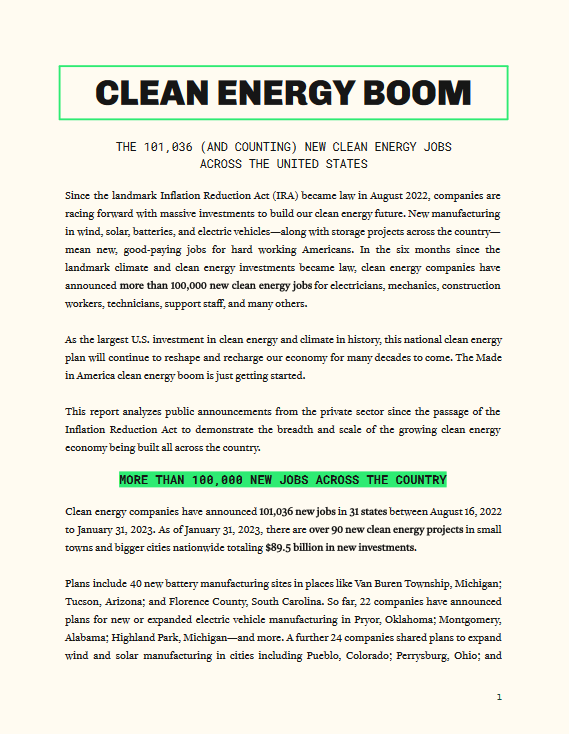
A leading climate action group on Monday published a report revealing that the 94 clean energy projects announced since U.S. President Joe Biden signed the Inflation Reduction Act into law last August are set to create more than 100,000 green jobs.

Climate Power—which published the report as part of a new six-figure national ad campaign touting the growing green economy—said that since the IRA became law without any Republican support last year, "companies are racing forward with massive investments to build our clean energy future."

"New manufacturing in wind, solar, batteries, and electric vehicles—along with storage projects across the country—mean new, good-paying jobs for hard-working Americans," the group continued. "In the six months since the landmark climate and clean energy investments became law, clean energy companies have announced more than 100,000 new clean energy jobs for electricians, mechanics, construction workers, technicians, support staff, and many others."

"As the largest U.S. investment in clean energy and climate in history, this national clean energy plan will continue to reshape and recharge our economy for many decades to come," Climate Power added.

While green groups have generally praised the IRA's historic $369 billion investment in renewable energy production and innovation, activists have condemned provisions including fossil fuel tax credits and mandatory lease sales on public lands and at sea.

The 94 new clean energy projects in the Climate Power report—which are spread across 31 states and have a combined investment value of $89.5 billion—include:

Forty new battery manufacturing sites in places like Van Buren Township, Michigan; Tucson, Arizona; and Florence County, South Carolina. So far, 22 companies have announced plans for new or expanded electric vehicle manufacturing in Pryor, Oklahoma; Montgomery, Alabama; Highland Park, Michigan—and more. A further 24 companies shared plans to expand wind and solar manufacturing in cities including Pueblo, Colorado; Perrysburg, Ohio; and Georgetown, Texas. The majority of the projects are in seven states—Arizona, Georgia, Michigan, Ohio, South Carolina, Tennessee, and Texas.

"Thanks to President Biden's affordable clean energy plan, businesses are investing in manufacturing like never before, and planning to create good-paying jobs in every corner of the country," Climate Power executive director Lori Lodes said in a statement.

"This is only the beginning—we're months after the passage of the Inflation Reduction Act and we're already at the precipice of a renewed manufacturing, made-in-America boom that will create opportunities for millions of Americans, all while reducing toxic emissions that harm the health and wellbeing of our communities," Lodes added.

Last month, the International Energy Agency said in a report that "the world is at the dawn of a new industrial age—the age of clean energy technology manufacturing," and that green manufacturing jobs will more than double by the end of the decade if countries worldwide live up to their climate and energy pledges—a huge "if" given that global emissions remain at record levels.

Read the report (Link).

Preliminary Assessment of Economic Benefits of Offshore Wind: Related to Seaport Investments and Workforce Development

By Paul Deaver and Jim Bartridge - California Energy Commission, February 2023

This report responds to the directive set forth by Assembly Bill 525 (AB 525, Chiu, Chapter 231, Statutes of 2021). The law directs that on or before December 31, 2022, the California Energy Commission (CEC) shall “complete and submit to the Natural Resources Agency and relevant fiscal and policy committees of the Legislature a preliminary assessment of the economic benefits of offshore wind as they relate to seaport investments and workforce development needs and standards.” This report addresses these requirements.

This report is the second of four products that AB 525 directs the CEC to prepare, informing a strategic plan for offshore wind energy turbines installed off the California coast in federal waters in coordination with federal, state, and local agencies and a wide variety of stakeholders. The strategic plan must be submitted to the California Natural Resources Agency and the Legislature no later than June 30, 2023. The strategic plan is to be informed by interim activities and products developed by the CEC that include this report and two additional reports. The first report, Offshore Wind Energy Development off the California Coast: Maximum Feasible Capacity and Megawatt Planning Goals for 2030 and 2045, was adopted by the CEC at the August 10, 2022, public business meeting. That report established offshore wind energy planning goals of 2,000–5,000 megawatts by 2030 and 25,000 megawatts by 2045. The other interim report, also due on or before December 31, 2022, will provide a permitting roadmap that describes the time frames and milestones for a coordinated, comprehensive, and efficient permitting process for offshore wind energy facilities and associated electricity transmission infrastructure off the California coast.

For more details, see: AB 525 Reports: Offshore Renewable Energy

Download a copy of this publication here (PDF).

Reimagining Energy For Our Communities

By Crystal Huang, Jessica Tovar, Nora Elmarzouky, Ruth Santiago, and Al Weinrub - The Energy Democracy Project, February 2023

The energy systems in place today, in which energy development, control, ownership, and decision-making resides within Wall Street and corporate electric utilities, negatively impact the health and safety of communities, and fail to provide the energy needed to live, especially in the face of climate disaster.

A product of deep collaboration between grassroots organizations, the REFOCUS zine is a graphic tool meant to be shared with community, teams, and anyone interested in understanding the path towards energy justice.

Download the zine to learn how Energy Democracy work is connected from Alaska to Puerto Rico, and build a movement for energy democracy with your community! 

Download a copy of this publication here (PDF).

Episode 1: Dreaming of Abandoned Wells

In Maine, coalition works to make sure organized labor has role in offshore wind

By Sarah Shemkus - Energy News, February 1, 2023

A group of environmental and labor organizations want a state offshore wind advisory committee in its final plan to include more specific language recommending project labor and labor peace agreements.

As Maine comes close to finalizing its roadmap for the development of offshore wind, a coalition of labor and environmental groups is asking the state to strengthen its commitment to supporting union jobs in the burgeoning industry. 

A group of 12 environmental and labor organizations has sent a letter to the Maine Offshore Wind Roadmap Advisory Committee asking that the final plan, expected by early February, incorporate explicit language recommending the use of project labor agreements and labor peace agreements as the offshore wind sector develops in Maine. Many of the same advocates are supporting a bill, announced by Democratic state Sen. Mark Lawrence last month, that would require union labor agreements on offshore wind projects. 

“Organized labor needs to be a crucial part of this investment,” said Kelt Wilska, energy justice manager for Maine Conservation Voters. “And we need to make sure working families, both coastal and inland, benefit from this.”

As states from New England down to North Carolina work on their own plans for implementing offshore wind projects, Maine is expected to be a major player in the growing industry. With strong, consistent winds, the Gulf of Maine is widely considered to be one of the most promising areas for offshore wind development.

Maine convened its Offshore Wind Roadmap Advisory Committee in July 2021 with the mission of creating an economic development plan for the fast-emerging industry. The panel — which includes 25 members representing state and municipal governments, private business, community and environmental nonprofits, and organized labor — released its draft plan in early December. 

The document outlines strategies for investing in infrastructure and workforce development; reducing costs and increasing resilience through renewable power; advancing Maine-based innovation; and protecting and supporting the seafood industry, coastal communities and the ocean ecosystem. Labor and environmental groups have praised much of the plan, particularly its focus on comprehensive planning, workforce and supply chain investment, and environmental monitoring and mitigation. 

What could a just transition to a ‘degrowth’ economy look like?

What kinds of jobs will be created by offshore wind farms?

Pages

The Fine Print I:

Disclaimer: The views expressed on this site are not the official position of the IWW (or even the IWW’s EUC) unless otherwise indicated and do not necessarily represent the views of anyone but the author’s, nor should it be assumed that any of these authors automatically support the IWW or endorse any of its positions.

Further: the inclusion of a link on our site (other than the link to the main IWW site) does not imply endorsement by or an alliance with the IWW. These sites have been chosen by our members due to their perceived relevance to the IWW EUC and are included here for informational purposes only. If you have any suggestions or comments on any of the links included (or not included) above, please contact us.

The Fine Print II:

Fair Use Notice: The material on this site is provided for educational and informational purposes. It may contain copyrighted material the use of which has not always been specifically authorized by the copyright owner. It is being made available in an effort to advance the understanding of scientific, environmental, economic, social justice and human rights issues etc.

It is believed that this constitutes a 'fair use' of any such copyrighted material as provided for in section 107 of the US Copyright Law. In accordance with Title 17 U.S.C. Section 107, the material on this site is distributed without profit to those who have an interest in using the included information for research and educational purposes. If you wish to use copyrighted material from this site for purposes of your own that go beyond 'fair use', you must obtain permission from the copyright owner. The information on this site does not constitute legal or technical advice.
