

You are here

renewable energy workers

The clean energy transition will create a lot of jobs — for men

By Jessica Kutz - 19th News, August 8, 2022

The investment in climate action from the Inflation Reduction Act will help create millions of jobs. But experts say changes are needed for women to reap those benefits.

Congress is poised to pass the Inflation Reduction Act, which includes $369 billion for climate action — what experts are calling the largest investment to combat climate change in U.S. history. It passed the Senate on Sunday and is expected to go to a vote in the House later this week. 

While it still falls short of the $500 billion Democrats were initially seeking for climate action, and includes some giveaways for fossil fuel companies, climate activists on the whole see it as a positive step. It’s expected to cut greenhouse gas emissions by 40 percent by 2030, through tax credits that incentivize solar and wind manufacturing and the production of electric cars, among other provisions. 

The influx of funding to combat climate change will add to the $1 trillion from the Bipartisan Infrastructure Law passed in November, which laid the groundwork for a clean energy transition through investments in the national grid, clean buses for schools, electric vehicle chargers, access to clean drinking water and public transit. Combined, the two pieces of legislation are predicted to create millions of jobs, many in the trades — for electricians and construction workers — and in the automotive and transportation industries. 

But without recruitment work and industry overhaul, most of those jobs will likely go to men.

According to the latest numbers released by the U.S. Department of Energy, women make up just 25 percent of the energy industry workforce, and when you drill down to where a lot of the job creation will come from in a clean energy transition and in infrastructure upgrades, the numbers look even more bleak. For example, women make up just 4 percent of the construction workforce. 

This is also where the opportunity lies to bring women — particularly women of color, who are disproportionately represented in low-paying jobs — into industries where wages can sustain a family, and where the educational barrier to entry can be low, said Marina Zhavoronkova, a senior fellow for workforce development at the left-leaning Center for American Progress. 

GWA Statement on Senate Passage of Inflation Reduction Act

By staff - Green Workers Alliance, August 8, 2022

Green Workers Alliance Praises Clean Energy Provisions of Reconciliation Bill, Opposes Fossil Fuel Concessions

“This bill is just a first step - and we will continue by taking the fight directly to utility companies to force them to use more renewable energy and help create millions of good, green jobs.”

Washington D.C. - In response to the Senate passing the climate and tax package now known as the Inflation Reduction Act, the Green Workers Alliance, an organization made of renewable energy workers, released the following statement:

The reconciliation bill which includes $260 billion in funding for renewable energy projects is a significant victory for people and the planet as we transition to an economy based on renewable energy. The bill is also a welcome boost for more than 400,000 renewable energy workers, many of whom have been laid off due to supply chain issues. The tax credits and other financial incentives will help kick-start renewables projects across the nation and put people back to work, and the labor provisions incentivizing prevailing wages and apprenticeships will help ensure these projects create good, middle-class jobs.

But while much of the bill is a noteworthy achievement given the current political landscape, we strongly oppose the provisions greenlighting more fossil fuel projects in protected natural lands and offshore and speeding up approval of pipeline projects. Continued investment in fossil fuel projects not only contributes to climate change, but also causes serious harm to local communities, especially people of color. We will continue to stand with front-line communities and fight for a renewable energy future, one that is free from the corruption and pollution of the fossil fuel industry.

The concessions in this bill are just another example of the long-running campaign by the fossil fuel industry and investor-owned utilities to continue pumping out fossil fuels, raking in huge profits while emitting harmful and deadly pollution at the expense of the people, the planet, and workers. Utilities emit 25 percent of the nation’s greenhouse gas emissions. This bill is just a first step - and we will continue by taking the fight directly to utility companies to force them to use more renewable energy and help create millions of good, green jobs.

Together, renewable energy workers, front-line communities, and citizens everywhere can take on corporate power and win a just, green economy.

Green Workers Alliance is an organization made of renewable energy workers demanding more and better jobs in the field and a just transition off fossil fuels.

Achieving a Net-Zero Canadian Electricity Grid by 2035

Equity in Focus: Building a Diverse, Inclusive Clean Energy Workforce

The UK Government's Nuclear Scam

Shifting America to Solar Power Is a Grueling, Low-Paid Job

By Lauren Kaori Gurley - Vice, June 27, 2022

Thomas Shade got his first job in a solar field at age 41. "I fell in love with it. I left a job where I didn't feel like a human," Shade told Motherboard. At 16, Shade worked in a cotton mill dyeing fabrics to support a newborn son. He then passed through a series of fiberglass factories. He spent a decade on the open road as a long haul trucker. In 2011, he was sick of working the graveyard shift in the oven room of a machine generator plant, so when a friend called him and said a temp firm was hiring laborers to install utility-scale solar power near his hometown in rural western North Carolina, Shade thought to himself “I wouldn’t mind doing that as a side gig.” Soon he had quit his other jobs to work full time in the solar fields. 

"Outside on the solar farm, I felt more free,” he said. “You didn't feel like you was trapped like you were inside of a plant.”

When the project ended, a few months later, Shade signed up with PeopleReady, the national temp labor agency, to work on another utility-scale solar farm two hours away in Rockingham, North Carolina. Since then, Shade has lived on the road chasing solar projects, from Texas to Virginia to South Carolina to Nevada to Florida to Maryland to Georgia. "It's a hard life to live," said Shade. "You're always away from friends and family. Sometimes you don't know anybody."

Temp agencies are as common in the solar industry as they are in construction. Many workers are needed to install a solar field, but much fewer are needed once it's up and running. Besides PeopleReady, there's companies like WorkRise, 360 Industrial Services, Aerotek, and Tradesmen. Shade has worked for lots of different temp companies.

For each project, Shade has had to negotiate with a recruiter on the phone over his hourly wages and a daily housing stipend, known as a per diem. In the solar industry, it's common to have two workers doing the same job for vastly different pay and living stipends, multiple solar workers and labor organizers told Motherboard. Nico Ries, an organizer at Green Workers Alliance who has engaged with hundreds of renewable energy workers, said getting paid a higher wage than other workers with the same experience often “boils down to nepotism.” “Workers often refer to it as the good ol’ boy system,” they said. Frequently, local hires and other newcomers to the industry who might commute an hour or two to get to a worksite do not receive per diem stipends.

Unjust Transition: I am one of tens of thousands of renewable energy workers without a voice on the job

By Crystal McCoy - Earth Island Institute, Summer 2022

Very often, the fossil fuel industry and its allies try to divide climate activists from blue-collar workers, as if our interest in a habitable planet where we can earn enough money to feed our families is not somehow shared. But from my own history, I know this is not the case.
I was born in Gillette, Wyoming, in one of the biggest coal mining regions in the world. I have spent my entire adult life working “out in the field,” so to speak. My very first industrial job was working for a company called Cotter in my hometown of Canon City, Colorado. During its heyday between 1958 until 1979, and intermittently since then, including when I worked there, it was a yellow cake uranium processing facility. It is now a Superfund site.

After that I moved to the scrap recycling industry, where I stayed for the majority of my adult life. There I worked on everything from decommissioned coal cars to your average everyday refrigerators. Over the years, I had to clean up many vehicles that came in to be shredded for scrap, which still had many contaminants inside. Working conditions were never favorable. My wages were always lower than those of most of my male counterparts. Sometimes I was not treated as an equal, despite being skilled in my field. And as a woman I also faced countless sexist remarks and gender discrimination on the job.

Good jobs and a Just Transition into wind technology

By staff - IndustriALL, June 16, 2022

On 7 June, the International Trade Union Confederation (ITUC), LO Norway and IndustriALL held a second workshop on wind technology as part of the Just Transition and the energy sector initiative. The initiative provides a platform for unions around the world to exchange information on energy transition technologies and the jobs, skills, markets, investments, and emissions related to them.

Workers want good jobs and just transition in the energy sector. This workshop looked at offshore and onshore wind technology, which employers and government see as a potential pathway for oil and gas companies to diversify their assets and bring down emissions. The information is not always easy to get but unions want to see how many jobs there are, when they will come, what kind of jobs they will be, what kinds of skills workers will need for these jobs, and the transition that workers will be faced with.

To get a better view of what the future holds, participants looked at the value chains of oil and gas, and onshore and offshore wind, breaking both value chains down to production, processing, distribution, and end-use (upstream, midstream, downstream).

Union-Made Offshore Wind: AFL-CIO 2022 Convention

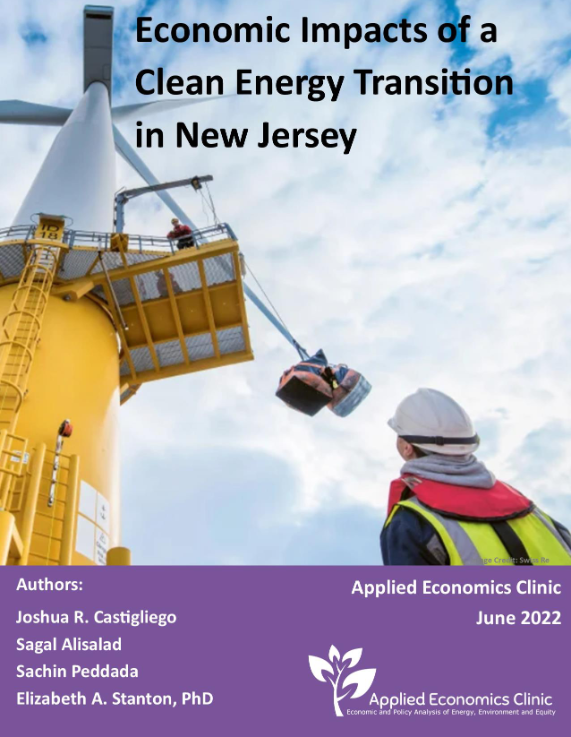
Economic Impacts of a Clean Energy Transition in New Jersey

By Joshua R. Castigliego, Sagal Alisalad, Sachin Peddada, and Liz Stanton, PhD - Applied Economics Clinic, June 7, 2022

Researcher Joshua Castigliego, Assistant Researchers Sagal Alisalad and Sachin Peddada, and Senior Economist Liz Stanton, PhD prepared a report on the economic impacts associated with a clean energy transition in New Jersey that aims to achieve the State’s climate and energy goals in the coming decades. AEC staff find that adding in-state renewables and storage, and electrifying transportation and buildings creates additional job opportunities, while also bolstering the state’s economy. From 2025 to 2050, AEC estimates that New Jersey’s clean energy transition will result in almost 300,000 more “job-years” (an average of about 11,000 jobs per year) than would be created without it. AEC also identifies a variety of additional benefits of a clean energy transition, including several benefits that are conditional on the design and implementation of the transition.

In a companion publication to this report—Barriers and Opportunities for Green Jobs in New Jersey—AEC discusses equity, diversity and inclusion in New Jersey’s clean energy sector along with barriers that impede equitable representation in New Jersey’s green jobs.

Download a copy of this publication here (PDF).

Pages

The Fine Print I:

Disclaimer: The views expressed on this site are not the official position of the IWW (or even the IWW’s EUC) unless otherwise indicated and do not necessarily represent the views of anyone but the author’s, nor should it be assumed that any of these authors automatically support the IWW or endorse any of its positions.

Further: the inclusion of a link on our site (other than the link to the main IWW site) does not imply endorsement by or an alliance with the IWW. These sites have been chosen by our members due to their perceived relevance to the IWW EUC and are included here for informational purposes only. If you have any suggestions or comments on any of the links included (or not included) above, please contact us.

The Fine Print II:

Fair Use Notice: The material on this site is provided for educational and informational purposes. It may contain copyrighted material the use of which has not always been specifically authorized by the copyright owner. It is being made available in an effort to advance the understanding of scientific, environmental, economic, social justice and human rights issues etc.

It is believed that this constitutes a 'fair use' of any such copyrighted material as provided for in section 107 of the US Copyright Law. In accordance with Title 17 U.S.C. Section 107, the material on this site is distributed without profit to those who have an interest in using the included information for research and educational purposes. If you wish to use copyrighted material from this site for purposes of your own that go beyond 'fair use', you must obtain permission from the copyright owner. The information on this site does not constitute legal or technical advice.
