You are here

Green New Deal (GND)

Just Transition in California: Robert Pollin in Conversation with Robert Kuttner

Labor Unions Rally Behind California’s Zero-Emissions Climate Plan

Robert Pollin interviewed by C.J. Polychroniou - Truthout, June 10, 2021

Robert Pollin, distinguished professor of economics and co-director of the Political Economy Research Institute (PERI) at the University of Massachusetts at Amherst, has been spearheading national and international efforts to tackle the climate crisis for more than a decade. Over the past few years, he and a group of his colleagues at PERI have produced green economy transition programs for numerous states. The latest such program is for California, and it is being released today.

The massive study — nearly 200 pages long — shows how California can become a zero emissions economy by 2045 while expanding good job opportunities throughout the state. Nineteen unions have already endorsed the green transition plan, making clear that they reject frameworks that falsely pit labor priorities and the environment against each other, and more are expected to do so in the days and weeks ahead.

In this interview for Truthout, Pollin, co-author with Noam Chomsky of Climate Crisis and the Global Green New Deal: The Political Economy of Saving the Planet (Verso 2020), talks about the climate stabilization project for California and the national implications of union support for a green economy transition.

C.J. Polychroniou: California has been at the forefront of the climate fight for years now, but the truth of the matter is that its efforts have fallen short. Now, you and some colleagues of yours at PERI have just completed a commissioned climate stabilization project for California. How does the project envision the clean energy transition to take place in a manner consistent with the emission targets set out by the UN Intergovernmental Panel on Climate Change (IPCC) in 2018, and how will it be financed?

Robert Pollin: This study presents a recovery program for California that will also build a durable foundation for an economically robust and ecologically sustainable longer-term growth trajectory. California has long been a national and global leader in implementing robust climate stabilization policies. This includes the 2018 Executive Order B-55-18 by then Gov. Jerry Brown. This measure committed the state to cut CO2 emissions by 50 percent as of 2030, to become carbon neutral no later than 2045, and to produce net negative emissions thereafter. These goals are somewhat more ambitious than those set out by the IPCC in 2018. Our study outlines a program through which the state can achieve its own established goals.

Our study shows how these 2030 and 2045 emissions reduction targets can be accomplished in California through phasing out the consumption of oil, coal and natural gas to generate energy in the state, since burning fossil fuels to produce energy is, by far, the primary source of CO2 emissions, and thereby, the single greatest factor causing climate change. The project we propose is to build a clean energy infrastructure to replace the existing fossil fuel-dominant infrastructure. The clean energy infrastructure will require large-scale investments to, first, dramatically raise energy efficiency standards in the state and, second, to equally dramatically expand the supply of clean renewable energy supplies, including solar and wind primarily, with supplemental supplies from low-emissions bioenergy, geothermal and small-scale hydro power. We show how this climate stabilization program for California can also serve as a major new engine of job creation and economic well-being throughout the state, both in the short- and longer run.

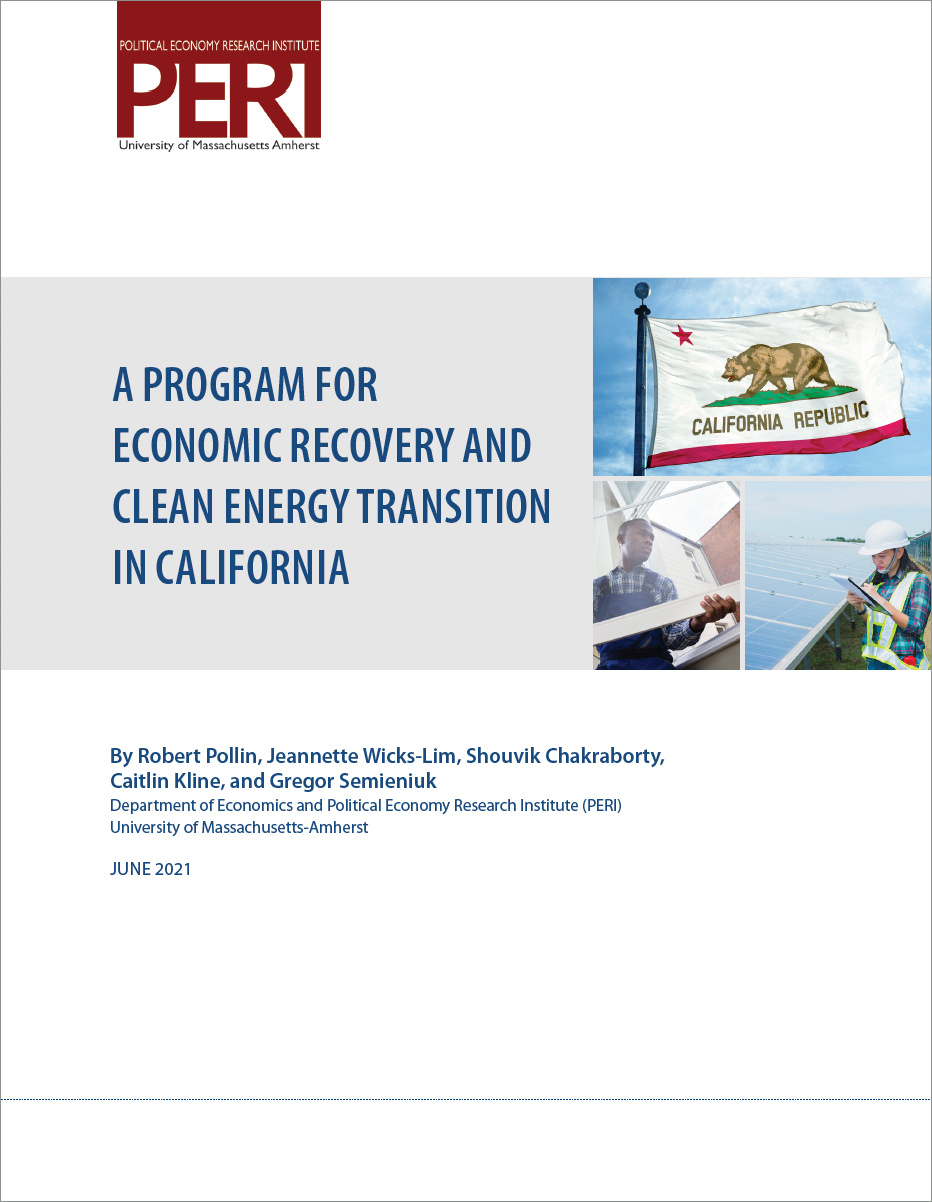
A Program for Economic Recovery and Clean Energy Transition in California

By Robert Pollin, Jeannette Wicks-Lim, Shouvik Chakraborty,Caitlin Kline, and Gregor Semieniuk - Department of Economics and Political Economy Research Institute (PERI); University of Massachusetts-Amherst, June 10, 2021

This study presents a robust climate stabilization project for California. It demonstrates that achieving the state’s official CO2 emissions reduction targets—a 50 percent emissions cut by 2030 and reaching zero emissions by 2045—is a realistic prospect. This climate stabilization project can also serve as a major engine of economic recovery and expanding economic opportunities throughout the state. This includes an increase of over 1 million jobs in the state through investment programs in energy efficiency, clean renewable energy, public infrastructure, land restoration and agriculture. The study also develops a detailed just transition program for workers and communities in California that are currently dependent on the state’s fossil fuel industries for their livelihoods. In particular, we focus here on condi­tions in Kern, Contra Costa, and Los Angeles counties.

The study is divided into nine sections:

  1. Pandemic, Economic Collapse, and Conditions for Recovery
  2. California’s Clean Energy Transition Project
  3. Clean Energy Investments and Job Creation
  4. Investment Programs for Manufacturing, Infrastructure, Land Restoration and Agri­culture
  5. Total Job Creation in California through Combined Investment Programs
  6. Contraction of California’s Fossil Fuel Industries and Just Transition for Fossil Fuel Workers
  7. County-level Job Creation, Job Displacement, and Just Transition
  8. Achieving a Zero Emissions California Economy by 2045
  9. Financing California’s Recovery and Sustainable Transition Programs

Nineteen labor unions throughout California have endorsed this study and its findings.

Read the text (PDF).

Over Fifty Organizations Release Green New Deal Plan for Pacific Northwest Forests

By Dylan Plummer - Cascadia Wildlands, June 9, 2021

Today, dozens of forest and climate justice organizations across northern California, Oregon, and Washington released a sweeping Green New Deal for Pacific Northwest Forests platform calling for the transformation of current forest practices on private, state, and federal land in the face of the climate crisis and ecological collapse. The platform emphasizes the critical role that the forests of the Pacific Northwest must play in efforts to mitigate climate change and to safeguard communities from climate impacts such as wildfire and drought. The six pillars of the Green New Deal for Pacific Northwest Forests address the intersecting issues of industrial logging, climate change, species collapse, economic injustice and the disempowerment of frontline communities.

Matt Stevenson, a high-schooler, and the leader of the Forest Team of Sunrise Movement PDX, a youth organization focused on climate justice, said:

As a high schooler, I have grown up without much hope for my future, and with the knowledge that my generation may inherit a broken and desolate earth. Industrial forestry practices and the timber industry is one of the largest causes of this hopelessness, one of the leading destructive forces of the Pacific Northwest, and the single largest carbon emitter in Oregon. If I, or my generation, wants any hope of a liveable future we must fundamentally transform the way we treat our forests.

Working less is both necessary and desirable from an environmental perspective.

By Kyle Lewis and Will Stronge - The Ecologist, June 8, 2021

With climate breakdown already at our doorstep, the pressing need to change course from capitalist models of growth has spawned new disciplines and approaches within the field of economics. 

One such approach is referred to as degrowth - a genre of research and activism that has been active for many decades, originally inspired by the political ecology of the French-Austrian  philosopher André Gorz. 

Conviviality

Those who advocate for degrowth define its approach as being- first and foremost- a critique of growth. Economic growth is unsustainable per se, because it is inseparable and cannot be ‘absolutely decoupled’ from greenhouse gas emissions and other negative environmental impacts.

In contrast to accounts that stress the need for ‘green growth’ or ‘socialist growth’, degrowth advocates demand the dethroning of growth as a goal in general and in its place want a political economy focused on using fewer natural resources in order to organise life and work. 

Rather than advancing an economic model destined for austerity, scarcity and recession - which are the socio-economic consequences usually associated with ‘flat’ or ‘non-growing economies’, degrowth and postgrowth advocates argue in favour of economic metrics and objectives that advance alternative modes of living, based on principles of sharing, conviviality, care and the common good. 

A framework of six essential policies for the U.S. to THRIVE

By Elizabeth Perry - Work and Climate Change Report, June 3, 2021

A new report by Jeremy Brecher of the Labor Network for Sustainability (LNS) was released in May. Making “Build Back Better” Better: Aligning Climate, Jobs, and Justice is a cast as a “living document” to provide a framework for discussion by the labour and environmental movements. Common Dreams summarizes it here. Brecher begins by identifying the range of climate-related policy proposals in the U.S.: “There are many valuable plans that have been proposed in addition to Build Back Better. The original Green New Deal resolution sponsored by Sen. Ed Markey and Rep. Alexandria Ocasio-Cortez; the THRIVE (Transform, Heal, and Renew by Investing in a Vibrant Economy) Agenda ; the Evergreen Action Plan; the Sierra Club’s “How to Build Back Better” economic renewal plan; the AFL-CIO’s “Energy Transitions”proposals; the BlueGreen Alliance’s “Solidarity for Climate Action,” and a variety of others. All offer contributions for overall vision and for policy details.” 

The contribution of this report from LNS is to frame these policy proposals around “six essential elements” : • Managed decline of fossil fuel burning • Full-spectrum job creation • Fair access to good jobs • Labor rights and standards • Urgent and effective climate protection • No worker or community left behind. The new report links to many of the previous LNS reports which have discussed these elements in more detail.

Labor Network for Sustainability has endorsed the THRIVE Agenda, with its strong emphasis on climate justice. At the end of April, The THRIVE Act was introduced in the U.S. Congress, spearheaded by Representative Debbie Dingell of Michigan and Senator Ed Markey of Massachusetts, and supported by progressive Democrats, environmentalists, and unions. The Rolling Stone summarized the provisions here , stating: “Bold” may be an understatement. While President Biden’s proposed infrastructure plan calls for spending $2 trillion over the next 10 years, the THRIVE Act green-lights the investment of $1 trillion annually. The money would go toward creating an estimated 15 million “family-sustaining” union jobs, rebuilding the nation’s physical and social infrastructure, and cutting carbon emissions in half by 2030.”

The Green New Deal Network has compiled extensive documentation of the economic studies behind the THRIVE Agenda here , based heavily on the work of the Political Economy Research Institute (PERI), led by Robert Pollin.

Gearing Up for Bargaining, Canadian Union Pushes for a Greener, Better Postal Service

By Derek Seidman - Labor Notes, June 2, 2021

With its contracts expiring in 2022, the Canadian Union of Postal Workers is stepping up the fight for its own vision of the post office of the future.

It’s a model for exactly the kind of Green New Deal campaign that U.S. unions should be launching now for a post-Covid economic recovery.

For several years, CUPW and its allies have proposed a visionary plan called Delivering Community Power. It advances a big but simple idea: take Canada Post, an institution that’s already publicly owned and embedded in communities, and reinvent it to drive a just transition into a post-carbon economy.

The post office would help to jump-start green vehicle production and infrastructure; it would provide free Internet access for all; it would create a nationwide system of public banking. And all these measures would help to shore up and expand the post office as a unionized, community-centered alternative to the proliferation of Amazon delivery vans. (For more detail, see the box at the bottom of this article.)

Gearing Up for Bargaining, Canadian Union Pushes for a Greener, Better Postal Service

By Derek Seidman - Labor Notes, June 2, 2021

With its contracts expiring in 2022, the Canadian Union of Postal Workers is stepping up the fight for its own vision of the post office of the future.

It’s a model for exactly the kind of Green New Deal campaign that U.S. unions should be launching now for a post-Covid economic recovery.

For several years, CUPW and its allies have proposed a visionary plan called Delivering Community Power. It advances a big but simple idea: take Canada Post, an institution that’s already publicly owned and embedded in communities, and reinvent it to drive a just transition into a post-carbon economy.

The post office would help to jump-start green vehicle production and infrastructure; it would provide free Internet access for all; it would create a nationwide system of public banking. And all these measures would help to shore up and expand the post office as a unionized, community-centered alternative to the proliferation of Amazon delivery vans.

Making "Build Back Better" Better: Aligning Climate, Jobs, and Justice

By Jeremy Brecher - Common Dreams, June 1, 2021

At the end of March 2021, President Joe Biden laid out his $2 trillion American Jobs Plan–part of his "Build Back Better" infrastructure program–to "reimagine and rebuild a new economy." Congress is expected to spend months debating and revising the plan. The public and many special interests will play a significant role in that process. President Biden has promised to follow up with additional proposals to further address climate policy and social needs.

Many particular interests will seek to benefit from the overall Build Back Better program–and that's good. But as Congress and the public work to shape the ultimate form of that program, we also need to keep our eyes on the ultimate prize: combining climate, jobs, and justice. What policies can integrate the needs of working people, the most oppressed, and our threatened climate and environment?

The Green New Deal reconfigured American politics with its core proposition: fix joblessness and inequality by putting people to work at good jobs fixing the climate. The Biden administration's Build Back Better (BBB) plan has put that idea front and center in American politics. Now we need to specify strategies that will actually achieve all three objectives at once.

There are many valuable plans that have been proposed in addition to Biden's Build Back Better plan. They include the original Green New Deal resolution sponsored by Sen. Ed Markey and Rep. Alexandria Ocasio-Cortez; the THRIVE (Transform, Heal, and Renew by Investing in a Vibrant Economy) Agenda; the Evergreen Action Plan; the Sierra Club's "How to Build Back Better" economic renewal plan; the AFL-CIO's "Energy Transitions" proposals; the BlueGreen Alliance's "Solidarity for Climate Action," and a variety of others. All offer contributions for overall vision and for policy details.

There are six essential elements that must be integrated in order to realize the Build Back Better we need for climate, jobs, and justice:

  • Managed decline of fossil fuel burning
  • Full-spectrum job creation
  • Fair access to good jobs
  • Labor rights and standards
  • Urgent and effective climate protection
  • No worker or community left behind

These strategies can serve as criteria for developing, evaluating, and selecting policies to make Build Back Better all that it could be.

Jobs and equitable transition: Bridging the chasm between rhetoric and action

By Sean O'Leary - Ohio River Valley Institute, May 26, 2021

There was a time when the sight of rows of office workers hammering away at their Friden adding machines would have sent me into paroxysms of delight because I, the Victor Comptometer salesman, had a new and better “programmable calculator” that could kick the Friden’s ass.

I was a young 1970s college graduate entering the workforce at the tail end of the era of mechanical business automation. Typewriters, adding machines, and mechanical cash registers were still the workhorses of stores and offices.

Behind all that machinery were companies – Burroughs, Monroe, Friden, Victor – whose names were as familiar then as Cisco, Oracle, and SAP are today. And those companies supported factories, sales offices, and repair facilities that provided living wage jobs to hundreds of thousands of workers and their families.

Then, within a little more than a decade, it was all gone. A year after I fizzled as a Victor salesman, I was playing at home with my new Radio Shack TRS-80 home computer and five years later, instead of an adding machine and typewriter on my desk at work, there sat an Apple II desktop computer, precursor to the Mac.

Gone too were those hundreds of thousands of jobs plunging not only workers and families, but entire communities, into financial crisis. One could argue that Dayton, Ohio, once home to National Cash Register and the business forms giant, Standard Register, never recovered.

The knock-out blow suffered by the office automation industry was as ferocious and sudden as the one that hit the American steel industry a few years earlier, the textile industry a few decades before that, and also as the one that possibly faces workers in the fossil fuel economy today.

So how did we as a society help displaced workers and communities manage the economic consequences of the transition from the mechanical workplace to a digital one? We didn’t. Thanks to the New Deal, we had unemployment insurance and Medicare and Medicaid were brand spanking new. But that was about it – a little help for individuals and families and none whatsoever for communities.

Pages

The Fine Print I:

Disclaimer: The views expressed on this site are not the official position of the IWW (or even the IWW’s EUC) unless otherwise indicated and do not necessarily represent the views of anyone but the author’s, nor should it be assumed that any of these authors automatically support the IWW or endorse any of its positions.

Further: the inclusion of a link on our site (other than the link to the main IWW site) does not imply endorsement by or an alliance with the IWW. These sites have been chosen by our members due to their perceived relevance to the IWW EUC and are included here for informational purposes only. If you have any suggestions or comments on any of the links included (or not included) above, please contact us.

The Fine Print II:

Fair Use Notice: The material on this site is provided for educational and informational purposes. It may contain copyrighted material the use of which has not always been specifically authorized by the copyright owner. It is being made available in an effort to advance the understanding of scientific, environmental, economic, social justice and human rights issues etc.

It is believed that this constitutes a 'fair use' of any such copyrighted material as provided for in section 107 of the US Copyright Law. In accordance with Title 17 U.S.C. Section 107, the material on this site is distributed without profit to those who have an interest in using the included information for research and educational purposes. If you wish to use copyrighted material from this site for purposes of your own that go beyond 'fair use', you must obtain permission from the copyright owner. The information on this site does not constitute legal or technical advice.