You are here

Green New Deal (GND)

They Wanted to Keep Working; Exxon-Mobil Locked Them Out: Facing deunionization efforts and the existential threat of climate change, oil refiners in Beaumont, Texas, seek a fair contract

By Mindy Isser - In These Times, May 24, 2021

The lockout began May 1, known in most parts of the world as International Workers’ Day. In a matter of hours, the ExxonMobil Corporation escorted 650 oil refiners in Beaumont, Texas, off the job, replacing experienced members of United Steelworkers (USW) Local 13 – 243 with temporary workers in an effort to force a vote on Exxon’s latest contract proposal. USW maintains the proposal violates basic principles of seniority, and more than three weeks after the union members were marched out of their facility, they remain locked out.

“We would have rather kept everyone working until we reached an agreement,” Bryan Gross, a staff representative for USW, tells In These Times. ​“That was our goal.”

Because strikes and lockouts are often measures taken under more dire circumstances, either when bargaining has completely stalled or is being conducted in bad faith, USW proposed a one-year contract extension. But Exxon rejected the offer, holding out for huge changes to contractual language regarding seniority, safety and layoffs. ​“It’s a control issue,” Gross adds. ​“Exxon wants control.”

As the oil industry attempts to deskill (and ultimately deunionize) its labor force, refinery workers like those in Beaumont find themselves under siege. Not only is their industry buckling beneath the weight of a global health crisis, but climate change has come to threaten their very livelihoods. Many workers remain skeptical of existing plans for a just transition.

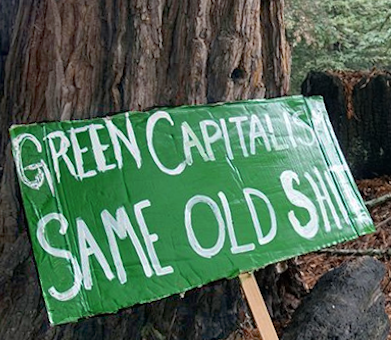
Green Economy, Green Capitalism? The Case Against The Case for Climate Capitalism

By Nick Grover - The Bullet, May 14, 2021

Even now, with a ten-year timeframe left for action, it’s rare for the climate crisis to be treated as the emergency it is. So, credit where due to Tom Rand. In his The Case for Climate Capitalism: Economic Solutions for a Planet in Crisis (Toronto: ECW Press, 2020), Rand calls for a rapid transition away from fossil fuels and toward renewables; he blames the political and business elite for the mess and says they will have to pay the price as markets turn against oil and assets are stranded; he even advocates for expansion of public transit. Where the book gets less refreshing is Rand’s tone toward the people who have been saying these things all along: his secondary enemy, leftists fusing demands for climate action with calls for economic justice.

Rand’s Case for Climate Capitalism aims to preserve and “co-opt” the forces of capitalism to usher in a transition toward green tech. His case is presented as simple pragmatism: the emergency we face affords us no time to discuss economic reforms; we must unite and do what works instead of holding out for a perfect system. His concern is that left ideas like the Green New Deal and Leap Manifesto – which wed strong climate action with job guarantees, labour protections, taxing the rich, and expanding social programs – alienate conservatives and the business class when we need them in our coalition to save the planet.

The National Black Climate Summit

Green Energy, Green Mining, Green New Deal?

Job creation potential of nature-based solutions to climate change

By Elizabeth Perry - Work and Climate Change Report, May 10, 2021

U.K. think tank Green Alliance commissioned research to measure the economic impact of nature-based investments for a green recovery, and released the results on May 4. The full report, Green Renewal – The Economics of Enhancing the Natural Environment, was written by WPI Economics, and states: “Looking at just three types of enhancement (woodland creation, peatland restoration and urban green infrastructure) we find that an expanded programme of nature restoration could create at least 16,050 jobs in the 20% of constituencies likely to face the most significant employment challenges. We present place-based analysis of the labour market and nature based solutions, which can also be found on an interactive webpage here.” The report emphasizes that nature-based interventions can create jobs in areas that need them the most – stating that two thirds of the most suitable land for planting trees is in constituencies with worse than average labour market challenges.

Jobs for a Green Recovery is a summary report written by Green Alliance, based on the economic WPI report. It emphasizes the impact of Covid on youth employment, stating that 63% of those newly unemployed in 2020-21 are under 25, argues that nature-based jobs are long-term, skilled and productive, and makes specific recommendations for the British government so that such jobs can become part of the U.K. green recovery. Green Alliance estimates that investments in nature-related jobs have a high cost-benefit ratio, with £4.60 back for every £1 invested in peatland, £2.80 back in woodland, and £1.30 back for salt marsh creation.

Jobs for a Green Recovery includes brief U.K. case studies. An interesting a related Canadian example can be found in the new Seed the North initiative, described in The Tyee here . Seed the North is a small start-up company in Northern B.C., with big ambition to scale up. Currently, the project collects wild seed from Canadian trees, uses innovative technology to encase the seed in bio-char, and then uses drone technology to plant seeds in remote forest areas. The result: increased regeneration of disturbed land, restored soil health, a statistically significant contribution to carbon sequestration, and economic benefits flowing through co-ownership to the local First Nations communities who participate.

Suds and Socialism Forum: Workers and the Environment

The Blue New Deal: Making a Living on a Living Ocean

By Jeremy Brecher - Labor Network For Sustainability, May 5, 2021

Last year Senator and presidential candidate Elizabeth Warren called for “A Blue New Deal for our Oceans.” Since then, there have been many additional proposals for a Blue New Deal–including measures that President Joe Biden could implement by executive order. Here’s the backstory of the Blue New Deal. Not surprisingly, it was a worker who inspired the idea.

Biden’s Climate Pledge Is a Promise He Cannot Keep

By Howie Hawkins - Solidarity, May 4, 2021

IWW EUC web editor's disclaimer: the IWW does not advoate electralism or endorse political parties, including the Green Party. This article is included to provide a critique of the reformism of the Democratic Party (a similar critique could be offered about the Greens and all other parties).

The climate emergency demands a radical and rapid decarbonization of the U.S. economy with numerical goals and timetables to transform all productive sectors, not only power production (27% of carbon emissions), but also transportation (28%), manufacturing (22%), buildings (12%), and agriculture (10%). It also requires that the U.S. pay its “climate debt” as the world’s largest historical carbon emitter and destroyer of carbon-storing forests, wetlands, and soils. Paying that climate debt would not only be reparations to the Global South for deforestation and fossil fuel emissions by the rich capitalist countries, but also an investment in the habitability of the planet for everyone. This emergency transformation can only be met by an ecosocialist approach emphasizing democratic public enterprise and planning.

Instead, Biden’s plan features corporate welfare: subsidies and tax incentives for clean energy that will take uncertain effect at a leisurely pace in the markets. It does nothing to stop more oil and gas fracking and pipelines for more gas-fired power plants, or to shut down coal-fired power plants. Without out directly saying so, it is a plan to burn fossil fuels for decades to come.

The scale of spending falls pathetically short of what is needed to decarbonize the economy. An effective plan would not only reach zero emissions on a fast timeline. It would also move quickly toward negative emissions. We have to draw carbon out of the atmosphere because we are already well past carbon levels that are triggering dangerous climate change.

Biden’s stated goal of a 50% cut in emissions does not actually cut current emissions in half. His proposed 50% cut is from a baseline of 2005 when emissions were at their peak, not what they are today. Emissions were 6 GtC (gigatons of carbon dioxide) in 2005. Due to a leveling of electric power demand, a trend away from coal to wind, solar, and gas for electric power, and more energy-efficient vehicles, U.S. emissions were down 13% from 2005 by 2019 to 5.1 GtC and, due to the covid contraction, down 21% in 2020 to 4.6 GtC, although emissions are now soaring back up as the economy re-opens. Biden’s goal of 50% below 2005 is 3 GtC per year in emissions instead of 2.5 GtC if 2019 were the baseline, or 2.3 GtC if 2020 were the baseline.

Biden provided no explanation for how the U.S. will get to the precisely stated range of “50% to 52%.” 52% seems to be an arbitrary number pulled out of the air so he can say he is aiming for more than 50%. Greta Thunberg’s video prebuttal to the targets that were to be announced by Biden and the other 40 world leaders at his Earth Day Climate Summit saw right through the staged spectacle. “We can keep cheating in order to pretend that these targets are in line with what is needed, but while we can fool others, and even ourselves, we cannot fool nature and physics… Let’s call out their bullshit.”

Rich People Are Fueling Climate Catastrophe, but Not Mostly Because of Their Consumption

By Matt Huber - Jacobin, May 2, 2021

The same study keeps coming out to show that the rich are causing climate change and environmental breakdown. In 2015, Oxfam released a report entitled “Extreme Carbon Inequality” that found the top 10 percent of people in the world are responsible for 50 percent of emissions, while the bottom 50 percent are only responsible for 10 percent. That same year, economists Thomas Piketty and Lucas Chancel crunched the data to reveal similarly stark numbers: the “top 10% emitters contribute to 45% of global emissions.”

More recently, a wide-ranging scientific review argued that “consumption of affluent households worldwide is by far the strongest determinant and the strongest accelerator of increases of global environmental and social impacts.” And just last month, a new study found that the wealthy — who they identify as a “polluter elite” — are “at the heart of the climate problem.” The study recommends, “far reaching changes in lifestyles are also required if we are to avoid dangerous levels of global heating.”

It shouldn’t be surprising that those on the Left have seized on these studies as grist for the mill of class struggle. Here at Jacobin, this data has led to call-to-arms articles like “Only class war can stop climate change” and “To save the planet, expropriate the rich.”

So far, so good. Yet these studies share a fatal flaw: they conceptualize the rich’s contribution to global heating and environmental breakdown solely in terms of their “affluence” or “consumption.” While the “lifestyles of the rich and famous” are often egregious from an environmental standpoint, we need to look beyond their personal consumptive choices to understand the true significance of their contribution to climate change — and to understand the political challenge ahead of us for actually halting catastrophic climate change.

The basis of these studies is household income data and an inferred relationship with spending patterns associated with emissions or “carbon footprints,” so it is no surprise that someone like Thomas Piketty, a world-famous analyst of income inequality, would use this data to link such inequality to carbon emissions.

But income is not the best way to understand inequality under capitalism. A plumber could have the same income as a college professor. The plumber could also have the exact same income if they ran their own plumbing business or if they worked for a massive plumbing corporation.

For Marxists, class and inequality has to do with your relationship to the means of production. More broadly, class is less about how much money you make and more about what you own and control. For the vast majority of us, we only own our labor power to sell on the market to live. For the rich, it is their ownership of property, businesses, and monetary wealth itself that makes them so powerful in a capitalist society.

Public Forum on Empowering the Post Pandemic Working Class

Pages

The Fine Print I:

Disclaimer: The views expressed on this site are not the official position of the IWW (or even the IWW’s EUC) unless otherwise indicated and do not necessarily represent the views of anyone but the author’s, nor should it be assumed that any of these authors automatically support the IWW or endorse any of its positions.

Further: the inclusion of a link on our site (other than the link to the main IWW site) does not imply endorsement by or an alliance with the IWW. These sites have been chosen by our members due to their perceived relevance to the IWW EUC and are included here for informational purposes only. If you have any suggestions or comments on any of the links included (or not included) above, please contact us.

The Fine Print II:

Fair Use Notice: The material on this site is provided for educational and informational purposes. It may contain copyrighted material the use of which has not always been specifically authorized by the copyright owner. It is being made available in an effort to advance the understanding of scientific, environmental, economic, social justice and human rights issues etc.

It is believed that this constitutes a 'fair use' of any such copyrighted material as provided for in section 107 of the US Copyright Law. In accordance with Title 17 U.S.C. Section 107, the material on this site is distributed without profit to those who have an interest in using the included information for research and educational purposes. If you wish to use copyrighted material from this site for purposes of your own that go beyond 'fair use', you must obtain permission from the copyright owner. The information on this site does not constitute legal or technical advice.