You are here

decarbonization

Aviation Workers Demand Industry to Reject Dangerous Growth

By Finlay Asher - Safe Landing, May 4, 2023

Finlay Asher of Safe Landing gave this talk on 4th May 2023 as part of the "Aero Lectures" series organised by the HAW University in Hamburg in cooperation with DGLR, Royal Aeronautical Society (RAeS), ZAL and VDI. He covered the need for aviation decarbonisation, the issues with various technological and policy options, what Safe Landing's positive view of the future for air travel is, and how we think we can achieve it (worker-led movements and Aviation Workers' Assemblies.)

The Green New Deal in the Cities, Part 1: Boston

By Jeremy Brecher - Labor Network for Sustainability, May 16, 2023

While the Green New Deal started as a proposed national program, some of the most impressive implementations of its principles and policies are occurring at a municipal level. Part 1 of “The Green New Deal in the Cities” provides an extended account of the Boston Green New Deal, perhaps the most comprehensive effort so far to apply Green New Deal principles in a major city. Part 2 presents Green New Deal-style programs developing in Los Angeles and Seattle, and reviews the programs and policies being adapted in cities around the country to use climate protection as a vehicle for creating jobs and challenging injustice.

Urban politics often seem to produce not so much benefit for the people as inequality, exclusion, and private gain for the wealthiest. Does it have to be that way? In cities throughout the US, new political formations, often under the banner of the Green New Deal, are creating a new form of urban politics. They pursue the Green New Deal’s core objectives of fighting climate change in ways that produce good jobs and increase equality. They are based on coalitions of impoverished urban neighborhoods, disempowered racial and ethnic groups, organized labor, and advocates for climate and the environment. They involved widespread democratic mobilization. A case in point is the Boston Green New Deal.

Union Win at Bus Factory Electrifies Georgia

By Luis Feliz Leon - Labor Notes, May 16, 2023

After a bruising three-year fight, workers at school bus manufacturer Blue Bird in Fort Valley, Georgia, voted May 12 to join United Steelworkers (USW) Local 697.

“It’s been a long time since a manufacturing site with 1,400 people has been organized, let alone organized in the South, let alone organized with predominantly African American workers, and let alone in the auto industry,” said Maria Somma, organizing director with the USW.

“It’s not a single important win. It’s an example of what’s possible—workers wanting to organize and us being able to take advantage of a time and a policy that allowed them to clear a path to do so.”

The vote was 697 to 435 with 80 percent turnout. At two factories and a warehouse near Macon, the workers build school buses and an array of specialty buses.

Blue Bird is the second-largest bus manufacturer in the country, after Daimler Truck’s Thomas Built Buses. The Auto Workers represent workers at a Thomas Built facility in North Carolina.

The main issues in Georgia were pay and safety. Workers began organizing in earnest at the height of the pandemic in 2020 after Blue Bird workers reached out to a Steelworker organizer following a union win at a tire factory in nearby Macon. They overcame a fierce anti-union campaign in a right-to-work state where only 4.4 percent of workers are union members.

But Somma adds that workers tapped into local union networks. “People think the South is non-union, but we have a lot of members in middle Georgia,” she said.

The Steelworkers represent thousands of members in the state—at BASF, which makes chemicals used in plastics, detergent, and paper manufacturing, Anchor Glass, and the paper giant Graphic Packaging International.

Steel built the Rust Belt. Green steel could help rebuild it

By Katie Myers - Grist, May 11, 2023

In the Mon Valley of western Pennsylvania, steel was once a way of life, one synonymous with the image of rural, working-class Rust Belt communities. At its height in 1910, Pittsburgh alone produced 25 million tons of it, or 60 percent of the nation’s total. Bustling mills linger along the Monongahela River and around Pittsburgh, but employment has been steadily winding down for decades.

Though President Trump promised a return to the idealized vision of American steelmaking that Bruce Springsteen might sing about, the industry has changed since its initial slump four decades ago. Jobs declined 49 percent between 1990 and 2021, when increased efficiency saw the sector operating at its highest capacity in 14 years. Despite ongoing supply chain hiccups and inflation, demand continues growing globally, particularly in Asia. But even as demand for this essential material climbs, so too does the pressure to decarbonize its production.

Earlier this month, the progressive Ohio River Valley Institute released a study that found a carefully planned transition to “green” steel — manufactured using hydrogen generated with renewable energy — could be a climatic and economic boon. It argues that as countries work toward achieving net-zero emissions by 2050, a green steel boom in western Pennsylvania could help the U.S. meet that goal, make its steel industry competitive again, and employ a well-paid industrial workforce.

“A transition to fossil fuel-free steelmaking could grow total jobs supported by steelmaking in the region by 27 percent to 43 percent by 2031, forestalling projected job losses,” the study noted. “Regional jobs supported by traditional steelmaking are expected to fall by 30 percent in the same period.”

Responsible Offshore Wind Development Starts with a Green Port

By Luis Neuner, Jennifer Kalt, Caroline Griffith, and Colin Fiske - Lost Coast Outpost (reposted at Wild California), May 10, 2023

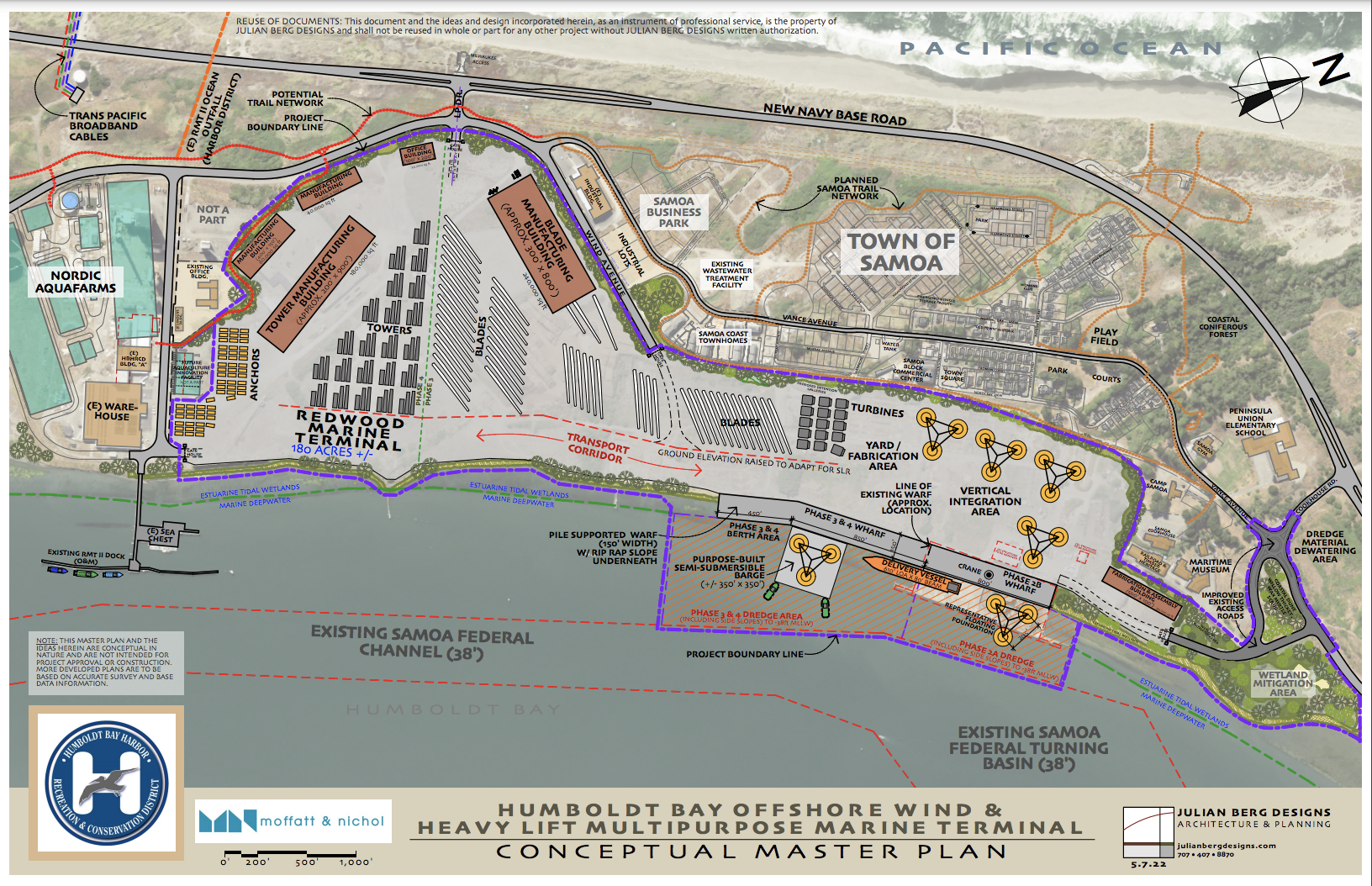
Humboldt Bay Offshore Wind & Heavy Lift Multipurpose Marine Terminal Conceptual Master Plan. Image from Humboldt Bay Harbor Resource & Conservation District.

Humboldt County’s proposed offshore wind project would significantly reduce carbon emissions throughout California by providing upwards of 1.6 gigawatts of clean, renewable-sourced energy. But to ensure the success of offshore wind and to meet the promise of climate action, decision-makers must commit to a green port facility capable of building and servicing the turbines while not further contributing to greenhouse gas emissions or polluting Humboldt Bay.

A key component of a thriving offshore wind industry is a port capable of constructing, assembling, and maintaining wind turbines. The Humboldt Bay Harbor District has partnered with Crowley Wind Services, a multinational port development company, to build this heavy lift terminal on the Samoa Peninsula. There are various potential benefits: port development could create many family-wage jobs and substantially contribute to a growing local economy—all while making important strides towards a clean-energy future to address the climate crisis.

Unfortunately, these types of heavy-lift terminals have a mixed track record for communities. On land, port equipment such as terminal tractors, forklifts, yard trucks, cranes, and handlers commonly run on diesel. In the water, most heavy-duty cargo ships and tugboats also run on diesel or heavy fuel oil, polluting the air. Ships and tugs even burn fuel while docked at the terminal to maintain a base load of electricity. As a result, communities surrounding these ports often suffer from the effects of air pollution. In Los Angeles, for example, air quality studies revealed that these diesel fumes significantly raised cancer risk for people within fifteen miles of the terminals.

Our port doesn’t have to be this way. Recent technological developments have made major progress towards enabling the possibility of a ‘green port.’ Green ports seek to make all aspects of operation sustainable, from the heavy machinery on land to the ships docked at the harbor. This work requires moving away from fossil fuels and shifting towards electrification and other zero-carbon energy sources, such as green hydrogen.

Building a Democratic Energy Future: Lithium Extractivism and North-South Inequalities

The “Electrify Everything” Movement’s Consumption Problem

By Amy Westervelt - The Intercept, May 8, 2023

In 2019, Thea Riofrancos was splitting her time between researching the social and environmental impacts of lithium mining in Chile and organizing for a rapid energy transition away from fossil fuels in the United States. A political science professor at Providence College and member of the Climate and Community Project, Riofrancos was struck by the contrast: Lithium is essential to the batteries that make electric vehicles and renewable energy work, but mining inflicts its own environmental damage. “Here I am in Chile, in the Atacama Desert, seeing these mining-related harms, and then there I go in the U.S. advocating for a rapid transition. How do I align these two goals?” Riofrancos said. “And is there a way to have a less extractive energy transition?”

When she went looking for research that would help answer that question, she found none, at least not for the transportation sector, which was her area of focus. “I saw forecast after forecast that assumed basically a binary of the future,” she said. “Either we stay with the fossil fuel status quo and the existential crisis that that is causing for the planet and all of its people. Or we transition to an electrified, renewably powered future, but that doesn’t really change anything about how these sectors or economic activities are organized.”

Riofrancos wanted to look at multiple ways to design an electrified future and understand what the costs and impacts of different scenarios might be. So she linked up with other Climate and Community Project researchers and put together a report mapping out four potential pathways to electrification for the transportation sector. Titled “Achieving Zero Emissions With More Mobility and Less Mining,” the report concluded that even relatively small, easy-to-achieve shifts like reducing the size of cars and their batteries could deliver big returns: a 42 percent reduction in the amount of lithium needed in the U.S., even if the number of cars on the road and the frequency with which people drive stayed the same.

It’s the sort of thing politicians and electrification advocates need to think through now, when decisions can be made to guide the energy transition in one direction or another. It’s also critical to an underdiscussed component of climate action: demand for products and services and the role energy plays in fulfilling those demands. Which connects right up to another topic that American politicians don’t want to touch with a 10-foot pole: consumption.

UAW Holds Off on Endorsing Biden in Bid to Secure Just EV Transition

By Kenny Stancil - Common Dreams, May 4, 2023

"We need to get our members organized behind a pro-worker, pro-climate, and pro-democracy political program that can deliver for the working class," says a memo from the union's new president.

The United Auto Workers is withholding its endorsement of U.S. President Joe Biden in the early stages of the 2024 race in an attempt to extract concessions that would ensure the nascent transition to all-electric vehicles benefits labor as well as the environment.

"We need to get our members organized behind a pro-worker, pro-climate, and pro-democracy political program that can deliver for the working class," says a memo written by UAW president Shawn Fain and shared internally on Tuesday.

Fain, an electrician from Indiana, won a March runoff election to lead the Detroit-based union, defeating incumbent Ray Curry of the powerful Administration Caucus in a major upset. Fain's victory, one of several in which challengers from the insurgent Members United slate prevailed, gave reformers control of UAW's direction. The new president quickly promised a more confrontational approach, decrying "give-back unionism" and vowing to "put the members back in the driver's seat, regain the trust of the rank and file, and put the companies on notice."

A reinvigorated UAW is also putting Biden on notice by holding onto its coveted endorsement. With 400,000 active members and a heavy presence in the battleground state of Michigan, the union remains a significant political force. Its goal is to pressure Biden into improving federal policies related to electric vehicle (EV) manufacturing.

"The federal government is pouring billions into the electric vehicle transition, with no strings attached and no commitment to workers," Fain wrote in his new memo. "The EV transition is at serious risk of becoming a race to the bottom. We want to see national leadership have our back on this before we make any commitments."

As The New York Timesreported Wednesday:

In April, the Biden administration proposed the nation's most ambitious climate regulations yet, which would ensure that two-thirds of new passenger cars are all-electric by 2032—up from just 5.8% today. The rules, if enacted, could sharply lower planet-warming pollution from vehicle tailpipes, the nation's largest source of greenhouse emissions. But they come with costs for autoworkers, because it takes fewer than half the laborers to assemble an all-electric vehicle as it does to build a gasoline-powered car.

But it's not just potential job losses that are of concern to UAW leaders. They also want to see higher wages and better benefits for workers at EV facilities.

The latest on the Just Transition

By staff - Nautilus International, May 2, 2023

At the Nautilus Professional and Technical Forum in April, head of international relations Danny McGowan gave a presentation on the hot maritime topic of 2023: the Just Transition.

What this means at its heart is that workers should be treated fairly in the move towards greener shipping. Nautilus is part of the international Maritime Just Transition Task Force, which recently commissioned a report by the DNV classification society to seek insights into the seafarer training and skills needed to support a decarbonised shipping industry.

The DNV report focuses on the four 'alternative' energy sources that are closest to widespread adoption: LNG and LPG, hydrogen, methanol and ammonia.

The concept of Just Transition means that if some of these alternatives are implemented, there should be a health and safety first approach, with strict rules about handling dangerous new fuels like ammonia and human-centred design for new vessels and new technologies onboard.

It also means that training should be standardised, should be provided at no cost to existing seafarers and not-for-profit for new seafarers.

The DNV report is helping to bring clarity on the uptake of alternative fuel options and the trajectory of decarbonisation, so that the industry can plan for the transformation of the maritime workforce.

Another document that contributes to this process is the Maritime Just Transition Task Force's 10 Point Plan, which establishes Just Transition principles such as global labour standards, gender and diversity and health and safety.

'Big Win': New York to Build Publicly Owned Clean Energy, Electrify New Buildings

By Julia Conley - Common Dreams, May 2, 2023

"A better world is possible," said campaigners who pushed for the passage of the Build Public Renewables Act. "And we are building it."

Climate campaigners in New York were credited on Tuesday with pushing Democratic Gov. Kathy Hochul and the state Legislature to include in the state budget "historic" provisions that will build publicly owned renewable energy and end the use of fossil fuels in new buildings—without a loophole allowing municipalities to opt out of the requirement.

The budget, hammered out in recent days in talks between the governor and the leaders of the Legislature as advocates refused to back down from their demands for far-reaching climate measures within the deal, includes the Build Public Renewables Act (BPRA), which was secured "through four years of organizing across the state by thousands of [Democratic Socialists of America members], the Public Power NY coalition, and more," said the NYC-DSA Ecosocialist Working Group.

"This text is the biggest Green New Deal win in U.S. history," said the group. "A better world is possible. And we are building it."

Pages

The Fine Print I:

Disclaimer: The views expressed on this site are not the official position of the IWW (or even the IWW’s EUC) unless otherwise indicated and do not necessarily represent the views of anyone but the author’s, nor should it be assumed that any of these authors automatically support the IWW or endorse any of its positions.

Further: the inclusion of a link on our site (other than the link to the main IWW site) does not imply endorsement by or an alliance with the IWW. These sites have been chosen by our members due to their perceived relevance to the IWW EUC and are included here for informational purposes only. If you have any suggestions or comments on any of the links included (or not included) above, please contact us.

The Fine Print II:

Fair Use Notice: The material on this site is provided for educational and informational purposes. It may contain copyrighted material the use of which has not always been specifically authorized by the copyright owner. It is being made available in an effort to advance the understanding of scientific, environmental, economic, social justice and human rights issues etc.

It is believed that this constitutes a 'fair use' of any such copyrighted material as provided for in section 107 of the US Copyright Law. In accordance with Title 17 U.S.C. Section 107, the material on this site is distributed without profit to those who have an interest in using the included information for research and educational purposes. If you wish to use copyrighted material from this site for purposes of your own that go beyond 'fair use', you must obtain permission from the copyright owner. The information on this site does not constitute legal or technical advice.