You are here

green syndicalism

The work-technology nexus and working-class environmentalism: Workerism versus capitalist noxiousness in Italy’s Long 1968

By Lorenzo Feltrin and Devi Sacchetto - Theory and Society, March 5, 2021

This article traces the trajectory of theory and praxis around nocività or noxiousness – i.e., health damage and environmental degradation – drawn by the workerist group rooted in the petrochemical complex of Porto Marghera, Venice. While Porto Maghera was an important setting for the early activism of influential theorists such as the post-workerist Antonio Negri and the autonomist feminist Mariarosa Dalla Costa, the theories produced by the workers themselves have been largely forgotten. Yet, this experience was remarkable because it involved workers employed by polluting industries denouncing in words and actions the environmental degradation caused by their companies from as early as 1968, when the workerists had a determining influence in the local factories.

The Porto Marghera struggles against noxiousness contradict the widespread belief that what is today known as working-class environmentalism did not have much significance in the labour unrest of Italy’s Long 1968. The Porto Marghera group’s original contribution was based on the thesis of the inherent noxiousness of capitalist work and an antagonistic-transformative approach to capitalist technology. This led to the proposal of a counterpower able to determine “what, how, and how much to produce” on the basis of common needs encompassing the environment, pointing to the utopian prospect of struggling for a different, anti-capitalist technology, compatible with the sustainable reproduction of life on the planet.

Read the text (Link).

One of the Best Places to Fight for the Environment Is in Your Workplace

By Libronaught - Medium, February 24, 2021

One of the biggest roadblocks standing in the way of practical, cooperative solidarity between social movements is the idea of “separate issues.” In recent years people have begun chipping away at this shibboleth, but we still have a ways to go. One significant problem within the problem of the single-issue silo effect is that labor is sometimes mistakenly viewed as just another issue.

Labor is not just an issue. Labor is a power base. Labor organizing can be more effective at winning social gains on a range of “single issues” than weekend demonstrations, conscious consumerism, electioneering or lobbying.

In the US, we are often taught to view voting, lobbying and mass demonstrations as ways to participate in democracy. They all are, of course, but it’s not the full picture. As Jane McAlevey persuasively explains in her extraordinary book, A Collective Bargain, US democracy as we know it today would not exist if not for the labor movement. The organizing and solidarity efforts among US workers that eventually won the 8-hour day and the weekend began right after the American Revolution. Labor solidarity and organizing among women has put a driving force behind demands for gender equality for over 150 years. From the 1910s to the 1940s, a massive swell of labor solidarity and organizing crossed race and gender lines, won the current US Labor Rights laws, and led the country out of the Great Depression. Labor unions went on to participate in the 60s Civil Rights movements.

Bows and Arrows: Indigenous Workers, IWW Local 526, and Syndicalism on the Vancouver Docks

By Jeff Shantz - LibCom.Org, February 17, 2021

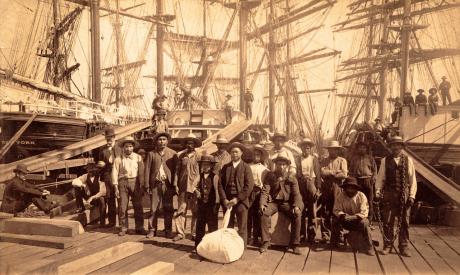
Few may be aware that the first union on the waterfront of Vancouver was organized by Indigenous workers, mostly Squamish and Tsleil-Waututh. And it was organized on an explicitly syndicalist basis as Local 526 of the Industrial Workers of the World (IWW). The IWW group would become known as the Bows and Arrows, a name that spoke to their active and more politically militant perspective and commitment to Indigenous solidarity. The Bows and Arrows organized on a multicultural/multiracial foundation of class solidarity.

While the lifespan of IWW Local 526 was brief (formally only a year while informally for about seven years) it had a lasting impact on working class organizing on the waterfront, anti-racism and racial solidarity on the docks, and on political organizing in Indigenous communities. It also showed the pivotal role of organizing within the logistical chains of global capitalism in sabotaging resource extractive industries, while providing a model of work organization that sustained community relevant work and work cycles rather than the single career monoculture of industrial capitalism at the time.

As historian Andrew Parnaby suggests, the Bows and Arrows:

"Join[ed] in the broader upsurge of support for the Wobblies that took place among loggers, miners, railroad workers, and seafarers prior to the Great War…Reformers, rebels, and revolutionaries: collectively, they were responsible for a level of militancy on the waterfront that was unmatched by most other occupations, provincially or nationally. Vancouver waterfront workers went on strike at least sixteen times between 1889 and 1923; the four largest and most dramatic strikes were in 1909, 1918, 1919, and 1923." (2008, 9)

While Local 526 would finally be broken through battles with waterfront employers that have been described as titanic, these workers provided important and lasting examples of working class militance, workplace organizing tactics, racial solidarity and anti-racism, and cultural defense. They offer a critical model of syndicalism in diverse workforces and changing economic conditions within a context of settler colonial capitalism.

Ecosocialism is the Horizon, Degrowth is the Way

Jason Hickel interviewed by Samuel Miller-McDonald - The Trouble, February 11, 2021

“Degrowth” means many things to many people. To most, it probably doesn’t mean much beyond an antonym to “growth,” the process of getting larger or more complex. To some detractors, the term represents a scary violation of the imperative to increase GDP annually, what’s now a holy sacrament to policymakers and economic pundits (though less so to actual academic economists, who are more ambivalent). To its less pedantic and more hysterical detractors, it’s a ploy to take away everyone’s Hummers and return to a mushroom-foraging-based economy. 

At its most distilled, “degrowth” refers to a process of reducing the material impact of the economy on the world’s many imperiled ecologies, abandoning GDP as a measurement of well-being, and forging an equitable steady-state economy.

Although the concept of placing limits to economic growth is not very new, having been articulated by environmentalists several decades ago—most famously by the Club of Rome in 1972—the more recent iteration, only just over a decade old, emerges from the French décroissance. Given that the community and scholarship is so young, there’s still a lot of debate around some of the fundamentals of what the term means, and what it should mean. Some who believe in the principles recoil at the term itself: Noam Chomsky has said “when you say ‘degrowth’ it frightens people. It’s like saying you’re going to have to be poorer tomorrow than you are today, and it doesn’t mean that.” But many degrowth defenders, one of the most prominent being ecological economist Giorgos Kallis, stand by it and see value in such a unifying notion. 

Even so, there lurks some danger in all such terms and political communities, like socialism or democracy, as I have warned elsewhere of the perennial risk of being co-opted and ill-defined by bad-faith actors. If the degrowth critique goes only as far as targeting economic growth, or even general anticapitalism, there’s little intrinsic to it to stop a right-wing authoritarian program from co-opting degrowth rhetoric to justify imposing authoritarianism, or giving cover to cynical Global North states to demand degrowth of the Global South while continuing to disproportionately consume and pollute. Degrowth, if it is to get traction and if that traction is to be desirable, needs to be abundantly clear about what it stands for and what it rejects. Luckily, we have just the book to offer this much needed clarity. 

Economic anthropologist Jason Hickel is among the most eloquent advocates of degrowth, and has been intimately involved in the community’s attempt to stake out a useful, clear meaning for the term and pathway to integrating its principles into a coherent program. Hickel’s latest book, Less is More: How Degrowth Will Save the World published in August 2020 (with a paperback edition released this month), offers an abundance of facts, concepts, and research alongside a passionate defense of ecocentric and humanistic values. Hickel has achieved something many writers of popular nonfiction seek in vain: a high density of ideas and data delivered in a light, enjoyable narrative prose. The book makes a very strong case for a topic in need of strong cases. And Less Is More arrives in good company: degrowth advocate Timothée Parrique counted 203 essays, 70 academic articles, and 11 books on degrowth published in 2020. 

Some bad-faith commentators have attempted to paint degrowth as dressed-up primitivist austerity, intrinsically harmful to the Global South, but Hickel does a persuasive job emphasizing that degrowth actually means the opposite. He musters an army of historical and contemporary data, anecdotes, and theory to argue definitively that an equitable degrowth scenario is more likely to increase material abundance and resource access. If the ideology of growthism offers an ethic of constant amoral expansion and exploitation, degrowth(ism) offers a more restrained ethic that values an abundance of time, leisure, love, and equality over concentrated wealth and distributed waste. 

While the book explores the moral imperative for controlled degrowth, Hickel is equally comfortable arguing for degrowth from a standpoint of a purely rational approach to fundamentally shifting an economy that is currently heating the world to death, guaranteeing centuries of mass death and destruction. The only way to slow the rapid race to collapse civilization and accelerate extinctions is to stop the omnicidal political economy that rules the globe. Given the natural limits that thermodynamics and terrestrial ecologies impose on human economies and non-human populations, degrowth is inevitable: it’s just a matter of deciding whether human agency will play a positive, benevolent role in the process, or continue to maximize the chaos and violence involved. I asked Dr. Hickel via email about some of the major challenges to achieving degrowth reforms and some important peripheral issues. Here is our discussion:

On Green Socialism and Working Class Politics

By Staff - Pittsburgh Green Left, February 8, 2021

Green Socialism is inspired partly by traditional worker-oriented socialist views, but attempts to transcend class struggle by organizing popular struggle for true democracy, ecology, and freedom.

As we enter the second decade of the 21st century, ecological and social crisis exist simultaneously in multiple forms within the US and across the world. Global neoliberal capitalism has captured the world’s economic and political structures, and we feel the growing pressures of poverty and climate change under the threat of a pervasive police state.

These deteriorating conditions imply that historical socialist revolutionary movements have largely failed to produce the widespread change they described in their visions. There’s an increasing feeling, particularly by the youth, that the “old ways” are insufficient to confront 21st century capitalism and win — particularly with the climate change clock running out — and that a new form of social movement and politics is necessary to directly confront capitalism and broader ecological and social issues.

I believe the new model for the 21st century must be Green Politics, or what I will call “Green Socialism” here to distinguish from other tendencies that lay claim to the more broad term “eco-socialism”. Green Politics is today largely associated with the Green Party, however anyone can practice Green Politics in or outside of the Green Party.

A simplistic description of Green Politics might be to list the 4 pillars — grassroots democracy, peace, social justice, and ecological wisdom — and the 10 Key Values of the movement, but to create a deeper discussion of what Green Politics and Green Socialism really means, a good place to start might be to address some complaints and criticisms of the Green Party and Green Socialism that you have no doubt already heard, particularly from other socialists.

Left Voice for example ran an opinion piece by author Ezra Brain making “a socialist case against” the Green Party and Howie Hawkins, the party’s 2020 presidential candidate, which echoes a number of common leftist complaints against Green Politics. 

However these complaints often ring hollow, either as grave misunderstandings of the Green platform that betray a lack of deeper research and knowledge about the subject — ironically often appropriating bourgeois neoliberal talking points against Green Politics — or as legitimate complaints that have a feel of “stones thrown from glass houses” as those same complaints often apply to other socialist and leftist organizations in the US and simply illustrate the challenge of organizing against global neoliberal capitalism in the 21st century.

A Rapid and Just Transition of Aviation: Shifting towards climate-just mobility

By staff - Stay Grounded, February 2021

Covid-19 has grounded air traffic. The aviation industry itself expects to be operating at a lower capacity over the next few years. This Paper discusses how long-term security for workers and affected communities can be guaranteed, without returning to business as before. 

With the looming climate breakdown, automation, digitalisation and likely climate induced pandemics, we need to be realistic: aviation and tourism will change – and they will do so either by design or by disaster. They will transition either with or without taking into account workers’ interests.

This Discussion Paper, published by the Stay Grounded Network and the UK Trade Union PCS in February 2021, is a result of a collective writing process by people active in the climate justice movement, workers in the aviation sector, trade unionists, indigenous communities and academics from around the world. It aims to spark debates and encourage concrete transition plans by states, workers and companies.

Read the text (PDFs: EN | DA | DE | ES | FR | PT ).

Murray Bookchin’s Legacy: A Syndicalist Critique

By Tom Wetzel - Ideas And Action, January 14, 2021

January 14th is the 100th anniversary of Murray Bookchin’s birth. Perhaps it is worth looking at his contribution to radical politics.

Bookchin had been involved in the communist youth movement in the 1930s. He eventually abandoned official Marxist organizations for a turn to libertarian socialism. A central feature of Bookchin’s politics from the Sixties to the end of his life was his opposition to the worker struggle orientation that was central to syndicalism and many anarchists — as well as Marxists — in the late 19th century and early 20th century.

After World War 2, the general strikes and pitched street battles of workers in the Thirties were a fading memory. The post-war years saw a consolidation of a conservative bureaucracy in the unions. The American working class by the 1960s no longer had the large “militant minority” of radical workers that had been a feature of American workplaces from the early 1900s through World War 2. This led certain radicals to seek out a new “agent” of revolutionary change. Bookchin was an example of this way of thinking:

“Contrary to Marx’s expectations, the industrial working class is now dwindling in numbers and is steadily losing its traditional identity as a class….Present-day culture [and]…modes of production…have remade the proletarian into a largely petty bourgeois stratum….The proletarian …will be completely replaced by automated and even miniaturized means of production….Class categories are now intermingled with hierarchical categories based on race, gender, sexual preference, and certainly national or regional differences.”

This quote is from Bookchin’s last book, The Next Revolution: Popular Assemblies and the Promise of Direct Democracy. This shows a certain lack of understanding of how syndicalists — and other socialists — view the working class. The basis for the revolutionary potential of the working class lies in its position as both the majority of the population and its objectively oppressed and exploited situation. Workers do not have their own means to obtain a livelihood. Thus we are forced to seek jobs from employers, to obtain the wages we need to live. And this arrangement forces workers to submit to autocratic managerial regimes where workers are denied control over the decisions that directly affect them day to day in the labor process and the running of the workplaces. Employers own the products of our labor and use this to suck down profits — an inherently exploitative situation.

Fight the Fire: Green New Deals and Global Climate Jobs

By Jonathan Neale - The Ecologist, January 2021

As I write, we are in the midst of a global pandemic which reveals every kind of cruelty and inequality. Worse is to come. We are entering into a global recession and mass unemployment. Looming beyond that is the threat of runaway climate change. But this is also a moment in history. It may be possible, now, to halt the onward rush of climate breakdown.

A door is opening. In every country in the world, a great debate is beginning. The question is, what can be done about the economy? In every country, one answer will be that the government must give vast sums of money to banks, hedge funds, oil companies, airlines, corporations and the rich. And that the government must pay for all this by cutting hospitals, education, welfare and pensions.

The other answer will be that we must spend vast sums of money to create new jobs, build a proper healthcare system, meet human needs and stop climate change.

Who do we rescue? Their banks and their corporations, or our people and our planet?

The answer in favour of helping people, not the rich, is called a “Green New Deal”. The idea of a Green New Deal has been around for a decade in many countries. But the decisive moment came in 2017, when Alexandria Ocasio-Cortez and Bernie Sanders in the United States decided to back a Green New Deal. That resonated widely. As we entered the pandemic, that idea was already there.

But those three little words, Green New Deal, can mean everything, anything and nothing. We want one particular kind of deal. The words need to mean something real and particular if the deal is to make a difference.

Read the text (link).

Working Class History: E47: The Green Bans, Part 1

By staff - Working Class History, January 2021

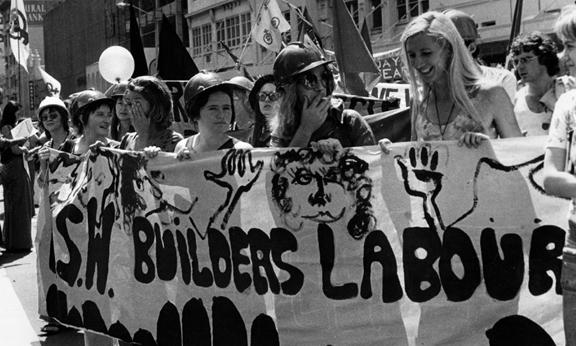
Double podcast episode about green bans by building workers in Australia from 1970 to 1975 which held up billions of dollars of development which would have been harmful to the environment, or working class and Aboriginal communities.

Our podcast is brought to you by our patreon supporters. Our supporters fund our work, and in return get exclusive early access to podcast episodes, bonus episodes, free and discounted merchandise and other content. Join us or find out more at patreon.com/workingclasshistory

In these episodes we speak with Dave Kerin, a former builders labourer and member of the Builders Labourers Federation (BLF) and current member of the Earthworker Collective, and Dr Meredith Burgmann, who was an active supporter of the green bans, co-authored Green Bans, Red Union: the Saving of a City with her sister Verity Burgmann, and was later a Labor member of parliament.

We have produced merch commemorating the BLF and the green bans here to help fund our work: shop.workingclasshistory.com/collection…green-bans

Listen to both parts of this podcast now, as well as an exclusive bonus episode, by supporting us on patreon: patreon.com/workingclasshistory

More information and full show notes here on our website: workingclasshistory.com/2020/10/30/e4…8-green-bans/

Working Class History: E48: The Green Bans, Part 2

By staff - Working Class History, January 2021

Concluding part of our double podcast episode about green bans by building workers in Australia from 1970 to 1975 which held up billions of dollars of development which would have been harmful to the environment, or working class and Aboriginal communities.

Our podcast is brought to you by our patreon supporters. Our supporters fund our work, and in return get exclusive early access to podcast episodes, bonus episodes, free and discounted merchandise and other content. Join us or find out more at patreon.com/workingclasshistory

In these episodes we speak with Dave Kerin, a former builders labourer and member of the Builders Labourers Federation (BLF) and current member of the Earthworker Collective, and Dr Meredith Burgmann, who was an active supporter of the green bans, co-authored Green Bans, Red Union: the Saving of a City with her sister Verity Burgmann, and was later a Labor member of parliament.

We have produced merch commemorating the BLF and the green bans here to help fund our work: shop.workingclasshistory.com/collection…green-bans

Listen to both parts of this podcast now, as well as an exclusive bonus episode, by supporting us on patreon: patreon.com/workingclasshistory

More information, transcripts and full show notes here on our website: workingclasshistory.com/2020/10/30/e4…8-green-bans/

Pages

The Fine Print I:

Disclaimer: The views expressed on this site are not the official position of the IWW (or even the IWW’s EUC) unless otherwise indicated and do not necessarily represent the views of anyone but the author’s, nor should it be assumed that any of these authors automatically support the IWW or endorse any of its positions.

Further: the inclusion of a link on our site (other than the link to the main IWW site) does not imply endorsement by or an alliance with the IWW. These sites have been chosen by our members due to their perceived relevance to the IWW EUC and are included here for informational purposes only. If you have any suggestions or comments on any of the links included (or not included) above, please contact us.

The Fine Print II:

Fair Use Notice: The material on this site is provided for educational and informational purposes. It may contain copyrighted material the use of which has not always been specifically authorized by the copyright owner. It is being made available in an effort to advance the understanding of scientific, environmental, economic, social justice and human rights issues etc.

It is believed that this constitutes a 'fair use' of any such copyrighted material as provided for in section 107 of the US Copyright Law. In accordance with Title 17 U.S.C. Section 107, the material on this site is distributed without profit to those who have an interest in using the included information for research and educational purposes. If you wish to use copyrighted material from this site for purposes of your own that go beyond 'fair use', you must obtain permission from the copyright owner. The information on this site does not constitute legal or technical advice.