You are here

green syndicalism

Going Slowly to 100% Renewables … by 2025?

By Dan Fischer - Peace News, April 5, 2020

It has been 55 years since the social ecologist Murray Bookchin argued that “wind, water, and solar power” (hereafter, WWS) could “amply meet the needs of a decentralized society” and eventually replace all fossil, nuclear, and bioenergy sources. The alternative, he warned, would be a future of “radioactive wastes,” “lethal air pollution,” “rising atmospheric temperatures,” “more destructive storm patterns,” and “rising sea levels.” Having declined to tear down its smokestacks, society has entered Bookchin’s dreaded scenario and, according to today’s scientists, accelerates toward “hothouse Earth,” “doomsday,” and even an “annihilation of all life.”

The urgency for reaching 100% WWS can’t be overstated. Leading climate scientists report that “tipping points could be exceeded even between 1 and 2°C of warming,” and today’s level is already at 1.2° and rapidly climbing. Moreover, society has pushed Earth past four other “planetary boundaries.” While all energy sources have an impact, small-scale WWS sources are by far the cleanest option available, and they also doesn’t involve nuclear power’s existential weapons proliferation risks.

It’s no wonder, therefore, that many Green New Deal supporters call for 100% WWS by 2030 or sooner. Activists in the United States and the United Kingdom are calling for zero emissions nationally by 2025, a stringent deadline that requires a very rapid phase-out of fossil and bioenergies and that necessarily excludes the lengthy construction of new nuclear power facilities and large-scale hydroelectric dams. The journalist Hazel Healy has even written about achieving zero emissions worldwide by 2025. To be sure, these targets are mind-bogglingly ambitious compared to, say, Joe Biden’s mid-century target. But if anything, 2025 is already pushing our luck from a climate and ecological perspective.

Wondering about the potential for rapidly reaching 100% renewable energy, I reached out to two of the most optimistic and two of the most pessimistic scholars on the technologies. Based on these conversations, I offer the following suggestion. Achieving 100% WWS within five to ten years, if it can be done at all, would likely require slowing down the industrialized world. It would mean abandoning what Michelle Boulous Walker calls today’s “culture of haste” and “relentless demand to decide, respond and act.” Instead of a frantic construction of hydrogen-powered airplanes and concrete-intensive high-speed rail, it would mean making most production local and most travel leisurely-paced. It would mean switching from full-time jobs to part-time crafts and hobbies, from patenting technology to sharing it, and from GDP to something like the Indigenous Environmental Network’s proposed “Index for Living Well.” While it’s common to read of “roadmaps” to WWS, we would probably get to the destination sooner with maps of biking trails and bus routes.

The Italian Workers Fighting Like Hell to Shut Down Their Workplaces

By Leopoldo Tartaglia - Labor Notes, March 22, 2020

Italy is the Western European country where the coronavirus pandemic spread first and where its tragic effects are being felt the most. As of March 17, the official data say 26,062 have tested positive in Italy for COVID-19, 12,894 have been hospitalized—including 2,060 in intensive care—and 2,503 have died.

The epidemic exploded in the richest and most industrialized regions of northern Italy. Lombardy is the most affected, followed by Emilia Romagna and Veneto.

Lombardy and Veneto are examples of one of the fundamental issues called into question by the pandemic crisis: the adequacy of the Italian health system, in particular the public one. Italy still has one of the best public health systems in the world. The health reform of 1978 established a universal and free health system, available to all citizens, financed by general taxation.

But this reform came at a time when the Italian Communist Party still existed and the Christian Democratic governments still had to deal with unions and the political power of the workers' movement. Since then, and with particular virulence since the late 1990s, three phenomena have overlapped which have weakened the system dramatically (even if, thanks to union struggles, they have not completely destroyed it): (1) the regionalization of the national health system, driven by agitation in the Northern Regions for secession; (2) the privatization of many health services, particularly in these regions; (3) European and national "austerity" policies that produced cuts in public spending and to worker pensions, cuts which have strongly affected public health.

In the last ten years, public health spending has been cut by 37 billion euros overall, with a huge reduction in hospital beds and a continuous drop in medical, nursing, and ancillary medical personnel. Today, there are probably no less than 50,000 doctors and 50,000 nurses missing from public health. The pandemic has highlighted the great shortage of intensive care facilities: in Italy there are 5,000 beds in ICU units for 60 million inhabitants. In France, with a few million more inhabitants, there are 25,000; in Germany there are 30,000 serving 80 million inhabitants.

The regionalization and the continuous cuts to state resources earmarked for health services—which are divided among the regions on the basis of "historical expenditure"—have led to the collapse of the public health system, especially in the Southern regions which, fortunately, are still to date the least affected by the pandemic. The drastic limitations on people's internal mobility should help limit the spread of contagion in these areas.

EMPLOYERS WANT PRODUCTION TO CONTINUE

In this context, workers and unions immediately mobilized to demand policies and procedures from the national government, regional governments, and employers which would guarantee the health and safety of workers and do the utmost to limit the spread of the virus.

The bosses, especially Confindustria (the General Confederation of Italian Industry, the largest employer association) but also small businesses (which are very common in the productive fabric of northern Italy), have insisted on the maximum functioning of all economic and production activities, including logistics and distribution, while asking that the emergency health measures imposed by public authorities not be mandatory, but simply recommendations.

They have insisted that the decision-making authority should remain in the hands of the companies, in a unilateral form, without any consultation with the unions on either a corporate or territorial level. The governors of Lombardy and Veneto have been "wavering" because on the one hand the drama of the situation in their regions required drastic measures to close down activities and oblige people to stay in their homes, but on the other hand they were subjected to strong pressure from their electoral base, companies, and small entrepreneurs who did not want to cease their economic activities in any way.

The turning point occurred on March 11, when the national government issued a decree that imposed the shutdown of a series of production and service activities and "required" everyone not to leave their homes except for proven reasons of “necessity.” But herein lies the problem: it is evident that essential public services and the whole agri-food chain—from production to retail distribution—should continue their activity, but why must other economic sectors continue their work, when the general precaution to slow down the spread of the virus is to sequester yourself in the house? And for those called to continue to work, what safety precautions for their health and the health of others exist at work? Suffice it to say that even in hospitals and health centers, with exhausting work shifts and scarce staff, there are not masks, gloves, overalls, or other necessary protective equipment for everyone!

Take the Plant Save the Planet (pamphlet)

By Green Jobs Oshawa - Socialist Project, March 22, 2020

On November 26, 2018, General Motors announced a number of plant closures in North America, the largest of which was in Oshawa, Ontario. The Oshawa facility, once the largest auto complex on the continent, was to end all its assembly operations by the end of 2019.

The issue is not simply a matter of bringing the environmental movement and the labour movement together; each must be transformed if the sum is to be more than the currently limited parts. The environmental movement must raise itself to a new level by concretely engaging the working class and the labour movement must escape what for it has become an existential crisis. The threats and opportunities of the environmental crisis offer a chance for labour revival, but only if this incorporates a renewed approach to organizing, struggle, radical politics, and the maximization of informed membership participation.

Read the report (PDF).

For a Sustainable Future: The Centrality of Public Goods

By Nancy Holmstrom - Socialist Register, Spring 2020

The most recent report of the UN’s Intergovernmental Panel on Climate Change (IPCC) makes it absolutely clear that ways of living in the twenty-first century must be premised on the existential threat to our survival posed by multiple ecological crises. Indeed it could all be over before the end of the century. If we do not radically suppress global CO2 emissions, global warming will rise to the point where it cannot be stopped. While not long ago the word ‘catastrophe’ seemed hyperbolic to many, today few could deny it is fitting. Melting glaciers, rising sea level, drought, fires, and flooding all over the world and the resulting migration are catastrophes for those who suffer them – and give us a taste of far worse catastrophes to come. Already the World Health Organization (WHO) estimates that there are 150,000 excess deaths per year due to climate change, likely to double by 2030.

After the 9-11 attack on the World Trade Center we heard the word ‘security’ incessantly, almost always invoked as intentional threats to our safety and well-being, which of course means they are threats by people, whether they be individuals, groups, or nations. Global warming, on the other hand, is a threat from nature that is an unintended result of human action – not what is usually intended by a ‘security’ threat, and it does not grip our imagination and fears in any way proportional to its severity. But it is not only intentional acts that can threaten our safety and well-being. Once threats to our security are conceived more broadly, consider the greater dangers from unclean air and water and contagious diseases, whatever the mix of intentional and unintentional acts that created the problem.

Download (PDF).

Motion: climate strikes and COP26

By RS21 members - RS21, January 18, 2020

As temperature records tumble and states fiddle while the world burns, we can’t afford to wait five years for a new government to tackle the climate emergency. Convergence between the climate movement and the labour movement offers the only hope of averting catastrophe. rs21 members have produced a model motion you can adapt and use in unions and the Labour Party to popularise the idea of a climate strike on International Workers’ Day, 1 May 2020, mobilise for the COP26 climate summit in Glasgow in November, and organise for action on climate in every workplace.
You can download a PDF copy of the motion here.

This (branch/region/committee/trades council/union/conference) notes the urgent need for action on the climate emergency, both in response to existing negative impacts such as extreme weather, fires, droughts, floods and loss of habitat and species; and to avoid the catastrophic and irreversible climate damage which people increasingly realise the world is on course for, after the 2018 Intergovernmental Panel on Climate Change (IPCC) report.

We recognise that big business, the military and the richest individuals are responsible for the vast majority of climate change, yet the global working class and poor are disproportionately at risk. A just transition (that protects the lives, livelihoods and rights of the working class, poor and disadvantaged) to a decarbonised economy is not only right, but is the only way the movement against climate chaos will secure the mass support needed to win, and avoid a rich minority protecting themselves at the expense of the planet and the vast majority of people.

We congratulate the school students striking around the world for real climate action and welcome the decision of the TUC to support them and call for a solidarity stoppage. We note that many workers did strike on 20 September 2019, despite Britain’s repressive legislation, by campaigning to pressure employers not to apply sanctions to climate strikers.

We note that there is discussion about the possibility of making Friday 1 May 2020, traditionally International Workers’ Day, also a climate strike. We note that the UN ‘COP’ climate change conferences have become a major focus for campaigners, that COP26 will be taking place in Glasgow from 9-20 November 2020, and that many organisations are already making plans.

First U.S. Union-Authorized Climate Strike?

By Jeremy Brecher - Labor Network for Sustainability, March 2020; images by SEIU Local 26

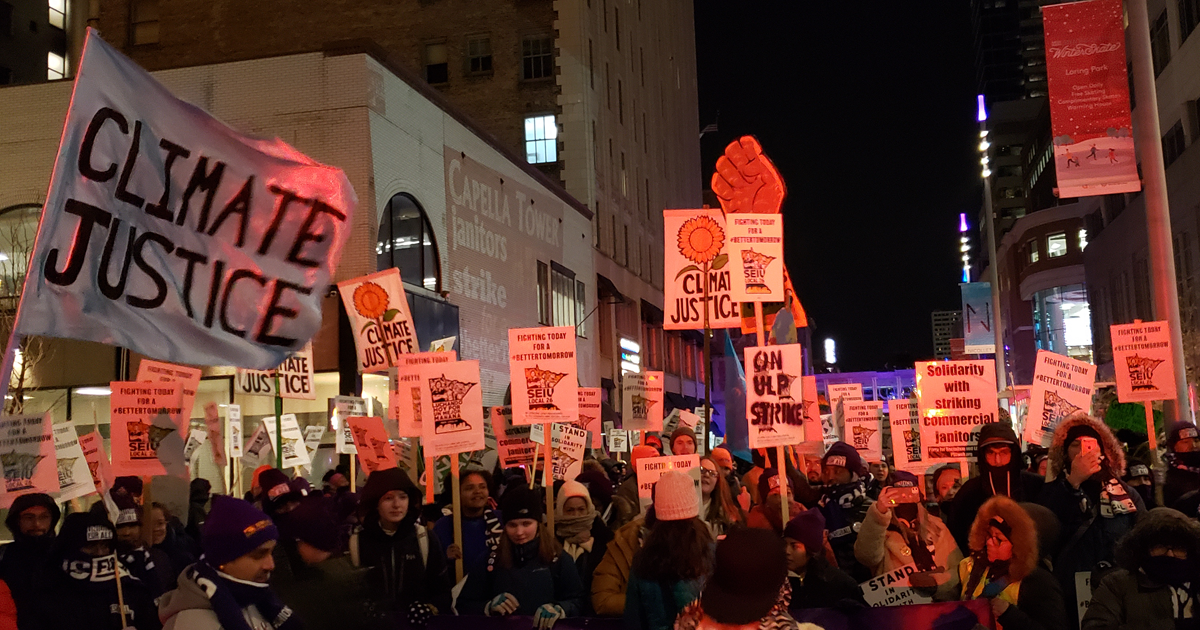
Above: Thousands of Minneapolis cleaning workers walked off their jobs and struck their downtown commercial high-rises. Among their key demands was that their employers take action on climate change. Quite possibly the first union sanctioned strike in the U.S. for climate protection demands. Credit: SEIU Local 26.

It isn’t easy for unions to strike to protect the climate. U.S. labor law doesn’t make it easy to strike over anything except wages, hours, and working conditions – even over things like climate change that profoundly affect workers and their future. So it was important news when Minneapolis commercial janitors held an Unfair Labor Practices strike this week to protest employer stalling – including on demands that their employers help fight climate change. This is the third in a series of commentaries on The Future of Climate Strikes. For the entire series see here.

On Thursday February 27 thousands of Minneapolis cleaning workers walked off their jobs and struck their downtown commercial high-rises. Among their key demands was that their employers take action on climate change. It was one of the first—as far as I have been able to discover, the very first—union sanctioned strike in the U.S. for climate protection demands.

The janitors are members of Service Employees International Union Local 26. They are employed by over a dozen different subcontractors like ABM & Marsden to clean corporate buildings like IDS, Capella Tower, EcoLab, U.S Bank, Wells Fargo, United Health Group, Ameriprise and many more across the Twin Cities.[1] The workers are overwhelmingly immigrants and people of color. One observer described the meeting authorizing the strike as “a rainbow coalition of immigrants from all over the world and people from every race and religion in the state.” The union provided simultaneous interpretation into Spanish, Somali, Vietnamese, Amharic, and Nepalese.[2]

I wanted to know something about the background to the strike, so I called Steve Payne, who wrote an excellent article about plans for the strike in Labor Notes.[3] He spent years as an organizer for Local 26 and now works for the North Star chapter of the Sierra Club. Much of this commentary is informed by my discussion with him.

Twin Cities Janitors and Guards Feature Climate and Housing in Their Strike Demands

By Steve Payne - Labor Notes, February 20, 2020; images by SEIU Local 26

“Twin Cities janitors and security officers vote to authorize strike over pay and sick leave,” read the headline in the Minneapolis Star Tribune.

It’s true that those are among the workers’ top demands. But Service Employees (SEIU) Local 26’s fight is also for something bigger: affordable homes and a healthy planet for us all.

The union is demanding that companies negotiate over climate emissions and pay more to support affordable housing.

On February 8, 500 janitors, security officers, and their allies crowded into a warehouse space normally used for photo shoots. Banners lined the walls as people waved signs.

Local 26 has lined up every single one of its contracts, covering 8,000 workers, for this moment. Commercial office janitors, retail janitors, security officers, window cleaners, and airport workers are all fighting simultaneously.

The room was a rainbow coalition of immigrants from all over the world and people from every race and religion in the state. The union provided simultaneous interpretation into Spanish, Somali, Vietnamese, Amharic, and Nepalese. Chants in multiple languages filled the air.

Supporters from other unions and the city’s regional labor federation were there, along with a more unusual set of allies—representatives of the state’s environmental movement, including MN350 and young climate strikers.

Know the Union: Steve Ongerth

By Editorial Collective - Industrial Worker, Fall 2019; IWW leaflet hand drawn by Judi Bari, October 1989.

How would you like your name printed? (Options include first and last, first and last initial, first, X-number, etc. It’s completely up to you)

Steve Ongerth

What are your pronouns?

He/Him

What branch or local are you affiliated with?

Bay Area IWW GMB

Do you hold a local or national office? If so, what is it?

No

Why did you join the IWW?

I was inspired to join by reading the work of Judi Bari (“Timber Wars”) and greatly appreciating her green syndicalism (she was also an IWW member) in 1995.

Why have you stayed?

I believe in what the IWW stands for and its potential (in spite of its imperfections and limitations).

Is there a wobbly (current or historical) you most admire? 

Judi Bari (of course! And I actually was friends & comrades with her from the time I met her and joined the IWW in May 1995 until she passed away in 1997).

The revolution is over, the wage system is abolished, we installed whatever post-capitalist system you prefer. What are you doing Saturday?

Hiking in the woods or along the Bay (which hopefully isn’t drowning the SF Bay Area due to climate change and sea level rise)

What are you working on right now (union-wise)?

I am one of the cofounders of and active organizers of the IWW Environmental Unionism Caucus (I also maintain its webpage https://ecology.iww.org) I am also the Bay Area IWW Tabling Coordinator.

Regenerative & Just 100% Policy Building Blocks Released by Experts from Impacted Communities

By Aiko Schaefer - 100% Network, January 21, 2020

The 100% Network launched a new effort to bring forward and coalesce the expertise from frontline communities into the Comprehensive Building Blocks for a Regenerative and Just 100% Policy. This groundbreaking and extensive document lays out the components of an 100% policy that centers equity and justice. Read the full report here.

Last year 100% Network members who are leading experts from and accountable to black, indigenous, people of color (BIPOC) and frontline communities embarked on a collective effort to detail the components of an ideal 100% policy. The creation of this 90-page document was an opportunity to bring the expertise of their communities together.

The Building Blocks document was designed primarily for frontline organizations looking to develop and implement their own local policies with a justice framework. Secondly, is to build alignment with environmental organizations and intermediary groups that are engaged in developing and advocating for 100% policies. The overall goals of the project are to:

  • Build the capacity of BIPOC frontline public policy advocates, so that impacted community groups who are leading, working to shape or just getting started on 100% policy discussions have information on what should be included to make a policy more equitable, inclusive and just
  • Align around frontline, community-led solutions and leadership, and create a shared analysis and understanding of what it will take to meet our vision for 100% just, equitable renewable energy.
  • Create a resource to help ensure equity-based policy components are both integrated and prioritized within renewable energy/energy efficiency policies. 
  • Build relationships across the movement between frontline, green, and intermediary organizations to create space for the discourse and trust-building necessary to move collaboration forward on 100% equitable, renewable energy policies. 

Power to the People: Winning public control of electric utilities

By Juliana Broad - Next System Project, January 10, 2020

The devastation wrought in recent years by preventable wildfires, targeted power shutoffs, and exorbitant rate hikes—with their hefty cost to life, health, and livelihoods—has made it clear that the for-profit model of electric utility provision has definitively failed. However, alternatives to this broken system have not only been proposed, but are gaining substantial traction. In the past few years, we’ve witnessed an eruption of support for taking back public control over electric utilities from absentee investors. With the public in charge, we can provide cheaper services—across the board, publicly owned utilities provide lower rates than investor-owned ones—and push for renewable energy to address the economic, environmental, and racial justice issues that are necessarily intertwined with how we meet our energy needs. 

But wresting control of our utilities from powerful corporate interests is not easy, and the community organizations and elected officials pushing for these changes have pursued a variety of strategies not only to change the narrative around public ownership⁠—long denigrated and vilified by profit-hungry private interests⁠—but to win the concrete, systemic changes we need to have an economy that serves our communities. Here, we highlight some of the wins, losses, and ongoing fights for public control of power that are playing out across the country at the city and state level.

Disasters Spark Public Ownership Campaigns

Pages

The Fine Print I:

Disclaimer: The views expressed on this site are not the official position of the IWW (or even the IWW’s EUC) unless otherwise indicated and do not necessarily represent the views of anyone but the author’s, nor should it be assumed that any of these authors automatically support the IWW or endorse any of its positions.

Further: the inclusion of a link on our site (other than the link to the main IWW site) does not imply endorsement by or an alliance with the IWW. These sites have been chosen by our members due to their perceived relevance to the IWW EUC and are included here for informational purposes only. If you have any suggestions or comments on any of the links included (or not included) above, please contact us.

The Fine Print II:

Fair Use Notice: The material on this site is provided for educational and informational purposes. It may contain copyrighted material the use of which has not always been specifically authorized by the copyright owner. It is being made available in an effort to advance the understanding of scientific, environmental, economic, social justice and human rights issues etc.

It is believed that this constitutes a 'fair use' of any such copyrighted material as provided for in section 107 of the US Copyright Law. In accordance with Title 17 U.S.C. Section 107, the material on this site is distributed without profit to those who have an interest in using the included information for research and educational purposes. If you wish to use copyrighted material from this site for purposes of your own that go beyond 'fair use', you must obtain permission from the copyright owner. The information on this site does not constitute legal or technical advice.

