

You are here

green unionism

What’s Wrong with Single Employee Train Operations?

By Ron Kaminkow - Railroad Workers United, March 2021

At first glance, the casual observer from outside of the rail industry is prone to say that single employee train operation sounds dangerous. “What if the engineer has a heart attack?” is an often heard question. And while this question has merit, there are many other and far more complex and unanswered questions about just how single employee train operations could be accomplished safely and efficiently for the train crew, the railroad and the general public. How will the train make a back-up move? What happens when the train hits a vehicle or pedestrian? How will the train crew member deal with “bad-order” equipment in his/her train, or make pick-ups and set-outs en route? What about job briefings and calling signals, copying mandatory directives and reminders of slow orders? These are just some questions that we take up in this article.
Remote Control and “Utility Conductors”

In recent years, the Class I rail carriers have been biding their time, slowly but surely inserting language into recent contracts with both unions of the operating crafts that will facilitate their schemes to run over the road trains with a lone employee. They have made arrangements with the Brotherhood of Locomotive Engineers & Trainmen (BLET) to allow the BLET represented crew member to make use remote controlled locomotives. With this scenario, the lone operator would strap on a belt pack, dismount from the locomotive, and run the locomotive by remote control operation (RCO) using radio control from the ground. And the carriers have also made deals with the United Transportation Union (UTU) to allow for “utility conductors”; i.e. a conductor who can “attach” to one or more over-the-road trains during the course of a single tour of duty. Between the two arrangements, the rail carriers apparently believe they can safely and efficiently operate road trains with just one employee aboard as opposed to the current standard of two. We disagree.

Extraction, Extremism, Insurrection: Impacts on Government Employees

One of the Best Places to Fight for the Environment Is in Your Workplace

By Libronaught - Medium, February 24, 2021

One of the biggest roadblocks standing in the way of practical, cooperative solidarity between social movements is the idea of “separate issues.” In recent years people have begun chipping away at this shibboleth, but we still have a ways to go. One significant problem within the problem of the single-issue silo effect is that labor is sometimes mistakenly viewed as just another issue.

Labor is not just an issue. Labor is a power base. Labor organizing can be more effective at winning social gains on a range of “single issues” than weekend demonstrations, conscious consumerism, electioneering or lobbying.

In the US, we are often taught to view voting, lobbying and mass demonstrations as ways to participate in democracy. They all are, of course, but it’s not the full picture. As Jane McAlevey persuasively explains in her extraordinary book, A Collective Bargain, US democracy as we know it today would not exist if not for the labor movement. The organizing and solidarity efforts among US workers that eventually won the 8-hour day and the weekend began right after the American Revolution. Labor solidarity and organizing among women has put a driving force behind demands for gender equality for over 150 years. From the 1910s to the 1940s, a massive swell of labor solidarity and organizing crossed race and gender lines, won the current US Labor Rights laws, and led the country out of the Great Depression. Labor unions went on to participate in the 60s Civil Rights movements.

How will electrification of vehicles impact auto workers?

By Elizabeth Perry - Work and Climate Change Report, February 23, 2021

Threats to traditional auto manufacturers are outlined in “The top trends killing the auto industry” in Corporate Knights (Feb. 3), including the climate crisis, the fall of fossil fuels, electrification and autonomous EV fleets, unfunded pension liabilities (US$14.4 billion for G.M., US$10.2 billion for Ford), as well as shifting government policies, and dampened demand in general. All the more reason to celebrate the good news about investment in EV production in Canada by GM, Ford and Fiat-Chrysler , as well as GM’s January 2021 announcement that it will sell only zero emissions vehicles by 2035. In February, Ford announced its target to sell EV’s only in Europe. But the good news is complicated, as described in “Auto industry peers into an electric future and sees bumps ahead” (Washington Post, Feb. 6) , and by “Canada and the U.S. auto sector’s abrupt pivot to electric vehicles” (National Observer, Feb. 15) . For Canada, the challenges include competition for the development of battery technology and the policy challenge of the new “Made in America” Executive Order by President Biden on January 25. Despite the brief and optimistic overview presented in “Jerry on the Job: How the president of Canada’s largest union, Jerry Dias, is driving the country’s electric vehicle push” (Corporate Knights, Feb. 4), our highly integrated North American auto industry has a complicated path forward. 

One of the most important issues ahead is how the conversion to electric vehicles will impact the jobs of current auto workers. In late 2020, Germany’s Fraunhofer Institute for Industrial Engineering conducted a detailed study of this issue on behalf of the Sustainability Council of the Volkswagen Group. Employment 2030 Effects Of Electric Mobility And Digitalisation on the Quality and Quantity of Employment at Volkswagen (Nov. 2020) is an English-language summary of the full, detailed study, which modelled the impacts of digitization and electrification in the industry. Although the study is specific to VW production in Germany, its findings are instructive, and include that job losses will be less than anticipated, ( a decrease of 12 percent in this decade, mainly due to planned output volumes and higher productivity). Digitization will result in a need for new skills, “will necessitate a profound change in corporate culture”, and will include higher employee expectations for job flexibility. A summary appearing in Clean Energy Wire states: “ …. there is no uniform employment trend in the ‘transformation corridor’ over the coming decade. Instead, there will be a complex, interconnected mixture of job creation, job upgrading and job cuts. It argues that it will be vital to ensure that small and medium-sized enterprises (SMEs) do not fall victim to this reorganisation, and warns that Germany’s automotive sector must establish new forms of cooperation so as not to “recklessly surrender the field of mobility to new market players.” The study is also summarized in a press release by VW (with links to the full study in German).

Phasing Out Fossil Fuels: A Just Transition in the Oil & Gas Drilling and Refining Sectors

Canadian university pension funds unite for low carbon goals, and public sector pension funds across the country act on sustainability

By Elizabeth Perry - Work and Climate Change Report, February 22, 2021

With the goal to leverage their collective financial clout, Canadian university endowment funds and pension plans launched the University Network for Investor Engagement (UNIE) on February 18. Working through SHARE, Canada’s leading not-for-profit in responsible investment services, “The UNIE initiative will focus on key sectors where advocacy can make the biggest difference, including finance, transportation, energy and utilities, and manufacturing, focusing both on reducing greenhouse gas emissions and accelerating the transition to a low carbon economy.” Initial participants include Carleton University, Concordia University, McGill University, McMaster University, Mount Alison University, Université de Montreal, University of St. Michael’s College, University of Toronto Asset Management, University of Victoria, and York University.

This development follows on a number of statements and initiatives by Canadian pension administrators – most of which reflect this general strategy to prefer engagement as shareholders over divestment from fossil fuel holdings. Some examples:

In November 2020, the CEOs of Canada’s eight major pension administrators, with approximately $1.6 trillion in assets under management, issued a press release announcing their joint position statement, Companies and investors must put sustainability and inclusive growth at the centre of economic recovery. The text calls on companies to provide consistent and complete environmental, social, and governance (ESG) information, and continues: “For our part, we continue to strengthen our own ESG disclosure and integration practices, and allocate capital to investments best placed to deliver long-term sustainable value creation.” The signatories included: AIMCo, BCI, Caisse de dépôt et placement du Québec, CPP Investments, HOOPP, OMERS, Ontario Teachers’ Pension Plan, and PSP Investments.

Why are Ontario pensioners investing in future Alberta stranded assets?” (in Corporate Knights, December 16, 2020) describes investment by OP Trust (which holds the pension funds of Ontario civil servants, teachers and healthcare workers) in a natural gas electricity-generation plant in Alberta. The authors summarize the growing global realization that fossil fuel investments are financially risky and conclude, “The people at OPTrust have begun to recognize this. They’ve created multiple reports, with pretty graphs and rosy statements about supporting the Paris Agreement. But this statement rings out: “Emission reduction targets are not today’s objective.” Like many other organizations, they are unwilling to walk the talk.”

Silicon Valley Bus Drivers Restored Community Rides for Free—By Taking Matters into Their Own Hands

By Richard Marcantonio - Labor Notes, February 17, 2021

With Covid cases surging in their ranks, bus drivers in Santa Clara, California, demanded to resume rear-door boarding, which is proven to reduce the risk of infection.

Management of the Valley Transportation Authority (VTA) balked, even blaming the workers for getting sick. Pressure mounted from the leadership of Transit (ATU) Local 265, and from rider and community groups.

But it was rank-and-file bus drivers who forced management’s hand when they started planning to stop boarding at the front door whether the agency agreed or not.

Bosses prefer anything to allowing workers to run the company. On February 3, the agency announced that it would resume rear-door boarding.

COVID SURGE AT VTA

Santa Clara County, in the heart of Silicon Valley, is where Covid claimed what was believed to be its first U.S. victim on March 6, 2020. (In fact, several February deaths in the county were later determined to be Covid-related.) By March 19, VTA had stopped collecting fares to reduce contact between bus drivers and passengers at the front door.

Rear-door boarding is a no-brainer during a pandemic. Bus drivers reported story after story of passengers fumbling to get their bills into the farebox or taking off their masks to chat. Boarding at the rear door created a safe distance between riders and the driver, protecting both.

Rear-door boarding also has a secondary benefit. Because the only farebox in a VTA bus is located at the front door, it meant the public would ride for free. At a time when many were calling for free public transportation, and some transit agencies in the U.S. and abroad had already eliminated fares, this additional shared interest attracted more community support for the union’s demands.

On August 1, however, claiming “We have done our part to protect our customers,” VTA resumed collecting fares at the front door. Little had changed to justify the move, other than the installation of what one bus driver described as a “janky plastic barrier” that did little to keep airborne microbes from finding their way from boarding passengers to the driver or vice versa.

VTA’s decision had serious consequences for transit workers. Only 15 had fallen ill with Covid before August, while riders boarded at the rear; 72 cases were confirmed from August through Christmas. One bus driver, Audrey Lopez, lost her life to Covid. The new year started off even worse, with more than 60 positive tests in January alone.

Texas: grids, blackouts, and green new deals

By Jonathan Neale - The Ecologist, February 17, 2021

The failure of the electricity grid in Texas, USA, and the rolling blackouts in the Midwest, are one more consequence of climate breakdown.

The root problem is that the Arctic is growing warmer. As it does so, paradoxically, there is less of a barrier preventing very cold weather in the far north from moving south. This extremely cold weather then blankets cities and downs where people live. 

Download Fight the Fire for free now.

The electricity grid in Texas simply cannot supply enough power for all the extra demands on heating. This is a problem what will grow much worse, and not just in Texas.

Complexity

But Fox News and the Governor of Texas are blaming the failure of the grid on the Green New Deal and renewable energy. That’s silly.

There is no Green New Deal in Texas. There are some wind turbines, that have apparently frozen. But the wind turbines in Canada and Antarctica have not frozen.

This is a problem caused by fossil fuels and privatized energy, not wind trubines.

But environmentalists have to be careful here, and we have to be up to speed on the full complexity of what a Green New Deal will mean for electricity grids.

That’s why The Ecologist is posting here the chapter on supergrids from my new book, Fight the Fire: Green New Deals and Global Climate Jobs.

Power

In what follows, I explain the difficulties in integrating 100 percent renewable energy into the grid, and how it can be done. I also show why that will be impossible if renewable energy and electricity supply are owned by private corporations.

The chapter is about supergrids around the world, but many of the examples come from the United States.

A rewired world does not mean that all energy will come from renewables. But it does mean that most energy will come from electricity, and all that electricity will come from renewables.

That will not be an easy thing to construct. We will need new national and international supergrids to integrate all these new kinds of power into new electrical supply systems. These will be qualitatively new undertakings.

The challenge of mixing together power from renewable energy is different in kind from mixing together energy from fossil fuels – and far more complex.

Bows and Arrows: Indigenous Workers, IWW Local 526, and Syndicalism on the Vancouver Docks

By Jeff Shantz - LibCom.Org, February 17, 2021

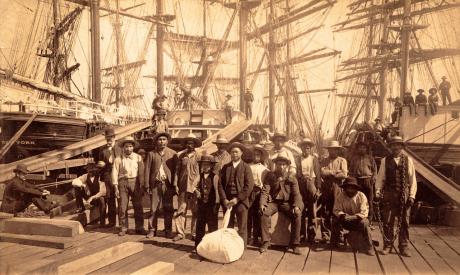
Few may be aware that the first union on the waterfront of Vancouver was organized by Indigenous workers, mostly Squamish and Tsleil-Waututh. And it was organized on an explicitly syndicalist basis as Local 526 of the Industrial Workers of the World (IWW). The IWW group would become known as the Bows and Arrows, a name that spoke to their active and more politically militant perspective and commitment to Indigenous solidarity. The Bows and Arrows organized on a multicultural/multiracial foundation of class solidarity.

While the lifespan of IWW Local 526 was brief (formally only a year while informally for about seven years) it had a lasting impact on working class organizing on the waterfront, anti-racism and racial solidarity on the docks, and on political organizing in Indigenous communities. It also showed the pivotal role of organizing within the logistical chains of global capitalism in sabotaging resource extractive industries, while providing a model of work organization that sustained community relevant work and work cycles rather than the single career monoculture of industrial capitalism at the time.

As historian Andrew Parnaby suggests, the Bows and Arrows:

"Join[ed] in the broader upsurge of support for the Wobblies that took place among loggers, miners, railroad workers, and seafarers prior to the Great War…Reformers, rebels, and revolutionaries: collectively, they were responsible for a level of militancy on the waterfront that was unmatched by most other occupations, provincially or nationally. Vancouver waterfront workers went on strike at least sixteen times between 1889 and 1923; the four largest and most dramatic strikes were in 1909, 1918, 1919, and 1923." (2008, 9)

While Local 526 would finally be broken through battles with waterfront employers that have been described as titanic, these workers provided important and lasting examples of working class militance, workplace organizing tactics, racial solidarity and anti-racism, and cultural defense. They offer a critical model of syndicalism in diverse workforces and changing economic conditions within a context of settler colonial capitalism.

Leveraging Strategic Position, Argentine Vegetable Oil Workers Win Big Raises with Coordinated Strike

By Julia Soul and Ernesto Torres - Labor Notes, February 16, 2021

Argentina’s vegetable oil workers ended 2020 on a high note, with a triumphant 21-day national strike for higher wages. They were pushing to make the minimum wage a living wage, as the constitution mandates.

Pages

The Fine Print I:

Disclaimer: The views expressed on this site are not the official position of the IWW (or even the IWW’s EUC) unless otherwise indicated and do not necessarily represent the views of anyone but the author’s, nor should it be assumed that any of these authors automatically support the IWW or endorse any of its positions.

Further: the inclusion of a link on our site (other than the link to the main IWW site) does not imply endorsement by or an alliance with the IWW. These sites have been chosen by our members due to their perceived relevance to the IWW EUC and are included here for informational purposes only. If you have any suggestions or comments on any of the links included (or not included) above, please contact us.

The Fine Print II:

Fair Use Notice: The material on this site is provided for educational and informational purposes. It may contain copyrighted material the use of which has not always been specifically authorized by the copyright owner. It is being made available in an effort to advance the understanding of scientific, environmental, economic, social justice and human rights issues etc.

It is believed that this constitutes a 'fair use' of any such copyrighted material as provided for in section 107 of the US Copyright Law. In accordance with Title 17 U.S.C. Section 107, the material on this site is distributed without profit to those who have an interest in using the included information for research and educational purposes. If you wish to use copyrighted material from this site for purposes of your own that go beyond 'fair use', you must obtain permission from the copyright owner. The information on this site does not constitute legal or technical advice.
