You are here

just transition

Just Transition Strategies: Workers and the Green Revolution

At TUED Global Forum, Scottish TUC Calls for Public Energy in preparation for COP26 in Glasgow: STUC General Secretary Roz Foyer delivers call for “A People’s Transition to Net Zero”

By Staff - Trade Unions for Energy Democracy, August 16, 2021

On August 11, TUED convened its latest Global Forum, to take up the question: "COP26: What Do Unions Want?"

The Forum saw contributions from COP26 host national center, the Scottish Trades Union Congress (STUC), the UK Trades Union Congress (TUC), the International Transport Workers Federation (ITF), Trade Union Confederation of the Americas (TUCA), the UK’s Public and Commercial Services Union (PCS), and Public Services International (PSI).

Nearly 150 participants joined the call, from 69 unions in 40 countries around the world.

The forum opened with remarks from Roz Foyer, General Secretary of the STUC. As the national trade union center for Scotland, with 40 affiliated unions as of 2020, the STUC represents over 540,000 trade unionists. Based in Glasgow, STUC will play host to trade unionists from around the world at COP26, in partnership with the UK’s TUC. (The recording of Foyer’s full contribution is available here.)

Foyer began by highlighting the STUC’s domestic campaigning priorities in Scotland in preparation for COP26, noting that these “chime in very closely with the TUED approach”:

We are first and foremost striving at the moment to build a genuine people’s recovery from the pandemic, and that people’s recovery that we are calling for is about calling for systematic changes to how our economy is organized, and really shifting the narrative around “private = good, public = bad.” And we’re also wanting to see our economy being rebuilt on a just transition. Everyone talks about a ‘just transition’ for workers, but we don’t believe that that just transition is being carried out by governments at this time. So we want to see a people’s recovery from the pandemic and a people’s transition to net zero.

The Covid crisis and the climate crisis have both brought into sharp focus the fact that the private sector and big business have proven themselves as being totally unable to meet the economic and social challenges that economies across the world now face. I think the writing was already on the wall when ordinary people through their governments were forced to bail out the banks during the financial crisis of 2010. And the latest incarnation of this are the various government rescue plans that we’ve seen across the world during covid, which, however necessary to save jobs in the short term, have really been largely focused on bailing out the bosses and the private sector.

So as we look forward to the vital need to decarbonize and achieve net zero through a Just Transition, it’s quite unthinkable that this could be achieved without massive government intervention, and without the efficiency and accountability that can only be delivered by direct, public sector delivery.

Turning to preparations for COP26, Foyer emphasized that the STUC’s approach is to use COP26 as a campaigning and leveraging opportunity, and as a means to build awareness and working class power, and make demands to government which are rooted in the real material needs of working people in Scotland. Towards that end, STUC has identified three campaign priorities which they will focus on in the months leading up to COP26.

Agreement reached to save Terra Nova offshore oil and gas field in Newfoundland

By Elizabeth Perry - Work and Climate Change Report, June 16, 2021

UPDATE: As reported by CBC News on June 16 in “New hope for Terra Nova as Suncor announces tentative deal to save N.L. oilfield” , and by a Unifor press release, an agreement in principle has been reached to restructure ownership of the Terra Nova oil fields, offering a path forward which may save the jobs of the workers. Details are not yet available, but Suncor will increase its equity stake and previous owners may participate in the new structure, contingent on the province honouring its commitment to provide $205 million from the oil industry recovery fund, and some $300 million in royalty relief .

Workers demonstrated outside the Newfoundland legislature on June 14 and 15 , as politicians debated inside about the fate of the Terra Nova oil field and an ultimatum from Suncor Energy, asking for the government to buy the assets of the Terra Nova FPSO, an offshore production and storage platform which employed nearly 1,000 workers in 2019, which is the last time oil was produced. Suncor is the last company remaining in the consortium which owned the oil field. The complexity of the situation is described in several CBC articles, including: “Talks to save Terra Nova oilfield collapse after N.L. government rules out equity stake” (June 10), and “As deadline for Terra Nova approaches, pressure mounts to save troubled oilfield” (June 11). To date, the government has refused to buy the asset, saying that the risks are too great because the oilfield is estimated to be 85% depleted. Instead, it has agreed to provide about $500 million in cash and incentives to the company. As of June 16, Suncor Energy has still not announced a decision, as reported by CBC in “Terra Nova deadline comes — and goes — without word of its fate” .

Unifor Local 2121 represents the workers at Terra Nova, and organized the demonstrations at the legislature. Unifor describes the rally here, and in this press release asserts that the Terra Nova decision is a harbinger of the future of the Newfoundland oil and gas industry.

Clean energy jobs as a transition destination

By Elizabeth Perry - Work and Climate Change Report, June 15, 2021

Released on June 3, Responding to Automation: Building a Cleaner Future is a new analysis by the Conference Board of Canada, in partnership with the Future Skills Centre. It investigates the potential for clean energy jobs as a career transition destination for workers at high risk of losing their jobs because of automation. The clean energy occupations were identified from three areas: clean energy production, energy efficiency , and environmental management and the “rapid growth” jobs identified range from wind turbine technicians and power-line installers to industrial engineers, sheet metal workers, and geospatial information scientists. Based on interviews with clean economy experts, as well as the interview responses from over five hundred workers across Canada, the analysis identifies the structural barriers holding employers and workers back from transition:

  • Lack of consistent financial support for workers to reskill
  • Employer hesitancy to hire inexperienced workers
  • Current demand for relevant occupations which makes change less attractive
  • Lack of awareness around potential transition opportunities
  • Personal relocation barriers, such as high living costs in new cities, and family commitments.

None of the recommended actions to overcome the barriers include a role for unions, with the burden for action falling largely on the individual employee. Only summary information is presented as a web document, but this research is part of a larger focus on automation, so it can be hoped that a fuller report will be published – if so, the partner group, Future Skills, maintains a Research website where it will likely be available.

Other news about renewable energy jobs:

“Renewable Energy Boom Unleashes a War Over Talent for Green Jobs” appeared in Bloomberg Green News (June 8), describing shortages of skilled workers in renewable energy, mainly in the U.S.. It also summarizes a U.K. report which forecasts a large need for workers in the U.K. offshore industry, which is expected to be met by people transferring from the oil and gas sector.

A report by the Global Wind Energy Council forecasts a growth of 3.3 million wind jobs worldwide by 2025, and suggests that offshore wind energy jobs could offer a natural transition for workers dislocated from offshore oil and gas and marine engineering workers. According to the analysis, in 2020, there were approximately 550,000 wind energy workers in China, 260,00 in Brazil, 115,000 in the US and 63,000 in India. A related report, The Global Wind Workforce Outlook 2021-2025 forecasts a large training gap: the global wind industry will need to train over 480,000 people in the next five years to construct, install, operate and maintain the world’s growing onshore and offshore wind fleet. That report is available for download here (registration required), and is summarized in this press release.

And forthcoming: Clean Energy Canada will release its research on the clean energy labour market in Canada on June 17. Their last jobs report, The Fast Lane: Tracking the Energy Revolution, was released in 2019.

Labor-Backed Report on Path to Equitable Green California

By Staff - Sunflower Alliance, June 10, 2021

Nineteen labor organizations—including unions representing refinery workers in Northern and Southern California and the Alameda Labor Council— have endorsed a detailed plan for an equitable transition to a clean-energy economy in California.

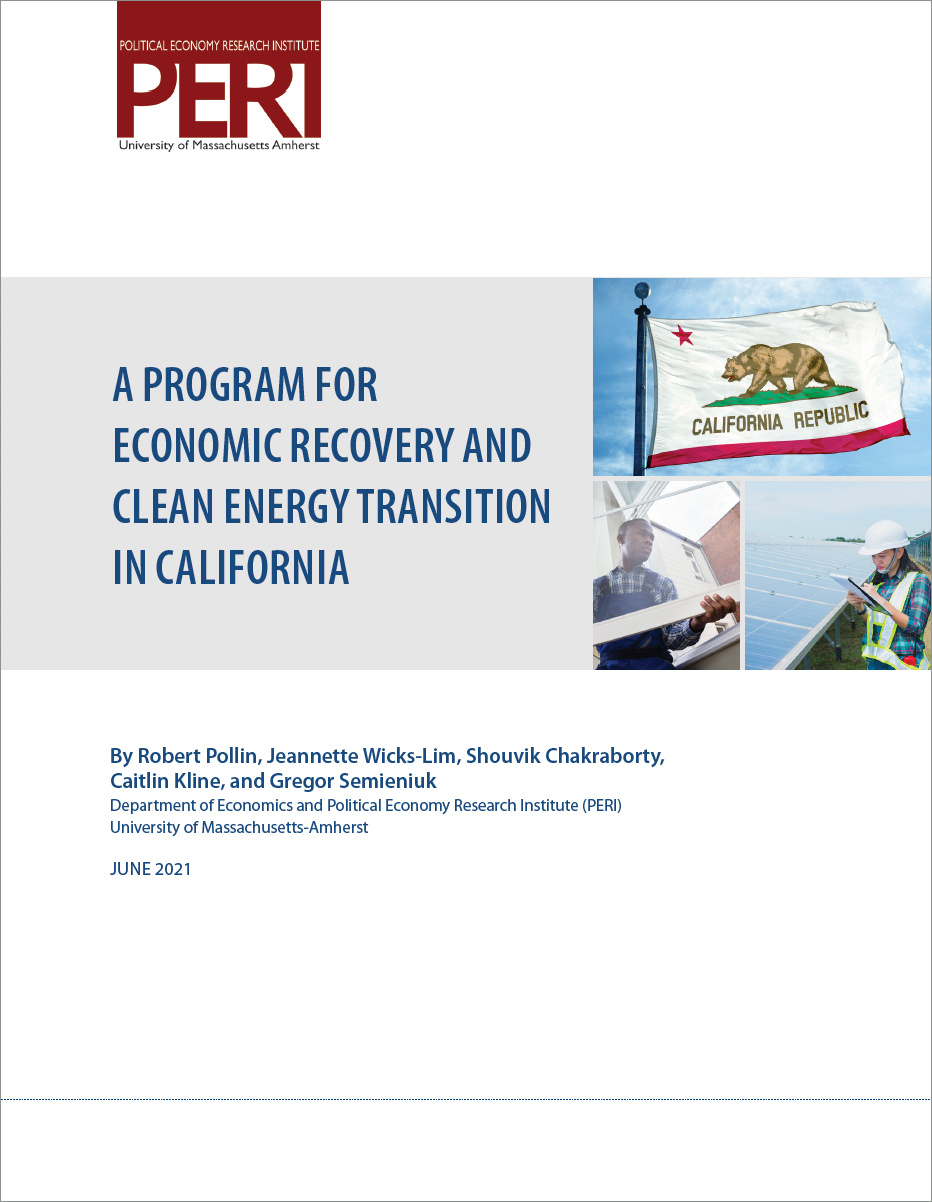
This major new report, A Program for Economic Recovery and Clean Energy Transition in California, details programs for meeting California’s 2030 climate goal (40 percent economy-wide reduction in greenhouse gas emissions from the state’s 1990 level) by creating roughly 418,000 jobs. It argues that state policy should ensure that the jobs created are good-paying jobs with full labor rights and access by historically excluded people.

The same strategies, the report says, could be continued to meet California’s longer-term goal of being carbon-neutral by 2045.

The report was commissioned by the American Federation of State, County and Municipal Employees Local 3299, the California Federation of Teachers, and the United Steelworkers Local 675. Its authors are faculty members of the University of Massachusetts at Amherst, including Robert Pollin, a leading expert on just transition.

The report provides detailed calculations for strategies outlined in an earlier report, Putting California on the High Road, from the UC Labor Center. Both reports emphasize the need for measures to protect fossil fuel industry workers including:

  • Pension guarantee for all workers.
  • Re-employment and income-level guarantees for all displaced workers.
  • Retraining and relocation support as needed.
  • “Glide-path income support” for workers 60 – 64.

The report comes as the Newsom administration is developing a report on Just Transition in California.

Just Transition in California: Robert Pollin in Conversation with Robert Kuttner

Labor Unions Rally Behind California’s Zero-Emissions Climate Plan

Robert Pollin interviewed by C.J. Polychroniou - Truthout, June 10, 2021

Robert Pollin, distinguished professor of economics and co-director of the Political Economy Research Institute (PERI) at the University of Massachusetts at Amherst, has been spearheading national and international efforts to tackle the climate crisis for more than a decade. Over the past few years, he and a group of his colleagues at PERI have produced green economy transition programs for numerous states. The latest such program is for California, and it is being released today.

The massive study — nearly 200 pages long — shows how California can become a zero emissions economy by 2045 while expanding good job opportunities throughout the state. Nineteen unions have already endorsed the green transition plan, making clear that they reject frameworks that falsely pit labor priorities and the environment against each other, and more are expected to do so in the days and weeks ahead.

In this interview for Truthout, Pollin, co-author with Noam Chomsky of Climate Crisis and the Global Green New Deal: The Political Economy of Saving the Planet (Verso 2020), talks about the climate stabilization project for California and the national implications of union support for a green economy transition.

C.J. Polychroniou: California has been at the forefront of the climate fight for years now, but the truth of the matter is that its efforts have fallen short. Now, you and some colleagues of yours at PERI have just completed a commissioned climate stabilization project for California. How does the project envision the clean energy transition to take place in a manner consistent with the emission targets set out by the UN Intergovernmental Panel on Climate Change (IPCC) in 2018, and how will it be financed?

Robert Pollin: This study presents a recovery program for California that will also build a durable foundation for an economically robust and ecologically sustainable longer-term growth trajectory. California has long been a national and global leader in implementing robust climate stabilization policies. This includes the 2018 Executive Order B-55-18 by then Gov. Jerry Brown. This measure committed the state to cut CO2 emissions by 50 percent as of 2030, to become carbon neutral no later than 2045, and to produce net negative emissions thereafter. These goals are somewhat more ambitious than those set out by the IPCC in 2018. Our study outlines a program through which the state can achieve its own established goals.

Our study shows how these 2030 and 2045 emissions reduction targets can be accomplished in California through phasing out the consumption of oil, coal and natural gas to generate energy in the state, since burning fossil fuels to produce energy is, by far, the primary source of CO2 emissions, and thereby, the single greatest factor causing climate change. The project we propose is to build a clean energy infrastructure to replace the existing fossil fuel-dominant infrastructure. The clean energy infrastructure will require large-scale investments to, first, dramatically raise energy efficiency standards in the state and, second, to equally dramatically expand the supply of clean renewable energy supplies, including solar and wind primarily, with supplemental supplies from low-emissions bioenergy, geothermal and small-scale hydro power. We show how this climate stabilization program for California can also serve as a major new engine of job creation and economic well-being throughout the state, both in the short- and longer run.

A Program for Economic Recovery and Clean Energy Transition in California

By Robert Pollin, Jeannette Wicks-Lim, Shouvik Chakraborty,Caitlin Kline, and Gregor Semieniuk - Department of Economics and Political Economy Research Institute (PERI); University of Massachusetts-Amherst, June 10, 2021

This study presents a robust climate stabilization project for California. It demonstrates that achieving the state’s official CO2 emissions reduction targets—a 50 percent emissions cut by 2030 and reaching zero emissions by 2045—is a realistic prospect. This climate stabilization project can also serve as a major engine of economic recovery and expanding economic opportunities throughout the state. This includes an increase of over 1 million jobs in the state through investment programs in energy efficiency, clean renewable energy, public infrastructure, land restoration and agriculture. The study also develops a detailed just transition program for workers and communities in California that are currently dependent on the state’s fossil fuel industries for their livelihoods. In particular, we focus here on condi­tions in Kern, Contra Costa, and Los Angeles counties.

The study is divided into nine sections:

  1. Pandemic, Economic Collapse, and Conditions for Recovery
  2. California’s Clean Energy Transition Project
  3. Clean Energy Investments and Job Creation
  4. Investment Programs for Manufacturing, Infrastructure, Land Restoration and Agri­culture
  5. Total Job Creation in California through Combined Investment Programs
  6. Contraction of California’s Fossil Fuel Industries and Just Transition for Fossil Fuel Workers
  7. County-level Job Creation, Job Displacement, and Just Transition
  8. Achieving a Zero Emissions California Economy by 2045
  9. Financing California’s Recovery and Sustainable Transition Programs

Nineteen labor unions throughout California have endorsed this study and its findings.

Read the text (PDF).

Over Fifty Organizations Release Green New Deal Plan for Pacific Northwest Forests

By Dylan Plummer - Cascadia Wildlands, June 9, 2021

Today, dozens of forest and climate justice organizations across northern California, Oregon, and Washington released a sweeping Green New Deal for Pacific Northwest Forests platform calling for the transformation of current forest practices on private, state, and federal land in the face of the climate crisis and ecological collapse. The platform emphasizes the critical role that the forests of the Pacific Northwest must play in efforts to mitigate climate change and to safeguard communities from climate impacts such as wildfire and drought. The six pillars of the Green New Deal for Pacific Northwest Forests address the intersecting issues of industrial logging, climate change, species collapse, economic injustice and the disempowerment of frontline communities.

Matt Stevenson, a high-schooler, and the leader of the Forest Team of Sunrise Movement PDX, a youth organization focused on climate justice, said:

As a high schooler, I have grown up without much hope for my future, and with the knowledge that my generation may inherit a broken and desolate earth. Industrial forestry practices and the timber industry is one of the largest causes of this hopelessness, one of the leading destructive forces of the Pacific Northwest, and the single largest carbon emitter in Oregon. If I, or my generation, wants any hope of a liveable future we must fundamentally transform the way we treat our forests.

It’s time to nationalize Shell. Private oil companies are no longer fit for purpose

By Johanna Bozuwa and Olúfẹ́mi O. Táíwò - The Guardian, June 7, 2021

It has been a bad month for big oil. A Dutch court just ruled that Shell must cut its carbon pollution by 45% by 2030. The court’s decision has rightly been celebrated: it is a much more stringent requirement than the ineffective regulations imposed to date. Meanwhile, shareholders are waging rebellions at various oil giants – ExxonMobil shareholders won two seats on the board to pressure the oil company towards a greener strategy, and shareholders at Chevron and ConocoPhillips passed nonbinding resolutions pressuring the companies to disclose their lobbying efforts and emissions amounts.

Private oil and gas companies are finally up against the wall. Shell has promised to appeal the Dutch court decision, but oil prices went negative last year and put companies on bankruptcy notice, and last week the International Energy Agency said to stop digging. Politicians have floated the idea of oil and gas magnates becoming “carbon management companies” as a way for those companies to have a “future in a low-carbon world” while retaining control over oil, gas, and profit in a planet increasingly aware of and hostile to their emissions-generating activity.

But as far as the Dutch court’s ruling or the new bout of shareholder activism goes, neither go far enough. Nor should Shell be turned into a “carbon management company”. Like all private oil companies, Shell should not exist.

Oil and gas companies are a political structure: they possess private, authoritarian dominion over the pace and volume of oil and gas production, and thus of important determinants of global emissions. These emissions and their consequences do not respect any sort of public/private distinction, nor borders, nor the rights to clean air or clean water. For decades, private oil companies have intentionally and recklessly obscured their role in the destruction of countless local environments as well as their role in the global climate crisis.

Private oil companies have propped up an ever-failing business on a complex system of national and international government subsidies, all of which function to privatize the benefits of oil and gas production while socializing its financial, environmental, and social costs – making the public pay in tax dollars, human rights abuses, and an unlivable climate. Now that these companies fear being left behind by a changing political context, their public relations strategy is to insist to a public increasingly aware of the dire need to stop carbon emissions that there is still a place for private oil companies in a “green” world.

There is a role for the workers, their skills and knowledge, and the equipment and infrastructure of oil and gas companies. But there is no longer a role for companies or profit-seeking as an organizing principle of this aspect of human society – not if we want to continue to have human society...

Read the rest here.

Pages

The Fine Print I:

Disclaimer: The views expressed on this site are not the official position of the IWW (or even the IWW’s EUC) unless otherwise indicated and do not necessarily represent the views of anyone but the author’s, nor should it be assumed that any of these authors automatically support the IWW or endorse any of its positions.

Further: the inclusion of a link on our site (other than the link to the main IWW site) does not imply endorsement by or an alliance with the IWW. These sites have been chosen by our members due to their perceived relevance to the IWW EUC and are included here for informational purposes only. If you have any suggestions or comments on any of the links included (or not included) above, please contact us.

The Fine Print II:

Fair Use Notice: The material on this site is provided for educational and informational purposes. It may contain copyrighted material the use of which has not always been specifically authorized by the copyright owner. It is being made available in an effort to advance the understanding of scientific, environmental, economic, social justice and human rights issues etc.

It is believed that this constitutes a 'fair use' of any such copyrighted material as provided for in section 107 of the US Copyright Law. In accordance with Title 17 U.S.C. Section 107, the material on this site is distributed without profit to those who have an interest in using the included information for research and educational purposes. If you wish to use copyrighted material from this site for purposes of your own that go beyond 'fair use', you must obtain permission from the copyright owner. The information on this site does not constitute legal or technical advice.