You are here

just transition

Job Creation for a Clean Jumpstart

By Amanda Novello - Data for Progress, July 2021

Government stimulus is sorely needed: more than a year into the pandemic recession, nearly 10 percent of Black workers are unemployed, and over 6 percent of all workers are unemployed. There are still more than 7 million fewer jobs than there were last June, and nearly 40% of all unemployed workers are long-term unemployed. A majority of those out of work have no college degree. In addition, there are 5 million fewer people in the labor force than pre-pandemic, including 3 million women who left the labor force since last February, and 2 million men.

Decarbonizing the economy in tandem with a full, job centered green recovery, will require many different plans to be executed at all levels of government and society. That’s why, this March, Data for Progress and Evergreen Action released the Clean Jumpstart 2021 report that offers 39 policy priorities for how to carry out our existing commitments, while increasing ambition and creating good jobs that Americans desperately need, in communities that need them most. All components of this plan are popular with likely voters. The Clean Jumpstart 2021 plan represents how a bold climate investment package, like the American Jobs Plan, could tackle the climate crisis and build a clean energy economy.

The Clean Jumpstart 2021 plan would invest a total of $2.3 trillion over four years. Some investments would create jobs more or less immediately, while others will take longer to realize full job-creation effects. Therefore, in this memo, we estimate that the plan would create an average of 2.7 million jobs annually for the first five years. But the job benefits of the plan don’t end there. The policies in Clean Jumpstart would also create up to 960,000 jobs annually for five years following (year 6-10 after investments begin). Approximately 40 percent of all jobs created would be “direct” jobs, or employment working directly toward these policy goals, and the rest would be due to additional work generated along supply chains and in communities due to the multiplied impacts of increased demand.

Read the text (PDF).

Volvo truck workers on strike

By Lee Wengraf - Tempest, June 29, 2021

At Volvo Trucks North America in Dublin, Virginia, picket lines stretch along Cougar Trail Road at the entrances to the 300-acre New River Valley assembly plant. Around 2,900 members of United Auto Workers (UAW) Local 2069 have been on strike since June 7 in this small town in the southwestern corner of the state near the West Virginia border. It’s their second strike this year. Just two months ago in April, workers walked out for two weeks after voting down a tentative agreement by a whopping 91 percent. The union went back to the table and again the membership turned down the deal, this time by a 90 percent margin, a resounding rejection.

At stake in the agreement are critical issues around the two-tier wage structure, work schedule and overtime, health and safety, and employee and retiree healthcare benefits, among others. The company claims they’ve offered “significant economic improvements for all UAW-represented workers,” but in reality the proposed 12 percent raise over six years falls well below the current rate of inflation. The latest agreement also calls for higher copays and out-of-pocket expenses from employees, including a doubling of the out-of-pocket maximum over the life of the contract. The last contract amounted to hundreds of dollars of added costs for retirees per month, according to a striker family member. The company hasn’t tried to sugarcoat these givebacks, stating bluntly on their website, “The hard truth is that there’s likely not a company left in the United States that can guarantee its people – hourly or salaried – that they won’t have to worry about retiree health care costs, even after 30 or more years of work.”

The union is fighting to abolish a two-tier wage system introduced in previous contracts. Although Volvo claims it will get rid of the tiers “over a reasonable time frame,” members 
with two years or fewer seniority still wouldn’t reach top pay over the life of the contract. The company is also pushing to change the work schedule to four 10-hour shifts, a move that would cut into overtime pay. Finally, the rejected agreement removed the union’s right to strike at the end of the proposed six-year deal in 2027.

How laid-off coal miners are reclaiming their own economy

By Trevor Decker Cohen - Sharable, June 28, 2021

For generations, hundreds of thousands of West Virginia coal miners earned a good living. The money they made supported local economies in towns across Appalachia. And their labor down in deep mines brought light to the rest of the world.

But this prosperity came at a high price. Mountains were blown to pieces, rivers ran orange with mine tailings, and generations of miners suffered from black-lung disease. For over a century, the coal industry dominated the region’s economy and psyche, preventing much else from taking root. Now, it’s crumbling. Three of the four largest coal companies that mine half the coal in the US have gone bankrupt. There’s a gaping hole in parts of Appalachia where an economy used to be.

The transition away from extractive energy, dependent on a few commodities, is not as simple as retraining miners. “You can have training programs until you’re purple, but if you don’t have a place to work, it’s just kind of mean,” said Marilyn Wrenn, the development director at Coalfield Development. “It’s not like you can move out of coal mining and go work for the big data firm that opened up down the street.” Recovery from the legacy of coal’s decline requires a thorough regeneration of local economies from the ground up.

On one abandoned surface mine, a new story has emerged. A tractor dragged a piece of machinery, scraping its way along the scattered remains of a former mountain. A crew member pushed the accelerator, and a stone crusher chewed through the rubble. “It’s eating these rocks and turning it into garden soil—and it’s awesome,” said Eva Jones, who drove the tractor.

The machine was capable of crushing stones up to 16 inches in diameter, and in one day, could make up to three acres of soil. In the new dirt, another crew planted an orchard. It was a mix of blackberries, hazelnuts, lavender, and pawpaws. Sustainably managed chickens, hogs, goats, and honeybees grazed and pollinated the half-farm, half-forest. Over time, these practices will capture carbon in the soil and generate income for the local West Virginians who farm the former minelands.

These efforts were the work of two enterprises founded by nonprofit Coalfield Development—an organization that seeks to restore economic diversity in a region long beholden to the wealth of just one commodity. “Whether you think coal is a good thing or a bad thing, it’s not wise to have all your eggs in one basket,” said Coalfield’s founder, Brandon Dennison.

As the US Pursues Clean Energy and the Climate Goals of the Paris Agreement, Communities Dependent on the Fossil Fuel Economy Look for a Just Transition

By Judy Fahys - Inside Climate News, June 28, 2021

Perhaps the proudest achievement of Michael Kourianos’ first term as mayor of Price, Utah was helping to make the local university hub the state’s first to run entirely on clean energy. It’s a curious position for the son, brother and grandchild of coal miners who’s worked in local coal-fired power plants for 42 years.

Kourianos sees big changes on the horizon brought by shifts in world energy markets and customer demands, as well as in politics. The mines and plants that powered a bustling economy here in Carbon County and neighboring Emery County for generations are gone or winding down, and Kourianos is hoping to win reelection so he can keep stoking the entrepreneurial energy and partnerships that are moving his community forward.

“That freight train is coming at us,” he said. “You look at all the other communities that were around during the early times of coal, they’re not around.

“That’s my fear,” he said. “That’s my driving force.”

New research from Resources for the Future points out that hundreds of areas like central Utah are facing painful hardships because of the clean-energy transformation that will be necessary if the United States hopes to reach the Paris agreement’s goals to slow climate change. Lost jobs and wages, a shrinking population and an erosion of the tax base that supports roads, schools and community services—they’re all costs of the economic shift that will be paid by those whose hard work fueled American prosperity for so long. 

“If we can address those challenges by helping communities diversify, helping people find new economic growth drivers and new economic opportunities, that might lessen some of the opposition to moving forward with the ambitious climate policy that we need,” said the report’s author, Daniel Raimi, who is also a lecturer at the Gerald R. Ford School of Public Policy at the University of Michigan.

Meeting the Paris agreement’s target of keeping global temperature rise “well below 2 degrees C” by the end of the century means Americans must burn 90 percent less coal over the next two decades and half as much oil and natural gas, Raimi said.

And less fossil fuel use will also affect employment, public finances and economic development region-by-region, according to Raimi. In 50 of the nation’s 3,006 counties, 25 percent or more of all wages are tied to fossil fuel energy, he notes. In 16 counties, 25 percent or more of their total jobs are related to fossil energy.

What Might an Ecosocialist Society Look Like?

By David Klein - System Change not Climate Change, June 27, 2021
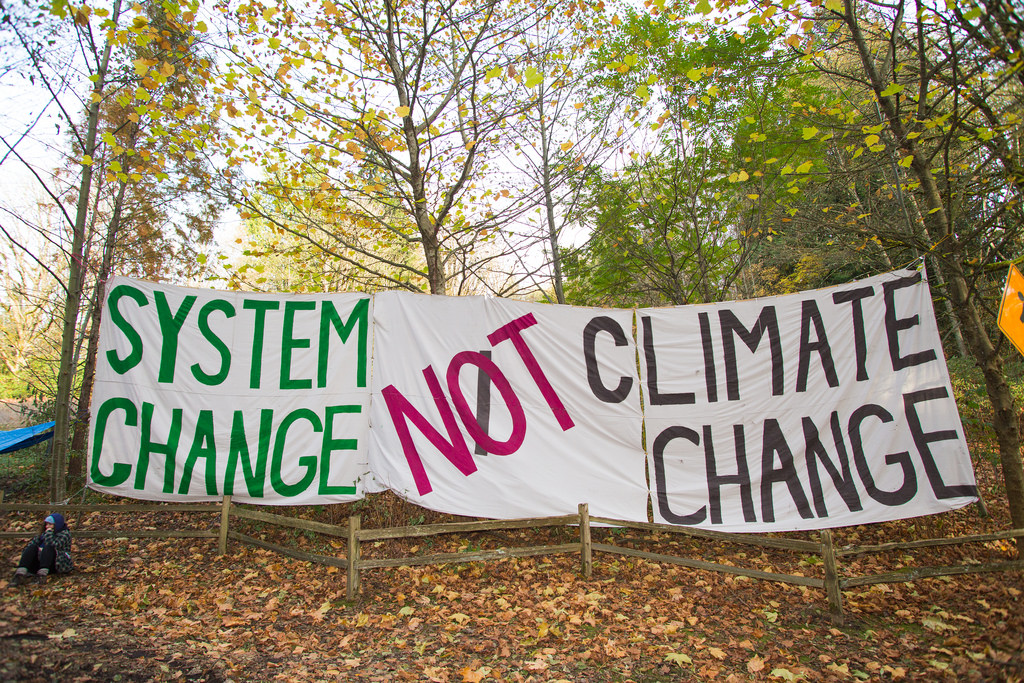
Why can’t the problems that ecosocialism would solve also be remedied within the current global capitalist system?

Before describing possible features of a future ecosocialism, it is worthwhile to consider why such a system is even needed. Why can’t the problems that ecosocialism would solve also be remedied within the current global capitalist system? Part I of this essay addresses that question by summarizing recent scientific reports on the state of the climate and extent of the ecological crisis; reviewing available methods and technologies that could be used to address the climate and ecological crises; and briefly describing capitalism’s structural inability to provide solutions at the scale of the crises. Part II then takes up the subject of the title, ecosocialism, along with strategies to move in that direction. 

Part I: Context and Background

The threat to life on Earth posed by the climate and ecological crises can hardly be overstated. A 2019 Nature article warned that up to a million species of plants and animals are on the verge of extinction, and a United Nations study the same year identified global warming as a major driver of wildlife decline. Much of the devastation to date was catalogued in the 2020 WWF Living Planet report, which recorded a 68 percent decline in the population of vertebrates around the world, in just the past five decades. More succinctly, scientists report that Earth is experiencing a sixth mass extinction. (The previous mass extinction, 66 million years ago, ended the dinosaurs).

The scale of the environmental crisis is unprecedented in human history. At stake are human civilization and billions of lives. An article last year in Proceedings of the National Academy of Sciences predicted that for every additional 1̊C rise beyond the 2019 global average, a billion people will be forced to abandon their locations or endure insufferable heat. The paper warns that under a scenario of increasing emissions, areas now home to a third of the world’s population could experience the same temperatures as the hottest parts of the Sahara within 50 years. 

Summing up the findings of some 150 scientific studies, a 2021 paper authored by 17 scientists warned that the “scale of the threats to the biosphere and all its life forms –- including humanity –- is in fact so great that it is difficult to grasp even for well-informed experts.” Adding further urgency, 101 Nobel laureates released an open letter in April 2021 in which they wrote, “We are seized by the great moral issue of our time: the climate crisis and commensurate destruction of nature.” The laureates called for a worldwide fossil fuel non-proliferation treaty

Global heating is driven by greenhouse gases in the atmosphere, and yet emissions continue at high levels despite the chorus of promises by “climate leaders” in governments. In 2020 global emissions decreased by a meager 5.8 percent due to Covid-19 lockdowns, but they were already on the rebound by the end of the year. For the current year, 2021, the International Energy Agency (IEA) forecasts the second largest annual increase in history of greenhouse gas emissions, as global economies recover from the Covid-19 recession. In May 2021 a record-breaking monthly average concentration of 419 parts per million (ppm) of CO2 was measured in Mauna Loa, Hawaii, breaking the previous May 2020 record of 417 ppm. 

The drivers of ecocide, more generally, include not only climate change, but also habitat destruction, toxic dumping, plastic pollution in the oceans, radiation poisoning, and other customary byproducts of the global capitalist economy. All of this destruction continues unabated despite the flood of warnings from scientists, lobbying by environmental activists, and even warnings from institutions deeply rooted in the capitalist economy. 

Consider, for example, that in May 2021 the IEA released an unprecedented call to the world to rapidly reach zero emissions in its report, Net Zero by 2050: A Roadmap for the Global Energy Sector. Widespread news coverage and expressions of optimism followed. Yet from February to the end of April 2021, the Biden administration approved nearly 1200 drilling permits on federal lands, along with more than 200 offshore permits, and defended in court the ConocoPhillips Willow project in Alaska, which is expected to emit 260 million metric tons of CO2 during the next 30 years, the equivalent of 66 coal-fired plants. And Biden is far from alone among world leaders in his support of fossil fuel expansions.

The Red Deal: Indigenous Action to Save our Earth

By Susan Rosenthal - The Bullet, June 23, 2021

Indigenous people have been fighting to survive for centuries. Recently, their struggles have become more militant, more global, and less isolated, aligning with other anti-racist and anti-colonial movements, and leading the environmental movement.

The growing challenge that Indigenous people pose to capitalist rule can be measured by the increasing use of military force to suppress their rebellions and by the targeted murders of Indigenous activists.

In Canada, the portion of Indigenous people incarcerated in federal facilities rose from under 18 per cent in 2001 to over 30 per cent in 2020. Indigenous women are just 4 per cent of the Canadian population, yet form an astonishing 42 per cent of all female prisoners in federal custody.

Imprisoning an adult in Canada costs about $10,000 per month, a minuscule sum compared with the profits that flow from exploiting Indigenous lands. Speaking for all capitalists, the president of Brazil remarked, “Where there is Indigenous land, there is wealth underneath it.”

All Hands on Deck: An assessment of provincial, territorial and federal readiness to deliver a safe climate

By Nichole Dusyk, Isabelle Turcotte, Thomas Gunton, Josha MacNab, Sarah McBain, Noe Penney, Julianne Pickrell-Barr, and Myfannwy Pope - Pembina Institute, July 22, 2021

Unlocking a prosperous future for all will require bold, ambitious action on climate from governments across Canada.

To measure readiness to act on climate, Pembina Institute in collaboration with Simon Fraser University’s School of Resource and Environmental Management assessed the performance of provinces, territories, and the federal government on 24 policy indicators across 11 categories. The indicators represent foundational climate policies and measures to reduce emissions in key sectors of the economy. Governments were invited to review the accuracy and completeness of the data and summary for their region prior to publication.

The assessment shows that there have been important examples of climate leadership and success across the country. Yet, progress made — for example with economy-wide carbon pricing and the phase-out of coal-fired electricity — has been offset by emissions increases elsewhere. In particular, emissions from transportation and oil and gas production have been on a steady upward trajectory since 2005. As a result, Canada’s overall greenhouse gas (GHG) emissions have dropped by only 1% between 2005 and 2019. Modelling that includes the federal climate policy published in December 2020 shows a national emissions reduction of 36% below 2005 levels by 2030 — still short of the federal government’s commitment to reduce emissions by 40-45% by 2030.

Read the Report (PDF).

From Black Lung to BlackRock: Striking Alabama Coal Miners Protest Wall St. Financiers of Warrior Met

Kim Kelly interviewed by Amy Goodman and Juan González - Democracy Now, June 22, 2021

More than a thousand coal miners at Warrior Met Coal are now in the third month of their strike in the right-to-work state of Alabama. The miners walked off the job on April 1 after their union, the United Mine Workers of America, called the first strike to hit the state’s coal mining industry in four decades. Workers are fighting for improvements to wages and benefits after they agreed to drastic cutbacks in 2016, when Warrior Met Coal took control of the mines after the previous company went bankrupt. Today a group of striking mine workers traveled from Alabama to Wall Street to protest the investment firms backing Warrior Met. “These are the companies that fund Warrior Met and allow Warrior Met to pay their executives millions of dollars a year, while the miners, the workers themselves who are creating that value, are struggling to get by on sometimes as little as $22 an hour,” says labor journalist and organizer Kim Kelly.

‘It’s virtually impossible’: Transition to renewables at risk as oil and gas workers struggle to access green jobs

By Daisy Dunne - The Independent., June 22, 2021

The UK’s transition away from fossil fuels to renewable power could be put at risk by barriers facing oil and gas workers looking to move into green jobs, campaigners say.

A survey of 600 offshore workers found that those looking to move from the fossil fuel industry into green jobs in renewable power currently face costly training fees, discouraging them from making the transition.

Workers responding to the poll said they are routinely forced to pay out thousands of pounds of their own cash for training courses when moving between one employer and another in the offshore sector, some of which they have already paid to take part in for their current positions.

One 42-year-old who has worked in the oil and gas sector for 20 years said the cost of training could be putting workers off trying to move into green jobs.

“People really need help to make the transition because it’s just virtually impossible to do it yourself with the way things are at the moment,” he told The Independent. None of the oil and gas workers interviewed wanted to provide their names, for fear of losing work.

He added he was hoping to see more opportunities in renewable power as the country transitions away from using fossil fuels.

“For me, it’s about moving forward in my career and about moving forward for the environment at the same time. I’ve got two young children and I can see the changes that are happening to the climate, it’s obvious to me.”

One 43-year-old who has worked in the sector for 24 years said that he would “love” to see more opportunities in renewable energy.

“I was one of the people living in a bubble thinking ‘that might not be quite right’ when it came to climate change. But it’s really my kids that brought it home to me,” he told The Independent.

Job growth in clean energy will more than offset fossil fuel losses

By Elizabeth Perry - Work and Climate Change Report, June 21, 2021

Clean Energy Canada released a new report on June 17, projecting that Canada’s clean energy sector will grow by almost 50% (over 200,000 jobs) by 2030, to reach 639,200 jobs. The report states that this will far exceed the 125,800 jobs expected to be lost in fossil fuels. Surprisingly, the province with the greatest increase in clean energy jobs will be Alberta – forecast to increase by 164% by 2030. As the introduction concludes: “Oil and gas may have dominated Canada’s energy past, but it’s Canada’s clean energy sector that will define its new reality.”

The New Reality report is the latest in the “Tracking the Energy Transition” series, updating the 2019 report. It is based on modelling by Navius Research – presented in a technical report here. Employment and GDP numbers are considered under two policy scenarios: the Pan-Canadian Framework for Clean Growth and Climate Change (the Liberal government’s previous policy) , and the Healthy Environment, Healthy Economy policy, unveiled in December 2020. The definition of “clean energy jobs” is broad, and forecasting breaks down into industry sectors – for example, stating that jobs in electric vehicle technology are on track to grow 39% per year, with 184,000 people set to be employed in the industry in 2030—a 26-fold increase over 2020. The report also highlights specific examples of the pioneering clean energy companies in Canada.

Pages

The Fine Print I:

Disclaimer: The views expressed on this site are not the official position of the IWW (or even the IWW’s EUC) unless otherwise indicated and do not necessarily represent the views of anyone but the author’s, nor should it be assumed that any of these authors automatically support the IWW or endorse any of its positions.

Further: the inclusion of a link on our site (other than the link to the main IWW site) does not imply endorsement by or an alliance with the IWW. These sites have been chosen by our members due to their perceived relevance to the IWW EUC and are included here for informational purposes only. If you have any suggestions or comments on any of the links included (or not included) above, please contact us.

The Fine Print II:

Fair Use Notice: The material on this site is provided for educational and informational purposes. It may contain copyrighted material the use of which has not always been specifically authorized by the copyright owner. It is being made available in an effort to advance the understanding of scientific, environmental, economic, social justice and human rights issues etc.

It is believed that this constitutes a 'fair use' of any such copyrighted material as provided for in section 107 of the US Copyright Law. In accordance with Title 17 U.S.C. Section 107, the material on this site is distributed without profit to those who have an interest in using the included information for research and educational purposes. If you wish to use copyrighted material from this site for purposes of your own that go beyond 'fair use', you must obtain permission from the copyright owner. The information on this site does not constitute legal or technical advice.

